



What Are the Causes, Symptoms, and Treatment Methods of Spina Bifida?
Spina bifida, commonly known as split or open spine disease, is one of the congenital anomalies that occur in 1 in every 1000 births worldwide and is one of the leading causes of disability in children after cerebral palsy (1). Although the exact cause is not known, research indicates that chronic health issues in expectant mothers, such as obesity and diabetes, insufficient folic acid intake, and/or a family history of neural tube defects increase the risk of spina bifida in infants (2).
Patients with split spine may need to undergo certain operations from birth to continue their lives independently. Although there is currently no definitive treatment for split spine anomaly, some precautions that expectant mothers can take may help minimize the risk of split spine disease. Questions such as “What is split spine disease, what are its symptoms?”, “What are the diagnosis and treatment methods?” are detailed in the following sections of the article.
What Is Spina Bifida?
Spina bifida is a type of congenital anomaly that occurs as a result of the neural tube (the part of the central nervous system that extends from the brain to the spinal cord) not closing completely during embryonic development. An opening occurs in the spine due to the improper fusion of the lower part of the neural tube during fetal development. Split spine generally occurs within the first 28 days of pregnancy (3).
Globally, spina bifida occurs in approximately 1 in every 1000 births, while in Turkey, it is observed in about 3 in every 1000 births. In other words, Turkey has a higher incidence of open spine compared to the world average (1). Some studies on the reasons for this indicate that insufficient folic acid intake during pregnancy increases the risk of split spine. Open spine disease typically manifests in three different forms. The main types of split spine disease can be listed as follows (3, 4):
- Occult Spina Bifida: The most common form of the disease, occult spina bifida usually affects a small portion of the spine. In these patients, symptoms are often not observed, and no treatment is required. The deformity in the spinal cord is covered by the skin. Many people may not be aware that they have spina bifida. However, in some cases, occult spina bifida may show symptoms such as dimpling, red or purple spots, or hair growth on the skin.
- Meningocele: One of the rarer types of spina bifida is meningocele. In patients with meningocele, the membrane (meninx) surrounding the spinal cord protrudes through the opening, forming a bulge or sac on the back. Meningocele can usually be repaired surgically without nerve damage. Surgical intervention can be performed during infancy, and after surgery, the spinal cord develops normally in these patients.
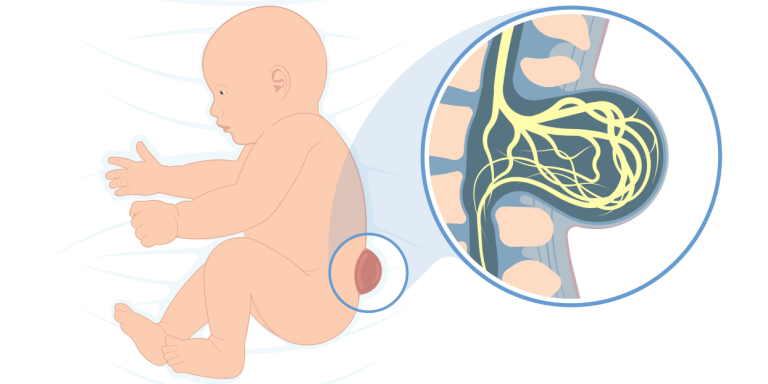
- Myelomeningocele: Myelomeningocele is the most severe form of open spine disease. Infants born with this anomaly do not develop the spinal cord properly, and part of it protrudes from the back. As a result, the deformity on the spinal cord becomes exposed, forming a sac that contains cerebrospinal fluid and blood vessels. Infants born with myelomeningocele may face severe disabilities. These children may also experience issues with bladder and bowel functions. Additionally, hydrocephalus, or excessive fluid accumulation in the brain, is also frequently observed in patients with myelomeningocele.
What Are the Symptoms of Spina Bifida?
The symptoms of spina bifida vary according to the type of the disease. Symptoms are more severe in patients with myelomeningocele, while the majority of patients with occult spina bifida may not exhibit any symptoms other than some skin changes. The main symptoms of spina bifida can be listed according to their types (3, 5):
- In myelomeningocele, the most severe form of the disease, there is an open spinal canal in the middle or lower part of the spine. The spinal cord and membranes protrude through this opening, forming a sac covered by skin or open. In this case, leg muscles may be weak or paralyzed, seizures may occur, and deformities in the feet may appear. Additionally, bowel and bladder issues may also be experienced in these patients.
- The rarer type, meningocele, presents with a small opening on the back and a visible sac. In these patients, the normal development of the spinal cord continues.
- Occult spina bifida is the mildest form of spina bifida. In these patients, no obvious symptoms are observed. A small birthmark, dimple, tuft of hair, or excess fat accumulation may be seen on the back. Although no significant symptoms are observed in patients with occult spina bifida, some changes in the skin may indicate underlying spinal cord issues.
What Are the Causes of Spina Bifida?
Despite research, the exact cause of open spine disease has not yet been determined. Additionally, some scientific studies indicate that there may be various risk factors involved in the emergence of spina bifida. Some risk factors for spina bifida are as follows (4):
- Folic Acid Deficiency: Some scientists suggest that folic acid, which is part of the B complex vitamins, may play a role in the closure of the spinal tube. Insufficient folic acid in expectant mothers may increase the risk of spina bifida in infants (6).
- Genetic Factors: If a couple has a child with a neural tube defect, the risk of having the same defect in the next child may be slightly higher. If two previous children were born with spina bifida, this risk may be even higher. Additionally, infants with a family history of occult spina bifida may also have a higher risk of developing spina bifida.
- Some Medications: Some medications used by patients with epilepsy may affect the body’s ability to utilize folate (folic acid). There are studies indicating that the use of certain epilepsy medications during pregnancy may increase the risk of open spine disease in infants.
In addition to the above, expectant mothers who experience health issues causing high fever during pregnancy or have chronic conditions such as diabetes and obesity may have a higher risk of having infants with spina bifida. If you are pregnant or planning to become pregnant, do not neglect to seek detailed information about potential risks from the nearest healthcare institution and to undergo necessary check-ups.
How Is Spina Bifida Diagnosed?
The diagnosis of spina bifida can be made by a specialist doctor using certain screening tests while the fetus is still in the mother’s womb. Evaluating a blood sample taken from the expectant mother in a laboratory may assist in diagnosing spina bifida. A high protein level observed in blood tests may indicate the risk of spina bifida. However, not every high protein level seen in expectant mothers is associated with open spine disease. Therefore, the definitive diagnosis of the disease can only be made with the help of ultrasound imaging. Additionally, in some cases, the specialist doctor may decide to take an amniotic fluid sample (the baby’s water) from the expectant mother to rule out other genetic diseases.
How Is Spina Bifida Treated?
The treatment of spina bifida depends on the type of the disease. Occult spina bifida usually does not require treatment, while other types may involve surgical treatment methods to alleviate symptoms. Prenatal surgery (fetal surgery) is a treatment option used to prevent the neurological functions from worsening after birth. This surgical intervention is usually performed before the 26th week of pregnancy. Research indicates that patients who undergo prenatal surgery may have a lower risk of disability. Additionally, fetal surgery is thought to reduce the risk of hydrocephalus.
How Is Spina Bifida Surgery Performed?
It is important to conduct a comprehensive evaluation to determine whether fetal surgery is feasible. Open spine surgery should be performed in a facility equipped with a team of experienced surgeons, pediatric neurosurgeons, maternal-fetal medicine specialists, fetal cardiologists, and neonatologists. However, if open spine surgery is deemed risky for both the mother and the baby before birth, surgery may also be performed within two days after birth (8). If you are pregnant or planning to become pregnant, do not forget to make an appointment with a specialist doctor and undergo necessary check-ups.
Pre-Surgery Preparation
In cases where fetal surgery is considered for spina bifida, expectant mothers undergo a detailed preparation process before surgery. During this process, the expectant mother is physically examined by a specialist doctor, and any chronic issues are thoroughly evaluated. The risks and benefits of the surgery are explained to the expectant mother before the operation. In cases where surgery is not appropriate, the development of the fetus is carefully monitored, and surgery may be performed after birth if necessary.
How Is the Surgery Performed?
The aim of spina bifida surgery is to protect the spinal cord and nerves and to minimize damage to the baby. How the surgery is performed depends on the type and severity of spina bifida. The surgery can be performed using open surgical methods or endoscopic techniques. During the surgery, the surgeon places the spinal cord, exposed tissue, or nerve back in its proper position. The opening is then closed with skin or muscle. Although the opening in the spine is closed during the surgery, this does not reverse nerve damage. Additionally, hydrocephalus (fluid accumulation in the brain) may also be observed in children born with spina bifida. In this case, the fluid in the brain may need to be redirected to another part of the body, such as the abdomen, using a special device placed surgically (7).
Post-Surgery Process
Currently, there is no method to completely cure spina bifida. Surgery may help alleviate the symptoms of the disease. However, patients with spina bifida may require regular check-ups and rehabilitation techniques such as physical therapy throughout their lives.
Frequently Asked Questions About Spina Bifida
Spina bifida is one of the conditions that expectant mothers or those planning to have a baby often wonder about. Some frequently asked questions about open spine are detailed below.
What does spina bifida cause?
Severe forms of spina bifida can lead to various problems, including difficulty walking, paralysis, limited mobility, and issues with the bladder and bowel.
Is there a treatment for spina bifida?
The sac on the back of babies born with open spine can be closed with surgery after birth. However, there is no treatment method that completely cures open spine disease.
How is spina bifida diagnosed?
A blood sample taken from the expectant mother during pregnancy can provide information to specialists about spina bifida. However, ultrasound imaging methods must be used to make a definitive diagnosis of spina bifida.
What causes spina bifida in babies?
Although the exact cause of open spine disease is unknown, factors such as genetic predisposition, folic acid deficiency, and certain medications used by the expectant mother may increase the risk.
Is spina bifida permanent?
Spina bifida surgeries are aimed at preventing the child from experiencing more complications later on. Although complete recovery may not occur after surgery, children can reach a point where they can manage their own care.
Does spina bifida cause pain?
Since spina bifida is a disease that affects the nervous system, patients typically do not experience pain.
Can spina bifida patients walk?
Patients with occult spina bifida do not have walking problems, while those with the most severe form, myelomeningocele, may experience foot deformities and walking difficulties.
If you are pregnant or planning to become pregnant, do not forget to make an appointment with a specialist doctor and undergo regular check-ups.