



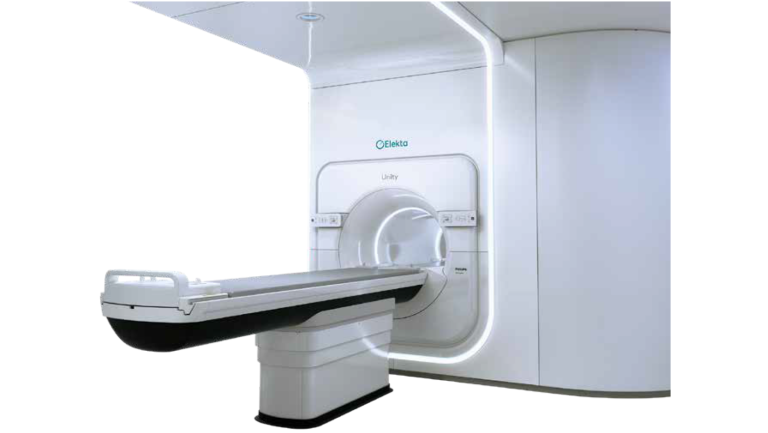
What is the MR-LINAC Device?
The MR-LINAC device, developed for the treatment of cancer patients with radiotherapy, is a high-tech hybrid radiotherapy device created by integrating Magnetic Resonance (MR) imaging with Linear Accelerator (LINAC) devices. MR technology is used for imaging while treating cancerous tissues.
With the high-quality imaging of the 1.5 Tesla MR-LINAC, one of three devices in Istanbul and one of the very few in Turkey, a “smart radiotherapy” method is applied by targeting the tumor with superior imaging in accordance with real-time anatomy, effectively destroying the tumor with radiation.
The MR-LINAC device is a medical device developed for cancer treatment. By combining magnetic resonance imaging and linear accelerator features, it allows for more precise and effective cancer treatment. During treatment with MR-guided radiotherapy, the tumor is visualized in real-time, enabling the planned radiation dose to be delivered directly to the tumor with high precision while protecting surrounding healthy tissues. Therefore, radiotherapy with the MR-LINAC device is expected to result in fewer side effects compared to other radiotherapy methods.
MR-LINAC is a versatile device that can be used for various types of cancer. It enables effective radiotherapy for a significant number of patients who previously could not receive radiotherapy due to the inadequacies of other radiotherapy devices. The patient’s observation is conducted just before and during treatment, allowing for real-time adjustments to the radiotherapy plan based on the current anatomy, thus managing the treatment process in the best possible way. Consequently, it maximizes the lethal effect on the tumor while minimizing the risk of potential side effects.
MR-LINAC Treatment Process
MR-LINAC allows us to effectively monitor the patient throughout the radiotherapy process and track the position of the tumor tissues and the anatomy of internal organs at every stage of treatment. This enables the radiation to be applied more accurately to cancerous cells while affecting healthy tissues less.
The device performs imaging with a magnetic field that provides a very high imaging capability, such as 1.5 Tesla, and delivers ionizing radiation to cancer cells through the LINAC device it houses. MR-LINAC treatment is performed by applying high-energy radiation beams to the targeted tumor area after ensuring that patients remain still in the appropriate position within the device. The radiation dose distribution is precisely adjusted with the MR-LINAC device, focusing on cancerous cells while minimizing damage to healthy tissues, allowing effective treatments to be completed.
MR-LINAC is a highly effective method for optimizing treatment by tracking the anatomical and biological changes of patients during the treatment process. This device helps ensure that treatment is applied correctly and reduces side effects by monitoring the position of tumor tissues and surrounding healthy tissues during radiation therapy.
What Diseases is the MR-LINAC Device Preferred For?
It can be used for all types of cancer and metastases. As can be inferred from its name, it is particularly advantageous in body regions where MR imaging excels. The abdominal (abdominopelvic) region, which contains the intestines that are highly sensitive to radiation and prone to involuntary organ movement, is particularly prominent for tumors.
Prostate, rectum, liver, adrenal gland, and pancreatic tumors are among the most common areas of use. Additionally, it has made it possible to treat intra-abdominal lymph node metastases and peritoneal/omentum tumors that previously could not be planned for radiotherapy due to the risk of side effects. It also provides safer and more effective treatment for brain, esophagus, muscle, and soft tissue tumors by allowing better visualization. Besides these, it can be used for lung, breast, cervical, uterus, heart, eye, head and neck cancers, and other tumors.
How is MR-LINAC Treatment Planned and Applied?
After clinical, pathological, and radiological evaluations are conducted by a radiation oncology specialist, patients deemed suitable are treated with MR-LINAC.
First, planning Computed Tomography (CT) images of the patient are taken, and optionally, MR imaging of the target area is obtained with the MR-LINAC device. The tumor areas targeted for radiation are identified, at-risk organs are outlined, and a treatment plan is created. The most suitable treatment plan for the patient is selected from the plans made by the medical physics specialist, and quality control is performed to prepare for treatment.
During each treatment session, when the patient is positioned in the device, MR imaging is performed to locate and verify the tumor’s position. The position of the targeted tumor area and surrounding healthy organs is determined according to the patient’s anatomy for that day, and dose distributions are checked based on the current position. If there are differences in the images taken during treatment, the treatment can be adjusted accordingly.
Treatment procedures are carried out without exposing the patient to additional radiation. At the beginning of each session, MR scanning is performed to monitor the tumor and surrounding healthy tissue and organs. Even in cases where the patient breathes or the tumor or at-risk healthy organs move during treatment, the radiation can be focused on the tumor with high precision, effectively destroying it. Headphones are used to reduce any MR noise that may occur during treatment.
How Long Does MR-LINAC Treatment Last?
The duration of MR-LINAC treatment varies depending on the type of cancer, the size of the cancerous tissues to be eliminated, sensitivity to radiation, location, treatment target, and many other factors. Since high-quality MR images are obtained in each session and new plans can be created daily if necessary, the daily treatment duration is longer compared to traditional LINAC devices.
However, since the dose applied in each session can be increased with MR-LINAC, thus reducing the total number of sessions, the overall treatment duration can be shorter compared to traditional LINAC devices. The total treatment duration for traditional treatments typically ranges from 30 to 45 minutes. For stereotactic or pinpoint radiations, the total treatment duration can vary between 45 to 70 minutes.
In our country and worldwide, radiotherapy is applied every weekday as long as there are no maintenance or malfunction issues with the device, while no treatment is applied on weekends. The total treatment duration is determined during the outpatient treatment planning phase, and arrangements can be made to complete it in shorter durations for suitable patients. The entire treatment usually lasts 4-6 weeks for traditional radiotherapy, while stereotactic radiotherapy applications are generally completed in 1-5 sessions. It does not require any invasive procedures.
What Advantages Does the MR-LINAC Device Provide in Treatment?
The MR-LINAC device has many advantages over traditional LINACs. These advantages include:
- More Accurate Treatment: With the device’s adaptive, superior imaging capability, high-quality imaging with 1.5 T MR is performed before each treatment session, allowing for the determination of the real-time position (proximity) and fullness (full/empty) of tumor and healthy organs with high precision. Based on the current situation, replanning can be done while the patient is on the treatment table. This ensures more accurate targeting, allowing the necessary dose to eliminate cancer cells to be delivered comfortably without harming healthy tissues.
- Fewer Side Effects: With the device’s adaptive, superior imaging capability, the positions and fullness of healthy tissues surrounding cancer cells can be observed more clearly with high precision imaging obtained before each treatment session. Based on the current situation, replanning can be done while the patient is on the treatment table. Thus, while cancer cells are irradiated, surrounding healthy tissues are exposed to less radiation, thereby reducing side effects. Additionally, due to better imaging, the irradiated area can be minimized, further reducing side effects. In summary, smaller irradiation areas can protect healthy organs more, minimize side effects, and even prevent them from occurring altogether.
- Real-time Monitoring: During treatment, simultaneous MR imaging allows for the positional tracking of tumors and healthy organs. Thus, uncertainty in treatment is completely eliminated.
- Higher Dose, More Permanent Tumor Control: With superior imaging and safe dose escalation, it is possible to eliminate tumor tissues more effectively and permanently.
- Shorter Total Treatment Duration: The time the patient spends in the device for each treatment session is slightly longer compared to traditional LINAC devices. However, due to the superior imaging capability, the daily radiation dose can be increased for suitable patients, and the number of treatment sessions can be reduced. Thus, the total treatment duration can be shortened for patients.
What Should Be Considered When Entering MR-LINAC?
- Patients with pacemakers cannot receive treatment.
- Patients with metal prostheses can receive treatment if their prostheses are MR-compatible.
- Patients with ferromagnetic metallic implants such as brain clips and bionic eyes can only receive treatment with doctor approval.
- Patients with phobias can receive treatment with medication support or anesthesia.
Before entering the treatment room, everyone (patients, healthcare personnel, etc.) must leave all metallic items (safety pins, hairpins, watches, belts, nail clippers, scissors, screwdrivers, keys, credit cards, non-MR-compatible stretchers or wheelchairs, etc.) outside.
Is Anesthesia Given During Treatment?
Patients do not feel pain during MR-LINAC treatments, no invasive procedures are performed, and therefore sedation or anesthesia is not required. However, anesthesia may be used if necessary for patients with phobias or those who cannot remain still for long periods.
Are There Side Effects of the Treatment?
As with other traditional LINACs, potential side effects exist in MR-LINAC treatments. However, due to superior features such as being able to clearly visualize tumor tissues and surrounding at-risk healthy tissues before and during each treatment, the likelihood of side effects is minimized, and sometimes no side effects are observed at all.
Side effects generally depend on the area where treatment is applied, the treatment method, the treatment dose, the patient’s overall health status, and many other factors. Potential side effects can generally be observed in the area of application and its surroundings. Besides very mild side effects such as fatigue, weakness, and nausea that can be encountered in all applications, different side effects may be observed depending on the area of application. Side effects are mostly temporary and manageable. To get an idea about potential side effects that may be observed during and after your treatment, be sure to consult the radiation oncology specialist who plans and administers your treatment.
Does the Patient Emit Radiation After MR-LINAC Treatment?
In radiotherapies applied to patients with LINAC devices that artificially produce radiation, only the treated patient is affected. Patients do not emit radiation to the environment. Therefore, there is no harm in patients mixing back into society immediately after treatment, such as sitting next to a pregnant woman or child. The same is true for MR-LINAC. There is no radiation exposure to individuals outside the patient.
Is Hospitalization Necessary During Treatment?
MR-LINAC radiotherapy does not require hospitalization. There is no condition for the patient to stay in the hospital.
You can make an appointment at Hisar Hospital Intercontinental Integrated Oncology to discuss treatment methods with a specialist doctor and get information about the MR-LINAC device.