



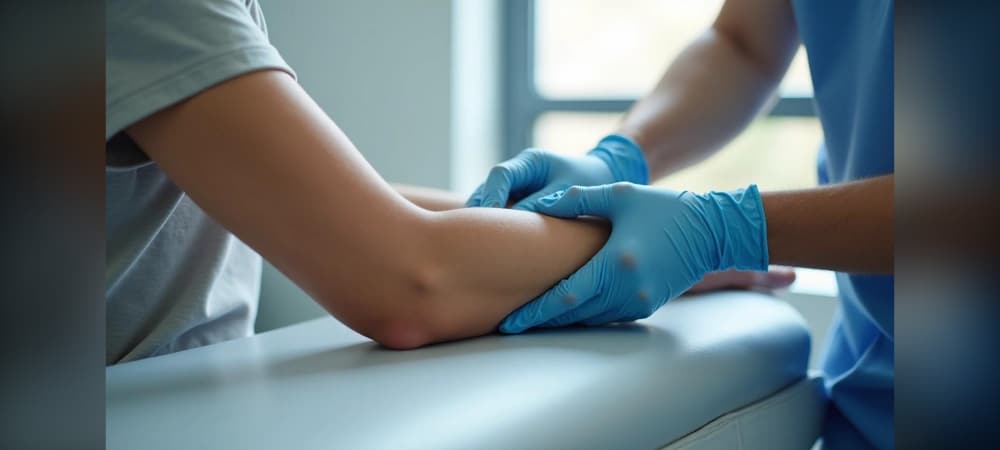
Elbow osteoarthritis is a condition that causes pain and limited movement due to the wear of joint cartilage. Known as osteoarthritis, this condition rarely affects the elbow joint but is more common in men, especially due to past traumas. Symptoms typically begin at age 50 and above, including pain and reduced range of motion. You can find information about the symptoms, diagnostic methods, and treatment options for elbow calcification in this article.
What is Elbow Osteoarthritis (Calcification)?
When the joint cartilage wears down over time, the bone surfaces start to rub against each other. This friction leads to pain, swelling, and difficulty in movement in the elbow region. Elbow calcification arises from the impact of this joint disease, known as osteoarthritis, on the elbow joint.
Cartilage tissue serves as a protective layer covering the bones. It allows for smooth movements in conjunction with the fluid in the joint space. However, when this protective structure is damaged for various reasons, the bones come into direct contact. Over time, this leads to deformity, swelling, and pain complaints.
Osteoarthritis is generally considered a natural process related to aging. However, when it reaches a degree that restricts daily life in advanced stages, it is evaluated as a disease. Elbow osteoarthritis is less common compared to other joints, which is related to the natural protection provided by the anatomical structure of the elbow.
Structure of the Elbow Joint
The elbow joint consists of three bones. The humerus, known as the upper arm bone, combines with the radius and ulna bones in the forearm to form the elbow joint. There are three different joints between these bones: humeroulnar, humeroradial, and proximal radioulnar.
Thanks to its hinge-like structure, the elbow allows for comfortable bending and straightening of the arm. Additionally, the arrangement of the bones permits a small degree of rotational movement. This rotation is particularly important in daily functions such as bringing the hand to the mouth.
The natural stability of the elbow comes from the anatomical features of the bone structures. The lateral and medial collateral ligament complexes are the main structures that provide stability to the joint. These strong ligaments protect the elbow from external impacts. Similarly, the joint capsule offers strong protection through ligament structures in the lateral and medial regions.
Relationship Between Osteoarthritis and the Elbow
Osteoarthritis is most commonly seen in weight-bearing joints. The knee, hip, fingers, and spine are frequently affected areas. In contrast, the elbow joint is rarely affected unless there is a specific injury. The strong ligaments that stabilize the elbow are the main reason for this situation.
Elbow osteoarthritis occurs in two ways. Primary osteoarthritis is the degeneration of cartilage that develops over time without any specific cause. Due to the structural stability of the elbow joint, such damage is quite rare. Secondary osteoarthritis develops due to an underlying health issue.
The most common cause of secondary elbow calcification is trauma. Previous elbow dislocations and fractures play a triggering role. Micro-damage in the joint area causes the cartilage tissue to become more sensitive over time. Severe sprains or improper healing lead to imbalances in the ligaments. The load on the cartilage increases during movement, resulting in the development of elbow calcification.
What are the Causes of Elbow Osteoarthritis?
Elbow calcification can develop due to multiple reasons. Natural wear associated with aging, past injuries, and repetitive movements negatively affect joint health. Impacts to the area or activities that stress the cartilage structure also play a role in the formation of the disease.
Aging and Joint Wear
Advancing age and continuous use of the joint are the underlying causes of elbow calcification. Over time, the water content in the cartilage tissue decreases, and natural elasticity is lost. These changes pave the way for the onset of wear.
Frequent repetition of activities that use the joint causes damage to the protective cartilage layer located at the ends of the bones. Loss of this protective cartilage leads to the rubbing of hard bone surfaces against each other during movement. Consequently, deformity, swelling, and pain complaints arise over time.
Past Traumas and Fractures
Previous elbow dislocations and fractures play a triggering role in these conditions. Osteoarthritis is particularly common after complex elbow fractures and dislocations due to high-energy injuries. The presence of cartilage damage during the injury and the degree of recurring instability affect the development of osteoarthritis.
Cases of elbow calcification due to past trauma are more common in men than in women. Fractures and dislocations cause roughness on the joint surfaces during the healing process. Improper healing or inadequate recovery accelerates cartilage degeneration in the long term.
Repetitive Movements and Occupational Factors
Some individuals diagnosed with elbow calcification may not have any history of past trauma. In these individuals, the disease develops due to the continuous use of the elbow joint during work or daily activities. Repetitive throwing or swinging movements wear out the joint tissues.
Chefs, painters, carpet layers, automotive industry workers, and plumbers are among the occupational groups that involve intense hand movements. Similarly, elbow problems are common among individuals engaged in cleaning, food preparation, and car repair. In desk workers, continuously resting the elbow on a hard surface can lead to damage in the area.
Ligament damage can lead to a loss of stability in the joint and the development of osteoarthritis. Elbow calcification cases that develop in this way may progress more rapidly than cases caused by other factors.
Risk Factors
The likelihood of developing elbow osteoarthritis is higher in certain groups of people. Generally, risk factors for the development of elbow calcification can be summarized as follows:
- Middle-aged men working in occupations involving strenuous physical activity
- Having previously experienced trauma to the elbow region
- Advanced age
- Having other affected individuals in the family
Individuals who play racket sports, especially golfers, tennis players, and boxers, are among the sports branches where elbow pain is most likely to occur. Activities such as weightlifting and fitness also continuously load the tendons around the elbow.
What are the Symptoms of Elbow Osteoarthritis?
Symptoms of elbow calcification can vary from person to person. Some patients may feel mild discomfort, while others experience severe pain and significant movement restriction. Complaints usually start gradually and worsen over time. Early detection of symptoms increases the success of treatment.
Pain and Movement Restriction
The most common complaints associated with elbow calcification are pain and restriction of joint movement. Pain is usually pronounced on the inner or outer side of the elbow. It increases during movement and may decrease with rest. Pain intensifies, especially during movements like fully extending the arm or lifting weights.
As the range of motion in the joint decreases, daily activities become more challenging. When the function of the elbow, which allows the hand to assume the desired position, is compromised, a person may be unable to eat, comb their hair, or maintain toilet hygiene. The inability to fully extend or flex the elbow over time leads to significant restrictions in professional and social life. In some cases, the inability to perform gripping movements completely may also be observed.
Joint Creaking and Locking
Creaking and locking sensations due to calcification are characteristic symptoms of elbow osteoarthritis. The complaint of creaking arises from friction caused by the loss of normal joint surfaces. The wear of the cartilage structure leads to roughness of the bone surfaces and friction noises during movement.
The complaint of locking occurs due to the interlocking of bone surfaces caused by the loss of cartilage tissue. While using the elbow joint, a sensation of catching or locking may occur. This situation, which occurs outside of normal joint movement, may sometimes be noticeable as the movement gets locked at a certain point. When accompanied by pain, movement restriction, and loss of function, medical evaluation is necessary.
Swelling and Stiffness
Another symptom that may occur with elbow calcification is swelling in the joint. This complaint, which is generally not present at first, tends to emerge in later stages as the condition progresses. Noticeable swelling and tenderness are observed in the elbow region.
Additionally, stiffness is very common. Some patients wake up with a feeling of stiffness in the elbow in the mornings. There may be a sensation of tightness or insufficient stretching in the joint. An increase in temperature during elbow movement is also a common symptom of joint inflammation. A sensation of catching may occur after movement.
Nerve Compression Symptoms
In the later stages of elbow calcification, complaints of numbness in the ring and little fingers may arise. Swelling in the joint creates pressure on the nerve structures in the canal located in this area, leading to the formation of cubital tunnel syndrome, which is characterized by nerve entrapment. Symptoms such as noticeable tingling and numbness develop on the side of the little and ring fingers.
Especially at night, the sensation of numbness in the ring and little fingers increases. Numbness may intensify during sleep, reaching a level that can wake the patient. Pain in the inner part of the elbow may be accompanied by sensations of numbness, tingling, or pinprick feelings in the fingers. Regional tenderness and pain around the elbow are observed. Weakness in the finger and hand muscles and a decrease in grip strength occur.
How is Elbow Osteoarthritis Diagnosed?
Accurate diagnosis is the cornerstone of effective treatment. Physicians follow a specific order in evaluating patients who present with complaints of elbow calcification. In the first stage, a detailed history of the patient’s complaints is taken, and a physical examination is performed.
Physical Examination and Medical History
During the physical examination, any signs of trauma or damage that could cause harm to the joint area are assessed. The location of pain, range of motion, muscle strength, and loss of function are checked. Then, various maneuvers are performed to examine how much the joint’s range of motion is affected.
The elbow is positioned at approximately 90 degrees for the examination. Tenderness points are identified, and joint movements are tested. Normally, the elbow flexion movement occurs between 135-150 degrees, and the extension movement occurs between 0-5 degrees. The arm is pressed against the body to control the forearm’s rotational movements. Visible signs such as swelling, redness, or deformity are also recorded.
Radiological Imaging Methods
Imaging methods are used to confirm the diagnosis. X-rays are a very useful examination in diagnosing elbow calcification. X-rays are used to reveal abnormalities in bone structures and to identify elbow calcification.
Examination of the elbow film allows for visualization of changes caused by osteoarthritis. This imaging method is also useful in diagnosing conditions that progress with calcification after fractures, revealing bone fragments that may develop due to osteoarthritis. X-rays detect signs of arthritis such as narrowing of the joint space, bone spurs, and joint deformities.
Advanced Diagnostic Techniques
In necessary cases, advanced imaging methods may also be utilized for the diagnosis of elbow calcification. Magnetic resonance imaging provides more detailed information for soft tissue injuries. Ultrasound is an effective option for evaluating tendon and ligament structures.
Computed tomography allows for detailed examination of bone, muscle, and joint structures. In some cases, when there is difficulty in diagnosis or when treatment planning is to be performed in the same session, arthroscopy may be applied for both diagnostic and therapeutic purposes.
How is Elbow Calcification Treated?
The treatment approach is determined based on the severity of the patient’s complaints and the degree of joint damage. Initially, non-surgical methods are employed, and if necessary, advanced treatment options are considered.
Non-Surgical Treatment Methods
The first step in treatment is to restrict movements that trigger the onset of complaints. Importance is given to resting during activities. Avoiding tasks that increase pain and resting the elbow supports the healing process.
The application of a splint helps reduce stress on the joint and aids in relaxation. In some patients, the use of a specially designed splint or brace for the elbow region may be beneficial. Treatment begins with protective bandaging or elbow support.
Physical Therapy and Exercise Applications
Physical therapy consists of gently performed exercises and cold or hot applications. Hot applications, exercises to increase joint range of motion, and muscle strengthening activities are performed. Ice applications and anti-inflammatory medications are used to reduce pain.
Range of motion exercises and stretching exercises are included in the program. Once acute inflammation and pain decrease, exercises to strengthen the wrist, forearm, and shoulder muscles are initiated. The aim is to maintain the balance of the musculoskeletal system and preserve the range of motion of the elbow joint.
Medication Treatment and Injections
Nonsteroidal anti-inflammatory drugs are prescribed for pain control. In cases of severe inflammation, corticosteroid injections can rapidly reduce pain. Steroid injection treatment may be considered in advanced cases.
Viscosupplementation, which involves injecting hyaluronic acid, is an alternative treatment method for osteoarthritis cases. It aims to improve the quality of joint fluid and control complaints. In patients where deemed necessary, PRP applications may be performed to control pain and support healing.
Surgical Treatment Options
If complaints cannot be controlled with non-surgical methods, surgical treatment may be considered. In these individuals, there is usually significant damage to the joint surface in imaging examinations.
Arthroscopic Surgery and Prosthetic Applications
Arthroscopic elbow calcification surgery is a very effective method for controlling complaints and improving range of motion. During this procedure, loose bone and cartilage fragments are removed, and inflammatory changes on the joint surface are cleaned. It can be performed with just a few small incisions through the skin.
In cases where the joint surface is completely damaged, joint replacement therapy using prostheses may be considered. In properly selected patients, significant improvement in complaints such as pain and loss of function can be achieved.
Frequently Asked Questions About Elbow Osteoarthritis
What is elbow osteoarthritis?
Elbow osteoarthritis is a disease characterized by the wear of cartilage tissue in the elbow joint and the formation of calcification on the joint surfaces over time. This condition is also known as “elbow calcification.”
What are the symptoms of elbow osteoarthritis?
- Pain in the elbow region
- Swelling and tenderness in the elbow
- Restriction of joint movements
- Creaking or friction sensation during movement
- Stiffness in the elbow joint (especially in the mornings)
- Deformation in advanced cases
What are the causes of elbow osteoarthritis?
- Advanced age
- Previous elbow injuries or fractures
- Repetitive overuse and micro-traumas
- Joint infections
- Inflammatory diseases like rheumatoid arthritis
- Genetic predisposition
- Long-term heavy sports activities
How is elbow osteoarthritis diagnosed?
To diagnose elbow osteoarthritis, the doctor first performs a clinical examination. Then, imaging methods such as X-ray, MRI, or CT may be used if necessary. In some cases, blood tests may also be requested.
How is elbow osteoarthritis treated?
Treatment generally progresses in stages as follows:
- Medication treatment (pain relievers and anti-inflammatory drugs)
- Physical therapy and rehabilitation
- Activity modification and rest
- Use of splints or braces
- Intra-articular injections (steroids, hyaluronic acid)
- Surgical treatment in advanced cases (arthroscopy or prosthesis)
Can elbow osteoarthritis be completely cured?
Elbow osteoarthritis is not a completely reversible disease, but with appropriate treatment, symptoms can be controlled, and the progression of the disease can be slowed down.
What is the importance of physical therapy in elbow osteoarthritis?
Physical therapy plays an important role in preserving joint range of motion, increasing muscle strength, and reducing pain. A regular exercise program and physical therapy applications improve the quality of daily life.
When is surgery necessary for elbow osteoarthritis?
Surgical intervention is generally preferred in patients with severe pain and loss of function who do not respond to conservative treatments. Arthroscopic surgery or prosthetic application may be performed in advanced cases.
How to live with elbow osteoarthritis?
- Avoid excessive strain
- Make ergonomic adjustments
- Implement a regular exercise program
- Adhere to medication treatment
- Use assistive devices when necessary
- Attend regular doctor check-ups
Who is more likely to develop elbow osteoarthritis?
Elbow osteoarthritis is more common in individuals over 40 years of age, those working in occupations requiring repetitive elbow movements, individuals who have previously suffered elbow injuries, and some athletes (tennis players, baseball players, wrestlers, etc.).
In Summary, Elbow Osteoarthritis
Elbow calcification can be a serious condition that complicates your daily life. Therefore, it is important to recognize symptoms such as pain, movement restriction, and swelling early.
Treatment options that begin with non-surgical methods yield effective results in most patients. In advanced cases, methods such as arthroscopic surgery can restore lost function.
Consult a specialist when your complaints begin. With early diagnosis and a proper treatment plan, you can preserve the range of motion in your elbow and continue your daily activities comfortably.
Elbow osteoarthritis causes pain and limited movement due to the wear of joint cartilage. Read our article for detailed information about its symptoms, diagnostic methods, and treatment options.