



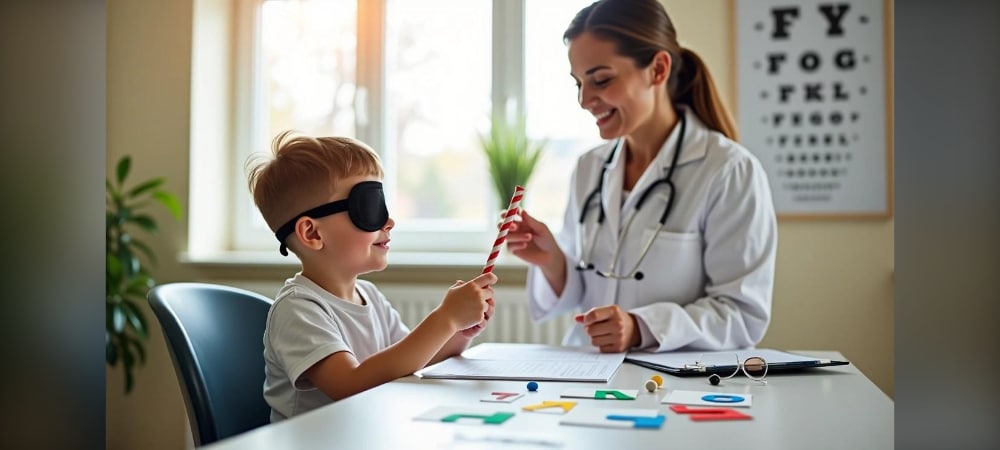
Vision therapies are applications that work like physical therapy for your eyes. If you are experiencing amblyopia, strabismus, reading difficulties, or 3D vision problems, vision therapy can help you. It provides effective results, especially in children with learning difficulties and in adults with vision problems after a stroke. In this article, we will examine in detail what vision therapy is, who it is applied to, how the treatment process works, and the benefits it provides.
What is Vision Therapy?
Definition of Vision Therapy
Vision therapy, applied under the supervision of a doctor, is a non-surgical and personalized visual activity program. Unlike assistive tools like glasses or contact lenses, it aims to teach the visual system to correct itself.
Vision therapy can be defined as a type of physical therapy for the eyes and the parts of the brain that control vision. While classical treatment methods change the anatomy of the eye, this approach strengthens the brain-eye coordination. The ‘vision therapy’ methods developed and widely used in America for years increase the simultaneous use and compatibility of both eyes.
During the treatment process, lenses, prisms, filters, and computer-assisted visual activities are used. Additionally, tools like balance boards and metronomes play an important role in the personalized program. Rather than strengthening the eye muscles, it accelerates communication between the brain and the eyes and improves coordination.
The Main Purpose of Vision Therapy
The main purpose of vision therapy is to solve vision problems that cannot be successfully treated with glasses, contact lenses, or eye surgery. It helps you achieve clear and comfortable vision in both eyes.
After achieving brain-muscle compatibility, perceptual exercises allow the brain to combine the images from the eyes more finely and in detail. Thus, both eyes begin to work in sync. Re-establishing communication between the eyes and the brain and retraining damaged or weakened visual skills is the fundamental principle.
Many studies have shown that vision problems affecting efficient reading among school children can be corrected with this method. It also contributes to reducing symptoms of eye fatigue and computer vision syndrome.
Types of Vision Therapy
Vision therapy is applied in different forms. CAM Therapy (Computer Aided Vision Therapy) is a modern method supported by computers. In this treatment, specially designed moving patterns, lines, and contrasting circles are used on the screen. Each session lasts about 25-30 minutes and is applied 2-3 times a week.
Visual Rehabilitation specifically targets vision problems that arise after brain injury or neurological disorders. This approach utilizes the brain’s neuroplasticity ability. It is applied to patients who experience narrowing of the visual field, have reading difficulties, or have weak 3D perception.
Sports Vision programs are specially developed applications for athletes. They provide improvement in areas such as depth perception, tracking ability, and focus flexibility.
Who Is Vision Therapy Applied To?
Vision therapy applications cater to a wide patient population from different age groups. The treatment yields effective results in various situations, from congenital issues to vision impairments occurring after a stroke.
Patients with Amblyopia
Individuals with amblyopia are among the groups that benefit the most from vision therapy. Special exercises called orthoptic applications are used in the treatment. These exercises are designed to help the eye gain depth perception.
In children who cannot comply with patching therapy, vision therapy serves as an alternative method. Especially in children aged 7 and older, computer-assisted programs are applied as a complementary treatment to patching therapy. These exercises performed during visual activities improve hand-eye coordination.
Individuals with Strabismus
Vision therapy is applied to individuals with strabismus problems that develop either congenitally or due to paralysis. Exercises are particularly beneficial for patients with latent outward deviation.
Convergence insufficiency is a condition where there is difficulty in bringing the eyes together. 73% of children with this problem achieve successful results after a 12-week office-based vision therapy program combined with home eye exercises. The treatment reduces the imbalance in the eye muscles and strengthens weak muscles.
In cases of intermittent strabismus, exercises are also used as an effective treatment method. Vision therapy ensures harmony between the eyes and increases coordination.
Children with Reading Difficulties
Children who have difficulty reading are an important group that benefits from vision therapy. On average, 80% of what a child learns in school is presented visually.
If your child is habitually bringing their head close to the book or watching television from very close, there may be a vision problem that will affect their learning ability. Deficiencies in functional visual skills can lead to blurry or double vision. Consequently, eye fatigue and headaches occur.
Individuals with Learning Difficulties
Vision problems in individuals with learning difficulties are often overlooked. However, how the eyes work and how the brain processes visual information directly affects learning ability.
Refractive errors, eye movement disorders, and focusing problems make learning difficult. Vision therapy improves these issues, enhancing the child’s academic performance. Unaddressed vision problems can mimic symptoms of learning difficulties or worsen the existing condition.
Special Applications for Athletes
Nearly 80% of perceptual input in sports is visual. Strong muscles or speed alone are not sufficient. Visual performance is critically important for athletes.
Sports Vision programs are specially designed applications for athletes. These programs work in the following areas:
- Improving depth perception and distance estimation
- Strengthening eye tracking abilities
- Increasing focus flexibility
- Improving hand-eye coordination
While an average person can see clearly from six meters away, a baseball player can see sharply from 12 meters away. Elite athletes, military Special Forces, and pilots use these programs to optimize their visual performance.
In Which Situations Is Vision Therapy Necessary?
Certain health issues and vision disorders necessitate the application of vision therapy. These situations arise when standard treatment methods cannot fully resolve the issue.
Convergence Insufficiency
Convergence insufficiency is a common problem that affects the ability of the eyes to work together when looking at nearby objects. Complaints arise during activities such as reading, using a computer, or looking at a phone.
Eye fatigue, headaches, and blurred vision are the most common symptoms. One may also experience the sensation of words moving while reading, double vision, and difficulty concentrating. Vision therapy or orthoptic treatment forms the cornerstone of the treatment for this condition. Especially office-based vision therapy yields significantly more effective results than home exercises.
Vision Problems After Stroke
Approximately 65% of stroke patients experience vision disorders. A stroke can affect many different aspects of the visual system, leading to various symptoms.
A stroke caused by blockage or bleeding of brain vessels weakens the muscles and nerves related to vision. Involuntary eye movements known as nystagmus, strabismus, and difficulties in focusing may occur. Loss of visual field is seen in 52% of patients, while eye movement disorders can be as high as 68%.
Visual neglect is a condition that particularly occurs in right hemisphere strokes. These patients cannot perceive visual stimuli on the left side. With early diagnosis and appropriate intervention, targeted treatment can improve the patient’s quality of life and independence.
3D Vision Problems
6 or 7 out of every 100 people have problems that hinder their ability to see in 3D. Stereopsis arises when the brain combines images received from both eyes to create a single 3D image.
Loss or distortion in depth perception can occur due to misalignment of the eyes or damage to brain areas related to processing visual information. Perception of height, width, and distance weakens. Vision therapy aims to improve the coordinated work of both eyes, focusing abilities, and the capacity to combine images through special exercises.
Eye Coordination Disorders
Loss of the ability of the eyes to move in a coordinated manner affects visual ability and reduces quality of life. This manifests as the eyes being unable to move in a specific direction, shaking, or making unwanted movements.
These disorders can cause headaches and dizziness. Situations such as letters shifting or blurring while reading and writing can occur. Treatment varies depending on the underlying cause, and eye exercises play an important role.
How Does the Vision Therapy Treatment Process Work?
The treatment process begins with a detailed evaluation of the patient. Visual acuity, the difference between the two eyes, and the presence of strabismus are checked. If necessary, optical correction is made. Before starting the treatment, the process is explained in detail, and a comfortable environment is provided.
Initial Examination and Tests
In the first two sessions, visual perception tasks are performed to identify neurological or functional disorders. The system analyzes the patient’s performance and develops a personalized treatment plan. Refraction, visual acuity, and contrast sensitivity are tested.
This evaluation, which is much more detailed than a standard eye examination, measures functional visual skills. Eye movement skills, teamwork of the eyes, and focusing ability are examined. A program tailored to the patient’s specific needs is created.
In-Office Exercise Sessions
The patient sits in front of a computer screen and focuses on visual stimuli shown through a special program. The screen typically displays black-and-white lines, rotating circles, or moving shapes. These images change at a specific speed and contrast to stimulate the brain’s visual center.
Each session lasts about 25-30 minutes. Treatment is usually applied 2-3 times a week. As treatment progresses, the contrast and speed of the patterns are increased, raising the difficulty level. The process is completely painless.
Successful treatment requires regular sessions of 40 minutes each, three days a week, with breaks in between. After the fifth, tenth, twentieth, and fortieth sessions, a doctor’s supervision is conducted to monitor the patient’s treatment progress.
Home Vision Exercises
Home exercises are an important part of the treatment. They are performed for 30 minutes, five days a week. Care should be taken to maintain a distance of 40 cm between your child and the screen. Getting too close to the screen makes the targets appear larger and prevents the exercises from achieving their purpose.
In the early stages, the targets appear large and easy. However, as progress is made, the targets systematically become smaller. When the correct answer is given, the application emits a “beep” sound, and when the wrong answer is given, it emits a “bop” sound. Progress in the application is only made when the correct answer is given.
Duration and Frequency of Treatment
The total duration of treatment varies based on the patient’s age, the level of amblyopia, and their response to treatment. It typically lasts 6-8 weeks. In patients with amblyopia, it consists of about 40 sessions. Each session lasts an average of 30-40 minutes, applied three days a week with breaks in between.
Treatment yields results within 3-4 months. The duration of therapy can last from a few months to a year, depending on the severity of the problem, the patient’s age, motivation, and response to therapy. Regular attendance at therapy sessions and diligent completion of home exercises are critical for the success of the treatment.
Results and Benefits of Vision Therapy
After treatment, patients experience significant improvements in their visual abilities. Vision therapy positively affects not only eye health but also overall quality of life.
Improvement in Visual Acuity
An increase in visual level is one of the most important results of therapy. Blurriness decreases, and objects begin to be seen more clearly. The ability to focus improves, especially when working at close range.
Patients with double vision experience significant improvement. The capacity of the eyes to work together increases. Consequently, a single and clear image is obtained. Visual sensitivity rises, and the ability to notice details improves.
Increase in Reading and Concentration
Improvements and developments in reading skills are recorded. Your reading speed increases, and issues like skipping lines are eliminated. With the development of eye muscles, problems like attention deficit and inability to concentrate decrease.
The duration of concentration and visual attention significantly increases. Fast reading becomes a skill that enhances concentration. During reading, the eyes make fewer jumps, which strengthens comprehension ability. Attention and concentration rise to maximum levels.
Under normal conditions, the brain can read and understand 1600 words per minute. With the expansion of the visual field and the shortening of the eye’s waiting time on the text, your reading performance improves.
Decrease in Headache Complaints
A decrease in headache complaints is observed. Eye fatigue and headaches begin to ease, and discomfort during visual tasks decreases. Long periods of reading or working in front of a screen become less tiring.
Light sensitivity also decreases. With special filters and therapies, your tolerance to bright light increases. Dizziness and balance issues improve, reducing your risk of falling.
Improvement in Quality of Life
There is a general increase in quality of life. You will face fewer difficulties in carrying out daily activities. Your ability to perform daily activities such as walking safely, shopping, and doing housework increases.
Your self-confidence rises. Overcoming visual difficulties and regaining independence contributes to your personal development. Social participation increases, and visual discomforts that cause avoidance of social interactions decrease. Symptoms of anxiety and depression begin to alleviate.
Frequently Asked Questions
Can vision therapy be applied at any age?
Yes, vision therapy can be applied at any age. Visual support therapy yields more effective results at an early age in cases of strabismus and amblyopia. However, this does not mean that adults cannot benefit from the treatment.
For years, it has been accepted that anyone over the age of eight or nine cannot be effectively treated for amblyopia. However, recent research has shown different results. Changes in neurons in the brain can occur after the critical age of 8-9, leading to improvements in visual acuity after this period.
As a person ages, the plasticity of the brain decreases. Nevertheless, the visual system, which includes the eyes, brain, and visual pathways, is flexible due to the brain’s plasticity, regardless of the person’s age. This information forms the basis for vision therapy for adults.
Are the treatment results permanent?
Vision therapy aims to achieve permanent healing by treating the entire visual system. The treatment targets reflexive behaviors, and these changes are permanent.
The goal of vision therapy is not just to provide temporary relief. It re-establishes coordination between the brain and the eyes. Therefore, the skills gained provide long-term benefits. Results such as a decrease in degrees of eye misalignment, an increase in directional skills, and an increase in visual sensitivity are permanent.
Eye health is a dynamic process. Due to the natural aging process of the eye and environmental factors, changes in vision may occur in the following years. However, this does not affect the success of vision therapy. Treated issues improve, and the visual skills gained are preserved.
Are there side effects of vision therapy?
Vision therapy is a non-surgical treatment method. Since it is exercise-based, it does not have serious side effects. The treatment process is completely painless and safe.
In the initial sessions, some patients may experience mild eye fatigue. This is normal and part of the adjustment process. As they get used to the exercises, this feeling fades. Since the treatment is conducted under the supervision of a doctor, any potential issues are detected immediately and necessary precautions are taken.
What is the cost of treatment?
The cost of treatment varies depending on the severity of the problem, the number of sessions, and the method applied. Since vision therapy is generally customized according to individual needs, costs may vary from person to person.
The duration of treatment can extend from a few months to a year. The number of weekly sessions and the intensity of the treatment program are factors that affect the total cost. To get the most accurate information, you should consult your specialist doctor by having a detailed eye examination.
In Summary, Vision Therapies
Vision therapy is an effective treatment option for many vision problems that cannot be solved with glasses or surgery. If you have amblyopia, strabismus, reading difficulties, or vision problems after a stroke, this method can help you.
The treatment process is non-surgical and painless. Undoubtedly, regular sessions and home exercises are necessary for successful results. You can expect an increase in visual acuity, a decrease in headaches, and a significant improvement in your quality of life.
Regardless of your age, the best step is to have a detailed eye examination and consult with your specialist doctor. Early diagnosis and a proper treatment plan can help you permanently resolve your vision problems.
Vision therapies are effective treatment methods for conditions such as amblyopia, strabismus, reading difficulties, and vision problems after a stroke. They are applied with non-surgical and personalized programs.