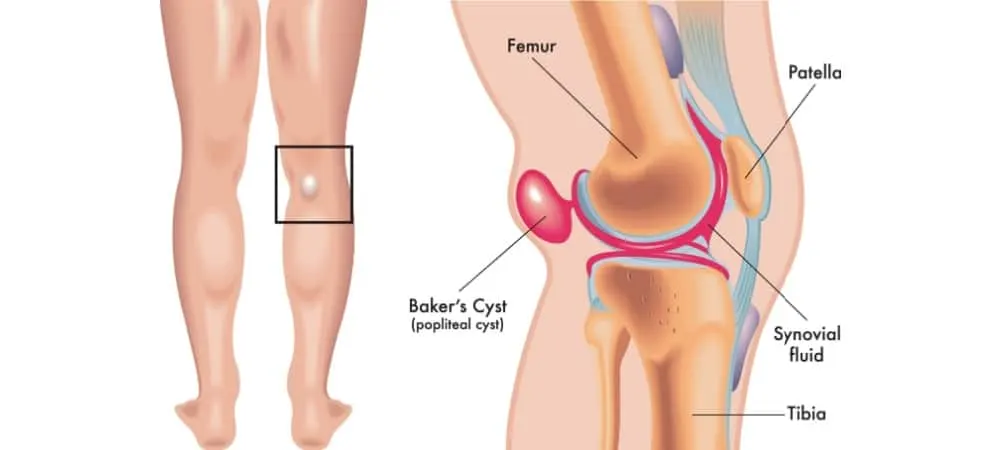
Diseases such as osteoarthritis or inflammatory arthritis can cause damage to the knee joint. As a result of this damage, inflammation and swelling may occur in the area. Due to the developing inflammation, a visible fluid-filled swelling just behind the kneecap, defined as a Baker's cyst, may form. The cyst, which develops together with pain symptoms, may resolve on its own over time, although in some cases various medications may be used to control the symptoms.
What Is a Baker's Cyst?
A Baker's cyst, also known as a popliteal cyst, is a health problem characterized by the development of edema behind the knee, creating a visible swelling in the area. This condition, which causes the person to feel pain during knee movement, may arise as a result of various knee joint problems. In particular, arthritis and cartilage tears can trigger the development of a Baker's cyst. With trauma or inflammation developing in the area, the cells in the region may produce a large amount of fluid and form a fluid-filled sac there.
A Baker's cyst is formed by a fluid called synovial fluid. Synovial fluid enables leg movements to be performed smoothly. During knee movements, it reduces friction between the parts there, especially the joints, and prevents wear. However, various events may increase the production of this fluid and result in its accumulation there. This is what causes the Baker's cyst.
Over time, a popliteal cyst may carry a risk of complications and may rupture spontaneously, allowing the accumulated fluid to spread into the surrounding tissues. This may result in severe pain being felt in the knee and its surroundings. It may also cause swelling or redness in the calf area.
What Are the Symptoms of a Baker's Cyst?
Symptoms of a Baker's cyst can be easily recognized by the person. In some cases, cyst development may cause only swelling behind the knee. In some people, the development of inflammation together with swelling in the area may cause the following symptoms:
Pain sensation behind the knee,
Pain in the calf,
Feeling of locking in knee joint movements,
Swelling in the leg,
Inability to fully bend the knee (decreased flexion ability).
How Does a Baker's Cyst Develop?
While cyst development in the knee can occur due to various causes, certain factors play a role in the formation of a Baker's cyst. One of the frequent causes of formation is damage to the area as a result of a blow to the knee. Swelling behind the knee may be seen particularly in sports-related injuries. Apart from injuries, the following may also be effective in cyst formation:
Osteoarthritis: Usually emerging with aging, osteoarthritis is a disease characterized by the breakdown of the cartilage tissue at the end of the bones and, over time, difficulty in moving the joint. It is also known colloquially as kireçlenme. Osteoarthritis causes wear in the joints and may result in the appearance of a Baker's cyst by triggering inflammation in the area.
Rheumatoid arthritis: Rheumatoid arthritis, another type of arthritis, is an immune system disease. An autoimmune disease, rheumatoid arthritis emerges when the immune system attacks its own joints and creates inflammation in this area. Cyst development may also be seen along with such conditions.
Gout: Known colloquially as the "disease of the wealthy," gout is a disease that develops as a result of uric acid accumulation in the body caused by excessive protein consumption. It is usually seen in the big toes, but in some people it may involve different joint areas. By causing conditions similar to arthritis, it can trigger cyst development.
A Baker's cyst is a condition that can be seen in every age group. It usually affects adults between the ages of 30 and 70. There is no gender difference in the disease.
How Is a Baker's Cyst Diagnosed?
People who apply to a healthcare facility due to swelling behind the knee are examined by a doctor. During the physical examination, the doctor may examine the area and diagnose a Baker's cyst. However, since the symptoms caused by the cyst are similar to those of different diseases, various tests may be used to rule out other disease possibilities. Diseases such as blood clots, tumors or aneurysms are serious conditions that show symptoms similar to a Baker's cyst.
In diagnosing a popliteal cyst, imaging techniques are applied. With these tests, the tissue and its surrounding tissues are visualized in more detail. The techniques used during diagnosis are as follows:
Ultrasound: Ultrasound, an imaging method performed using sound waves to obtain an image of the tissues under the skin, can be used to diagnose Baker's cyst formation. Ultrasound images may also be used to rule out a different disease condition.
X-ray: Another frequently used imaging technique is the X-ray. The measurement performed using X-rays uses electromagnetic waves. During the imaging, a black-and-white photograph of the relevant area of the body is taken. With these images, different tissue formations can be detected.
Magnetic resonance imaging (MRI): An imaging technique used to produce detailed images of tissues in the body. During this technique, a magnetic field is created with radio waves, and the obtained images are transferred to a computer. MRI is one of the methods used in diagnosing many diseases, as in cyst problems.
How Is a Baker's Cyst Treated?
A Baker's cyst is a health problem that can heal on its own. In cases where patients go through the process with mild symptoms, no intervention may be needed. Avoiding activities that trigger pain may be sufficient to support the healing process.
In cases where symptoms are severe and the cyst is very large, treatment may be needed. Various procedures may be applied for the treatment of swelling behind the kneecap. Treatment planning is done especially according to the main cause that triggers cyst development. Treatments that may be applied depending on the patient's health condition can be explained as follows:
Drug therapy: Anti-inflammatory drugs may be effective in cyst treatment. These drugs may support the resolution of inflammation in the area and reduce pain. In cases where inflammation is intense, an injection of a corticosteroid drug containing cortisone may be performed. Cortisone may reduce the size of the cyst in the area and contribute to the lessening of pain as the cyst resolves.
Therapies: Under the guidance of a doctor and physiotherapist, the patient may be shown movements that will strengthen the regional area. In this way, the range of motion restricted by the cyst can be increased and strengthening of the muscles in the surrounding tissues can be supported. Through therapies, a decline in knee function can be prevented and knee health can be maintained.
Surgical procedures: In cases where the Baker's cyst is very large, minimally invasive procedures may be performed to reduce the size of the cyst. Minimally invasive methods, which mean making a small incision, may allow the fluid inside the cyst to drain. The procedure is performed with support from ultrasound images. The physician performs needle aspiration to transfer the fluid in the area outside the skin.
In cases where a cyst has developed due to tissue damage in the area, arthroscopic surgery may be considered. During arthroscopic procedures, torn or damaged tissues such as cartilage are repaired. During the procedure, the fluid accumulated inside the cyst is also drained to accelerate the healing process.
In some rare cases, the entire cyst tissue may need to be removed from the body. This method, which is preferred in cases not responding to other treatments, is performed so that patients can carry out physical activities of daily life such as walking.
Frequently Asked Questions
Swelling behind the knee may develop due to trauma resulting from a blow to the knee area, as a result of inflammatory joint diseases such as osteoarthritis and rheumatoid arthritis, or due to inflammation developing as a result of gout. Swelling behind the knee may also decrease when the main disease is brought under control. Baker's cysts are not considered dangerous. While the cyst disappears on its own in most cases, some complications may be encountered if the cyst ruptures. Among these complications, swelling and redness in the calf and pain may be encountered. If you have a complaint related to joint diseases, you may apply to the Orthopedics and Traumatology department of the hospital. Baker's cysts are not a tumor structure; they are cysts that form as a result of fluid accumulation in the area. Therefore, they do not carry a risk of turning into cancer. You may use over-the-counter pain relievers recommended by your doctor for Baker's cyst pain. Apart from this, by limiting your physical activity, you can reduce damage to the knee joint and minimize pain severity. If the pain severity does not decrease, you should inform your doctor about this matter, and if your doctor recommends it, you may switch to using cortisone-based medications. A Baker's cyst may develop as a result of diseases that may cause inflammation in the joints. These diseases include rheumatoid arthritis, osteoarthritis and gout. Inflammation developing in joint tissues due to these diseases may increase the amount of fluid released in the area and trigger the development of a fluid-filled cyst. In most cases, a Baker's cyst is a formation that heals on its own without requiring treatment. However, treatment may be needed in cases where it causes severe pain or the cyst is very large. If treatment is interrupted, the cyst may rupture and the severity of symptoms may increase. Individuals may encounter, apart from complaints such as pain in the calf, a health problem called compartment syndrome, which causes a painful pressure sensation in the muscles, and nerve damage. If you notice a swelling behind your knee, you can benefit from early diagnosis and treatment by applying to the Orthopedics and Traumatology specialists of Hisar Hospital without losing time. In this way, you can prevent complications that may develop due to Baker's cyst.
Start with the right assessment for Baker's Cyst: What Is It? Symptoms, Causes and Treatment Methods
Share your symptoms with our specialist physicians; let us determine the right diagnosis and treatment plan together.
Warning
If your symptoms started suddenly, are progressing rapidly, or significantly restrict your daily life, consult a physician without delay.
Plan your Baker's Cyst: What Is It? Symptoms, Causes and Treatment Methods journey with our specialists.
Fill in the form or book an appointment to learn about treatment options, the process and preparation.