Allergic lung diseases are common enough to account for 60 to 80 percent of asthma cases. Resulting from the hypersensitivity of your airways to environmental allergens, these conditions can significantly affect your daily life.
Symptoms of allergic lung diseases include cough, shortness of breath, wheezing, and a feeling of chest tightness. In this article, we will explain the types, symptoms, diagnostic methods, and treatment options of allergic lung diseases in plain language for you.
What Are Allergic Lung Diseases?
Allergic lung diseases develop as a result of your respiratory system's excessive response to certain substances. These diseases are grouped under four main categories, and each has its own unique characteristics.
Asthma
Asthma is a chronic disease that occurs as a result of the narrowing and inflammation of the airways in your lungs. When your bronchial tubes encounter allergens, they constrict, swell, and excessive mucus production begins. Allergens such as pollen, dust mites, and pet dander can particularly trigger your asthma symptoms. Allergic asthma manifests with symptoms such as runny nose, red and itchy eyes.
Eosinophilic Lung Diseases
Eosinophilic lung diseases are a group of conditions characterized by an abnormal increase in white blood cells called eosinophils in your lungs and sometimes in your blood. This group of diseases can follow an acute or chronic course.
Acute eosinophilic pneumonia manifests with fever, cough, and rapidly progressing shortness of breath. The average age of diagnosis is 30, and it is more common in males. Thirty-one percent of cases consist of individuals who have newly started smoking or increased their amount.
Chronic eosinophilic pneumonia, on the other hand, presents with mild shortness of breath, cough, fever, and weight loss. In this disease, incidence peaks between the ages of 30-40, and women are affected twice as much as men.
Hypersensitivity Pneumonitis
Hypersensitivity pneumonia is an immune-mediated disease that develops in susceptible individuals after exposure to specific antigens. It affects your lung tissue and small airways. It is the third most common interstitial lung disease after idiopathic pulmonary fibrosis and connective tissue diseases.
With an incidence rate of 1.3-1.9 per 100,000, it is observed more frequently in female patients and non-smokers. The average age of onset is 52, and over 200 antigens have been associated with this disease. However, the antigen cannot be identified in approximately 50 percent of patients.
Allergic Bronchopulmonary Aspergillosis (ABPA)
ABPA develops as a result of an allergic reaction against fungi of the genus Aspergillus fumigatus. This fungus species is widely found in nature, but it triggers an IgE response in certain individuals. It is seen in 1-2 percent of asthma patients and 2-15 percent of cystic fibrosis patients. Thick sputum constitutes one of the typical symptoms in 31-69 percent of patients.
Symptoms of Allergic Lung Diseases
Symptoms vary depending on the type of disease. While some symptoms begin within minutes, others develop insidiously over months.
Asthma Symptoms
Wheezing sound while breathing is the most common symptom of asthma. A feeling of tightness or pain in the chest, and a cough that strikes particularly at night or in the early morning are typical. These symptoms are generally frequent and recurrent.
Asthma symptoms come in attacks and usually appear at night or towards morning. They improve spontaneously or with medications and may show seasonal variations. Cough and shortness of breath start immediately with triggers such as dust, smoke, and odors.
Symptoms of Eosinophilic Pneumonia
Acute eosinophilic pneumonia manifests with fever, cough, and chest pain lasting 1-5 days. Progressive respiratory distress and respiratory failure may develop. Rapid breathing, rapid heart rate, and crackling sounds in the lungs are heard upon physical examination.
Chronic eosinophilic pneumonia, on the other hand, proceeds with progressive cough, shortness of breath, weight loss, chest pain, and fatigue. Fever rises, wheezing and crackles are heard in the lungs. The cough often starts dry and sometimes turns into productive sputum.
Symptoms of Hypersensitivity Pneumonitis
Common symptoms of both non-fibrotic and fibrotic hypersensitivity pneumonitis are shortness of breath, cough, and crackles during mid-inspiration. Weight loss, flu-like symptoms, chest tightness, and wheezing are observed less frequently.
In the acute form, high fever, chills, muscle aches, cough, and shortness of breath start suddenly within 4 to 6 hours after intense exposure to the allergen. This picture is confused with viral or bacterial infections. In the chronic form, there is insidiously progressing shortness of breath, dry cough, fatigue, and weight loss.
Symptoms of ABPA
The most prominent feature of ABPA is the worsening of asthma symptoms. Shortness of breath is seen in 85-95 percent of cases, and cough and sputum in 80-90 percent. Yellow-brown sputum is present in 56 percent of cases.
Fever occurs at a rate of 60-70 percent, and chest pain at a rate of 40-50 percent. A cough that increases particularly in the morning hours and at night is characteristic.
Common Symptoms and Warning Signs
Consult a doctor if a wheezing or whistling sound is heard when breathing, or if sleep is interrupted due to coughing at night. A feeling of tightness and pressure in the chest, and shortness of breath after exercise are important warning signs. If there is bluish discoloration of the skin or dizziness along with respiratory distress, an emergency application is required.
Causes and Risk Factors of Allergic Lung Diseases
Allergic lung diseases occur when your immune system overreacts to harmless substances. Three main factors play a role in the development of this condition.
Environmental Allergens
Allergens such as pollen, dust mites, and pet dander lead to the narrowing of the bronchial tubes in your lungs. Colds, flu, and excessive exercise also act as triggers. While pollens cause runny nose and sneezing, they also trigger your asthma symptoms.
Dust mites, which are microscopic organisms in house dust, increase nasal congestion and asthma symptoms throughout the year. Dander, fur, and saliva of cats, dogs, and other furry animals affect your airways. There is an asthma risk particularly for cat and dog owners.
Cold weather, beta-blockers, aspirin, and ibuprofen-type medications can be triggers. Intense stress, air pollution, and gastroesophageal reflux disease also worsen your asthma symptoms. Cigarette smoke, air pollution, and chemical substances cause irritation in the bronchi.
Occupational Exposures
Approximately 15-33 percent of adult-onset asthma cases are attributed to occupational exposures. Cleaning workers, healthcare professionals, hairdressers, metal and automotive industry workers are at risk.
Substances such as epoxy resin, nickel, cobalt chloride, potassium dichromate, formaldehyde, and glutaraldehyde cause both skin disease and respiratory tract diseases. Exposure to welding fumes is associated with asthma, skin irritation, and rhinitis.
Those working in dusty environments bear significant risk. Fungal species that appear on decaying food and damp surfaces are triggers for ABPA. Animal proteins, chemical substances, fungi, and bird droppings cause hypersensitivity pneumonitis.
Genetic Predisposition
Asthma arises as a result of the interaction of genetic and environmental factors. If either the mother or the father has asthma, the risk of asthma occurring in the child increases. While the risk is around 20-30 percent if one of the parents has asthma, this probability rises to 60-70 percent if both have asthma.
Variations in genes playing a role in the immune system and inflammation processes increase the risk of asthma. The risk is higher in individuals with a family history of allergies, high-risk occupational groups exposed to chemicals, and highly stressed individuals.
Diagnosis of Allergic Lung Diseases
For an accurate diagnosis, your doctor applies a systematic evaluation process. This process consists of several stages ranging from listening to your complaints to advanced diagnostic methods.
Physical Examination and Patient History
The first step of the diagnostic process is taking your disease history in detail. Your doctor inquires about your smoking use, occupation, and the characteristics of your symptoms. They learn when symptoms such as cough, sputum production, shortness of breath, wheezing, and chest pain started. You are asked whether there is a history of asthma or tuberculosis in your family.
Physical examination involves visual inspection, palpation, and auscultation of your rib cage. Wheezing, crackles, or abnormal sounds are detected while your lungs are listened to with a stethoscope. You are asked to take deep breaths with your mouth open during auscultation.
Pulmonary Function Tests
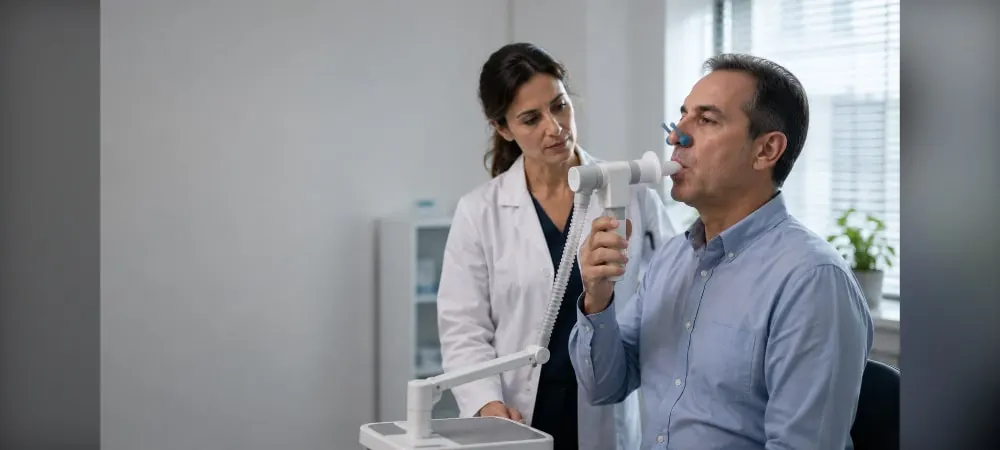
Spirometry is the main diagnostic method that measures the performance of your lungs. During the test, a clip is placed on your nose, and you are asked to blow into the spirometer device. Following normal breathing, you take a deep breath, and then exhale quickly and forcefully. This maneuver is repeated 4-5 times.
FEV1 and FVC values are measured and compared with normal values according to your age, gender, and height. An FEV1/FVC ratio below 70 percent indicates airway obstruction. An increase of more than 12 percent in FEV1 with a bronchodilator drug supports the diagnosis of asthma.
Blood Tests and Allergy Tests
Total IgE, specific IgE levels, and eosinophil count are measured in blood tests. Different allergens are applied to your skin with the prick test, and reactions are evaluated after 15-20 minutes. You need to stop your antihistamine medications 1 week before the test.
Intradermal testing and patch tests are also used to detect respiratory tract allergies. Blood tests reveal your immune system's response to allergic substances.
Imaging Methods
Chest X-ray is the first preferred radiological examination. The structure of your lungs, masses, and fibrosis are examined in detail with computed tomography. High-resolution CT is important in the evaluation of interstitial lung diseases.
Bronchoscopy and Advanced Diagnostic Methods
Bronchoscopy is performed by advancing a thin tubed camera through your nose or mouth into your lungs. The procedure takes 20-30 minutes under local anesthesia. Tissue samples can be taken, or bronchial washing fluid can be collected. These samples are examined in the pathology laboratory to reach a definitive diagnosis.
Treatment Methods for Allergic Lung Diseases
Your treatment plan consists of five steps: avoidance, drug therapy, allergy shots, complementary treatment, and patient education. Your doctor prepares a treatment plan specific to you based on the severity and frequency of your symptoms.
Drug Therapy
Reliever medications quickly alleviate your shortness of breath. Bronchodilator drugs provide relief for 3-6 hours by widening your bronchi within 5 minutes. They give quick results during acute attack periods.
Controller medications are used for long-term control. Inhaled corticosteroids reduce inflammation in your lungs. Antihistamines suppress histamine release at the root of the allergic reaction. Leukotriene antagonists provide long-term control with their allergic inflammation-regulating effect.
In untreated conditions, frequent cough and shortness of breath increase. You reach a state where you cannot produce sputum. As a result, pneumonia may develop and lead to permanent damage in the lungs.
Allergen Immunotherapy (Shot Therapy)
Immunotherapy aims to reduce your immune system's response to allergens. Symptoms decrease significantly in 70 to 80 percent of patients receiving treatment. It is administered as subcutaneous injection or sublingual tablet.
The starting dose is kept low and increased over time. The first 6-16 weeks of treatment constitute the build-up phase. Afterwards, it needs to be applied regularly at least once a month for 3 years.
Patients who complete allergy shot therapy usually experience a comfortable process for 10-15 years. Shots do not contain cortisone, they only contain allergens.
Lifestyle Changes and Prevention Methods
Protection from allergens is one of the most important steps of treatment. Use your mattress covers to reduce house dust mites. Keep windows closed during pollen season.
Using an air purifier with a HEPA filter reduces the allergen load. Stay completely away from cigarette and passive cigarette smoke. Exercise regularly and eat healthily.
Emergency Management
A severe asthma attack is a life-threatening condition. High-flow oxygen, repeated bronchodilator, and systemic corticosteroid are the first-line treatment. Magnesium sulfate is administered in case of inadequate response.
Frequently Asked Questions
Are allergic lung diseases dangerous?
Allergic lung diseases left uncontrolled carry serious risks. When untreated, your immune system weakens, and your probability of catching pneumonia increases. Especially uncontrolled asthma in pregnancy increases the risk of miscarriage and adversely affects the baby's development. Complications such as premature birth, low birth weight, and neonatal hypoxia may occur. However, these risks decrease largely with regular follow-up and treatment.
Are allergic lung diseases contagious?
No, allergic lung diseases are not contagious. Unlike the flu and common cold, they do not pass from person to person. These diseases develop with the combination of genetic predisposition and environmental factors. While the frequency of allergic diseases in society is around 20 percent, the risk of a child having an allergic parent rises to 45 percent. If both mother and father have allergic disease, this risk rises to 70 percent.
Do allergic lung diseases heal completely?
Most allergic lung diseases follow a chronic course, but they are brought under control with effective treatments. Successful results are achieved in 80 percent of patients with standard first-line treatments. Individuals who complete allergy shot therapy usually experience a comfortable period for 10-15 years. Symptoms decrease significantly in 70 to 80 percent of patients receiving treatment. Your quality of life increases significantly with regular medication use and protection from allergens.
How are allergic lung diseases managed during pregnancy?
Asthma medications during pregnancy do not harm the baby. The risk of uncontrolled asthma is far greater than the potential side effects of medications. Most mothers with asthma can have normal deliveries. Breast milk supports the baby's immunity and reduces the risk of allergy. Allergy skin tests are not recommended during pregnancy; blood tests are preferred when necessary. You need to be followed regularly by an allergy specialist throughout pregnancy.
When do allergic lung diseases start in children?
Allergy symptoms in children usually appear from the age of 2 onwards. In some children, symptoms can be seen from birth. The first allergy symptoms start towards the end of infancy or in early childhood. The probability of developing an allergy is higher in children with a family history of allergies. Consult a pediatric allergy specialist when symptoms such as runny nose, itchy skin rashes, and wheezing are observed in children.
Allergic Lung Diseases in Summary
Allergic lung diseases affecting your airways are among increasingly rising health problems today. They have different types such as asthma, eosinophilic pneumonia, hypersensitivity pneumonitis, and ABPA. Each appears with its own prominent features.
Cough, shortness of breath, wheezing, and chest tightness are among the most common symptoms. Be careful if your symptoms increase at night or in the morning hours. Pollen, dust mites, pet dander, and occupational exposures are among the triggering factors. The risk rises even further if you have a genetic predisposition.
The diagnostic process starts with patient history. Your doctor uses spirometry, blood tests, and imaging methods. Allergy tests reveal which substances you are sensitive to. Advanced methods such as bronchoscopy come into play when necessary.
Protection from allergens is the first step in treatment. While bronchodilator drugs provide emergency relief, corticosteroids are necessary for long-term control. Allergy shot therapy re-educates your immune system. Lifestyle changes and regular follow-up increase your chance of success.
Uncontrolled disease can lead to serious complications. However, you can lead a normal life with early diagnosis and appropriate treatment. Use your medications regularly, stay away from triggers, and do not neglect your doctor check-ups. Monitor your children if there is a history of allergic disease in the family.
As a result, allergic lung diseases are manageable conditions. Your quality of life can be preserved with a conscious approach and regular treatment. Do not underestimate your symptoms and get expert support.
Fill Out the Form for Detailed Information and Contact!
Start with the right assessment for What Are Allergic Lung Diseases? What Are the Symptoms? How Are They Diagnosed and Treated?
Share your symptoms with our specialist physicians; let us determine the right diagnosis and treatment plan together.
Warning
If your symptoms started suddenly, are progressing rapidly, or significantly restrict your daily life, consult a physician without delay.
Plan your What Are Allergic Lung Diseases? What Are the Symptoms? How Are They Diagnosed and Treated? journey with our specialists.
Fill in the form or book an appointment to learn about treatment options, the process and preparation.