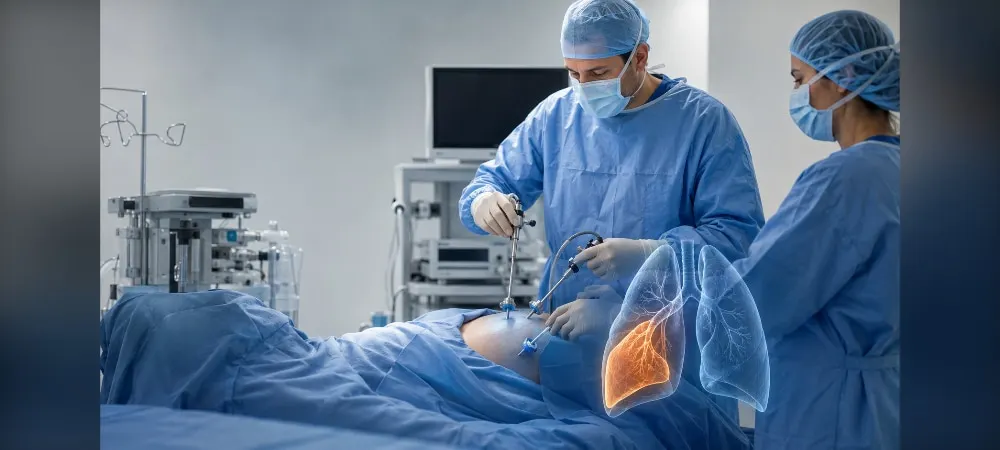
A lobectomy is the surgical removal of a lobe-shaped section of an organ in your body. Primarily performed for lung conditions, this surgery comes into consideration in cases such as lung cancer, tuberculosis, fungal infections, and benign tumors. Answers to the questions of what a lobectomy surgery is and how it is performed extend to minimally invasive surgical techniques. Thanks to these techniques, the recovery process after a lobectomy can be significantly shortened. The surgery generally takes 1.5 to 3.5 hours and varies depending on the general condition of the patient.
What is a Lobectomy? Definition of Lung Lobectomy
Anatomical Structure of the Lungs and Lobes
Your lungs are spongy structures located in the thoracic cavity that enable respiration. Your right lung consists of 3 parts (lobes), and your left lung consists of 2 parts (lobes). This structure forms a system organized as separate sections rather than a single entity in your body.
You might wonder why your left lung has only 2 lobes. The fact that the heart is normally on the left side of the body is the main reason for this situation. The heart is located in place of a part of your left lung. Therefore, the right lung is larger than the left lung; weighing approximately 700 grams, while the left lung weighs 600 grams.
Each lobe contributes to the efficient realization of respiration by housing bronchi, blood vessels, and air sacs within itself. In fact, a lobe is a section of the lung with its own unique airway artery and venous drainage. There are natural fissures between them formed by the deep infolding of the outer membrane of the lung. While there are two such boundaries in the right lung, there is one in the left lung.
What is Lobectomy Surgery?
The clearest answer to the question of what a pulmonary lobectomy is, is the ligation and transection of the lobes' unique airway (bronchus), artery, and vein, separating the lobe from the lung and removing it. It is the surgical removal of a specific diseased lobe of the lung while preserving healthy tissues.
It is performed to clear cancerous or non-functional tissues, and the remaining part of the organ continues to assume its function. Following the surgery, your body adapts to compensate for the absence of the removed lobe. The remaining healthy lung tissue expands to fill the space, and other lung regions assume the function of the removed lobe.
Another point you need to know about what lobectomy surgery is, is that this procedure is the gold standard method especially in the treatment of early-stage lung cancer. If performed on the right lung, it is named as right upper lobectomy, right middle lobectomy, or right lower lobectomy. Since there are 2 lobes in the left lung, it is named as left upper lobectomy or left lower lobectomy.
A lobectomy can be performed when there is a problem in only one part of the lung. The affected lobe is removed, and the remaining healthy lung tissue can function normally.
In Which Cases Is a Lobectomy Performed?
A lobectomy procedure is performed when damage occurs in any of the lung lobes or when cancer involvement arises. This surgical method also comes into the agenda in cases where large air spaces render the lungs useless and prevent healthy lung tissue from working.
Lung Cancer
In early-stage lung cancers, the most effective treatment method is the surgical removal of the tumorous lung tissue. However, not every lung cancer patient is suitable for surgery. Only about 1 in 5 lung cancer patients are eligible for surgery.
Since lung cancer is detected only in the 3rd and 4th stages in a large portion of patients, approximately 80%, surgery does not provide significant benefit to the patient in these late stages. Surgery is performed only in stage 1 and stage 2. The absence of cancer spreading to other organs, the complete resectability of the cancer, and adequate cardiac and respiratory functions of the patient are necessary conditions for surgery.
Tuberculosis and Infections
Tuberculosis, which is a chronic bacterial infection usually affecting the lungs, can create foci resistant to drug therapy. If an abscess formed in the lung does not resolve with antibiotic medication, it may need to be removed.
In a study conducted between January 1980 and July 2000, the rate of patients undergoing major surgery among 41,576 patients diagnosed with pulmonary tuberculosis was 0.68%. Mortality was determined as 5% and morbidity as 40%. If extensive damage, a cyst, or an abscess has formed in the lung due to tuberculosis, the infected tissue can be removed.
Emphysema and Bullae
Emphysema, resulting from the breakdown of elastic fibers in the lungs and the formation of useless air sacs, is a chronic disease. These useless air sacs make it difficult for other healthy lungs to move during breathing.
Giant bullae covering more than 1/3 of the hemithorax and causing significant compression on the neighboring lung tissue require surgical intervention. Progressive shortness of breath occurring with rest or exercise, recurrent pneumothorax, intrabullous infection, or bullae showing rapid growth constitute indications for surgery. Congenital lobar emphysema is a rare condition characterized by the overinflation of one or more lobes of the lung, and it is recommended that all symptomatic cases be treated with lobectomy.
Benign Tumors
These non-cancerous growths can put pressure on major blood vessels and affect the functions of other organs. Especially those positioned close to the airways can cause respiratory problems over time. Benign tumors detected as large must definitely be evaluated surgically. They should be considered malignant until proven otherwise and followed meticulously.
How is a Lobectomy Performed? Surgical Methods
Lobectomy operations can be performed using open and closed methods. The surgeon's preference, along with the location and size of the tumor, determines which technique will be used.
Open Surgery (Thoracotomy)
This method, performed through an incision made on the side of the chest, is also called a thoracotomy. It is performed through an incision ranging between 7-20 cm depending on the location, size of the tumor, and whether it has spread to other organs. The incisions can largely extend from below the shoulder blade in the back to the armpit.
The thoracic cavity is entered through an incision made between the ribs, and direct access is provided to the region planned for surgical intervention. When the ribs are gently spread apart with special instruments thanks to their flexible structures, the surgeon can clearly see all the organs inside.
The surgery lasts on average between 1.5 hours and 3.5 hours. The hospital stay ranges between 2-7 days. A drainage tube is placed at the surgical site to drain remaining fluid and air in the thoracic cavity. These tubes are usually removed on the second day of the surgery.
Video-Assisted Thoracoscopic Surgery (VATS)
It is performed by inserting a thin, rigid tube, a special camera, and other small instruments through 2-4 incisions, each approximately three centimeters in length, opened in the chest wall. In this method, which is applied without cutting the ribs, the surgeon, who visualizes the inside of the chest with the aid of a camera, removes the problematic lung lobe in this way.
In situations preventing the camera or hand instruments from reaching, the need to switch to open surgery may arise. Large muscles are not cut, ribs and joints are not detached from their places, and tendons, nerves, and vessels are not damaged.
Since only small incisions are required, it provides less pain, a shorter hospital stay (typically 2 to 4 days), and faster recovery. Postoperative pain does not significantly affect the patient's recovery process in this method.
Robotic Surgery Method
The surgery is performed via four to five small, one-centimeter incisions opened between the patient's ribs. A high-resolution camera is placed into one of the opened incisions. The surgeon, sitting at the console and directing the robot arms with the help of a control lever called a joystick, performs the surgery.
The robotic system possesses instruments ranging from 5 mm to 8 mm and offers a 180-degree rotation capability. The entire procedure takes between 1.5-3.5 hours. 10x magnification offers a clear view among deep and hidden anatomical structures.
Following robotic lobectomy, patients generally spend 4-5 days in the hospital. This duration is much shorter compared to traditional open surgery. Patients start walking the day after surgery, and most return to desk jobs within two weeks.
Pre- and Post-Lobectomy Surgery Process
Preoperative Preparation and Tests
The surgical process begins with a detailed evaluation and preparation phase. Before the operation, the patient's respiratory functions, heart health, and general condition are analyzed to determine risks.
Patients undergo numerous tests during diagnosis. X-rays, computed tomography, PET-CT are performed, and bronchoscopy or needle biopsy is performed in certain cases if necessary. Pulmonary function tests measure your lung capacity and determine whether you are fit for surgery. ECG, echocardiography, or stress tests may be performed to check your heart health.
Necessary blood tests are administered prior to surgery, and it is evaluated whether a special risk factor for surgery will form. If you smoke, it is recommended that you quit at least 4 weeks before the surgery. This process allows the cleansing cilia in the lungs to function again and reduces the risk of postoperative infection by 50%.
Surgical Process and Anesthesia
The surgery is performed under general anesthesia, and the duration of the operation may vary depending on the chosen surgical method. Anesthesia procedures range between 30-45 minutes. The surgery itself averages between 1.5-3.5 hours, though it varies according to the center and the case.
The anesthesiologist can manage your right and left lungs independently thanks to a special double-lumen tube placed into your windpipe. The lung on the side where the surgery will be performed is temporarily put to sleep. Thus, the surgeon works in a completely immobile field. Throughout the operation, your other lung continues to meet your body's oxygen need with the support of a ventilator.
At the end of the surgery, a chest tube is placed to drain air and fluid accumulation in the lungs.
Length of Hospital Stay
Following surgeries such as a lobectomy or segmentectomy, the length of hospital stay is generally between 3-7 days. After closed surgeries, the average hospital stay is 3 or 4 days, and after open surgeries, it is 5 days.
Patients are discharged within 5 to 7 days after surgery depending on their clinical condition. Prior to discharge, respiratory support is discontinued, and pain management is stabilized. With the VATS technique, the recovery period is only 2-3 days.
Post-Lobectomy Recovery Period
The recovery process after surgery generally varies between 4-8 weeks. It is recommended that you avoid strenuous physical activities during the first weeks. Light activities can usually be performed within 2-4 weeks.
Postoperative physical therapy and breathing exercises accelerate the recovery process. Exercises aimed at increasing lung capacity and regular check-ups are of great importance. Use the medications prescribed by your doctor regularly and perform deep breathing exercises.
Patients who undergo closed surgery can return to normal life 1 week after leaving the hospital. After open surgeries, this period is approximately 3 weeks. The time to return to daily life and business life in a full sense can take up to 4-8 weeks.
Lobectomy Surgery Risks and Complications
Like every surgical intervention, the answer to what lobectomy surgery is also includes risk factors. Your age, general health status, and underlying diseases affect the magnitude of these risks.
Potential Surgical Risks
When performed appropriately according to patient selection and indication, a lobectomy procedure is generally safe. Nevertheless, complications occur in approximately 15% of patients. The 30-day mortality recorded in patients undergoing anatomical resection is between 1% and 6%, while morbidity is between 15% and 35%.
Bleeding at the surgical site and clot formation in the surgical field can be observed. Closed surgeries can be converted to open surgery when necessary, and in this case, blood transfusion may be required due to bleeding. Development of infection may occur at the surgical site or in the lungs. Antibiotics are prescribed to prevent or treat infections.
A persistent air leak lasting longer than 7 days can occur in the lungs. Air can leak into the thoracic cavity and cause the lung to collapse, which requires additional treatment. Incomplete expansion of the lung is also among potential problems.
Cardiac arrhythmias may appear after surgery. Blood clots may form in the legs and reach the lungs, leading to serious complications. Anesthesia-related complications can occur, albeit rarely.
Respiratory failure or long-term oxygen need may develop. Nerve injuries that could affect the diaphragm or vocal cords may be seen. Fluid may accumulate in the space between the lung and the inner chest wall. Patients may experience anxiety or depression after surgery.
The 30-day mortality rate for a lobectomy operation in lung cancer ranges between 0.8 per thousand and 1.5 percent. This variation depends both on conditions such as medical equipment and experience, and on whether the patient has co-morbidities.
Who Is It Not Suitable For?
Lobectomy surgery is not performed on patients with insufficient respiratory capacity and individuals with uncontrolled extra diseases. Patients with advanced chronic obstructive pulmonary disease or severe pulmonary fibrosis may not tolerate the loss of lung tissue.
Surgical risks may be higher in individuals with significant co-morbidities such as uncontrolled diabetes, heart disease, or kidney failure. Active infections such as pneumonia or tuberculosis can make surgery difficult.
Patients with forced expiratory volume in 1 second (FEV1) values lower than 40% of the predicted value may not be suitable candidates for lobectomy. Extreme obesity can increase the risk of complications during and after surgery. Active smokers are generally advised to quit smoking before surgery.
Frequently Asked Questions
The question of how postoperative pain management works comes to the minds of many patients. Your doctor prescribes pain relief medication for the discomfort you feel at the surgical site. Stronger pain relievers are used in the first days, followed by a transition to milder drugs according to need. It is important to report the severity of your pain to your healthcare team regularly.
Patients researching what lobectomy surgery is generally wonder when arm movements will return to normal. Moving your arm on the operated side may be challenging for the first few days. However, you can regain normal mobility within 2-3 weeks with physical therapy exercises. Simple exercises strengthening your arm muscles accelerate the recovery process.
The question of when I can drive is an important issue related to practical life. Safe driving requires your reflexes to be fully intact and to be able to apply pressure to your chest in sudden braking situations. It is generally recommended to wait 2 weeks after closed surgery and 4-6 weeks after open surgery. You should definitely not get behind the wheel while using prescription pain medication.
Patients who obtain information on what pulmonary lobectomy is question how much their respiratory capacity will be affected. Remaining lung tissue expands over time to compensate for functional loss. Most patients do not experience a significant restriction in their daily activities. You may feel mild shortness of breath only during strenuous physical exercise.
The question of how often postoperative check-ups are performed is related to the follow-up process. You are asked to come for check-ups every month for the first 3 months, and then every 3 months for 6 months. During these check-ups, a chest X-ray is taken and blood tests are performed if necessary. If the surgery was performed due to cancer, advanced imaging methods such as PET-CT may also be applied.
Individuals who learn the answer to how a lobectomy is performed worry about scarring. In surgeries performed with VATS or robotic methods, only small scars remain and fade over time. A more noticeable scar forms after open surgery, but since it is on the side of the chest, it is generally invisible with your daily clothes.
There are also those who ask whether I can travel during the recovery period following a lobectomy. You can start short-distance car journeys after 2-3 weeks. For air travel, you need to wait at least 4-6 weeks and get your doctor's approval. Cabin pressure changes can affect your lungs, and staying immobile for a long time increases the risk of blood clots.
The question of how long after quitting smoking I can have surgery is of critical importance. It is a condition that you must not smoke for at least 4 weeks before surgery. The ideal is to quit 8 weeks before surgery. After quitting smoking, your lungs begin to regenerate themselves and surgery complications decrease significantly.
In Summary, Lobectomy
A lobectomy is an important surgery performed by removing the damaged or diseased lobe of your lung. If you have cancer, infection, or chronic lung problems, this surgery may be suitable for you. Today, thanks to VATS and robotic methods, your recovery period is significantly shortened. Your preoperative pulmonary tests and general health status must be evaluated.
Following a successful lobectomy, the remaining lung tissue assumes its function and most patients return to normal life. Determine the method suitable for you by having a detailed discussion with your doctor. Do not neglect your postoperative exercises and follow your follow-up appointments regularly.