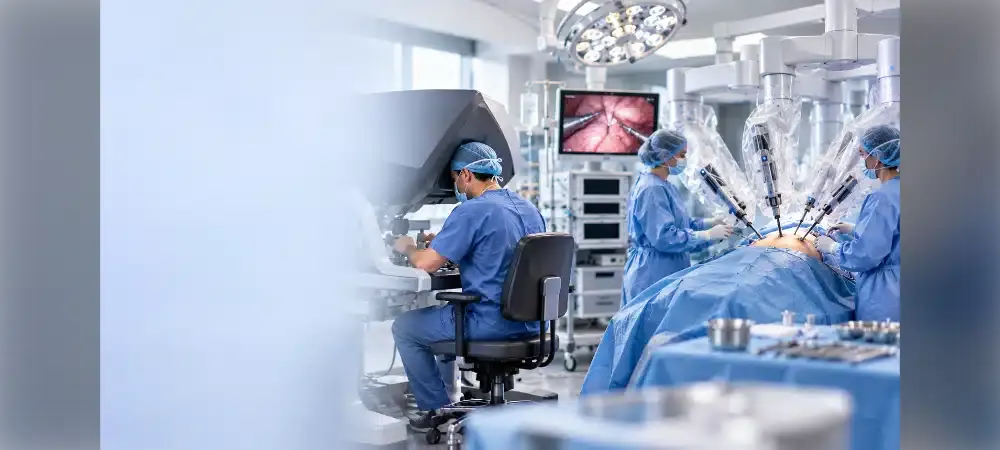
The retroperitoneal space is a region located at the back of the abdominal cavity that contains important structures such as the kidneys, adrenal glands, aorta and vena cava. The removal of lymph nodes in this area using robotic surgical methods is known in the medical world as "Robotic Retroperitoneal Lymph Node Dissection."
This minimally invasive technique offers significant advantages over conventional open surgery. First of all, robotic retroperitoneal lymph node dissection is performed through smaller incisions, which results in less bleeding, less pain and a faster recovery time. In addition, robot-assisted retroperitoneal lymph node dissection provides oncological outcomes similar to those of open surgery. This procedure is performed under general anesthesia in both primary and secondary retroperitoneal lymph node removal surgeries.
In this article, we will provide clear and understandable information about the situations in which Robotic Retroperitoneal Lymph Node Dissection is performed, the surgical process, and its advantages and risks. You will also find a wide range of information, from the question of what retroperitoneal fibrosis is to the applications of robotic surgery in this area.
What Is Robotic Retroperitoneal Lymph Node Dissection?
Robotic Retroperitoneal Lymph Node Dissection (RPLND) is a minimally invasive surgical procedure used in the treatment of urological cancers. It plays an especially important role in the treatment of testicular cancer. Thanks to the precision of robotic systems, this modern surgical technique allows lymph nodes to be removed in a more controlled manner.
What is the retroperitoneal space?
The retroperitoneal space is an anatomical region located behind the peritoneum (the lining of the abdominal cavity). This special region contains vital organs and vessels such as the kidneys, ureters, aorta and inferior vena cava. Because the retroperitoneal space lies at the back of the abdominal cavity, any change in this area can have wide-ranging effects on the body.
From an anatomical point of view, retroperitoneal structures are divided into two categories:
- Primary retroperitoneal structures: These are organs that remain in a retroperitoneal position throughout development. They include:
- Kidneys and ureters
- Adrenal glands
- Aorta and inferior vena cava
- Anal canal.
- Secondary retroperitoneal structures: These are organs that are initially suspended within the mesentery but move behind the peritoneum during development. They are:
- The remainder of the duodenum, except for its first proximal segment
- The ascending and descending parts of the colon
- The remainder of the pancreas, except for its tail.
Approximately 75% of masses in the retroperitoneal region are malignant. For this reason, the status of the lymph nodes in this area is of critical importance, particularly during cancer treatment.
The role of robotic surgery in this area
Robotic surgery offers significant advantages for intervention on the lymph nodes in the retroperitoneal space. This technique is less invasive than conventional open surgery and provides many benefits. Robotic Retroperitoneal Lymph Node Dissection stands out with the following features:
- High precision: Robotic systems allow the surgeon to perform movements with high precision and reduce the risk of damage to surrounding tissues.
- 3D imaging: High-resolution three-dimensional imaging during surgery allows the surgeon to see the operative field in greater detail.
- Fast recovery: Recovery is very quick after operations performed with laparoscopic and robotic methods.
- Cosmetic advantage: Because this operation is performed with a closed system, cosmetic concerns are kept to a minimum.
- Less pain: Because pain after surgery is much lower, patient comfort is increased.
At the same time, robotic RPLND offers both diagnostic and therapeutic benefits. With this procedure, the question "Has the disease spread to the lymph nodes?" can be answered definitively by pathological examination. If cancer cells are present in the lymph nodes, they are removed with this intervention, so that the diagnosis is made and treatment is provided at the same time.
In this procedure performed with robotic surgery, the patient is prepared under general anesthesia and the surgical position is determined according to the type of procedure. It can be performed through the peritoneum (transperitoneal) or outside the peritoneum without touching the intestines (retroperitoneal).
In conclusion, Robotic Retroperitoneal Lymph Node Dissection has gained an important place in modern urological surgical treatment, thanks to the precision, control and minimal invasiveness it offers in removing lymph nodes in the retroperitoneal space.
When Is RPLND Performed?
Robotic Retroperitoneal Lymph Node Dissection (RPLND) is a surgical procedure of great importance particularly in certain clinical situations. This surgical technique can be used for both diagnostic and therapeutic purposes, and the situations in which it is performed vary according to the patient's clinical condition.
Staging after testicular cancer
In the treatment of testicular cancer, RPLND is critically important for staging. RPLND may be preferred particularly in clinical stage I non-seminomatous germ cell tumors (NSGCT) when high-risk factors are present. In patients with high-risk features such as lymphovascular invasion, the likelihood of metastasis increases, and RPLND may be necessary in this case.
For patients without metastasis (clinical stage I) or with a low burden of lymph node metastasis (clinical stage II), RPLND offers the advantage of pathological staging. With this procedure, pathological stage 2 disease can be detected in 15-20% of clinical stage I seminomas and in more than 30% of non-seminomatous germ cell testicular tumors.
Lymph nodes that do not respond to treatment
The presence of a residual mass after chemotherapy is one of the most important indications for RPLND. In advanced-stage testicular cancers, residual masses may remain in the retroperitoneum after chemotherapy, and they need to be removed. These masses may contain viable cancer cells, teratoma or necrotic tissue.
Removal of residual masses larger than 1 cm after chemotherapy is a generally accepted practice. In patients whose mass increases in size without a rise in tumor markers, chemotherapy-resistant teratoma should be suspected, and RPLND should be the first treatment option.
Diagnostic applications
RPLND may be performed to obtain tissue for histopathological examination and to definitively confirm the disease. This is critically important particularly in cases that remain suspicious.
Retroperitoneal lymph node dissection is also used to assess whether testicular tumors have spread to the lymph nodes behind the abdomen. With RPLND, both the stage of the disease is clarified and residual tumor cells are cleared, reducing the risk of recurrence.
PET (Positron Emission Tomography) imaging has a high negative predictive value, particularly after seminoma treatment, and plays an important role in the evaluation of suspicious masses.
Primary and secondary retroperitoneal lymph node removal
Robotic RPLND can also be performed for primary and secondary retroperitoneal lymph node removal. Primary retroperitoneal RPLND can be performed in stage I, that is, non-seminomatous germ cell testicular tumors confined to the testis, when risk factors are present. In this case, risk factors such as microscopic vascular and lymphatic invasion indicate a 25% probability of metastasis to the lymph nodes.
In advanced-stage (Stage II) testicular tumors, there is metastasis to the lymph nodes, and the shrinkage of the lymph nodes despite chemotherapy may not be at the desired level. For this reason, "Post-chemotherapy RPLND" is performed to remove the masses remaining after chemotherapy together with the lymph nodes in that region.
RPLND performed with robotic surgery is a procedure that has low complication rates when performed by experienced surgeons and has both diagnostic and therapeutic value. However, whether it is performed with robotic surgery or open surgery, it is important that this operation be performed by very experienced and skilled surgeons.
Surgical Process and Stages of the Procedure
Robotic RPLND surgery is a carefully managed process, from the patient's preparation to the pathological evaluation. This delicate surgical procedure consists of several stages for the removal of lymph nodes in the retroperitoneal space.
General anesthesia and preparation
Robotic RPLND surgery is always performed under general anesthesia. Various tests are performed beforehand according to the patient's age and medical condition. In some patients, the anesthesiologist may also administer epidural anesthesia to reduce pain after surgery.
Before surgery, the patient undergoes an allergy check, and an antibiotic injection is usually given afterwards. In patients who have received a chemotherapy regimen containing bleomycin in particular, pulmonary function tests and an anesthesia evaluation are mandatory, because bleomycin-induced lung disease can lead to interstitial pneumonia and fibrosis.
Bowel cleansing may be necessary for some patients, and enemas are used in this process.
Surgical access with the robotic system
In robotic RPLND, the patient is usually positioned lying on their back. Surgery begins using the DaVinci robotic system. Two different approaches can be used for surgical access:
- Transperitoneal approach: Performed through the peritoneum
- Retroperitoneal approach: Performed outside the peritoneum, without touching the intestines
During robotic RPLND, 4-5 trocars are usually placed in the abdomen. These are:
- An 8 mm camera port (usually 4 cm below the navel)
- 8 mm robotic trocars
- A 12 mm assistant port
Using the DaVinci Xi system allows a wider dissection to be performed, and the robot is positioned at the patient's side.
Removal of the lymph nodes
The surgeon opens the retroperitoneum and carefully exposes the large vessels (aorta, vena cava). Using the "split and roll" technique, the tissue over the vessels is carefully lifted and critical branches are identified.
Large lymphatic channels are ligated to reduce the risk of chylous leakage after surgery. The tissues over the aorta and vena cava are moved aside to identify the lumbar arteries, which are then ligated. Meticulous use of surgical clips around the left renal vein and lymphatic channels can minimize the risk of chylous ascites.
A nerve-sparing technique can be applied to preserve ejaculatory function. This technique focuses on preserving the hypogastric plexus and its branches. In this way, ejaculatory function can be preserved in 100% of patients.
Pathological examination process
The removed lymph nodes are sent for pathological examination. In this way, the presence of cancer or its extent of spread is definitively evaluated. Pathological examination is critically important in determining the content of masses after chemotherapy (viable cancer cells, teratoma or necrotic tissue).
After examination, there may be no sign of cancer in the removed lymph nodes. This information plays an important role in planning the patient's treatment and determining the prognosis.
Advantages and Risks
While the robotic RPLND procedure offers several advantages compared with conventional open surgical methods, like any surgical procedure it also carries some risks. Both the positive aspects and the potential complications of this modern approach are critically important in informing patients.
Benefits of the minimally invasive approach
Because Robotic Retroperitoneal Lymph Node Dissection is performed with minimally invasive techniques, it provides many benefits to the patient. First of all, since only 4-5 small openings are made in the abdomen, patients experience less pain and their recovery is faster. In addition, with this approach:
- There are no cosmetic drawbacks, and no large incision scar is visible on the abdominal wall
- Pain after surgery is much lower and can usually be controlled with mild pain relievers
- The hospital stay is only about 1-2 days, and 95% of patients can be discharged on the second day after surgery
- Recovery is quick, and most patients can return to their normal lives within 2-3 weeks
In addition, because blood loss is much lower compared with conventional open surgery, the need for blood transfusion is 1-2% in robotic surgery, whereas in open surgery this rate is around 40-45%.
The advantage of three-dimensional imaging
One of the most remarkable features of robotic surgery is that it offers surgeons three-dimensional imaging. This technology makes it possible to work with a high-resolution (HD) image magnified 10-15 times compared with normal vision. Three-dimensional imaging provides the following advantages:
Thanks to the robotic system, surgical instruments have 540 degrees of movement and never tremble. As a result, the erectile nerves going to the penis that lie adjacent to the prostate and the urinary continence muscles can be better preserved. Thanks to this precise control, the surgeon can clearly observe the relationship between the lymphatics and the nerve network and can comfortably apply the nerve-sparing approach.
Risk of bleeding and infection
However, as with every surgical intervention, Robotic RPLND has some risks. Because the operation is performed on large vessels, bleeding is a potential risk. In particular, during the removal of lymph nodes around large blood vessels such as the aorta and vena cava, injuries to these vessels can cause major blood loss.
At the same time, as with all surgical procedures, there is a risk of infection. Although broad-spectrum antibiotics are usually given to patients before surgery, urinary tract infections and incision-site infections may rarely develop.
Complications of robotic surgery also include the possibility of injury to the renal vessels (less than 1%), liver injury (less than 1%), spleen injury (less than 1%) and bowel injury.
However, because a closed system is used in robotic surgery, the intestines do not come into contact with air, and since there is no excessive heat or fluid loss, metabolic imbalance is seen very rarely. This leads to lower complication rates compared with open surgery.
Recovery and Follow-Up After Surgery
Properly managing the patient's recovery after a successful Robotic Retroperitoneal Lymph Node Dissection is as important as the success of the operation itself. So how should this process be managed, and what should be paid attention to?
Length of hospital stay
One of the most important advantages of robotic RPLND surgery is the short hospital stay. While patients usually stay in the hospital for 7-10 days after conventional open surgery, this period is dramatically shortened with robotic surgery. Patients mostly stay in the hospital for only 1-2 days. In some centers, this period may range from 3 to 5 days.
During the hospital stay, the patient is helped to walk on the first day, and the return of passing gas and tolerance of food are expected on days 2-3. The drain is usually removed within 2-5 days, and the patient is kept under close observation during this time.
Pain management and physical activity
Pain management after surgery is one of the cornerstones of a successful recovery. Patients' pain levels after robotic RPLND are significantly lower compared with open surgery. In most cases, strong pain relievers are not needed.
As for physical activity, the following recommendations are given to the patient:
- Walking 4-6 times a day is recommended (especially for the first two weeks)
- Sitting or lying down for a long time may increase the risk of pneumonia and deep vein thrombosis
- Light exercise can be started within 2-3 weeks after surgery
- Heavy lifting and strenuous activities should be avoided for 4 weeks after surgery
Time to full recovery
Full recovery after robotic RPLND varies from patient to patient, but a return to daily life is usually possible within 2-3 weeks. The time to return to work is approximately 2-3 weeks, although for some patients it may extend to 4-8 weeks.
Stitches are usually removed after 1 week. To start driving, the use of narcotic medication must have ended and full range of motion in the lower back must have been regained, which takes about 4 weeks. It is recommended to wait 4-6 weeks before starting sexual activity and heavy sports.
Long-term follow-up and risk of recurrence
Regular follow-up after robotic RPLND is extremely important for reducing the risk of recurrence. In testicular cancer, the median time to recurrence is 7 months, and 90% of patients who experience a recurrence do so within the first 2 years.
The follow-up schedule varies according to the patient's stage, but at a minimum it includes the following:
- Physical examination and tumor marker measurement every 2-3 months for the first 2 years
- Regular chest X-rays
- Periodic abdominal and pelvic CT scans
Recurrence in the retroperitoneum after robotic RPLND is rare. However, with regular follow-up, possible recurrences can be detected early and appropriate treatment can be planned.
Frequently Asked Questions
Patients have various concerns about Robotic RPLND. In this section, we will answer the most frequently asked questions.
Is it possible to have children after RPLND?
The nerve-sparing RPLND technique allows the removal of retroperitoneal lymph nodes while preserving the sympathetic nerves that control ejaculation and sexual function. Thanks to this modern technique, antegrade ejaculation is preserved in 95-98% of men with testicular cancer after modified RPLND, and 76% of them are able to father children naturally. With robotic RPLND, particularly with modified templates in the primary setting, ejaculatory function can be preserved in 100% of patients.
What should be paid attention to during recovery?
Patients usually stay in the hospital for a few days after surgery. Adequate pain control should be provided and early mobilization should be encouraged. During the first 4-6 weeks:
- The incision site should be checked for signs of infection
- Follow-up for symptoms such as fever, significant pain or changes in urinary function
- Attention should be paid to signs of lymphocele, such as swelling or discomfort in the abdomen
Which is better, robotic surgery or open surgery?
Open surgery takes 39 minutes less on average, but there is less bleeding with robotic surgery (507 ml less on average). The number of lymph nodes removed with robotic surgery is 1.6 times higher, and the complication rate is lower. There is no significant difference between the two techniques in terms of urinary continence and erectile function.
Is retroperitoneal fibrosis related to this procedure?
The most predictable side effect of RPLND is infertility due to ejaculatory dysfunction. Retroperitoneal fibrosis is not directly related to the procedure and is a rare condition after surgery. However, sperm freezing before surgery is an option that can be considered for patients who wish to have children in the future.
In Summary: Robotic Retroperitoneal Lymph Node Dissection
In conclusion, Robotic Retroperitoneal Lymph Node Dissection has an important place in the treatment of urological cancers such as testicular and kidney cancer. Compared with conventional open surgery, it provides less pain, less bleeding and a much faster recovery.
Thanks to three-dimensional imaging technology and the precision of the robotic system, surgeons can perform the operation while preserving critical nerve structures. In this way, ejaculatory function is preserved in most patients, and the likelihood of fathering children naturally remains high.
The hospital stay after robotic RPLND is only about 1-2 days, and patients can usually return to their normal lives within 2-3 weeks. However, regular follow-up after surgery is extremely important. Periodic check-ups, particularly during the first two years, play a critical role in reducing the risk of recurrence.
In addition, higher yield is achieved in the removal of lymph nodes with robotic surgery. This procedure, which can be used for both diagnostic and therapeutic purposes, has a very low complication rate when performed by experienced surgeons.
As with all surgical procedures, Robotic RPLND has some risks. However, thanks to the minimally invasive approach, these risks are significantly reduced compared with conventional open surgery.
Robotic RPLND is one of the important advances that technology has brought to urological surgery. Together with appropriate patient selection and the right surgical technique, it offers an effective and safe option in cancer treatment. By benefiting from the advantages of this modern surgical approach, patients can have a more comfortable treatment process and regain their quality of life more quickly.