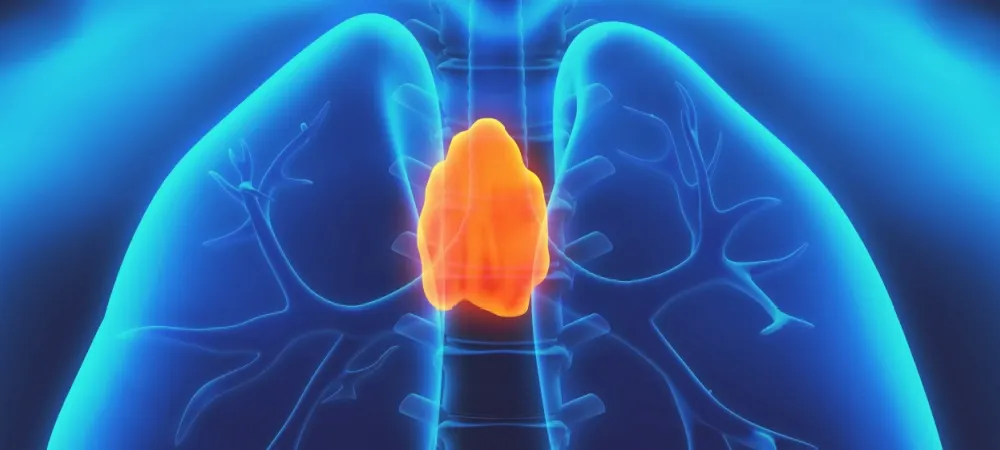
Thymus gland cancer is a rare type of cancer that develops in the thymus gland, located behind the rib cage and serving as an important part of the immune system. Known for subtypes such as thymoma and thymic carcinoma, this disease generally has an insidious course and does not show symptoms in early stages, but in later periods it can lead to serious symptoms and systemic problems.
What is Thymus Gland Cancer?
The thymus gland is a small organ located just behind the sternum and in front of the heart. The function of the thymus gland is to ensure the development and maturation of T cells, which are the main defense cells of the immune system, during childhood and adolescence. With age, this gland shrinks and is replaced by adipose tissue. Thymus gland cancer occurs when the cells in this organ divide and multiply uncontrollably. The two most common types of this cancer are thymoma and thymic carcinoma:
Thymoma cancer generally grows slower, is well-defined, and can be completely removed by surgery when detected at an early stage.
Thymic carcinoma is rarer and has a more aggressive course. Early diagnosis and treatment can be difficult.
Both types are referred to as mediastinal masses because they are located in the middle part of the chest cavity called the mediastinum. This type of cancer accounts for approximately 0.2-1.5 percent of all cancer cases and is seen in 1-5 people per million annually. It is most frequently diagnosed between the ages of 40-60, and the male-to-female ratio is approximately equal. Although the exact cause of thymus gland cancer is unknown, it is thought to be associated with immune system diseases.
What Are the Symptoms of Thymus Gland Cancer?
The symptoms of thymus gland cancer are related to the size of the tumor and its pressure on surrounding organs. In addition, because this gland is located deep in the chest cavity, it may not show symptoms in early stages, which is why diagnosis is often delayed. Cancer symptoms that share similarities with thymus gland diseases can be listed as follows:
Respiratory system symptoms: Shortness of breath, persistent cough, feeling of tightness in the chest, difficulty breathing in a lying position
Chest pain: Constant or intermittent pain in the anterior chest wall that may increase with movement
Difficulty swallowing: Difficulty swallowing solid or liquid foods, feeling of obstruction in the throat
Myasthenia gravis symptoms: Drooping eyelids, double vision, speech impairment, difficulty chewing, general muscle weakness (increasing later in the day)
Superior vena cava syndrome: Swelling in the face, neck, and arms, blue-purple discoloration, headache
General cancer symptoms: Fatigue, loss of appetite, unexplained weight loss, night sweats
Autoimmune disease symptoms: Anemia, recurrent infections, tendency to bruise on the skin
Voice changes: Hoarseness, difficulty speaking
Edema: Swelling in the feet and legs
How Does Thymus Gland Cancer Occur?
The exact cause of thymus gland cancer is not yet fully understood. Research indicates a link between genetic factors, environmental influences, and immune system disorders.
From a genetic perspective, various chromosomal anomalies and gene mutations have been detected in thymus gland cancer. Changes in TP53, RB1, and MYC genes are common in this type of cancer. In addition, some familial inheritance cases have been reported, but hereditary transmission is extremely rare. Radiation exposure holds a significant place among environmental risk factors. Especially individuals who received radiotherapy to the chest area during childhood have an increased risk of developing thymus gland cancer years later. It is also thought that certain viral infections, such as the Epstein-Barr virus, may be a risk factor.
There is a strong link between immune system diseases and thymus gland cancer. Autoimmune conditions such as myasthenia gravis, red blood cell aplasia, and hypogammaglobulinemia can occur alongside thymus cancer. This condition can be explained by the role of the thymus gland in the immune system. The age factor is also important; thymus gland cancer is most frequently seen in middle age. There is no significant difference in terms of male and female gender, but certain subtypes may manifest according to gender.
How is Thymus Gland Cancer Diagnosed?
The diagnosis of thymus gland cancer is usually a multi-step process and requires various imaging methods and tissue sampling for a definitive diagnosis.
Physical Examination: The first step is taking a detailed medical history and conducting a physical examination. The doctor listens to the patient's complaints, specifically investigating symptoms of myasthenia gravis. During the physical examination, the rib cage is auscultated, and signs of superior vena cava syndrome are checked.
Imaging Methods: Imaging methods are of critical importance in diagnosis. Although a chest X-ray is the first step, it is usually insufficient. Computed tomography (CT) details the mass within the thymus region, evaluating its size, relationship with neighboring organs, and spread status. Magnetic resonance imaging (MRI) better demonstrates the relationship with vascular and nerve structures, in particular. Positron emission tomography (PET-CT) measures the metabolic activity of the tumor and investigates whether it has spread to other regions of the body. This examination is valuable in terms of treatment planning and follow-up.
Biopsy: Tissue sampling is required for a definitive diagnosis. This is usually done via biopsy. Needle biopsy, mediastinoscopy, or open surgical biopsy are among the options. The obtained tissue sample is examined under a microscope, and immunohistochemical stains are performed.
Blood Tests: Blood tests are also part of the diagnostic process. Complete blood count, biochemical parameters, tumor markers, and specific antibodies for myasthenia gravis are investigated. Acetylcholine receptor antibodies are important in the diagnosis of this disease.
How is Thymus Gland Cancer Treated?
The treatment plan is determined according to the stage of the disease, the type of tumor, and the general health status of the patient. More than one treatment method can be applied in combination for thymus gland cancer. The primary treatment methods are as follows:
Thymectomy (Removal of the thymus gland): If the tumor is in an early stage, surgery is the most effective method. When the tumor can be completely removed, the risk of recurrence of the disease is quite low.
Radiotherapy: Used to destroy remaining tumor cells after surgery. It can also be administered for tumor-shrinking (palliative) purposes in advanced cases.
Chemotherapy: Used particularly in aggressive tumors such as thymic carcinoma.
Immunotherapy and Targeted Therapies: These methods, which have revolutionized cancer treatment in recent years, have started to yield promising results in thymus cancer as well. They may not be suitable for every patient, so compatibility is checked through genetic tests.
Regular follow-up of patients after thymus gland cancer treatment is very important. A potential relapse can be detected early through routine CT scans, blood tests, and physical examinations.
Frequently Asked Questions
Thymus gland cancer can be dangerous, especially if not diagnosed early. As the tumor grows, it may put pressure on surrounding organs or pose a risk of metastasis, but if diagnosed at an early stage, it responds very well to treatment. Therefore, symptoms such as chest pain or shortness of breath should be taken seriously. Thymus cancer, especially in more aggressive types like thymic carcinoma, can metastasize to the lungs, liver, lymph nodes, and rarely bones. When spread occurs, the treatment of the disease becomes more complex. Therefore, staging performed in the early period is critical to determine the risk of metastasis. Thymoma is technically a malignant tumor, but in most cases, it grows slowly and shows limited spread. According to the Masaoka staging system, stage I-II thymomas are confined to the capsule and behave relatively benignly. Stage III-IV thymomas show spread to surrounding tissues and have a more aggressive course. Completely benign thymomas are extremely rare, and generally, all thymomas are considered malignant. Thymoma is not considered a directly hereditary disease, but it can be seen in conjunction with certain genetic syndromes and autoimmune diseases. Having a family history of thymus cancer, although rare, may increase the risk. Even without a genetic predisposition, it can be associated with immune system diseases. Untreated thymoma cancer in the chest can grow over time and put pressure on vital organs such as the heart, lungs, and major blood vessels. Additionally, it can lead to serious problems such as difficulty breathing and swallowing. Some thymomas may transform into malignant ones or regrow. Therefore, it should not be left untreated. Thymoma surgery generally lasts between 2 to 4 hours. The size, location, and spread of the tumor to its surroundings can cause the duration to vary. This duration can be even shorter with minimally invasive surgical techniques. It is important to perform surgical planning with detailed imaging before surgery. Thymoma diagnosis is primarily established using imaging methods such as CT or MRI performed on the chest region. A fine-needle biopsy is generally applied to the mass detected in the imaging to obtain a tissue sample. This sample is pathologically examined to finalize the type and grade of the tumor. If necessary, staging is performed with PET-CT. Thymoma cancer is generally not fatal since it is a slow-progressing tumor that responds well to treatment; however, if diagnosed late, spread to surrounding organs, or left untreated, it can lead to serious consequences. Therefore, early diagnosis and regular follow-up greatly reduce the risk of death.
If you are experiencing symptoms of thymus gland cancer or think you are at risk, do not waste time for early diagnosis. We offer you a personalized diagnosis and treatment plan with Hisar Hospital's expert Thoracic Surgery teams.
Contact us to make an appointment or for detailed information.
Start with the right assessment for What is Thymus Gland Cancer? Symptoms, Causes, Diagnosis, and Treatment Methods
Share your symptoms with our specialist physicians; let us determine the right diagnosis and treatment plan together.
Warning
If your symptoms started suddenly, are progressing rapidly, or significantly restrict your daily life, consult a physician without delay.
Plan your What is Thymus Gland Cancer? Symptoms, Causes, Diagnosis, and Treatment Methods journey with our specialists.
Fill in the form or book an appointment to learn about treatment options, the process and preparation.