Strabismus (Eye Misalignment)
Strabismus (eye misalignment) is an eye health problem characterized by the inability of both eyes to focus on the same point at the same time. While strabismus is frequently encountered in infants who have weak control over their eye muscles, eye misalignment can also occur in adults in some cases. In cases of eye misalignment, which can usually be treated using non-surgical methods such as glasses and eye patches, surgical interventions may be required in certain situations.
What is Strabismus (Eye Misalignment)?
Strabismus, medically known as strabismus, is the focusing of the eyes in different directions as a result of the disruption in the parallelism of the visual axis. In other words, while one of the eyes looks in one direction, the other looks in a different direction. This is the primary reason why strabismus is commonly referred to as eye misalignment among the public. Under normal circumstances, 6 muscles controlling the movement of the eyes work together to ensure that the eyes focus on the same point. As a result of this focusing, the image coming from the same point in both eyes simultaneously is transmitted via nerves to the visual center in the brain, and the image is formed. If there is any problem with these muscles that control eye movements, the eyes cannot focus on the same point. In short, while one of the eyes of those with an eye misalignment problem looks straight ahead, the other may look inward, outward, or to the side.
Strabismus can affect people of all age groups, especially infants and children. Research shows that the prevalence of strabismus in infants and children worldwide ranges between approximately 0.14% and 5.65%. Additionally, health issues such as strokes or exposure to various traumas can cause eye misalignment in adults as well. Furthermore, in some cases, untreated or recurrent eye misalignment from childhood can lead to eye misalignment in adults.
Strabismus is classified into various categories based on its mechanism of onset. Accordingly, the main types of strabismus are as follows:
Accommodative esotropia (inward turning due to high hyperopia): Often in individuals with a family history or personal history of high hyperopia, the extra focusing effort required to keep distant objects in sharp focus can cause the eyes to turn inward.
Intermittent exotropia (outward strabismus): In this type of strabismus, while one eye focuses on a target, the other eye's focus is directed outward. It is usually called intermittent exotropia because the eye alternates between looking straight ahead and looking outward.
Infantile esotropia: This type of eye misalignment appears within the first 6 months of infancy; an eye misalignment that is intermittent at first can become constant over time.
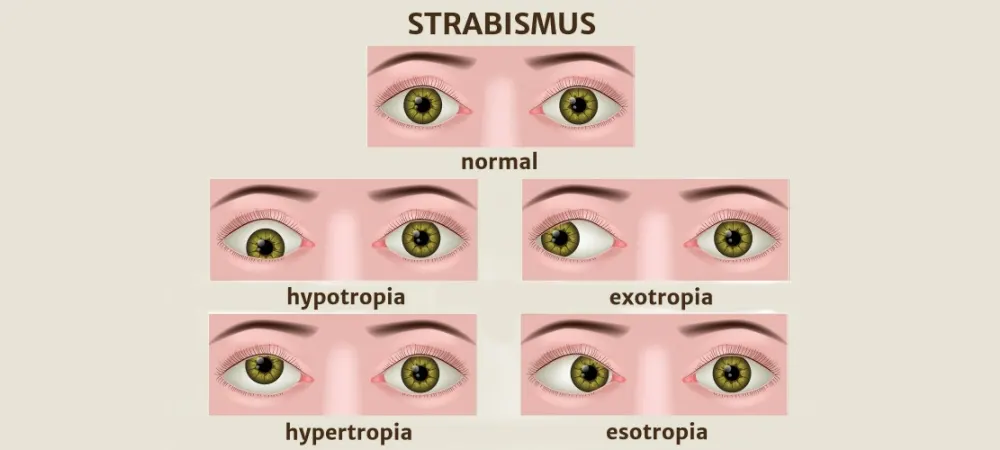
Strabismus can also be classified differently according to the direction of eye misalignments, its frequency, and whether it affects a single eye or both the left and right eyes. While horizontal strabismus types are referred to as looking inward (esotropia) and outward (exotropia), vertical strabismus forms are referred to as looking upward (hypertropia) and downward (hypotropia).
How Does Strabismus Occur?
Although the exact cause of strabismus is unknown, research shows that factors such as refractive errors (vision disorders), congenital anomalies, and neurological disorders can cause eye misalignment. In addition, studies indicate that genetic factors have an influence in approximately 30% of children with strabismus. The main risk factors are as follows:
Untreated refractive errors such as hyperopia and myopia,
Vision impairment affecting one eye,
Cerebral palsy,
Congenital hydrocephalus characterized by fluid accumulation in the brain,
Brain tumor,
Stroke in adults,
Trauma to the region of the brain controlling eye movements, the optic nerves, or the eye muscles,
Neurological problems,
Graves' disease developing as a result of the overproduction of thyroid hormone.
In addition to those listed, research shows that strabismus is found in approximately 20-60% of people with Down syndrome, meaning that Down syndrome also has a significant place among the risk factors for strabismus.
How is Strabismus Diagnosed?
Although it generally does not cause serious complications initially, the visual center of the brain may ignore the image coming from the misaligned eye over time to prevent double vision issues. This condition can lead to vision loss in the affected eye or both eyes over time. Therefore, it is important to diagnose strabismus early to prevent potential complications in the future. Strabismus diagnosis can usually be easily made through a physical examination conducted by a specialist physician. Eye misalignment is a common condition in newborns. However, if eye misalignment persists after 3 months, it is recommended that infants, especially those with a family history of eye misalignment, undergo a comprehensive examination by a specialist ophthalmologist without delay.
During the examination, specialists may first ask the patient or their family questions such as whether there is a history of eye misalignment in the family, whether any medications are used, whether the eye misalignment appeared in the first 6 months of life or later, or if there is any chronic health problem in order to obtain the patient's medical and family history. Following the physical examination, specialists may apply various diagnostic methods to examine visual acuity and focusing issues in the eye. The main diagnostic methods used by specialists during the diagnosis of strabismus are as follows:
Visual acuity test, which is based on the principle of reading letters of different sizes on an eye chart from a specific distance,
Corneal light reflex test (Hirschberg), which helps check whether the reflected light is symmetrical in both eyes by shining a light onto the center of the child's eyes from a certain distance,
Alignment and focusing tests used to evaluate the coordination of eye muscles.
In addition to those listed, specialists can also utilize additional examinations to test for neurological health problems, especially in patients who have other complaints alongside eye misalignment.
How is Strabismus Treated?
The treatment process varies depending on the patient's age, the type, and the severity of strabismus. Here are the methods used in the treatment of strabismus:
Glasses and contact lenses: Glasses and contact lenses can be used, especially in cases of eye misalignment caused by refractive errors.
Patching therapy: Eye misalignment can lead to amblyopia, i.e., lazy eye, over time. In such cases, the healthy eye can be covered with the help of special patching tapes to strengthen the weaker eye.
Orthoptic (eye) exercises: Various eye exercises can be recommended to strengthen eye muscles and provide coordination, especially in conditions like convergence insufficiency where near misalignment is greater than distance misalignment.
Medication treatment: Various eye drops and creams can be used to weaken an overactive eye muscle. In addition, botulinum toxin (botox) can be injected into the eye muscles to temporarily paralyze them. These methods are generally applied for temporary strabismus treatment or before strabismus surgery.
Strabismus surgery: In cases where positive results cannot be obtained from other treatment methods, strabismus surgery can be performed to correct the position of the eye muscles.
In addition, if refractive errors are identified as the cause of strabismus in adults, strabismus can also be treated with laser eye surgery. However, it is beneficial to know that laser surgery is mostly a method applied in the treatment of refractive errors.
What to Consider After Strabismus Treatment?
What needs to be considered after strabismus treatment may vary depending on the type of treatment and the severity of eye misalignment in the individual. However, one of the most important points is to pay attention to following the recommendations of specialist physicians before, during, and after treatment. Complete recovery after strabismus surgery can take 3 to 12 weeks. Avoiding swimming in the sea or pool for 2 weeks after surgery, in particular, can help reduce the risk of infection. Additionally, it is important to refrain from driving until permitted by doctors.
Frequently Asked Questions
The cause of eye misalignment is the inability of the muscles controlling the eyes to move in coordination. Early diagnosis and initiation of treatment can help the muscles regain their coordination ability and allow the eyes to focus on the same point at the same time. Glasses and contact lens therapy, eye exercises, medication treatment, patching therapy, and surgery in severe cases can help resolve eye misalignment. Although eye misalignment is generally a health problem seen in infants and children, it can also develop later due to neurological health problems such as stroke. Even mild strabismus can be easily noticed in infants and children. The inward, outward, upward, or downward drift of one or both eyes is the primary sign of eye misalignment. The exact causes of strabismus in newborns are unknown. However, research shows that factors such as untreated refractive errors, health issues like cerebral palsy and hydrocephalus, advanced maternal age, and a family history of eye misalignment can increase the risk of eye misalignment. The duration of strabismus surgery varies between half an hour and 2 hours depending on the degree of misalignment in the eye. With early diagnosis and a personalized treatment plan prepared by specialists suitable for the patient, eye misalignment can be corrected. Depending on the degree of misalignment in the eye, surgery may need to be repeated for complete recovery, especially in children. Eye misalignment is a common problem, particularly in infancy and childhood. However, it can also appear at later ages due to various traumas and health problems such as strokes. Contact lens use is one of the preferred treatment options, especially in cases of eye misalignment due to refractive errors. Astigmatism, a type of refractive error, can cause strabismus to occur. Latent eye misalignment (latent strabismus) is the name given to eye misalignment that is noticed when one of the child's eyes is covered, but not noticed when both eyes are open.
If you or your child exhibit symptoms of strabismus, it is important to consult a specialist ophthalmologist without delay. Early diagnosis can prevent permanent vision loss. Schedule your online appointment immediately from the Hisar Hospital Department of Ophthalmology and secure your health with our specialists.
Start with the right assessment for What is Strabismus (Eye Misalignment)? Symptoms, Causes, and Treatment Methods
Share your symptoms with our specialist physicians; let us determine the right diagnosis and treatment plan together.
Warning
If your symptoms started suddenly, are progressing rapidly, or significantly restrict your daily life, consult a physician without delay.
Plan your What is Strabismus (Eye Misalignment)? Symptoms, Causes, and Treatment Methods journey with our specialists.
Fill in the form or book an appointment to learn about treatment options, the process and preparation.