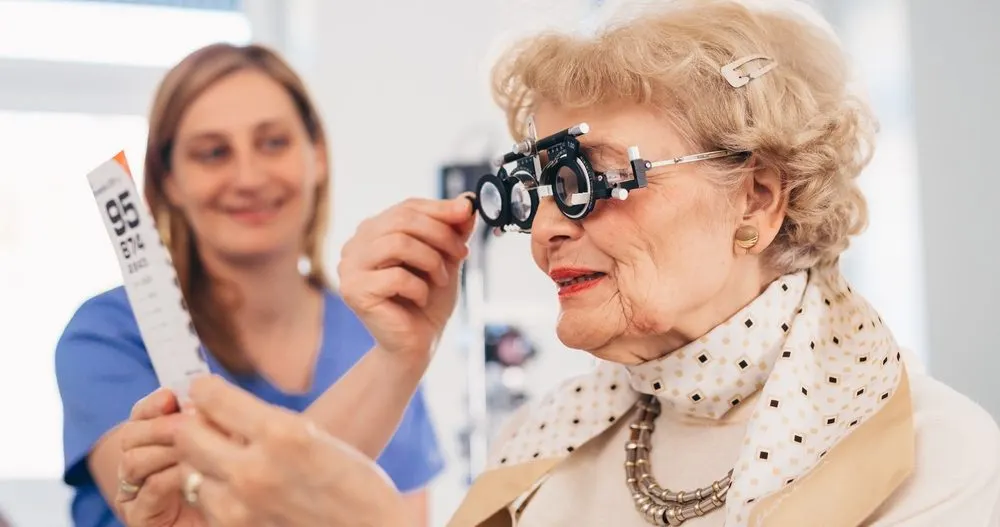
Low vision rehabilitation is a treatment procedure that aims to achieve better vision by improving the existing visual function of patients whose eyesight has decreased for various reasons. People with low vision can achieve better visual acuity through the rehabilitation process. Low vision rehabilitation can be beneficial in cases where vision is not completely lost, but visual acuity cannot be achieved with treatment methods such as glasses or lenses. "What is low vision?" "What is low vision rehabilitation and in which cases is it applied?" "How are low vision diagnosis and treatment carried out?" Detailed information about low vision and low vision rehabilitation, such as these questions, is provided in detail in the following sections of this article.
What Is Low Vision? What Causes It?
When vision impairment is mentioned, two general groups usually come to mind: those who cannot see at all and those who partially see. Low vision refers to vision loss in which some limited vision remains, and which cannot be corrected with treatment methods such as contact lenses, glasses, or surgery. Although it is often confused with blindness, low vision does not mean blindness. A person with low vision may be able to see objects from a distance of 2–6 meters, whereas a healthy person can see them from 6 meters.
Low vision can develop due to various causes. Although it can be seen in every age group, low vision is encountered more frequently in people of advanced age. In other words, advanced age is one of the main causes of low vision. Research shows that 1 in every 6 adults over the age of 45 has a low vision problem. The main known causes of low vision can be listed as follows:
Macular degeneration: Macular degeneration is an eye problem that occurs in the light-sensitive macula layer located at the back of the retina, where visual focusing takes place. Worldwide, macular degeneration is one of the leading health problems causing age-related vision loss. Macular degeneration can impair the eye's ability to see clearly, leading to blurred vision and visual impairment.
Cataract: This is the clouding of the transparent lens inside the eye. This condition can prevent light entering the eye from being properly focused on the retina, which may cause vision loss.
Glaucoma (eye pressure): When pressure increases inside the eye due to various causes, there may not be sufficient blood flow to the optic nerves. As a result, the nerves in the eye can be damaged and vision loss may occur. Glaucoma, or eye pressure, is a health problem in which increased pressure causes damage to the optic nerves.
Diabetic retinopathy: Diabetes, that is, diabetes mellitus, can damage tissues and nerves in the body. Due to diabetes, damage can also occur in the blood vessels that supply the retina. As a result, the retina may be damaged over time and vision loss may occur.
Retinitis pigmentosa (night blindness): Also known as "chicken blindness" or night blindness, retinitis pigmentosa is a hereditary disease in which night vision gradually decreases and the patient has difficulty seeing objects in the peripheral parts of the eye.
Amblyopia (lazy eye): This is an eye problem that arises when visual development during childhood does not occur as it should. Lazy eye, which is characterized by blurred vision in one or both eyes, cannot be easily corrected with glasses or contact lenses. Therefore, people with lazy eye may often need to benefit from low vision rehabilitation.
Traumatic brain injury: Low vision rehabilitation may also be applied to vision loss that occurs due to health problems such as head trauma, brain damage, and stroke.
If health problems that damage visual function, such as macular degeneration or retinopathy, are not treated in the early stages, they may cause permanent vision loss over time. For this reason, if you notice that your vision is no longer as sharp as before, do not neglect to make an appointment with a specialist ophthalmologist without delay and to have your check-ups done.
What Are the Symptoms?
People with low vision do not have complete vision loss; some vision is present, at least partially. However, people with low vision may experience certain difficulties in daily life compared to healthy individuals. The main symptoms of low vision can be listed as follows:
Vision impairment that does not improve with glasses or contact lenses,
Difficulty reading and writing,
Difficulty seeing the board in school-age children,
Eye deviation (squint) in infancy,
Difficulty recognizing faces,
Difficulty seeing while watching television,
Sensitivity to light,
Blurred vision,
The entire field of vision appearing as if covered with a film,
Inability to see near and distant objects clearly,
Difficulty seeing in poorly lit areas (night blindness),
Inability to see objects above, below, and/or to the side of the eye
In addition to those listed above, people with low vision may also experience difficulties during activities such as shopping and driving.
What Is Low Vision Rehabilitation?
Low vision rehabilitation is a treatment procedure that helps to develop and improve existing visual abilities in people whose normal eye function is not as it should be due to various causes. Thanks to low vision rehabilitation, people who experience vision loss can gain the ability to perform their daily activities without depending on others. The decision on how the rehabilitation process will be carried out is made by a specialist ophthalmologist based on factors such as the patient's individual needs and the severity of the vision loss. The main purpose of rehabilitation is to maximize the person's current visual potential and to develop their remaining visual abilities. For example, after rehabilitation, patients with low vision may experience fewer problems when performing activities that were difficult before rehabilitation, such as recognizing objects and faces, driving, following routes, and reading books. Starting rehabilitation in the early stages of vision loss significantly affects the chance of success of the treatment. For this reason, if you or your child notice low vision, do not neglect to make an appointment with a specialist ophthalmologist without delay and to have the necessary check-ups done.
For Whom Is It Applied or Not Applied?
Low vision rehabilitation is a treatment process that aims to improve the existing visual function in people who have a significant decrease in vision due to health problems such as macular degeneration, diabetic retinopathy, and head trauma. Additionally, for low vision rehabilitation to be applied, the patient must have limited vision, but vision cannot be achieved with treatment options such as glasses, lenses, and surgery. In cases of complete blindness, low vision rehabilitation may not yield positive results.
What Are the Diagnosis and Identification Methods?
Contrary to popular belief, a decline in vision with age is not a normal process. For this reason, when a decrease in vision is noticed, a comprehensive examination by a specialist ophthalmologist is necessary to investigate the cause and determine the correct treatment. The specialist doctor begins the examination by first evaluating the patient's medical history and the symptoms currently present. If the patient has a chronic health problem that may cause vision loss, such as diabetes, measures may need to be taken during the rehabilitation process to keep that health problem under control as well. During the examination, parts of the eye such as the retina and macula can be examined with special instruments, and the patient may be asked to read letters of different sizes at a certain distance to test visual acuity. If the patient has difficulty reading small letters or seeing distant objects, and also has difficulty with daily activities such as watching television or driving that cannot be corrected, the specialist ophthalmologist may recommend low vision rehabilitation to the patient.
What Are the Treatment Methods?
The treatment of low vision depends on the cause of the low vision. For this reason, specialists prepare a treatment plan tailored to the individual during the rehabilitation process. In low vision rehabilitation, certain devices may be used to increase the patient's vision and to ensure that they make the best use of their existing visual capacity. Chief among these are telescopes, microscopes, magnifiers, telemicroscopes, and electro-optic systems. The main treatment methods used in low vision rehabilitation are as follows:
Magnifiers: Magnifiers mounted on glasses are generally preferred to increase near-distance vision, such as for reading and writing.
Telescopic glasses: Telescopic glasses, which have the feature of magnifying the image, are mostly used to increase distance vision, such as for watching television.
Contrast-enhancing devices: Contrast devices improve vision by making objects more distinct.
Electro-optic systems: Thanks to today's developing technology, there are also devices specially designed for people with low vision among technological devices such as computers and phones.
The main goal of low vision rehabilitation is to enable individuals to become self-sufficient in daily life while increasing their existing visual capacity. Therefore, in addition to those listed above, there are also vision-aiding products today, such as large-print books and talking clocks, that make daily activities easier for people experiencing vision loss.
Early diagnosis is important in low vision. Failure to start low vision treatment in the early stages may lead to permanent vision loss or total blindness in patients at later stages. For this reason, if you or your relatives notice low vision, do not neglect to make an appointment with a specialist ophthalmologist and to have your check-ups done.