Lordosis is a condition that occurs when the natural curvature of your spine increases or decreases more than normal. The normal lordosis angle is between 40 and 60 degrees in the lumbar region and between 30 and 40 degrees in the cervical region. When these angles increase, hyperlordosis occurs, and when they decrease, straightening of lordosis occurs. You can find answers to questions such as what is lumbar lordosis, what is cervical lordosis, what is lordosis and how is it treated in this article. We will also examine in detail the relationship between kyphosis and lordosis, symptoms of decreased lordosis, and treatment methods.
What Are Lordosis Disorders?
Definition of Lordosis and Its Role in the Spine
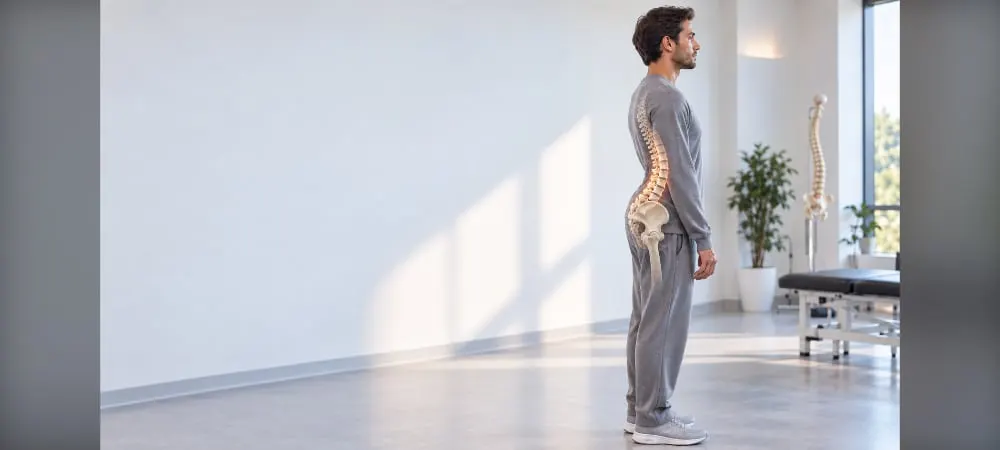
When viewed from the side, your spine has natural curvatures in the shape of an S. One of these curvatures is lordosis, which creates a forward curve in the lumbar and cervical regions. Lordosis ensures the equal distribution of loads in the biomechanics of the spine and balance during movement.
Thanks to this natural curve, stresses placed on your spine during activities such as walking, running, and weightlifting are better tolerated. It balances your weight, facilitates shock absorption, and supports healthy posture. Lordosis also protects the integrity of your musculoskeletal system by distributing the load on the intervertebral discs equally.
There are two main lordosis regions in the spine. Cervical lordosis is located in the C1-C7 vertebrae in the neck region, and lumbar lordosis is located in the L1-L5 vertebrae in the lower back region. Cervical lordosis is critical for balancing the weight of your head and supporting your neck movements. Lumbar lordosis is vital for absorbing your body weight during standing and walking.
Normal and Abnormal Lordosis Curves
For your spine to be considered healthy, your lordotic curvature must be at certain angles. A curve of approximately 20-40 degrees in the cervical region and approximately 40-60 degrees in the lumbar region is considered normal. An angle of 20-45 degrees in the lumbar region is also within normal limits.
When the normal lordotic curve is preserved, your spine functions healthily. However, an increase in the curve can lead to hyperlordosis, while a decrease or straightening can lead to postural and functional problems. Especially when the lordosis angle goes beyond normal values, various biomechanical problems arise.
An abnormal lordosis curve develops when the 30 to 40 degree curve in the neck region is exceeded or the 40 to 60 degree curve in the lower back region is exceeded. This abnormality can cause poor posture, pain, and loss of function.
What Is Hyperlordosis?
Hyperlordosis is the increase of the curvature in the lower back above 60 degrees. Also referred to as an increased lower back curve, this condition means that lordosis exceeds the ideal angle and curves excessively inward. It is also popularly known as "duck walk" or swayback.
Excessive curvature can pave the way for your abdomen to protrude, muscle imbalances, and lower back pain. In case of hyperlordosis, your lower back curve deepens and your abdominal area appears to protrude forward. Increased lumbar lordosis can trigger joint, disc, and ligament problems due to the excessive load placed on your vertebrae.
What Is Straightening of Lordosis?
Straightening of lordosis is defined as the loss of the natural curvature of your spine. While the spine naturally has a slightly curved structure, in straightening of lordosis, this curve disappears and your spine takes on a straight shape.
Hypolordosis is the condition where the curvature drops below the 40-degree curve. Straightening of cervical lordosis can lead to tension in your neck muscles, headache, restriction in your neck movements, and the risk of nerve compression. Straightening of lumbar lordosis reduces your body's shock absorption capacity and can be one of the most common causes of chronic lower back pain by placing excessive load on your lower back muscles.
Types of Lordosis Disorders
Lordosis disorders can occur in different regions of the spine. Each region has its own unique characteristics and effects. When lordosis types in the lower back and neck regions are evaluated together with other spinal curvatures such as kyphosis and scoliosis, a more comprehensive picture emerges.
What Is Lumbar Lordosis?
Lumbar lordosis is the natural curvature formed by the vertebrae in your lower back region. Five vertebrae between L1 and L5 located in the lower back part form this curvature. The slight forward curve of your vertebrae allows you to move your lower back easily.
This concave curve in the lower back region helps balance your body weight and facilitates movement. While walking, running, or lifting weights, lumbar lordosis balances the load distribution on the spine. Therefore, it prevents excessive tension or pressure on your muscles, ligaments, and discs.
Straightening of lumbar lordosis means the disappearance of the curve in the lower back region. A sedentary lifestyle, excess weight, falls, or desk work can cause your lower back muscles to tense. On the other hand, excessive increase in lumbar lordosis creates the condition of hyperlordosis and is associated with obesity, pregnancy, or weakness in the abdominal muscles.
What Is Cervical Lordosis?
Cervical lordosis is the natural curve of the spine in your neck region. Seven vertebrae between C1 and C7 located in the neck form this curvature. This curve ensures that your head remains balanced and your neck movements are performed smoothly.
The curvature in the neck region creates an inward concave curve forward, similar to the letter C. It helps balance the weight of your head. It also plays a critical role in load distribution and shock absorption in the biomechanics of your spine.
Straightening of cervical lordosis is the condition where your neck curve decreases or disappears. Working at a desk, poor posture, looking at a phone or computer for a long time can lead to this straightening. Similarly, increased cervical lordosis means that the neck curve is more than 20 degrees.
What Are Kyphosis and Lordosis?
Your spine includes a forward curve called lordosis in the lumbar region and a backward curve called kyphosis in the upper back region. Kyphosis refers to the greater than normal backward curve in the thoracic region of the spine. It is popularly known as a humpback.
Lordosis and kyphosis together form the natural S-shaped structure of your spine. There is a slight hollow in the neck and lower back region, and a slight hunch in the back region. This balanced structure is necessary for your spine to function healthily.
What Is Lordosis Kyphosis Scoliosis?
Scoliosis is the sideways curvature of the spine by more than 10 degrees. While lordosis and kyphosis are front-to-back curves, scoliosis is a curve that occurs sideways. It is one of the most common deformities in the spine.
Poor posture, unilateral leg length discrepancy, or carrying unbalanced weight can cause scoliosis. For example, carrying a heavy bag or purse with only your right arm causes imbalance in your spine. People with scoliosis are often not even aware of this condition and notice the abnormality in their spines upon warnings from others.
What Are the Symptoms of Lordosis Disorders?
Lordosis symptoms vary from person to person and may appear mildly or prominently depending on the degree of curvature. Complaints may increase especially after standing or sitting for a long time. Over time, not only the lower back region but also surrounding muscle groups are affected.
Symptoms Seen in the Lower Back and Neck Regions
A pronounced inward curve in the lower back region is the most visible symptom of lordosis. You experience lower back pain after standing for a long time. The pain is usually felt as a dull and aching sensation in the lower part of the waist. If cervical lordosis is present, this pain can spread to your neck, shoulders, and upper back.
You may notice that there is more space than normal between the lower part of your back and the surface during lying down or leaning against a wall. Hips that turn forward or protrude can draw visual attention. In addition, aesthetic concerns may come to the forefront in some individuals.
Movement Restriction and Postural Disorders
You experience significant restriction in your movements. You have difficulty bending forward or backward. You feel stiffness in your lower back, especially in the mornings or after remaining in the same position for a long time. Your lower back pain may worsen during movement.
Changes in your posture become noticeable from the outside. You have difficulty standing straight and display a slightly forward-leaning posture. The individual's capacity of the body to stand straight decreases. Body mechanics are disrupted and the spinal canal can be narrowed.
Muscle Pain and Tension
Tension develops in your lower back and hip muscles. You experience muscle spasms. Your muscles around the lower back contract involuntarily due to excessive tension. While your abdominal muscles weaken, your hip muscles tighten.
Feelings of fatigue are common. Since your body constantly makes extra effort to balance the abnormal posture, general fatigue and exhaustion occur. Similarly, you feel constant pain due to the tension formed in the muscles.
Neurological Symptoms
Numbness or tingling symptoms may develop. This is felt especially in areas with curvature. If the pressure caused by straightening on the discs between the vertebrae increases, nerve roots can be affected. Therefore, your pain can spread to your hips, the back of your thighs, and your legs.
You may experience electric shock-like pains. Neurological problems may occur due to pressure on the spinal cord or nerve roots. In some cases, even bladder or bowel difficulties can be seen.
Causes of Lordosis Disorders
Both structural and environmental factors play a role in the development of lordosis disorders. Your daily life habits, muscle imbalances, and certain health problems can trigger this condition. A sedentary lifestyle is a particularly important risk factor. While some causes are temporary, others can lead to permanent changes.
Poor Posture and Lifestyle Factors
Long-term poor posture habits can disrupt the natural curves of your spine and contribute to the development of lordosis. Sitting leaning forward all day long or staying at a desk for long hours can cause excessive inward curving in your lower back region. Non-ergonomic working conditions and unconscious posture positions while working at a computer can lead to lower back pain and movement restriction over time.
Sitting or standing in the wrong position disrupts the natural alignment of your spine. Working by constantly leaning forward can increase the curvature in the lower back region. People working desk jobs are under this risk.
Obesity and Excess Weight
Your excessive body weight can place additional load on your spine and disrupt its natural alignment. Excess adipose tissue accumulated in the abdominal region can cause your pelvis to tilt forward and excessive inward curving in the lower back region. This condition is seen in individuals with intense fat accumulation in the abdominal region.
These mechanical changes create pressure on the lower part of your spine and lay the groundwork for the development of lordosis. Every kilogram lost significantly reduces the pressure on your lumbar spine.
Pregnancy Period
The expanding uterus during pregnancy can cause your center of gravity to shift forward, creating an extra curve in the lower part of your spine. Your body leads to an inward curve in the lower back region in an effort to maintain balance. Temporary weight and abdominal load increase your lower back curve.
This condition usually resolves after pregnancy, but may become permanent in some women. Hormonal changes and increased weight in the abdominal region create extra load on the lower back region.
Muscle Imbalances and Weakness
Imbalances in strength and flexibility between your abdominal and lower back muscles can affect the natural curvatures of your spine. Weak abdominal muscles and tight lower back muscles can cause your pelvis to tilt forward, increasing the lordotic curvature. This condition is frequently seen in individuals who do not exercise regularly.
Your weak abdominal and back muscles cannot support your spine. Muscle imbalances can lead to postural disorders and lower back pain.
Congenital Structural Disorders
Some individuals may be more prone to the development of lordosis due to genetic predisposition. The likelihood of similar postural disorders increases in individuals with a family history of spinal curvatures. Your spine structure may be born differently than normal.
Congenital spinal anomalies can prevent the proper development of the spine. Some individuals naturally have a prominent lower back curve.
Trauma and Injuries
Traumas or injuries occurring in the spine can disrupt your spinal alignment and cause the development of lordosis. Spinal fractures or disc problems can affect the natural curvatures of your spine, leading to abnormal postures. Traffic accidents, falls, or sports injuries can trigger the development of lordosis.
If such injuries are not treated appropriately, chronic pain and movement restrictions may occur.
How Is Diagnosis and Treatment of Lordosis Disorders Performed?
When you notice an abnormal curvature in your lower back or neck, you need to consult a specialist physician. The diagnostic process begins with listening to your complaints, a physical examination, and imaging methods if deemed necessary.
Physical Examination and Posture Analysis
Your doctor first listens to your medical history and evaluates your complaints. Then, they examine the shape of your spine by asking you to stand and bend forward. If the abnormality in the lower back curve is visible enough to be seen with the naked eye, the first symptom for diagnosis is obtained. Your shoulder and hip alignment, spinal curvatures, lower back space, muscle strength, and flexibility are evaluated. During posture analysis, the curvature of your spine is examined in detail.
Imaging Methods
X-rays show your lordosis angle and spinal alignment. By measuring the angle of your lumbar spine on a standing lateral X-ray film, it is clearly determined whether normal lordosis has decreased or not. MRI reveals your soft tissues and nerve root compression. Especially when nerve compressions are suspected, an MRI can be taken for detailed examination. CT shows your bone details. Thus, the angle between the vertebrae, disc disorders, or possible nerve compressions can be detected.
Physical Therapy and Exercise Programs
Physical therapy plays a critical role in the treatment of lordosis. Exercises performed under expert guidance to strengthen your muscles and correct your posture can be extremely beneficial. With personalized exercise programs performed under the supervision of a physiotherapist, your weak abdominal and back muscles are strengthened. Your tight hamstring and hip muscles are stretched. Manual therapy techniques can help increase your joint mobility and resolve your muscle spasms.
Drug Therapy and Brace Use
Medications used to relieve your pain and inflammation provide temporary relief. Painkiller and muscle relaxant treatments can be used. The use of a brace contributes to supporting your spine. It can be recommended as a short-term support, especially in young patients or to halt progression.
Surgical Intervention
Surgical procedures are considered as a last resort. If there is a severe structural disorder or advanced nerve compression in your spine, surgical methods may come to the agenda. Surgery is usually applied in cases where medications or physical therapy are insufficient.
Ways of Prevention
Acquiring a good posture habit is the main way to protect against lordosis. It is important not to remain in the same position for a long time, to exercise regularly, and to strengthen your lower back and abdominal muscles. Using appropriate mattresses and chairs, avoiding excess weight, and creating an ergonomic working environment provide protective effects.
Frequently Asked Questions About Lordosis Disorders
Patients ask many questions about lordosis. Let's answer the most frequently curious topics.
Can Lordosis Disorder Be Seen at Any Age?
Yes, lordosis can be seen in both children and adults. It can occur due to postural disorders, especially in children of growing age and in older ages. Symptoms may vary according to age groups. Lower back stiffness can be experienced when getting out of bed in the morning in young individuals. In children, the prominence of the lower back or neck region is among the symptoms of lordosis.
What Is Decreased Lordosis and How Is It Understood?
Straightening of lordosis is the loss of the natural curvature of the spine. Its occurrence in the lower back part is known as straightening of the lower back. When the natural curve in the lower back region begins to decrease more than normal, the appearance of the lower back hollow changes significantly. Straightening of lordosis can be easily diagnosed with physical examination and imaging results obtained when necessary.
Does Lordosis Improve with Sports?
Regular sports and exercise can help improve lordosis and alleviate its symptoms. Especially exercises strengthening the abdominal and back muscles support spine health. However, since heavy or incorrect sports activities can worsen lordosis, expert guidance is important. Receiving professional support is recommended.
When Is Lordosis Surgery Required?
Surgery is usually applied in cases where medications or physical therapy are insufficient. It is performed in the case of advanced nerve compression and if the individual's pains are severe. Surgery is a method applied as a last resort.
How Do I Know If I Have Lordosis?
If your hand easily slides under your lower back when you lie on your back and there is extra space, you may have lordosis. It can be noticeable when the lower part of the back protrudes abnormally forward while standing.
What Is Lordosis and How Is It Treated?
Lordosis is the inward curving of the lower back or neck region of the spine. Treatment is applied according to the angle and region of lordosis. Exercise, physical therapy, and methods aimed at correcting posture disorder are applied.
Lordosis Disorders in Summary
The natural curvature in your spine is of vital importance for the balance of your body. When you notice an abnormal curving in your lower back or neck region, you should go to a specialist check-up to increase your chance of early diagnosis. Especially regular exercise, correct posture habits, and weight control play an effective role in protecting you from lordosis.
Treatment options usually yield successful results with physical therapy and exercise. Surgical intervention is only required in severe cases. Therefore, making small changes in your lifestyle for a healthy spine will make a big difference in the long run. Invest in your spine health starting today.
Fill Out the Form for Detailed Information and Communication!
Start with the right assessment for What Are Lordosis Disorders? What Are the Symptoms? How Is It Diagnosed and Treated?
Share your symptoms with our specialist physicians; let us determine the right diagnosis and treatment plan together.
Warning
If your symptoms started suddenly, are progressing rapidly, or significantly restrict your daily life, consult a physician without delay.
Plan your What Are Lordosis Disorders? What Are the Symptoms? How Is It Diagnosed and Treated? journey with our specialists.
Fill in the form or book an appointment to learn about treatment options, the process and preparation.