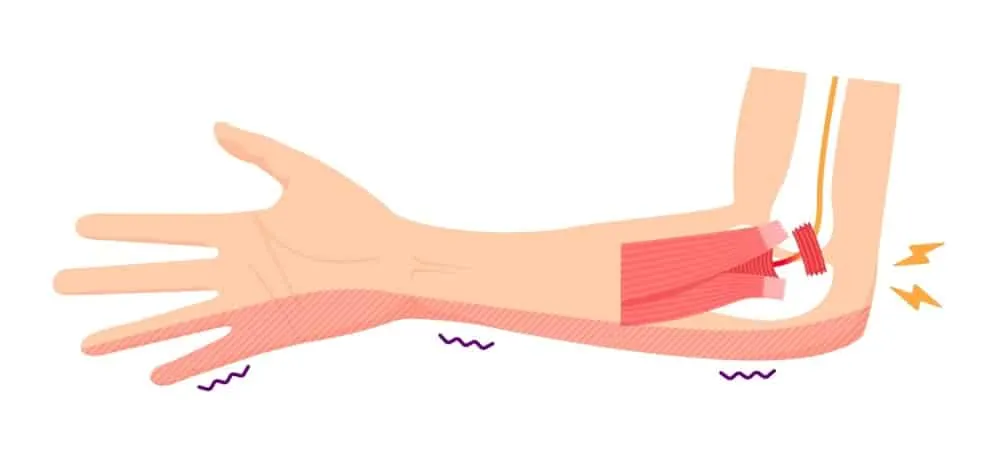
Manifesting with complaints such as numbness, tingling, and loss of strength around the elbow, cubital tunnel syndrome is a condition that occurs due to the compression of the ulnar nerve. Passing particularly through the inner side of the elbow, this nerve controls certain hand muscles and also manages the sensation in the ring and little fingers. If this nerve is under pressure, both the quality of daily life may decline and permanent nerve damage may occur in later stages. This condition can be prevented thanks to cubital tunnel syndrome treatment methods.
What is Cubital Tunnel Syndrome?
Cubital tunnel syndrome is a type of neuropathy that occurs as a result of the compression of the ulnar nerve in the elbow region. This condition develops when the ulnar nerve remains under pressure within a narrow passageway called the cubital tunnel behind the elbow. The ulnar nerve is an important nerve starting from the spinal roots in the neck region, extending along the arm, and providing sensation to the fourth and fifth fingers of the hand.
The cubital tunnel is a natural anatomical structure located between the bony prominences inside the elbow. This tunnel is surrounded by the medial epicondyle, olecranon, and ligaments. Under normal conditions, the ulnar nerve can move freely within this tunnel, but when this area narrows due to various factors, pressure occurs on the nerve. This syndrome is the second most common peripheral nerve compression condition after carpal tunnel syndrome. It is more commonly seen especially in individuals aged between 40-60 and shows a slight increase in men compared to women. It also holds an important place among occupational diseases.
What Are the Symptoms of Cubital Tunnel Syndrome?
Cubital tunnel syndrome symptoms usually appear gradually and manifest as mild discomforts at first. The most characteristic symptom is the tingling and numbness felt in the fourth and fifth fingers of the hand. This condition becomes more pronounced especially at night or after keeping the elbow in a bent position for a long time.
Pain symptoms also appear with the progression of the disease. This pain usually starts from the inner part of the elbow and radiates towards the edge of the hand. Sometimes the pain may also travel upwards along the arm. Complaints increase especially during activities such as talking on the phone, bending the elbow while reading, or using a keyboard. Among motor symptoms, weakness in the hand muscles plays an important role. Difficulty is experienced in fine motor skills, especially because the small muscles inside the hand are affected. Difficulty is encountered in delicate movements such as holding objects, buttoning shirts, and writing. In advanced stages, muscle wasting can be seen between the fingers, and this condition changes the appearance of the hand. In some patients, tenderness and hypersensitivity to touch develop inside the elbow. This condition is particularly prominent in the cubital tunnel region where the nerve passes. Additionally, an increase in symptoms during cold weather is also a characteristic finding.
What Causes Cubital Tunnel Syndrome?
Cubital tunnel syndrome causes are varied and generally develop depending on anatomical, traumatic, or systemic factors. The most common cause is keeping the elbow bent for a long time. This situation is frequently seen in desk workers, during phone calls, or during sleep.
Anatomical causes include a congenitally narrow cubital tunnel, extra muscle bands, or bone spurs. Traumatic causes can include elbow fractures, dislocations, and direct traumas. Anatomical changes occurring especially after previously experienced elbow fractures can create chronic pressure on the nerve. Furthermore, soft tissue injuries in the elbow region can also affect nerve functions.
Occupational and lifestyle factors are significant risk elements. Professions that require keeping the elbow in a bent position for a long time, workers performing repetitive movements, and individuals working constantly leaning on their elbows are at risk. Especially computer users, operators, and artisans performing delicate handwork have a high risk of developing this syndrome. Systemic diseases can also contribute to the development of cubital tunnel syndrome. Conditions such as diabetes, kidney diseases, thyroid disorders, and arthritis affect nerve functions and create a predisposition to compression syndromes. Moreover, the loss of tissue elasticity with advancing age is also considered a risk factor.
How is Cubital Tunnel Syndrome Diagnosed?
Cubital tunnel syndrome diagnosis is primarily made through a detailed anamnesis and physical examination. The physician questions in detail the patient's complaints, the onset pattern of the symptoms, and the situations in which they increase and decrease. Occupation, hobbies, and past traumas are important anamnesis information. During the physical examination, various provocation tests known as cubital tunnel syndrome tests are applied.
The Tinel test evaluates whether a tingling sensation occurs in the 4th and 5th fingers upon gently tapping the cubital tunnel region. In another method similar to the Phalen test, the elbow is bent as much as possible and waited in this position for about 1 minute. If complaints such as numbness, tingling, or pain in the hand arise during this time, it is evaluated as a finding indicating that the nerve is compressed.
Electrophysiological tests are the gold standard methods to confirm the diagnosis. Nerve conduction studies and electromyography (EMG) tests evaluate nerve functions objectively. These tests provide information about the degree of nerve damage, localization, and prognosis. Cubital tunnel syndrome EMG findings include a slowdown in the ulnar nerve conduction velocity and findings of deterioration in the muscle nerves.
Among imaging methods, ultrasonography is gaining increasing importance. With high-resolution ultrasonography, the thickness of the nerve, tunnel dimensions, and surrounding tissues can be evaluated. MRI is particularly useful in demonstrating bone structure anomalies and soft tissue pathologies. If you also have these and similar complaints, you may have cubital tunnel syndrome. To avoid neglecting it, consult our orthopedics and traumatology physicians as soon as possible.
Do not neglect your health. If you are also experiencing numbness, tingling, or loss of strength around the elbow, consult our Hisar Hospital Orthopedics and Traumatology specialists without wasting time. You can protect your quality of life by making an appointment for early diagnosis and correct treatment.
Start with the right assessment for What is Cubital Tunnel Syndrome? Symptoms, Causes, and Treatment Methods
Share your symptoms with our specialist physicians; let us determine the right diagnosis and treatment plan together.
Warning
If your symptoms started suddenly, are progressing rapidly, or significantly restrict your daily life, consult a physician without delay.
Plan your What is Cubital Tunnel Syndrome? Symptoms, Causes, and Treatment Methods journey with our specialists.
Fill in the form or book an appointment to learn about treatment options, the process and preparation.