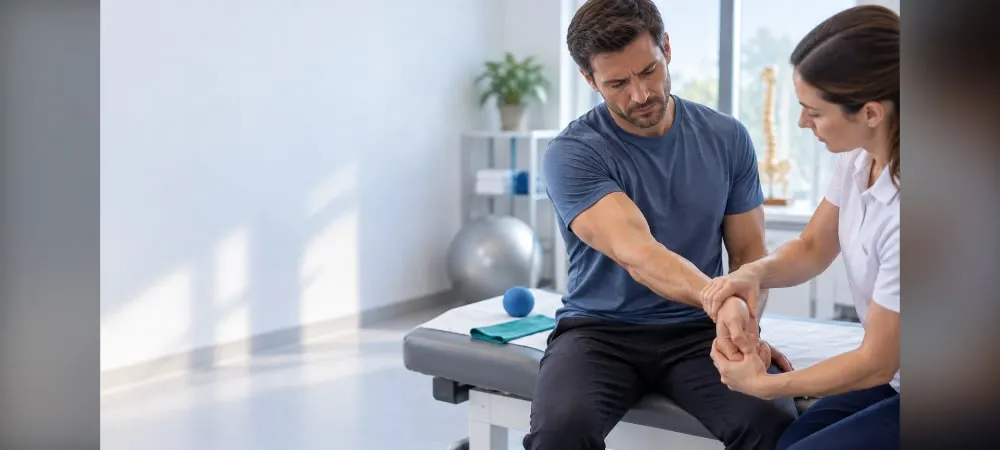
Golfer's elbow is one of the common causes behind the pain and tenderness you feel on the inner side of your elbow. Affecting individuals particularly between the ages of 45-65, this condition is more common in women. Contrary to its name, it can affect anyone who performs repetitive hand and wrist movements, not just golfers. In this article, we will discuss topics such as what golfer's elbow is, its symptoms, how the diagnostic process works, and what the treatment options are. Additionally, you will find information about golfer's elbow exercises and preventive approaches.
What is Golfer's Elbow (Medial Epicondylitis)?
Medial epicondylitis is defined as a musculoskeletal issue that occurs as a result of inflammation of the tendons on the inner part of your elbow. Tendons are tough cords of tissue that attach your muscles to your bones. Golfer's elbow develops when damage occurs at this attachment point of the muscles that bend your wrist toward your palm.
This disorder is a type of tendinitis. When you move your wrist and arm in the same way repeatedly, tiny tears can form in the tendons. Over time, these tears accumulate, leading to inflammation and pain. Due to the overuse of the flexor muscle group on the inner side of the elbow, edema occurs where the tendons attach to the bony prominence on the inner part of the elbow joint.
The pain generally radiates from the inner part of your elbow toward your forearm. In advanced cases, this discomfort can extend down to your wrist and fingers. If correct treatment is not applied, you may experience chronic pain and restricted movement.
In Which Situations Does It Occur?
Golfer's elbow occurs when you apply excessive force to bend your wrist toward your palm. Although the sport of golf gave this condition its name, it can develop due to many different activities. Delivering a powerful serve or using a spin serve in tennis, participating in javelin throwing, and lifting weights are among the sports activities that cause this condition.
Aside from sports, the tasks you perform in your daily life also pose a risk. If you perform continuously repeating movements such as using a keyboard and mouse, your probability of developing golfer's elbow increases. Activities such as carpentry, carrying heavy suitcases, cutting wood with an axe, using a chainsaw, and frequent use of hand tools can also strain your tendons.
Using incorrect technique can trigger the problem. If you have weak shoulder and wrist muscles or if you use equipment that is too tight, too short, or heavy, the pressure on your tendons increases. Therefore, choosing the right equipment and technique plays an important role in protecting against this condition.
Who Does It Affect?
Golfer's elbow generally occurs in the dominant arms of patients. If you use your right hand, it is more likely to appear in your right elbow; if you use your left hand, in your left elbow. This situation stems from using your dominant arm more frequently.
Compared to tennis elbow, medial epicondylitis occurs approximately 10 times less frequently. Nevertheless, certain occupational groups and athletes are at higher risk. Golfers, tennis players, and baseball players encounter this condition more frequently. Construction workers, carpenters, and individuals working in jobs requiring continuous hand-wrist movement are also in the high-risk group.
Anyone who frequently uses their wrist and fingers with repetitive movements can develop golfer's elbow. This issue can even be seen particularly in people who write. It is known that the rate of development is higher in women.
What Are the Symptoms of Golfer's Elbow?
Symptoms of golfer's elbow generally appear gradually. Initially, a mild ache that you feel only during activity can turn into a constant pain over time. Your symptoms can vary from mild, moderate, to severe levels. Medial epicondylitis can appear suddenly or develop slowly within days or weeks.
Pain on the Inner Side of the Elbow
The most prominent symptom among golfer's elbow symptoms is the pain you feel in the bony prominence located on the inner side of your elbow. This pain is concentrated on the inner side of the elbow and can radiate toward the inner part of your forearm. In some cases, the pain extends all the way to your wrist.
Your pain increases when you squeeze an object, bend your wrist downward, or rotate it inward. Your elbow pain becomes prominent when you make a fist, squeeze a small rubber ball, or lift a heavy object. Your daily activities such as gripping, lifting, opening a door, or shaking hands can become painful.
Tenderness and Stiffness
When you touch the medial epicondyle region on the inner part of your elbow, you feel distinct tenderness. This tenderness is concentrated especially over the bony prominence.
A feeling of stiffness develops in your elbow or forearm. You may experience elbow stiffness and limited movement in the mornings. You notice stiffness when moving the elbow. You may feel discomfort during full bending or straightening of your elbow. A feeling of tension and fatigue can occur in your forearm muscles.
Decrease in Grip Strength
You experience weakness in your finger and wrist movements. Difficulty during object gripping or a decrease in your holding strength may be observed. A feeling of weakness develops in your hand and wrist muscles.
Your pain increases while squeezing an object, bending your wrist forcefully, or rotating your palm to face the ground. Especially in chronic cases, meaning if the problem persists for a long time, the decrease in your grip strength becomes more pronounced.
Numbness and Tingling Sensation
The ulnar nerve passes through the inner side of your elbow. In about 20% of athletes with medial epicondylitis, numbness and tingling symptoms related to ulnar nerve injury are present.
You may experience a numbness or tingling sensation in your fingers, particularly the ring finger and little finger. This is a symptom of ulnar nerve entrapment, namely cubital tunnel syndrome. Numbnesses can increase during night sleep to a level that wakes you up. In advanced cases that are not treated, not only is sensory loss experienced, but muscle wasting also begins because the motor signals going to the small muscles inside the hand are cut off.
What Causes Golfer's Elbow?
The answer to the question of what causes golfer's elbow starts with repetitive stress and overloading applied to your tendons. When your forearm muscles contract, they pull on these tendons. If these forces are very strong and occur very frequently, they cause your tendon to swell. Medial epicondylitis is not an acute inflammatory process, but a chronic degenerative tendinopathy. Your treatment approach is concerned not only with reducing inflammation, but also with supporting tendon healing.
Repetitive Movements and Overuse
Golfer's elbow develops when you use your forearm muscles for a long time without resting. Frequently repeating activities involving gripping, lifting, pulling, or bending creates damage in your tendons. When you perform these movements, your muscles pull on the tendons. The forces lead to micro-tears, degeneration, and pain at the bone attachment site.
The appearance of symptoms can take weeks or months. Over time, small tears accumulate. If you do not eliminate this strain in time, small tears and deterioration appear right where the tendons attach to the bone. Consequently, a painful condition develops on the inner part of your elbow.
Occupational factors pose a risk. Jobs requiring repetitive hand or wrist movements, such as carpentry, plumbing, or keyboard use, can increase the risk. Butchers and individuals using keyboards for long periods become prone to this condition by excessively using their wrist and forearm muscles. Continuous gripping, bending, and squeezing movements can cause micro-tears and inflammation at the muscle-tendon junction points.
Sports-Related Causes
Sports such as golf, tennis, and baseball place excessive load on your elbow, especially when performed with incorrect technique. Tennis players who have a technique where the racket stays behind the elbow at the moment of contact with the ball are at risk. Similarly, the problem is also seen in tennis players whose forehand stroke techniques are weak.
Throwing sports strain your tendons. Activities such as baseball pitching and javelin throwing cause repetitive strain. Weightlifters are also in the high-risk group. When the movement of bending the elbow and rotating the wrist inward is performed excessively in golf players, stretching occurs in the tendons first.
Failing to perform adequate warm-up exercises while doing sports triggers the problem. When you skip the pre-training preparation phase, your tendons are exposed to sudden load. This situation lays the groundwork for tissue damage.
Incorrect Technique and Equipment Use
Using incorrect technique places more load on your tendons. Incorrect grip of the racket while playing tennis or errors made in gripping the golf club can cause your forearm muscles to work excessively and the tendons to be strained. Movements you make during weight lifting by bending your wrist or holding it in an incorrect position create repetitive stress in the tendons.
Equipment selection plays an important role. Tennis athletes who use heavy and short-length rackets may develop golfer's elbow. Not using a vibration dampener in the tennis racket increases the risk. Excessive load on the hand and wrist while lifting heavy objects strains the muscle-tendon connections on the inner part of the elbow.
Poor conditioning can be listed among the triggering factors. If your shoulder and wrist muscles are weak, the load on your elbow increases. As you age, your tendons become less flexible and more prone to injury. Applying excessive pressure to the inner part of your elbow as a result of a fall, impact, or sudden blow leads to damage in the tendons.
How is Golfer's Elbow Diagnosed?
Diagnosis of golfer's elbow is largely made by the physical examination performed by your doctor. Imaging methods are generally not needed in the initial stage. Your doctor primarily makes an evaluation based on the history and symptoms you describe.
Physical Examination
During the diagnostic process, your doctor learns about your work and sports history, which activities you perform, and the severity of your pains. Then, they perform a physical examination to evaluate the tenderness of your wrist, arm, and elbow. The most important step of the examination is palpation, meaning your doctor examining the area with their fingers.
The most typical finding of golfer's elbow is the detection of clear tenderness just below the bony prominence inside your elbow, approximately one fingertip down and slightly forward. This point is where the problematic tendon attaches to the bone. In the majority of patients, maximum tenderness appears approximately 5 mm distal and at the midpoint of the medial epicondyle. Tenderness is observed in the medial epicondyle region on the inner part of the elbow during physical examination.
During the examination, it is also definitely investigated whether there are other problems that may accompany it. Specifically, the condition of the ulnar nerve passing right behind your elbow is checked. Swelling and an increase in temperature may also be observed in the area.
Imaging Methods
In a typical case of golfer's elbow, imaging methods such as X-rays or MRI are generally not necessary for diagnosis. However, it may be necessary to resort to these methods in some special cases. An X-ray can be requested to check whether there is bone damage. Routine radiography is usually normal in newly onset cases. However, soft tissue calcification adjacent to the epicondyle can be observed in 20-25% of patients.
MRI can be performed to evaluate the degree of damage or inflammation in the tendons. Edema is seen around the epicondyle on MRI images. Ultrasound can be utilized to learn the condition of soft tissues and tendons. Musculoskeletal ultrasound evaluation has 95.2% and 92% sensitivity and specificity in diagnosing golfer's elbow, respectively.
Resistance Tests
Some special tests are performed to confirm the diagnosis. Your doctor may ask you to place your arm on the table with the palm side facing up and lift your hand by bending your wrist against resistance. In the presence of golfer's elbow, pain is generally felt on the inner side of your elbow.
In another test, the patient is asked to apply resistance against wrist flexion. It is accepted as positive with pain in the medial epicondyle. Similarly, resistance against forearm pronation shows test positivity with pain in the medial epicondyle. Your doctor stabilizes your humerus and simultaneously palpates the medial epicondyle, then passively supinates your forearm, extends it from your wrist, and fully extends the elbow. If you complain of sudden pain in the medial epicondyle, this test is positive.
Golfer's Elbow Treatment and Exercises
In the treatment of golfer's elbow, more than 90% of patients achieve recovery with non-surgical methods. Your treatment process starts with stopping or reducing the activities causing pain. It is recommended to rest your hand, arm, and wrists for at least six weeks.
Rest and Ice Application
First of all, you need to avoid repetitive movements that increase pain. Stopping activities for approximately 6-12 weeks is the first step of treatment. Ice application is an effective method to relieve pain and reduce swelling.
You can apply a cold compress 3-4 times a day for 15-20 minutes. Apply the ice pack or ice massage to the painful area of your elbow. It is recommended to use a damp towel to prevent direct contact of the ice with your skin.
Drug Treatment
Anti-inflammatory drugs reduce pain and inflammation. You can use pain-relieving medications recommended by your doctor. Nonsteroidal anti-inflammatory drugs (NSAIDs) help control pain.
In severe cases, corticosteroid injections can provide short-term relief in acute pain. Additionally, PRP (Platelet Rich Plasma) treatment is used as a modern method supporting tendon healing.
Physical Therapy and Exercises
Physical therapy is the cornerstone of golfer's elbow treatment. Correct and progressive loading is performed in order to reorganize the structure of your tendon and regain its strength. Stretching exercises stretch your shortened forearm muscles and reduce the passive tension placed on the tendon.
Strengthening exercises are particularly important. Eccentric strengthening exercises are at the center of treatment. You can perform wrist flexion and extension exercises with weights or a resistance band. Methods such as manual therapy, deep friction massage, and ultrasound help reduce pain.
Support and Brace Use
The use of an elbow bandage or strap reduces the pressure on the tendon. The forearm band alleviates pain by distributing the load on your elbow. The use of a night splint is also beneficial during the treatment process.
It is recommended to wear the epicondylitis band approximately 2.5 cm below your elbow. Position it so that it will squeeze lightly but not obstruct blood circulation.
Surgical Intervention
Surgery is always the last option. If your pains continue despite trying non-surgical treatment methods lasting at least 6 months, sometimes 1 year, surgery can be considered. During surgery, damaged tendon tissue is cleaned and ulnar nerve decompression is performed if necessary.
Golfer's elbow mostly heals without requiring surgery. Surgery can be applied in cases unresponsive to conservative treatment lasting 3-6 months.
Preventive Approaches
Strengthening your arm muscles is important in prevention. Do not neglect to stretch your muscles before activity. Use correct equipment and check your form. Take regular breaks in activities requiring repetitive movements. Try not to overuse your elbow and apply correct techniques when lifting something.
Frequently Asked Questions About Golfer's Elbow
How Long Does Golfer's Elbow Take to Heal?
Recovery time varies depending on the severity of the condition and your compliance with treatment. In mild cases, recovery can be seen within 4-8 weeks with rest, ice application, and exercises. When correct treatment is applied, most people return to normal within 6-12 weeks.
In general, the treatment duration can last from 6 weeks to 6 months. Severe situations can take several months. This period may be prolonged in chronic cases. Recovery differs from person to person, based on the seriousness of symptoms and compliance with the treatment program.
Symptoms generally develop slowly. It first starts with a mild feeling of discomfort, but as repetitive movements continue, the pain increases. In some people, symptoms appear slowly within weeks or months.
Does Golfer's Elbow Go Away on Its Own?
Mild cases may pass by reducing activity and resting. However, most of the time symptoms persist or recur. If left untreated, pain can become chronic, elbow movement restriction may increase, and it can lead to serious difficulties in daily life.
In advanced cases, weakness in the wrist and forearm muscles can become permanent, and surgical intervention may be required. A correct rehabilitation program is important for permanent recovery. Therefore, rather than just waiting, starting treatment in the early period is a smarter approach.
What is the Difference Between Golfer's Elbow and Tennis Elbow?
Golfer's elbow affects the inner part of the elbow, while tennis elbow affects the outer part of the elbow. Both conditions are types of tendinitis but involve different tendons. Tennis elbow is referred to as lateral epicondylitis, whereas golfer's elbow is seen in medial epicondylitis.
At their core, they are the same disease. The only difference is the location of occurrence. While the muscle group tears from the inner side in one, the muscle group tears from the outer side in the other. The treatment processes of both disorders are similar, but the pain points are different. Specifically, tennis elbow occurs approximately 7 to 10 times more frequently than golfer's elbow.
Which Doctor Should Be Consulted for Golfer's Elbow?
You should consult the orthopedics and traumatology or physical medicine and rehabilitation department for golfer's elbow. If your pain continues despite rest and home treatments, you should go to your doctor. If you are experiencing severe pain, swelling, or difficulty moving your elbow, specialist evaluation is definitely required. Do not neglect to seek medical help if your symptoms prevent your daily activities.
Golfer's Elbow in Summary
You can bring golfer's elbow under control with correct treatment. The vast majority of patients recover with non-surgical methods. Rest, regular exercises, and correct technique use yield successful results.
Do not neglect your symptoms. Early intervention shortens your recovery time and prevents chronic pain. Do not forget to take preventive measures if you perform repetitive movements.
If your pain hinders your daily activities or does not pass within a few weeks, definitely consult your doctor. A correct diagnosis and personalized treatment plan will ensure you return to your healthy and active life.
Fill Out the Form for Detailed Information and Communication!
Start with the right assessment for What is Golfer's Elbow (Medial Epicondylitis)? What Are Its Symptoms? How Is It Diagnosed and Treated?
Share your symptoms with our specialist physicians; let us determine the right diagnosis and treatment plan together.
Warning
If your symptoms started suddenly, are progressing rapidly, or significantly restrict your daily life, consult a physician without delay.
Plan your What is Golfer's Elbow (Medial Epicondylitis)? What Are Its Symptoms? How Is It Diagnosed and Treated? journey with our specialists.
Fill in the form or book an appointment to learn about treatment options, the process and preparation.