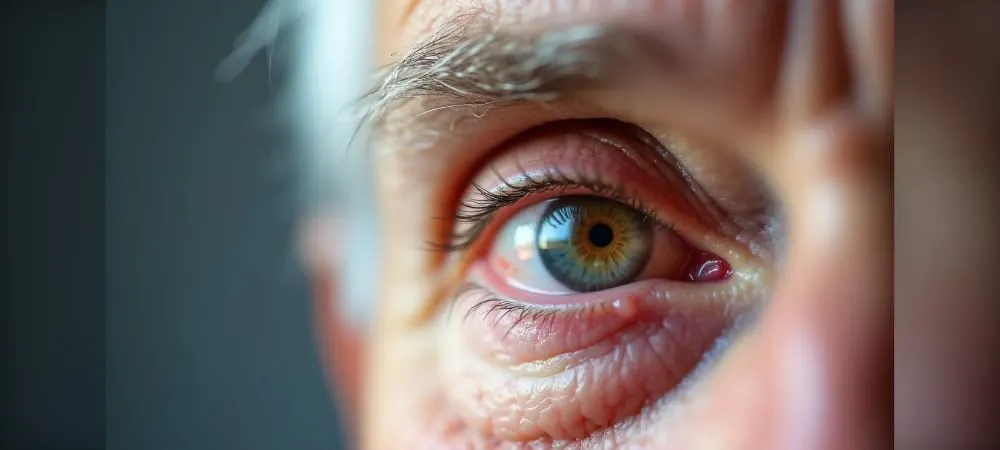
Ectropion is a condition characterized by the outward turning of your eyelids and the drying of the eye surface, which can cause both discomfort and cosmetic issues. Particularly emerging due to tissue laxity in advanced age, ectropion can lead to serious eye problems if left untreated.
In this article, you will find everything you need to know about ectropion symptoms, diagnosis, and treatment. Additionally, we will examine surgical treatment options and the recovery process in detail.
What is Ectropion?
Normally, the edge of your eyelid rests gently against your eyeball and protects your eye. Ectropion is the condition where this eyelid margin turns outward and pulls away from the eye surface. This condition, which is more commonly encountered in your lower eyelid, causes the inner surface of your eyeball to be exposed.
When the lid turns outward, the function of the tear system is disrupted. Normally, your tears spread across the eye surface and drain into the nose through small channels in the inner corner of your eyelid. Ectropion disrupts the position of these channels, and your tears begin to accumulate on your eyelid. As a result, your tears flow down your cheek.
Ectropion can develop in both of your eyelids, but the incidence in the upper lid is quite low. Because your exposed eye surface is in direct contact with the air, it dries out and becomes irritated rapidly.
Eyelid anatomy and function
Your eyelids are structures that protect your eyes from foreign bodies and ensure the proper distribution of tears. Your upper eyelid is more mobile than your lower lid and can move up to 15 mm thanks to the levator palpebrae muscle. While this muscle opens your eyelid, the orbicularis muscle works in the opposite direction to ensure the lids close.
In adults, the vertical opening between the lower and upper eyelids is around 10-11 mm. With age, this distance narrows and drops to 8-10 mm. Your blinking reflex distributes tears homogeneously over the eye surface and prevents your eye from drying out.
Inside your eyelid, there are firm fibrous tissues called the tarsus. These structures, which are 10 mm high in the upper lid and 4 mm in the lower lid, give your lid its shape and rigidity. They also house the meibomian glands, which secrete the oily part of the tears. The skin of your eyelid is the thinnest skin layer on your body and forms a protective barrier together with the muscle tissue located just beneath it.
Types of Ectropion
Age-related (involutional) ectropion is the most common type. With the aging process, the muscle and connective tissues in your eyelid loosen, and the supporting structures weaken. This laxity disrupts the position of your lid and causes it to sag outward. You will frequently encounter this type of ectropion, especially in individuals over 60 years of age.
Paralytic ectropion occurs as a result of facial nerve paralysis. The facial nerve is responsible for controlling your eyelid muscles, and when this nerve is damaged, your muscles are not stimulated sufficiently. The lids loosen and outward turning begins.
Cicatricial ectropion develops due to scarring on your eyelid. Burns, trauma, skin diseases, or surgeries you have undergone can create scar tissue on the lid skin. Over time, this tissue pulls your lid downward and leads to it turning outward.
Mechanical ectropion occurs due to a tumor or mass formed on your eyelid. The weight of the mass mechanically pulls your lid downward. Similarly, constant eye rubbing and wiping movements can also cause laxity in the lid tissue.
Congenital ectropion is quite rare. In infants, lids may be turned outward from birth due to anatomical defects, but this condition is very rarely encountered.
What Are the Symptoms of Ectropion?
Symptoms vary from person to person, and ectropion symptoms change according to severity. How much of your eyelid has turned outward determines which symptoms you will experience.
Watery eyes and tear discharge
Constant watering of your eyes is one of the most prominent signs of ectropion. Your tears normally drain through a small hole in the inner corner of your eyelid. This hole is called the punctum and carries your tears to the tear sac.
When the lid turns outward, the punctum moves out of place. Your tears can no longer drain properly and accumulate on your eye surface. As a result, your tears overflow from the edge of the eye and run down your cheek. This creates constant wetness and discomfort. Watering increases even more in windy weather or during emotional moments.
Dry eye and irritation
Although it may seem like a paradox, you will also experience dryness along with eye watering. Because your eyelid is turned outward, tears do not spread properly over your eye surface. Your eye surface is exposed to the air and dries out rapidly.
Dryness is felt as burning, stinging, and itching. A sensation as if there is sand in your eye occurs. In windy environments or air-conditioned spaces, this feeling becomes more pronounced. Your blinking frequency increases. Especially when you wake up in the morning, the discomfort of dryness reaches its peak because your eye surface has dried out more during the night.
Redness and signs of infection
Your exposed eye surface becomes prone to irritation and inflammation. Your cornea and conjunctiva (the membrane covering the white part of the eye) are exposed to chronic irritation. This causes significant redness in the eye.
Constant irritation makes your eye more sensitive and your discomfort increases. Mucus discharge or crusting may develop. Signs of infection include increased discharge, pus formation, and severe pain. These symptoms require urgent medical intervention.
Sensitivity to light
The dryness and irritation on your eye surface increase your sensitivity to light. This condition, medically known as photophobia, makes your daily life difficult. You feel discomfort when looking at bright lights. You feel the need to squint your eyes.
Light sensitivity triggers eye watering. Your eye produces more tears to protect itself. This cycle increases your discomfort even further.
Vision disturbances
The dryness and irregularity on your corneal surface affect your vision quality. Light cannot focus properly on your eye. You experience temporary or constant blurred vision. The blurriness may be more pronounced in the mornings.
The instability of your tear film is another cause of blurred vision. Blurriness may temporarily improve as you blink, but it recurs as long as the problem persists. If you notice sudden changes in your vision or persistent blurriness, consult your ophthalmologist immediately.
How Is Ectropion Diagnosed?
Ectropion is easily diagnosed through a doctor's examination. An experienced ophthalmologist evaluates the lid position and determines the severity of the condition. The diagnostic process usually progresses quickly and does not require complex tests.
Physical examination
Your doctor will first listen to your complaints and ask when they started. They will want to know how long symptoms such as dryness, burning, stinging, watering, or redness in your eye have been continuing and under what conditions they increase. This information helps in understanding the possible causes of ectropion.
Your medical history is also important. Surgeries you have undergone, traumas, medications you use, and known health problems are questioned. Certain types of ectropion are more likely in patients with a history of facial paralysis, trauma, or surgical history. Therefore, your doctor will take a detailed patient history and evaluate the condition fully.
During the physical examination, your doctor will carefully examine your eyes and eyelids. The outward turning of the lid, the position of the tear ducts, and signs of irritation on the eye surface are evaluated. Although this examination may seem simple, it tells a lot to an experienced eye.
Evaluation of eyelid structure
How much of your eyelid remains exposed and the distance between it and your eyeball are measured. Your doctor examines the lid position and determines the degree of outward turning. The condition of your lower or upper eyelid is evaluated separately.
The tightness of the muscles and tissues forming your eyelid is checked. In age-related ectropion, laxity and loss of tone are usually observed. Your doctor tests the elasticity of the tissues by gently pulling your lid. This examination shows how much the lid structure has weakened.
You are asked to close your eyes. It is observed whether the lid closes completely and whether there is a gap left during closing. In paralytic ectropion, the closing movement may be weak. This test evaluates the function of your eyelid muscles.
Your eye surface is examined with special dyes. Dyes such as fluorescein or lissamine green make areas of dryness, scratches, or ulcers visible. Your eye surface is examined in detail under a special microscope called a biomicroscope. This microscope magnifies the anterior segment of the eye and allows your doctor to see subtle changes. Additionally, the eye surface and eyelids are evaluated in detail with a slit-lamp examination.
Additional diagnostic tests
In some cases, additional tests are needed to better understand the cause or severity of ectropion. Tests can be performed to evaluate the stability of the tear film. The Schirmer test measures the amount of your tear production. The tear break-up time test evaluates the stability of the tear film and helps determine the degree of dryness.
Tests measuring your eyelid's resistance to pulling and pushing forces can be applied. These tests show how much the supporting tissues have weakened. Your doctor will have you perform different movements to understand lid function.
Imaging methods are rarely needed. Magnetic Resonance Imaging or Computed Tomography may be requested to better evaluate the cause of facial paralysis or masses around the eye. Ultrasound or CT scans can be used to evaluate underlying structures. When necessary, blood tests, thyroid functions, or kidney functions are checked.
If the problem has a neurological basis, the diagnosis can be clarified with various blood tests and a neurology consultation. However, most ectropion cases are detected with a simple eye examination and do not require additional radiological investigations.
How Is Ectropion Treated?
Ectropion treatment varies according to the severity and cause of the condition. In mild cases, controlling the symptoms may be sufficient. However, a permanent solution is achieved through surgical intervention.
Non-surgical treatment methods
Non-surgical approaches provide temporary relief and alleviate symptoms. These methods are used in patients for whom surgery is not suitable or during the period leading up to surgery.
Artificial tear drops keep your eye surface moist and reduce dryness. Regular use throughout the day helps alleviate irritation symptoms. Especially the ointments you use before going to sleep at night ensure your eye remains moist throughout the night. Lubricating ointments protect the eye surface and reduce the discomfort you experience when you wake up in the morning.
If an infection develops, antibiotic drops or ointments are prescribed. Your eyelid can be temporarily fixed in place with an eye patch or special tapes. This method prevents your eye from remaining open, especially during sleep.
Environmental protection is also important. Avoid irritants such as wind and dust. Using sunglasses outdoors protects your eyes. Humidifiers keep the ambient air moist and reduce dryness.
Surgical treatment options
Permanent and effective ectropion treatment is usually achieved through surgery. The type of surgery is determined according to the cause of the ectropion. The surgery is planned after a detailed examination by the ophthalmologist.
In age-related ectropion, loosened eyelid tissues are tightened, and supporting tendons are repaired. After the eyelid is numbed with local anesthesia, the lid is shortened. A small piece is removed from the outer edge of the lid, the edges are sutured, and the lid is tightened. Then, the incision area is closed with aesthetic sutures.
In paralytic ectropion, the closing function of the eyelid is improved. A weight is placed on the lower edge of the eyelid, or the eyelid muscles are tightened. In patients with muscle weakness, the repair and support of the muscles are ensured.
In cicatricial ectropion, the scar tissue is removed. In cases where there is skin loss, a skin graft taken from another part of the body is placed. This procedure restores the elasticity of the eyelid.
In mechanical ectropion, reconstructive surgery may be required after the tumor or mass on the eyelid is removed. In necessary cases, a bone implant can be applied through surgery.
Post-operative recovery process
Rest your eyes for a few days after the surgical intervention. Mild swelling, redness, or bruising may be seen in the first few days. These symptoms resolve within a short time.
Use the antibiotics prescribed by your doctor regularly to reduce the risk of infection. Using the given medications on time accelerates the recovery process.
Use sunglasses, do not rub your eyes, and avoid excessive physical activity. Go for regular doctor check-ups after surgery. Check-ups are important for monitoring the recovery process.
Treatment success rates
The recovery time varies depending on the surgical procedure performed and individual recovery rates. Most patients can expect a gradual improvement within a few weeks. The post-operative recovery process usually takes a few weeks.
Eyelid functions and appearance improve significantly after surgery. Patients following the doctor's instructions reduces the risk of infection and helps achieve the best result. The recovery period is usually fast.
Frequently Asked Questions
Does ectropion go away on its own?
Mild ectropion can sometimes resolve on its own. Most mild cases get better on their own within 3-6 months. During this process, your eye surface shows adaptation, and symptoms may decrease.
However, you need to be in a position to wait socially. In mild cases, a watch-and-wait approach may be preferred instead of surgery. During this time, you provide relief to symptoms by using artificial tears.
In advanced ectropion, waiting is not an option. Immediate intervention is required for your eye health and psychological well-being. In severe cases, your eye surface is damaged rapidly, and the risk of infection increases. Therefore, your ophthalmologist determines the most appropriate approach by evaluating your condition.
Is ectropion surgery risky?
Ectropion surgery is a safe procedure in experienced hands. The surgery is usually performed under local anesthesia. Thanks to local numbing, you do not feel pain during the procedure.
The duration of the surgery varies according to the chosen method. It can take between 20 minutes and 1 hour on average. While simple lid tightening procedures take less time, cases requiring lid reconstruction may take longer.
Intervention by a physician who has mastered the principles of oculoplastic surgery brings the most successful result. It is important that you choose an experienced ophthalmologist who applies protective approaches to the eyes and lids. The surgeon considers both your eye health and the aesthetic result.
What happens if ectropion is left untreated?
If left untreated, ectropion leads to significant consequences for your eye health. The risk of constant irritation and infection on the eye surface increases. This situation leads to more serious problems over time.
Corneal ulcers may develop. Constant drying of the eye surface paves the way for the formation of wounds on the cornea. These ulcers can become infected and threaten your vision. Permanent damage due to infection may occur.
In the long term, vision loss may be experienced. Untreated corneal ulcers and infections leave permanent scar tissue on the cornea. This scar tissue permanently impairs your vision quality.
Chronic conjunctivitis is another complication. Constant irritation of the membrane covering the inner surface of the eyelid leads to chronic inflammation. You experience constant redness, stinging, and discharge in your eye.
Can ectropion recur?
Recurrence after surgery is very rare. The eyelid corrected with professional surgical intervention regains its functional structure. Repairing the tissue provides permanent results.
In case of sagging in the eyelid again, the surgery may need to be repeated. In some patients, tissues may loosen again over time. Especially in age-related cases, tissue quality may be low.
Repeated surgeries may increase scarring. Therefore, choosing the right approach in the first surgery is of critical importance. An experienced surgeon aims to get the best result in the first intervention.
Following post-operative instructions carefully reduces the possibility of recurrence. Not rubbing your eye, going to doctor check-ups regularly, and performing the recommended care support the recovery process. These measures increase the long-term success rate.
In Summary, Ectropion
Ectropion is a serious condition that affects your eyes, but treatment is available. It is important to state that early diagnosis and the right approach significantly reduce the risk of permanent damage. Do not delay consulting your ophthalmologist when you notice the symptoms.
Although non-surgical methods provide temporary relief, the permanent solution is surgery. Intervention performed with an experienced eye surgeon is safe and effective. The post-operative recovery process usually progresses quickly.
Your eye health directly affects your quality of life. Instead of ignoring ectropion symptoms, take action immediately. With the right treatment, you both get rid of the discomfort and prevent serious complications.
Ectropion is a condition caused by the outward turning of the eyelid. In this article, you can find detailed information about its symptoms, diagnostic methods, and treatment options.
Start with the right assessment for What is Ectropion? What Are Its Symptoms? How Is It Diagnosed and Treated?
Share your symptoms with our specialist physicians; let us determine the right diagnosis and treatment plan together.
Warning
If your symptoms started suddenly, are progressing rapidly, or significantly restrict your daily life, consult a physician without delay.
Plan your What is Ectropion? What Are Its Symptoms? How Is It Diagnosed and Treated? journey with our specialists.
Fill in the form or book an appointment to learn about treatment options, the process and preparation.