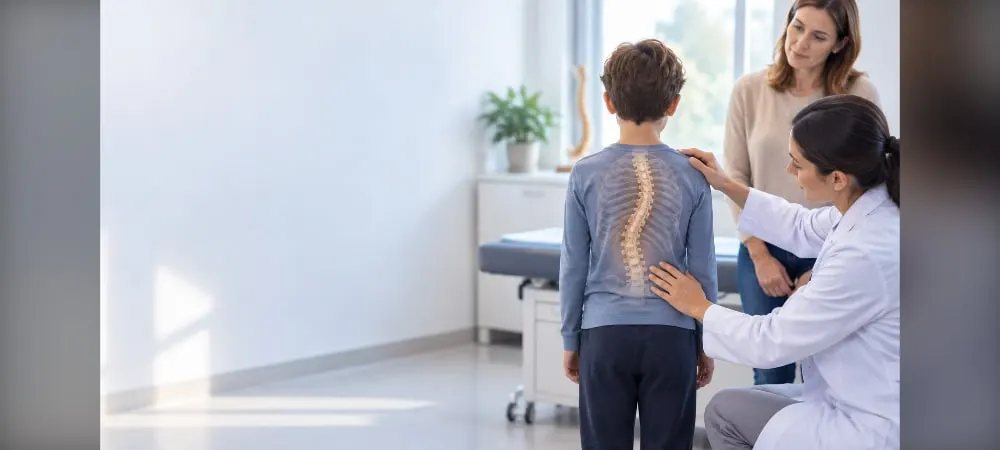
Approximately 2% of the population is affected by pediatric scoliosis. Defined as an abnormal curvature of the spine to the right or left, this condition typically does not cause pain. However, you should watch for signs such as uneven shoulder height.
What is pediatric scoliosis, what are its symptoms, and how is it diagnosed? In this article, we will examine the causes of pediatric scoliosis and treatment options in detail. Thus, you can take the right steps for your child's health.
What is Pediatric Scoliosis?
Simple Definition of Scoliosis
Curvature of the spine to the right or left of more than 10 degrees is defined as scoliosis. When you look at a healthy spine from behind, you see a straight line. In scoliosis, however, the spine takes the shape of the letter S or C.
This condition is not simply leaning to one side. The spinal bones rotate around their own axes, creating a three-dimensional deformity. This malformation occurring in the lumbar and thoracic regions can sometimes be seen together with a hunchback.
Scoliosis can be present at birth or develop later. It affects people of all ages, but most commonly appears during adolescence.
Frequency in Children
Approximately 2-3% of school-age children show signs of scoliosis. In Turkey, 3 out of every 100 children of growing age encounter this problem. The prevalence in the population ranges between 2% and 4%.
Scoliosis occurs much more frequently in girls. The prevalence in girls aged 10-15 is 8 times higher than in boys. According to some sources, this ratio can go up to 8-10 times. Especially between the ages of 10-16, three out of every hundred children have scoliosis.
Only 10% of people with curvature in their spine progress to a degree requiring scoliosis treatment. A vast majority consists of low-degree curvatures.
In Which Age Groups Does It Occur?
Pediatric scoliosis is divided into different groups according to age. 1-3% of idiopathic scoliosis is infantile type, and 12-21% is juvenile type.
Infantile scoliosis is seen between the ages of 0-3. This type occurs more frequently in boys and is 3 times higher compared to girls. Usually, before the age of 1, families notice the asymmetry in the baby's back.
Juvenile scoliosis covers the age range of 4-10. It is seen 3 times more frequently in girls compared to boys. It is diagnosed around age 5 in boys and age 7 in girls.
Adolescent scoliosis appears during the 11-18 age period[32]. This is the most common type. Due to rapid height growth, curvatures become more pronounced during this period. The vast majority of cases are diagnosed in the 10-16 age group.
In recent years, a new classification has been developed as early-onset and late-onset. Early-onset scoliosis includes age 10 and under, while late-onset scoliosis includes age 11 and above. Scoliosis starting at an early age is generally progressive. Because the more growth potential the child has, the higher the risk of progression.
What Are the Symptoms of Pediatric Scoliosis?
Symptoms of scoliosis in children generally appear with externally noticeable asymmetry. In most children, the first noticed condition is not pain, but a difference in shoulder level and a change in posture. Families mostly notice these symptoms during holidays at the beach or while the child is standing with a bare back.
Shoulder and Scapula Asymmetry
One of the shoulders standing higher or lower than the other is one of the earliest signs of scoliosis. This situation is easily seen in front of a mirror or in photographs. When one shoulder is positioned higher, one of the arms may appear longer than the other.
Significant differences also occur in the shoulder blades. One shoulder blade may look more protruding or prominent compared to the other. The right and left shoulder blades look different from each other. Especially when the child bends forward, a prominent bulge appears on one side of the back compared to the other. If there is asymmetry in the ribs, a more prominent bulge or depression is observed on one rib side compared to the other.
Hip and Waist Line Irregularities
Asymmetry in the waist hollows is an important symptom of scoliosis. If the spaces on the right and left sides of the waist are not equal or do not look symmetrical, you need to pay attention. Due to the curvature in the spine, the indentation on one side is greater than the other.
Height difference in the hips is also common. If one side of the hip stands higher than the other, this can be a sign of scoliosis. Similarly, tipping of the pelvic bones to one side can be observed. When you observe your child from behind, you may notice inequality at the hip level.
Truncal Imbalance and Visual Symptoms
The body not being on the midline is a clear indicator of scoliosis. If the child's back does not exhibit a straight posture, if it stands tilted to one side, you should take this situation seriously. When standing upright, the space between the arms and the body may not look equal on both sides.
The irregular posture of the head relative to the pelvis is also a reflection of the balance disorder caused by scoliosis. It is noticeable that the head is not aligned with the rest of the body. You should also consider that scoliosis may be present in situations such as one side of clothing hanging longer or one side of a skirt looking crooked. Clothes, especially skirts or pant legs, may appear longer on one side.
Sometimes gait disturbance or limping can also be observed. However, these symptoms appear more rarely.
Pain and Physical Complaints
Scoliosis in children generally does not cause pain. Therefore, it can be difficult to notice. Mild scoliosis can progress without giving symptoms. In most children, changes in physical appearance take precedence over pain.
However, if scoliosis has progressed, back pain may occur. The feeling of pain and fatigue increases when sitting or standing for a long time. In severe curvatures, deformation of the rib cage can reduce lung capacity and lead to shortness of breath. In advanced cases, complications such as respiratory problems, muscle fatigue, and movement restriction can be seen.
Causes and Types of Pediatric Scoliosis
Scoliosis develops depending on different causes, and these causes directly affect the treatment approach. Pediatric scoliosis causes are divided into three main groups: idiopathic, congenital, and neuromuscular scoliosis.
Idiopathic Scoliosis (Unknown Cause)
The term idiopathic means "cause unknown." This type constitutes about 80% of scoliosis cases. It is the most common form. 80-85% of all cases are idiopathic scoliosis.
In this type of scoliosis, all other factors that could cause curvature in the spine are investigated. When none of the potential factors provide a prerequisite for deformity, a diagnosis of idiopathic scoliosis is made. Although the exact cause is not fully known, genetic factors, hormonal imbalances, and growth dynamics are thought to play a role together.
It appears during periods of rapid height growth. Poor posture or carrying heavy bags does not cause idiopathic scoliosis. However, it can delay the recognition of the existing curvature.
Congenital Scoliosis (Present at Birth)
Congenital scoliosis occurs as a result of disorders that form during the development of the baby's spine in the womb. It is dependent on problems during the formation or differentiation stage of the vertebrae between the 4th and 8th weeks of gestation. It occurs in the first 6 weeks of embryological formation and becomes pronounced as the baby grows.
It is the second most common type of scoliosis. Its prevalence in the society is between 1-4%. The failure of one or more vertebrae to form completely or the partial or complete fusion of the vertebrae causes scoliosis. Vertebrae that should be rectangular can be triangular.
In congenital scoliosis, accompanying abnormalities can be seen at a rate of 41% in the spinal cord, 7-12% in the heart, and 20% in the kidney. The risk of occurrence in a person who has a first-degree relative with congenital scoliosis is around 15%. It is generally progressive and early diagnosis is important.
Neuromuscular Scoliosis
It is the second most common type of scoliosis. It develops depending on diseases in the brain, spinal cord, nerves, or muscles. It occurs due to muscle weakness and nervous system disorders. When muscles cannot keep the spine in balance, the curvature increases over time.
Conditions such as cerebral palsy, muscular dystrophies, spina bifida, spinal cord injuries, and spinal muscular atrophy cause neuromuscular scoliosis. It progresses quite rapidly compared to idiopathic scoliosis and generally requires surgical intervention. It may continue to progress even at adult age.
Genetic and Familial Predisposition
Genetic factors play an important role in the development of scoliosis. The risk increases in individuals with a family history of scoliosis. Research shows that about 30% of scoliosis patients have similar cases in their family history.
When the family history of idiopathic scoliosis cases is examined, a scoliosis problem is seen at a rate of 17-42%. In general terms, 30% have a mild or severe scoliosis problem. When the mother or father has scoliosis, the probability of occurrence is 11% in first-degree relatives and 2.4% in second-degree relatives.
The frequency of scoliosis appearing in both siblings in identical twins is 70%. This situation shows that environmental factors are also effective in the development of scoliosis alongside genetic predisposition.
How is Pediatric Scoliosis Diagnosed?
When there is a suspicion of scoliosis, the diagnostic process begins with a detailed examination. Your doctor first evaluates your child's family history, growth history, and physical complaints. Age of menarche in girls is important to predict progression. Height and weight measurement is performed to track skeletal growth.
Physical Examination and Adams Test
During the physical examination, your child's clothes are removed. Asymmetries in the shoulders, shoulder blades, waistline, and hips are carefully observed. If the leg length difference exceeds 2 cm, a detailed examination is performed.
The Adams test is the most important test in diagnosing scoliosis. While your child is standing, they bend forward 90 degrees, leaving their arms and head free. In this position, an asymmetric protrusion on one side in the back or waist region suggests scoliosis.
During the test, the thoracic rotation angle is measured with a scoliometer. An measurement above 7 degrees leads to a diagnosis of scoliosis in 70% of children. Curvatures above five degrees are monitored with a suspicion of scoliosis. The rib hump appearing during forward bending is the most prominent sign of scoliosis.
Your doctor also investigates other causes of scoliosis by performing range of motion, muscle testing, and sensory examination. Potential secondary causes of scoliosis are ruled out in the initial examination.
Cobb Angle Measurement with X-ray
A standing full spine X-ray is required for definitive diagnosis. The actual condition of the spine under load is evaluated on the X-ray. Anteroposterior and lateral plane images are taken.
The Cobb angle is measured by calculating the angle between the uppermost vertebra where the curvature begins and the lowermost vertebra where it ends. This measurement determines the degree of scoliosis. Curvatures below ten degrees are not accepted as scoliosis. Curvatures between 10 and 20 degrees are classified as mild, between 20 and 40 degrees as moderate, and above 40 degrees as severe scoliosis.
There may be a margin of error of 5-10 degrees in measurement. Therefore, it is important to take measurements from the same level in follow-up films.
MRI and Advanced Imaging Methods
An MRI is not taken for every child. Especially in patients planned for surgery, an MRI is requested to investigate whether there is additional pathology in the nerve structures. Since the probability of neural anomaly is found to be higher in children under ten years of age, MRI evaluation may be required.
An MRI is taken in atypical features such as male gender, pain, left-sided curvatures, and rapidly progressing curvatures. In congenital scoliosis, an MRI is essential to understand anomalies in bone and nerve tissue.
Progression Tracking and Control Frequency
Since growth continues, the adolescent period is the most risky period. A regular follow-up is planned according to the degree of curvature and growth potential. Follow-ups are generally done at 4-6 month intervals. Control X-rays are used to understand whether there is progression.
How is Pediatric Scoliosis Treated?
When making a treatment plan, your doctor evaluates the degree of curvature, your child's age, growth potential, and general health status. Early diagnosis significantly increases treatment success.
Observation and Regular Follow-up
In curvatures below 20 degrees, surgery or bracing is generally not required. Regular follow-up and monitoring are sufficient. In children whose growth continues, a doctor check-up is performed every 4-6 months.
During checks, an X-ray is taken to monitor how much the curvature has increased. If the curvature does not show progression, treatment may not be necessary. Physical therapy and special exercises play a supportive role during this period.
Brace Treatment
Brace treatment is applied in curvatures between 20-40 degrees. It gives effective results, especially in children of growing age. The brace does not completely eliminate the curvature, but it stops its progression.
Brace use is recommended for 18-23 hours a day. The treatment duration continues until skeletal development is completed. Brace treatment is successful in 80% of children whose growth continues. Although the curvature can rise up to 60 degrees when bone development stops, brace treatment is tried first.
Patient compliance is the most important factor determining success. Regular use and proper fit of the brace are of critical importance.
Surgical Treatment
Surgical treatment is evaluated in curvatures above 40-50 degrees. The curvature is corrected by placing metal rods and screws into the spine with surgery. Fused surgery is the most common method.
In recent years, tethered vertebral body body tethering surgery has been developed. In this method, the mobility of the spine is preserved and the child's growth is allowed. It is preferred especially in children interested in sports.
Exercise and Physical Activity
Exercises do not treat scoliosis on their own, but they support brace treatment. Scoliosis-specific exercise programs such as the Schroth method strengthen the spine muscles. In 80% of patients who exercise along with a brace, the curvature does not increase or decreases.
Swimming, pilates, and yoga are beneficial for spine health. The exercise program must be created under the supervision of a physiotherapist.
Things to Consider During the Treatment Process
Redness or wounds may form on the skin during brace use. Daily showers should be taken, and the skin should be checked regularly. Frequent cleaning of the brace is important.
Heavy lifting and excessive bending should be avoided for the first 3 months after surgery. The healing process should be supported with physical therapy. Regular doctor follow-up increases the success of treatment.
Frequently Asked Questions
Is scoliosis painful?
Most children do not have pain. Especially in mild and moderate curvatures, your child does not feel any discomfort. However, in advanced cases, back pain may be experienced after sitting or standing for a long time.
When should I take them to the doctor?
Consult immediately when you notice a difference in level in your child's shoulders, asymmetry in waist hollows, or a bulge in their back. Early diagnosis increases treatment options. You should be more careful, especially in female children of growing age.
Can scoliosis be prevented?
Idiopathic pediatric scoliosis cannot be prevented. Poor posture or carrying heavy bags does not cause scoliosis. Since genetic predisposition and growth dynamics play a role, there is no preventive method. Therefore, regular checks and early diagnosis are the most important approaches.
How long is the brace used?
Brace treatment continues until bone development is completed. This period is generally around ages 14-15 in girls and 16-17 in boys. Daily usage time varies between 18-23 hours according to your doctor's recommendation.
Can they play sports?
There is no harm in playing sports in mild and moderate scoliosis. Activities like swimming and pilates are beneficial. Your child using a brace can remove the brace during training. However, you must follow your doctor's recommendations in the first months after surgery.
Does scoliosis go away?
Pediatric scoliosis does not correct on its own. As growth continues, the curvature may increase. It exhibits a progressive course in cases left untreated. Actually, with proper treatment, the progression of the curvature is stopped or corrected with surgery.
We have scoliosis in our family, will it pass to my child?
Familial predisposition is an important risk factor. If the mother or father has scoliosis, the probability of it occurring in your child increases. You can generally increase your chance of early diagnosis by making regular checks.
Are school screenings sufficient?
School screenings are useful, but they may not always be sufficient. You should also perform regular checks at home. You can observe the asymmetry in your child's back by having them bend forward. Always consult a specialist in cases where you suspect.
What happens if it is not treated?
Progressive curvatures can reduce lung capacity and affect heart functions. Cosmetic problems and movement restriction are experienced in severe cases. Especially curvatures above 50 degrees continue to progress even in adulthood.
What should we pay attention to when using a brace?
Check daily whether redness or wounds have formed on the skin. Your child should shower every day, and you should clean the brace regularly. Adaptation problems may be experienced in the first weeks, but adjustment is achieved over time.
Childhood Scoliosis in Summary
Pediatric scoliosis has a very high chance of treatment when noticed early. Do not ignore symptoms such as differences in shoulder level or asymmetries in the waistline. Thanks to regular checks, you can prevent the progression of the curvature.
While monitoring is sufficient in mild cases, brace treatment gives effective results in moderate curvatures. In advanced cases, surgical options are available. The important thing is to apply the right treatment at the right time.
Do not neglect regular examinations for your child's health. In every case where you suspect, make sure to get a specialist opinion. With early diagnosis and the right treatment approach, your child can go through a healthy development process.
Fill Out the Form for Detailed Information and Communication!
Start with the right assessment for What is Pediatric Scoliosis? What Are Its Symptoms? How Is It Diagnosed and Treated?
Share your symptoms with our specialist physicians; let us determine the right diagnosis and treatment plan together.
Warning
If your symptoms started suddenly, are progressing rapidly, or significantly restrict your daily life, consult a physician without delay.
Plan your What is Pediatric Scoliosis? What Are Its Symptoms? How Is It Diagnosed and Treated? journey with our specialists.
Fill in the form or book an appointment to learn about treatment options, the process and preparation.