Skin Cancer Symptoms and Treatment Methods
Cancer is the second group of diseases causing the most deaths in our country and worldwide, after heart and blood vessel diseases. Skin cancer, one of these types of cancer, occurs when the cells that make up the skin grow and multiply abnormally. Skin cancer has different types and can usually be treated when it is diagnosed in its early stages. However, as diagnosis is delayed and the stage of the cancer progresses, treatment may become more difficult and cancer cells may spread to different parts of the body. For this reason, attention should be paid to skin cancer symptoms, and if any symptoms occur, health institutions must be consulted without delay.
What Is Skin Cancer?
Skin cancer is the condition in which cells in the epidermis, the outermost layer of the skin, begin to multiply uncontrollably after mutating, when DNA damage in these cells cannot be repaired. Skin cells that grow and multiply out of control form malignant tumors and begin to produce the typical signs of skin cancer. Thus, an area with an abnormal appearance, such as a spot or mole, develops on the skin. Such formations on the skin do not always mean that you have skin cancer. Benign tumors can also cause areas with a different appearance to form on the skin surface. However, due to the possibility of skin cancer, any abnormal formation on the skin surface, especially those with a sudden onset, rapid growth, or irregular shape, definitely requires medical examination and investigation.
How Is Skin Cancer Recognized, and What Are Its Symptoms?
The most common sign of skin cancer is changes on the surface of the skin. Typically, a new mole formation or a change in an existing mole may be a sign of skin cancer. The most common skin cancer symptoms are as follows:
Formation of a new mole or spot on the skin
Swellings on the face, ears and neck
Pink, red or brown colored lumps
Areas of skin that look like scars
Bleeding moles or marks
Sores or growths that do not heal, or that recur after healing
Itchy, crusting and scaling lesions
Pre-existing skin tags or spot-like lesions may be benign, but they may also indicate skin cancer. Likewise, moles that have been present for a long time may start to change and turn into skin cancer. The likelihood of skin cancer is increased if a lesion on the skin has asymmetrical edges, color variations within itself, grows and changes, and especially if it is larger than 6 mm. Medical support must be obtained and a detailed examination must be undergone for such skin lesions.
What Are the Causes of Skin Cancer?
The most important cause of skin cancer is exposure to sunlight. Ultraviolet rays from the sun cause genetic damage to skin cells, especially when exposure occurs without sun protection. After this stage, cancerous cells that grow and multiply in an uncontrolled manner may turn into skin cancer if they cannot be brought under control by the immune system. Every individual has the possibility of developing skin cancer, regardless of gender or race. However, some skin cancer causes that are accepted as risk factors for skin cancer include the following:
Being constantly exposed to the sun due to one's work
Frequently going out in the sun without using sunscreen creams or lotions
Living in sunny and high-altitude regions
Having fair skin
Having many moles, especially irregularly shaped moles
Presence of pre-cancerous skin lesions called actinic keratosis, which appear rough, brown or dark pink, and scaly
Having a family history of skin cancer
Having had an organ transplant or using immunosuppressive drugs for any reason
Having received UV light therapy for the treatment of diseases such as psoriasis and eczema
What Are the Most Common Types of Skin Cancer?
Skin cancer has different types, some of which are more common and some of which are rare. The most common types of skin cancer are as follows:
Basal cell carcinoma: A type of skin cancer that occurs in the basal cells of the epidermis layer of the skin.
Squamous cell carcinoma: A skin cancer that develops as a result of the squamous cells in the epidermis layer becoming cancerous.
Melanoma: Skin cancers formed by the cancerous transformation of skin cells called melanocytes, which produce melanin pigment that gives color to the skin.
Merkel cell carcinoma: Merkel cell carcinoma, a rarer skin cancer with an aggressive nature, has a high likelihood of spreading through the lymphatic system and often develops in the head and neck regions.
Kaposi sarcoma: Kaposi sarcoma, another rare skin cancer, develops in the blood vessels of the skin and causes red-purple spots on the skin or on mucous membranes.
Sebaceous gland carcinoma: It arises from the sebaceous glands in the skin and presents as firm, painless nodules.
How Is Skin Cancer Diagnosed?
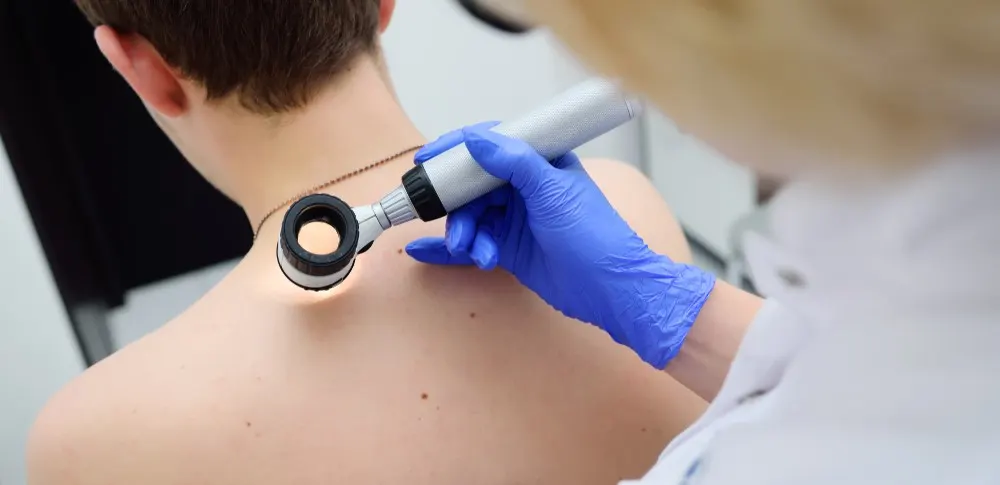
The diagnostic process for skin cancer begins primarily with a physical examination performed by the physician. The physician determines whether further diagnostic tests are needed based on the physical examination of the patient who presents with a suspicious lesion on the skin surface. The physician may examine the entire skin, apart from the area where the lesion is located, to check whether similar formations are present. If skin cancer is suspected as a result of the examination, a biopsy may be performed, and all or part of the lesion may be removed and sent for pathological examination. In this way, it can be definitively determined whether the lesion is a benign formation or skin cancer. At Hisar Hospital Intercontinental, all diagnostic tests are carried out in qualified laboratories that provide careful service 24 hours a day. Thanks to the fact that the necessary staff and equipment are always ready for rapid intervention, your treatment process is started quickly after diagnosis by experienced dermatology physicians and their teams.
How Is Skin Cancer Treated, and What Are the Treatment Methods?
Treatment of skin cancer may vary according to some personal circumstances, but most often it involves surgical removal of the lesion. In general, in skin cancers where the lesion is small in size, the entire tumor may be removed even during the biopsy. In the presence of large tumors, a more detailed plan is made by considering factors such as the type of skin cancer and its stage, if any. While non-surgical methods such as cryotherapy may be preferred depending on the type and spread area of the cancer, in severe cases treatment methods such as chemotherapy, radiotherapy, immunotherapy, photodynamic therapy, and various surgical approaches may be used.
Is There a Surgical Treatment for Skin Cancer?
It is possible to speak of different surgical treatment approaches for skin cancer. The most basic of these are classified as follows:
Excisional surgery: To allow complete clearance of the cancerous tissue, the entire tumor and a portion of the surrounding healthy tissue are removed surgically.
Mohs surgery: Operations that plan to preserve healthy skin as much as possible by removing only the diseased tissue, applied to cosmetically sensitive areas such as the eyelids, lips and scalp.
Curettage and electrodesiccation: Operations performed by completely scraping out the tumor with a special instrument, followed by destroying the remaining cancer cells with an electric needle.
Can Skin Cancer Be Treated Without Surgery?
Skin cancers of an appropriate type and structure can also be treated with non-surgical methods, especially when they are small in size and have no risk of spreading. In skin cancer treatment performed without surgery with a treatment method called cryotherapy, the tumor is frozen using liquid nitrogen. After this stage, the skin cancer cells gradually slough off and the tumor is eliminated.
Frequently Asked Questions
Some questions and topics of curiosity commonly asked by many people about skin cancer are as follows: In general, a visit to the hospital is recommended for any lesion noticed on the skin surface that raises suspicion, especially those with a sudden onset or that have suddenly begun to grow, and any lesion with irregularities in color or edges or asymmetry. The most important risk factor for skin cancer is excessive exposure to sunlight. In addition, genetic predisposition, certain medications used, and fair skin tone can also be counted among the risk factors. However, it should not be forgotten that skin cancer can also be seen in people who have none of these. In skin cancer, examination is carried out first by physical examination, followed by biopsy. For skin cancer tumors that are determined to be malignant as a result of pathological examination, in addition to the treatment plan, different cancer screening methods may also be used to investigate the possibility of spread. To protect yourself from skin cancer, excessive sun exposure should be avoided, and the use of sunscreen cream should become a habit regardless of the season. Any newly noticed lesion on the skin, or any lesion that has begun to grow or change, must definitely be examined. Skin cancer always requires medical treatment, and waiting for it to go away on its own is not an option. Since early diagnosis is very important for the success of treatment, do not delay getting examined. If left untreated, skin cancer may progress and lead to serious health problems. Tumor growth will make treatment more difficult, and the likelihood of spreading to different parts of the body also increases. For this reason, treatment in the early period is extremely important. If you observe a formation on your skin that raises suspicion of cancer, you can apply to the dermatology (skin and venereal diseases) department and get examined. Following the physical examination by the physician, if deemed necessary, you may be referred to departments such as general surgery or oncology for biopsy or, in the treatment stages after a cancer diagnosis. If you notice spots, moles or various lesions on your skin that raise suspicion of cancer, you can apply to Hisar Hospital Intercontinental, which provides service with experienced Dermatology physicians and teams, to get examined and have the necessary diagnostic tests done.
Start with the right assessment for Skin Cancer Symptoms and Treatment Methods
Share your symptoms with our specialist physicians; let us determine the right diagnosis and treatment plan together.
Warning
If your symptoms started suddenly, are progressing rapidly, or significantly restrict your daily life, consult a physician without delay.
Plan your Skin Cancer Symptoms and Treatment Methods journey with our specialists.
Fill in the form or book an appointment to learn about treatment options, the process and preparation.