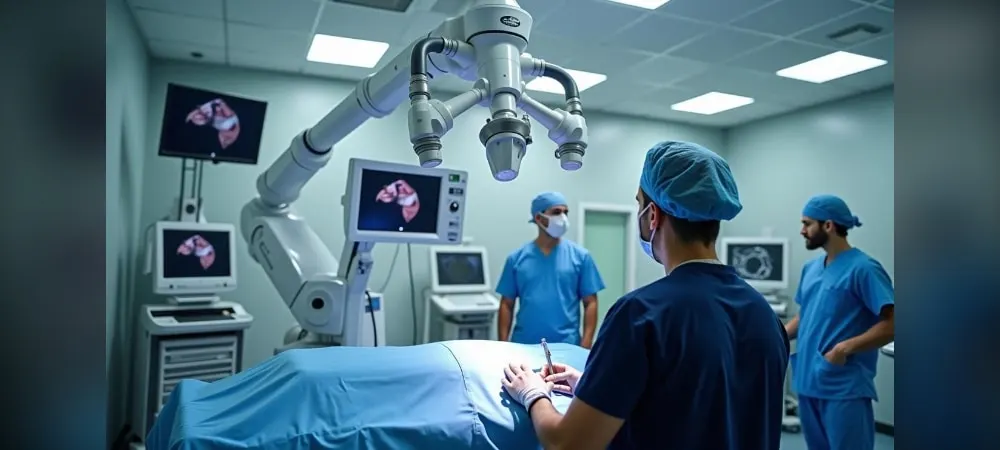
Robotic hernia surgery, the most advanced technological method in minimally invasive hernia treatment, offers a modern surgical option performed through small incisions instead of large ones. This method is preferred by general surgeons for the repair of inguinal, umbilical, or abdominal wall hernias.
In this procedure, instead of making a large incision in your abdomen, the surgeon inserts special robotic arms and a high-resolution three-dimensional camera through a few small holes, each only 8 mm in size. This technology provides a 10-15 times magnified 3D view of the surgical site, while the robotic arms can perform 540-degree rotations that the human wrist cannot.
The recovery process after robotic hernia surgery is much more comfortable compared to open surgery. You will experience less postoperative pain, and you can generally return to your daily activities, such as driving, within a week. Furthermore, the very low recurrence rate of this method increases the likelihood of long-term success.
In this article, you will learn how robotic hernia surgery is performed, its advantages, who it is suitable for, and the recovery process in clear and understandable language.
What Is Robotic Hernia Surgery and How Is It Performed?
Definition of the surgery and the technology used
Robotic hernia surgery is the most advanced minimally invasive surgical method used to repair inguinal, umbilical, or abdominal wall hernias. Unlike traditional open surgeries, in this method, the surgeon makes a few small holes approximately 8 mm in size instead of large incisions in your abdomen. Special robotic arms and a high-resolution three-dimensional (3D) camera are inserted into your body through these small holes.
The technology used provides a clear, and most importantly, 3D view of the surgical site magnified 10-15 times. Thanks to this depth perception, your surgeon can see delicate structures such as nerves and blood vessels much more clearly. However, the robot is merely a tool and does not perform the surgery on its own—it is entirely under the surgeon's control.
Contribution of the robotic system to the surgical process
The robotic system makes several significant contributions to the surgical process. First, the robotic arms can rotate at 540-degree angles that the human wrist cannot. This feature makes suturing and fixing the mesh to the abdominal wall much easier and more precise, especially in narrow spaces.
Additionally, the robotic system completely filters out the surgeon's hand tremors. This allows for much more precise and stable movements. Thanks to robotic surgery:
Superior visual clarity is provided in complex and recurrent hernias
Hernia defects can be closed more easily with sutures
Complex abdominal wall hernias can be repaired as successfully as with the open method
It provides a great advantage, especially in the pelvic region and narrow spaces
The role of the general surgeon and the control mechanism
The general surgeon assumes the primary role in robotic hernia surgery. The surgeon performs the operation by sitting at a special console next to the operating table. From this console, they perform the hernia repair by precisely managing the robotic arms with controls that mimic their own hand and wrist movements.
The robot never performs the surgery itself; it is merely an extension of the surgeon's hand. Thanks to the 3D imaging and millimeter-level movement capability provided by the robotic system, the surgeon can perform delicate procedures. In fact, the system reflects the surgeon's hand movements in real-time—the surgeon can work as if they were directly inside the surgical site.
Moreover, the robotic system reduces surgeon fatigue while increasing the quality of the surgery. Guided by the high-resolution images provided by the robotic camera, the surgeon can carefully remove the herniated tissue that is pressing on a nerve.
The duration of robotic hernia surgery can vary—some surgeries take as little as 30 minutes, while in complex cases, this time can extend to hours. Each case is planned individually in accordance with the surgeon's assessment.
Advantages of Robotic Hernia Surgery
Compared to traditional methods, robotic hernia surgery significantly improves patient comfort and surgical outcomes. This minimally invasive hernia treatment method, preferred by general surgery specialists, provides superiority in many aspects.
Less pain and faster recovery
Since robotic hernia surgery uses only a few small incisions, postoperative pain is significantly less than in traditional open surgery. This allows patients to require fewer painkillers. Most patients can stop taking painkillers a few days after the surgery. Thus, the time to return to daily life is significantly shortened.
Furthermore, the recovery process is quite fast. In general, patients who undergo robotic hernia surgery feel much better within a week and can quickly return to their daily activities. The typical recovery time after robotic hernia surgery is between two to four weeks, and many people can return to work a few days after the surgery.
Superior imaging and precision
Robotic systems provide a 10-15 times magnified, high-resolution, and most importantly, 3D view of the surgical site. This depth perception allows the surgeon to see delicate anatomical structures such as nerves and blood vessels much more clearly.
In addition, the robotic arms mimic the surgeon's hand movements exactly and can rotate at angles (540 degrees) that the human wrist cannot. Moreover, the system completely filters out the surgeon's hand tremors. This superior precision makes it easier to suture and fix the mesh to the abdominal wall, especially in narrow spaces.
Lower risk of complications
Thanks to clearer imaging and precise surgery, the risk of damaging surrounding tissues and blood vessels during robotic hernia surgery is reduced. Since small incisions are used, the risk of wound infection and bleeding is also minimized.
Scientific studies show that the robotic group experiences significantly fewer complications compared to the laparoscopic group. Furthermore, readmission rates for patients who undergo robotic surgery are also lower.
Lower recurrence rate
Especially in complex abdominal wall hernias, the precise suturing capability offered by robotic surgery ensures that the mesh is fixed to the abdominal wall more securely. Thanks to the surgeon's anatomical precision in robotic surgery, the risk of hernia recurrence is minimized.
Some studies show that the general recurrence rate in robotic hernia surgeries is only 1.2%. This rate is quite low compared to traditional methods.
Better cosmetic results
Robotic hernia surgery typically uses three to five small incisions, each approximately 8 mm wide. These small incisions serve as entry points for the robotic arms and camera, allowing the surgeon to perform the operation with high precision.
Because small incisions are used, visible scars after robotic hernia surgery are minimal. Some incisions can even be hidden inside the navel and become almost invisible. This is a significant advantage, especially for patients with cosmetic concerns.
In Which Types of Hernias Is Robotic Surgery Used?
Robotic surgery technology can be successfully applied to many different types of hernias. Robotic technology provides significant advantages in the repair of almost all types of hernias seen in the abdominal region. It is a minimally invasive hernia treatment method preferred by general surgeons, especially for complex and recurrent hernias.
Inguinal hernia
Inguinal hernia is the most common type of hernia. It occurs when a part of the intestine protrudes through a weak point in the abdominal muscles. Robotic surgery provides superior visual clarity, especially in the repair of inguinal hernias. The robotic method may be preferred for inguinal hernias that cause pain or make daily life difficult.
The robotic system shows the nerves and blood vessels in the groin area much more clearly. Thus, the general surgeon can complete the surgery without damaging these delicate structures. Additionally, by working from inside the abdomen, they can perform the hernia repair in an area where there is minimal scar tissue.
Umbilical hernia
Umbilical hernia is the protrusion of a part of the intestine through the umbilical opening in the abdominal muscles. This type of hernia can be seen in both infants and adults. In adults, it can occur due to obesity, lifting heavy objects, or previous surgeries.
In umbilical hernia repair with robotic surgery, fixing the mesh to the abdominal wall from the inside with secure sutures can be done more easily and effectively thanks to the maneuverability of the robotic arms. It provides a great advantage, especially in umbilical hernias in larger or overweight patients.
Incisional (abdominal wall) hernia
Incisional hernia is a type of hernia that develops due to previously performed open surgeries. Repairing these types of hernias is usually difficult. One of the areas where robotic surgery makes the most difference is incisional hernia surgeries.
Robotic surgery allows large and complex incisional hernias to be repaired through small incisions. Rejoining the abdominal wall muscles and safely placing a large mesh inside the abdomen can be performed more successfully with the robotic method. In this way, the ergonomics provided by the robotic system in abdominal wall hernias is at the highest level.
Bilateral and recurrent hernias
Bilateral inguinal hernias and recurrent hernias are situations where robotic surgery provides significant advantages. In bilateral inguinal hernias, the surgeon can repair both sides through the same small incisions.
Robotic surgery can also be considered as a priority in the treatment of recurrent hernias, i.e., hernias that have been operated on before but have formed again. Especially in the surgical treatment of recurrent hernias, the robotic method reduces the risk of the hernia forming again by allowing the surgeon to place sutures more securely.
Robotic minimally invasive hernia surgery can be applied to almost all patients who do not have contraindications for general anesthesia and are suitable for closed surgery. As a result, robotic hernia surgery offers a superior solution in the treatment of complicated incisional hernias and recurrent hernias.
Recovery Process After Robotic Hernia Surgery
The recovery process after robotic hernia surgery is much faster and more comfortable compared to traditional open surgeries. Thanks to minimally invasive hernia treatment, your body experiences less trauma, and you can return to your normal life much sooner.
Length of hospital stay
The length of hospital stay after robotic hernia surgery is quite short. You can usually be discharged on the same day or the next day for inguinal or umbilical hernia surgeries. In more complex abdominal wall hernias, this period may extend to a maximum of 2-3 days. Thanks to small incisions and minimal tissue damage, your body recovers faster.
The robotic surgery technique significantly reduces the length of hospital stay compared to traditional methods. Most patients can stand up and take short walks within 24 hours after surgery.
Pain management and medication use
Pain after robotic hernia surgery is minimal. It can usually be easily controlled with simple painkillers. It is considered normal to feel mild pain, tension, and fatigue for the first few days after surgery.
If you have undergone closed robotic surgery, you will need painkillers for a shorter time and simpler ones—most patients can stop taking painkillers completely within two or three days after surgery. Thanks to the minimally invasive approach, you will feel less pain and recover faster than with traditional surgery.
Time to return to daily life
The process of returning to daily life after robotic hernia surgery is quite fast. You can generally return to your daily activities, such as driving, and your desk job within 1 week. While most patients operated on with robotic surgery can return to their daily activities within 1-2 weeks, full recovery may take a few weeks.
If you have spent the first week without any problems and by following the rules, you are considered to have overcome the most difficult part of the recovery process. Starting from the second week, you can gradually return to your daily life by following your doctor's recommendations.
Exercise and heavy lifting restrictions
You can start light walks the day after robotic hernia surgery. However, to prevent the hernia from recurring, it is very important to avoid strenuous exercises that increase intra-abdominal pressure and heavy lifting (more than approximately 5-10 kg) for 4-6 weeks.
There are usually three stages in the recovery process:
First 6 Weeks: Your focus during this period is wound healing. Lifting weights is prohibited. You can take walks on short and flat surfaces.
6 Weeks - 3 Months: After receiving approval from your doctor, you can focus on strengthening your "core" muscles. Equipment such as light elastic bands and a pilates ball are helpful at this stage.
After 3 Months: At this stage, you can gradually start lifting weights with your doctor's approval.
You should definitely avoid bending forward and lifting heavy objects, especially in the first few weeks. Standing for hours and walking for more than an hour are also not recommended in the first weeks.
Who Is It Suitable For and What Are the Risks?
As an alternative to traditional open surgeries, robotic hernia surgery may not be suitable for every patient. The surgeon determines the most appropriate treatment method by evaluating the patient's condition. So, who is robotic surgery suitable for in minimally invasive hernia treatment, and what should be considered?
Patient profile suitable for robotic surgery
Robotic hernia surgery can be applied to almost all patients who do not have contraindications for general anesthesia and are suitable for closed surgery. It is a strong option, especially in the following situations:
Bilateral inguinal hernias
Recurrent hernias
Large and complex abdominal wall hernias
Hernias in obese patients
Additionally, it is ideal for patients who want to focus on strengthening their "core" muscles and expect a faster recovery process. The patient's general health status, previous surgeries, and tolerance to anesthesia are among the evaluated factors.
Obesity and complex hernia cases
In the treatment of obesity, robotic surgery stands out as a strong treatment option, especially for patients with morbid obesity and related serious health problems. In addition, it offers significant advantages for complex hernia cases.
First, it can be preferred in morbidly obese patients with a Body Mass Index (BMI) over 40. Likewise, patients with a BMI between 35-40 who have additional health problems such as type 2 diabetes, hypertension, or sleep apnea can also benefit from robotic surgery.
Besides this, patients who have previously undergone unsuccessful bariatric surgery may be candidates for revisional surgery. The precision offered by robotic systems provides significant advantages in such complex cases.
Possible complications and risks
The risks of robotic hernia surgery are generally similar to laparoscopic surgery and are quite low. Nevertheless, as with any surgical procedure, there are some possible risks:
Infection (such as wound site infection)
Bleeding or hematoma formation
Nerve damage (temporary or permanent)
Hernia recurrence
Complications related to anesthesia
Especially in surgeries in areas close to nerve tissues, the robotic system helps reduce risks by providing the opportunity for precise work. Thanks to the minimally invasive nature of robotic surgery, the risk of complications is lower than in traditional open surgery.
Most importantly, the surgery being performed by a surgeon with high experience in this field is the most critical factor that minimizes risks. Complications can be largely controlled with the surgeon's experience and the center's infrastructure.
In Summary: Robotic Hernia Surgery
In conclusion, robotic hernia surgery is a modern treatment option that offers many superior features compared to traditional open surgery. Especially by providing less pain, faster recovery, and a quick return to daily life thanks to small incisions, it increases patient comfort. Additionally, the superior maneuverability of the robotic arms and 3D imaging technology allow your surgeon to perform the surgery more precisely.
However, robotic hernia surgery may not be suitable for every patient. You need to make this decision together with your surgeon. Your surgeon will recommend the most appropriate method for you by looking at the type of your hernia, its complexity, and your general health status.
The low complication and recurrence rates of robotic surgery offer patients the possibility of long-term success. It provides a great advantage in inguinal, umbilical, or abdominal wall hernias, especially in bilateral and recurrent hernias. Following your surgeon's recommendations during the postoperative recovery process is one of the most important factors affecting success.
As a result, robotic hernia surgery is one of the most advanced minimally invasive hernia treatment methods offered by modern medicine. With the right patient selection and an experienced surgeon, this method can help you solve your hernia problem safely and comfortably.
Frequently Asked Questions
Does the hernia recur after robotic hernia surgery?
When the correct technique and appropriate mesh are used, the recurrence rate of robotic hernia repair is quite low. Especially in complex hernias where the mesh is fixed with secure sutures, the recurrence rate is even lower than standard laparoscopy. Scientific studies show that recurrence rates drop below 1% with the use of mesh in hernia repair.
Is the use of mesh safe?
The meshes used today are produced from synthetic materials that are highly compatible with the human body and do not cause allergic reactions. The use of mesh forms the basis of hernia repair and is a method accepted as a standard worldwide, especially in adult patients. When used with correct patient selection and appropriate technique, it is a treatment option that is both safe and significantly reduces the risk of recurrence.
Should robotic surgery or laparoscopic surgery be preferred?
Closed methods offer less pain, faster recovery, and a shorter hospital stay compared to open surgery. The additional advantage of the robotic system is that the surgeon can rotate their wrist movements up to 540 degrees and eliminate hand tremors. Also, thanks to 3D imaging, the surgeon can work as if they were directly inside the surgical site.
Will robotic surgery be the standard in the future?
Robotic surgery, which is the most advanced point of minimally invasive surgery, is increasingly becoming the standard, especially in the repair of complex hernias, due to the technical superiorities it offers. It is expected to become even more widespread in the future with developments in artificial intelligence and imaging technologies.
Robotic hernia surgery provides hernia repair with minimally invasive methods. It increases patient comfort with less pain, fast recovery, and a low recurrence rate.