A pilonidal sinus, commonly known as an ingrown hair cyst, is an abscess or sinus that contains hair. This condition occurs when body hairs bend toward the deeper layers of the skin and grow within that layer. The likelihood of this infection may increase, especially if you sit for long periods or remain inactive.
Pilonidal sinus excision is the surgical removal of the pilonidal disease that develops in the tailbone (coccyx) area. This treatment method can be performed as total excision, surgical excision, local excision or wide excision. Each type of excision has its own technique and healing process.
In this article, we will explain in clear and understandable language what total excision of a pilonidal sinus is, how it is performed, and what the recovery process after surgery involves. You will also learn in detail what you need to pay attention to after treatment and how long healing takes. Complete healing generally takes between 4 and 6 weeks, while the wound created is filled in by the body within approximately 1-2 months and healing is completed.
What is total excision of a pilonidal sinus?
Total excision is one of the most frequently preferred surgical methods in the treatment of pilonidal sinus. Understanding this type of treatment and how it differs from other excision methods will help you determine the most suitable treatment option for you.
Definition of total excision
Total excision is the complete removal of the cyst and sinus that form in pilonidal disease, together with all of the diseased tissue. The aim of this method is to minimize the risk of recurrence of the infection by eliminating all of the diseased tissue. In the medical literature, total excision means "surgical removal" and is regarded as a classic method in the treatment of pilonidal sinus.
In this procedure, the surgeon carefully removes the sinus together with the surrounding tissues and thoroughly cleans the area. Two different approaches can be used for the cavity that forms after excision: the wound can be left open (open technique) or closed with sutures (closed technique).
In some cases, total excision with primary closure is preferred. This technique is advantageous because it provides a comfortable postoperative period for the patient and the healing time is significantly shorter than with other methods.
Differences from surgical excision
Surgical excision and total excision are terms that are often confused. In fact, total excision is a type of surgical excision, but surgical excision has different applications. While total excision involves removing all of the diseased tissue, in some types of surgical excision only certain areas are targeted.
The types of surgical excision are as follows:
- Excision + Secondary Healing: In this technique, in which the wound is left open, healing takes longer, but the risk of recurrence and the complication rate are lower.
- Excision + Primary Closure: In this method, in which the wound is closed with sutures, healing is rapid.
- Excision + Flap Advancement: Although this is a more complex operation, healing is rapid.
The common aim of all these methods is to completely eliminate the pilonidal sinus and prevent its recurrence. There is a consensus that surgical excision is the definitive and permanent treatment, but there are different approaches regarding the ideal surgical method.
Comparison with local and wide excision
Local excision is a method in which only the sinus itself is removed, with minimal intervention in the surrounding tissues. This approach is advantageous because it is less invasive and the healing time is shorter, but the risk of recurrence may be higher.
Wide excision, on the other hand, is a method in which a wide area of tissue surrounding the sinus is also removed. In one study, after wide excision the recurrence rate was found to be 3% with the open technique, 4.41% with primary closure and 2.9% with the flap technique. These results show that all three techniques can achieve low recurrence rates when appropriate patient selection is made.
However, the size of the diseased tissue and the suitability of the chosen surgical technique are important factors affecting the recurrence rate. The ideal operation is one that is simple, requires a short hospital stay, has a low cost, allows a rapid return to normal activities and has a low recurrence rate.
When compared in terms of operative time, the mean operation time was determined to be 32±9 minutes in the wide excision group, 53±15 minutes in the primary closure group and 76±17 minutes in the flap group. Therefore, when choosing the total excision method, factors such as patient characteristics, the size of the cyst and the experience of the surgeon should be taken into consideration.
What happens before surgery and how is the diagnosis made?
Making the correct diagnosis before starting treatment of a pilonidal sinus is the most important step affecting the success of the treatment process. Understanding the steps followed in diagnosing a pilonidal sinus and how the decision for total excision is made will help you shape your expectations about your treatment process.
Physical examination and symptoms
The diagnosis of a pilonidal sinus can usually be made easily by physical examination. During the examination of the tailbone area, your general surgery specialist will look for the following signs:
- Tenderness and pain in the gluteal cleft
- Swelling and redness at the tailbone
- Openings in the skin (sinus openings)
- Yellowish or sometimes bloody discharge
- Signs of an abscess in the area
The disease can be diagnosed by the doctor's physical examination, and the sinus openings can be detected during the examination. On examination, the sinus openings in the intergluteal sulcus are visible; if there is an abscess, there is swelling, redness and tenderness over it.
A pilonidal sinus can present in three basic forms: the asymptomatic form, the acute abscess and the chronic form. In the asymptomatic form, sinus openings are present, but the patient may have no complaints. Patients with an acute abscess have severe pain, swelling and redness. In the chronic form, the most common complaint is persistent, ongoing discharge.
Imaging and laboratory tests
Although in most cases of pilonidal sinus the diagnosis can be made by physical examination, imaging methods and laboratory tests may be needed in some cases:
- Ultrasonography (USG): It can be used to evaluate the structure of the sinus in complex or recurrent cases.
- Magnetic Resonance Imaging (MRI): It may be preferred, especially in deep and extensive cases, to determine the size of the sinus and its relationship with surrounding tissues.
- Blood Tests: If the infection is severe, blood tests may be performed to determine the degree of infection.
In which cases is total excision preferred?
The decision for total excision varies according to the severity and extent of the disease and the characteristics of the patient. In general, total excision is preferred in the following situations:
- If there are recurrent infections and complaints
- If there are wide and deep sinus structures
- If the chronic form has developed
- If previous treatment methods have failed
In one study, when patients were staged according to physical examination, MRI and USG findings, the rate of surgery was seen to increase as the stage increased. It was reported that surgery was performed in 45% of stage 1 patients, 90% of stage 2 patients and all stage 3 patients.
However, not only the stage but also the patient's age, general health status, occupation and lifestyle influence the decision for total excision. For example, a more radical treatment approach may be preferred in people who work sitting for long periods, in obese individuals and in those with excessive sweating.
Total excision aims in particular at the complete elimination of the pilonidal sinus and at minimizing the risk of recurrence. The most appropriate treatment approach for you will be determined after a detailed discussion with your doctor.
How is total excision of a pilonidal sinus performed?
The total excision procedure is one of the most effective methods in the treatment of pilonidal sinus. Knowing how this surgery is carried out will reduce your concerns about the process.
Types of anesthesia
Three different anesthesia methods can be used in pilonidal sinus surgery. Which type of anesthesia is chosen depends on the extent of the surgery and your individual circumstances.
Local anesthesia: It numbs only the surgical area, and you stay awake during the procedure. This method is preferred for small sinuses, and recovery after surgery is faster.
Spinal anesthesia: This is a type of anesthesia that numbs the lower part of your body with an injection into the lower back. This method carries a lower risk of complications and is preferred especially in the treatment of medium-sized sinuses.
General anesthesia: You are put completely to sleep throughout the surgery. This method, which is suitable for complex and large sinuses, is preferred for longer procedures.
Removal of the cyst and tissue cleaning
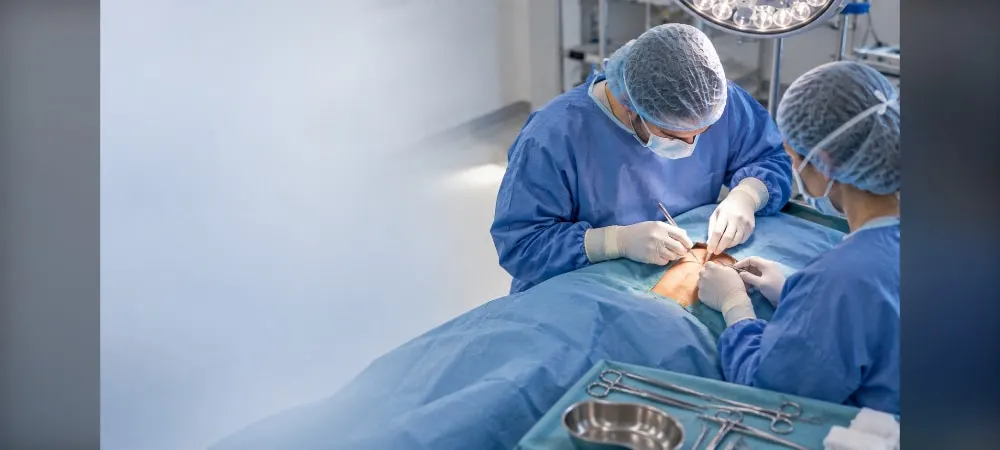
During the surgery, the surgeon first disinfects the area and covers it with sterile drapes. Then the entire sinus and the diseased tissue around it are removed. At this stage, the hairs, pus and other debris inside the sinus are completely cleaned out.
In the first step, the surgeon prepares the infected area and removes the tissues surrounding the cyst. This step prevents the sinus from forming again. Then, when necessary, a drain is placed. The drainage tube prevents fluid accumulation that may occur after surgery, speeds up healing and reduces the risk of infection.
Open and closed wound methods
There are two basic approaches after total excision: leaving the wound open and suturing the wound closed.
Open wound method: After the sinus is removed, the wound is left open and is expected to heal on its own. With this method:
- The risk of infection is lower
- The healing process takes 4-7 weeks on average
- The recurrence rate is between 1-7%
- Patient comfort is lower because regular dressing changes are required
Closed wound method: After the sinus is removed, the wound is closed with sutures. With this method:
- The healing time is generally short, around 2 weeks
- The need for dressing changes is lower
- The recurrence rate varies between 6-22%
- The risk of infection is higher
Flap method and its advantages
The flap method is a technique preferred especially when extensive tissue removal is required. In this method, the cavity that forms is closed by advancing the surrounding healthy tissues.
The flap method has several advantages:
- Extensive tissue can be removed, including the hair cyst, its surrounding capsule and discolored skin
- The wound can be closed without tension
- The depth at the tailbone disappears, which reduces the likelihood of recurrence
- The time to return to daily life is about 1 week
Commonly used flap techniques include the Karydakis, Limberg, V-Y flap and rhomboid flap. With the modified Limberg flap method, although the scar is larger, pain and the risk of recurrence are lower.
Alternatives such as laser and phenol
As an alternative to traditional surgical methods, minimally invasive methods have gained popularity in recent years.
Laser treatment (SiLaT/FiLaC): After the sinus tract is cleaned, a special laser probe is inserted into the tunnel. The sinus walls are closed by being burned in a controlled manner with laser energy. The advantages of laser treatment:
- It does not require an incision or sutures
- Pain is minimal
- Wound care is easy and cosmetic results are excellent
Crystallized phenol application: This is a simple and effective method performed under local anesthesia. After the sinus openings are cleaned, crystallized phenol is placed inside. Phenol chemically clears the hairs and epithelialized tissue within the sinus.
- It does not require hospitalization
- The procedure takes approximately 10-15 minutes
- The patient can walk home or return to work immediately after the procedure
- The recurrence rate is between 15-20%
Other minimally invasive methods include Microsinusectomy and EPSiT (Endoscopic Pilonidal Sinus Treatment). These methods provide less pain, faster healing and more aesthetic results.
Recovery process after surgery
A successful recovery after pilonidal sinus surgery is a part of the treatment that is at least as important as the surgery itself. During this process, proper care and attention are vital for preventing recurrence.
What to pay attention to in the first days
The first days after surgery are a critical stage of the recovery process. During this period, you need to rest and protect the wound. It is recommended that you rest as much as possible for the first 1-2 days. It is important that you regularly use the painkillers your doctor has given you, especially in the first days, and do not interrupt your medication. If you have a drain in your wound, it can usually remain in place for up to 8 days, and you should not bathe during this time. If you experience unusual discharge, bleeding or severe pain after surgery, you should definitely contact your doctor.
Dressing and hygiene rules
Wound care is the most important part of the recovery process. For the first few days, you should change your dressing 1-2 times a day or as often as your doctor recommends. Keeping your wound clean and dry reduces the risk of infection. You should gently clean and dry the area after every toilet use. You should take care to use sterile materials and renew your dressing after every bath. During the recovery process, you can dry the tailbone area 4-5 times during the day so that the wound does not stay moist, sweaty or wet.
Sitting and movement restrictions
In the first days after surgery, you should not sit directly on the wound. Instead, you can prefer lying on your side or on your stomach. The time until you can walk without pain varies according to the technique used; it is on average 27±7.5 days with primary closure and 14±3.5 days with the Limberg flap technique. The time until you can sit on the toilet without pain varies similarly: 24.5±5.5 days with primary closure and 13.5±4 days with the Limberg flap technique. The time to return to work is on average 23±7 days with excision + primary closure and 18±6 days with the Limberg flap method.
Healing time and risk of recurrence
The total healing time varies according to the surgical method chosen. While healing takes 6-8 weeks with methods in which the wound is left open, this time falls to 2-3 weeks with closed techniques. The mean wound healing time is 12.5±4 days with the Limberg flap technique, whereas it is on average 43±8 days with the excision + secondary healing method. The risk of recurrence of a pilonidal sinus varies between 3% and 50%. To prevent recurrence, you should pay attention to your personal hygiene, and if hair density in the area is high, you can have laser hair removal. Regular laser hair removal started one month after surgery reduces the risk of recurrence by 80%.
Frequently asked questions
We have compiled the most frequently asked questions about the treatment of pilonidal sinus for you. You can find answers to the questions you have before treatment.
Will there be a scar after total excision?
A scar after total excision is unavoidable. A wider scar may form especially in wounds treated by being left open. With the microsinusectomy method, only a very small incision is made, so a barely noticeable scar remains. Larger scars are generally seen with flap methods, while cosmetic results are better with minimally invasive methods.
How long does recovery take?
The healing time varies according to the technique used. While healing takes 4-8 weeks in wounds left open, this time falls to 2-3 weeks with the primary closure technique. The mean wound healing time is 12.5±4 days with the Limberg flap technique, whereas it is on average 43±8 days in patients who undergo excision and are left to heal by secondary intention. Considering all techniques, complete healing is generally completed within 4-6 weeks.
How long until I can return to work after surgery?
The time to return to work depends on the technique and the nature of your job. It was found to be on average 11.5±4 days in patients who underwent a Limberg flap and 14.5±4 days in patients who underwent excision and were left to heal by secondary intention. In another study, the time to return to work was reported as 13 days with excision and primary closure and 16 days with the open technique. If you work sitting for long periods, the time to return to work may be longer.
Can a pilonidal sinus recur?
Yes, a pilonidal sinus can recur after treatment. Recurrence rates vary according to the technique used: 18.4% with primary closure, 9.6% with the open technique and 4.3% with the Limberg flap method. If you follow hygiene rules, the risk of recurrence is quite low. In addition, having the hair in the area removed regularly reduces the likelihood of recurrence.
Is local excision sufficient?
Local excision may be sufficient in small and simple cases. However, it may be inadequate depending on the extent and depth of the disease. Total excision is a safer option especially in complicated cases with a higher risk of recurrence. During the preoperative examination, your surgeon will determine the most suitable treatment method for you.
When is wide excision necessary?
Wide excision is generally preferred in recurrent, complicated or abscessed cases. Wide excision may be necessary when the pilonidal sinus is extensive, when there are multiple sinus openings, or when the condition has recurred after previous treatment. To reduce recurrence rates, wide excision is a safer choice, especially when the diseased tissue is large.
In Summary: Total Excision of a Pilonidal Sinus
Success in the treatment of a pilonidal sinus depends on choosing the right surgical method and on postoperative care. Total excision in particular stands out as an effective treatment option because it removes all of the diseased tissue. However, it is extremely important that the surgical method is chosen to suit your situation.
In the period after surgery, paying attention to wound care and hygiene rules will speed up your recovery. In addition, you need to keep the area clean and dry, change your dressings regularly and follow your doctor's recommendations. Otherwise, the risk of infection and the likelihood of recurrence may increase.
Remember that the treatment of a pilonidal sinus does not end with surgery. Postoperative care and lifestyle changes are vital to prevent the disease from recurring. Therefore, showering regularly, keeping the area free of hair and avoiding sitting for long periods reduce the risk of recurrence.
In conclusion, total excision of a pilonidal sinus is a treatment method that gives successful results when performed correctly and when the postoperative period is well managed. It is important to follow your recovery by meeting regularly with your surgeon and to contact your doctor immediately if you notice anything abnormal. If you are patient and follow all the recommendations, you can return to your daily life in good health in a short time.