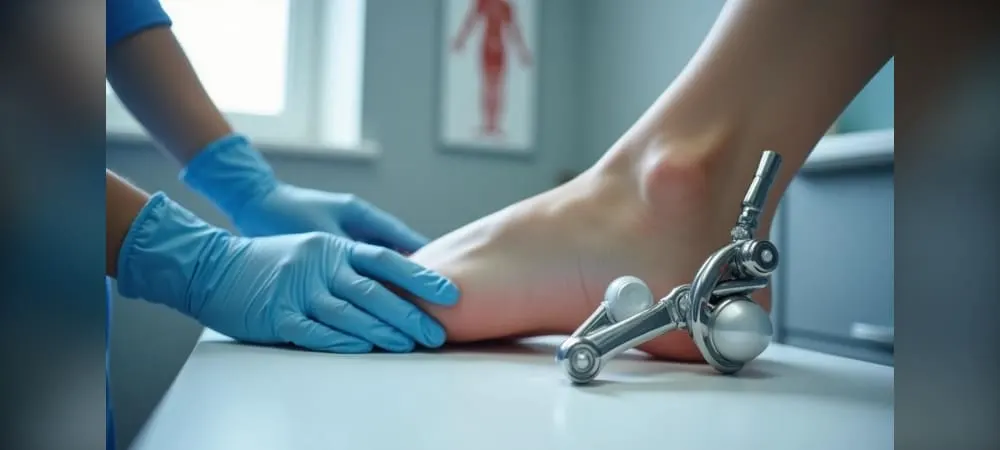
Osteoarthritis and traumatic injuries in the ankle joint can cause severe pain. Ankle arthroplasty is one of the modern treatment methods for these problems. So, what is an ankle replacement, who is it for, and in which cases is it necessary? In this article, you will find all the details you are wondering about ankle replacement surgery.
What Is an Ankle Replacement?
An ankle replacement is a surgical treatment method applied in cases of severe joint damage and osteoarthritis. In this procedure, the damaged joint surfaces are removed and replaced with an artificial joint implant. Also known as ankle arthroplasty, this procedure works on a principle similar to hip and knee replacements.
During the replacement procedure, the damaged cartilage and a portion of the bone tissue on the lower surface of the shinbone (tibia) and the upper surface of the talus bone are removed. Components made of metal alloys and a high-density polyethylene piece placed between them to ensure smooth movement are put in their place.
Ankle replacement surgery is an option resorted to when no results can be obtained from all other joint-preserving treatment methods. Therefore, it is considered the last resort treatment method.
Function and Importance of the Prosthesis
The primary purpose of an ankle replacement is to eliminate severe pain caused by osteoarthritis. However, the prosthesis not only relieves pain but also preserves the natural up-and-down movement of the ankle. Thanks to this feature, patients regain the ability to walk comfortably again.
When joint damage occurs, natural functions cannot be performed. This leads to pain, swelling, and restricted movement. Ankle replacement is a frequently preferred method in solving these problems.
The prosthesis is different from ankle fusion surgery, which completely eliminates joint movement. Because it preserves mobility, patients can return to their daily activities more easily. It also restores freedom of movement, which directly affects the quality of life.
Different types of prostheses are chosen according to the patient's needs. Total ankle replacement involves replacing the entire joint. Partial replacement is used in cases where only the damaged section needs to be replaced. Mobile-bearing prosthesis preserves the natural mobility of the ankle and is preferred in individuals leading an active life. Fixed-bearing prosthesis provides stability by limiting the joint's ability to move.
Prevalence of Prosthesis Use
Ankle replacement has been a practiced procedure for about 25 years. Although it is not as common as hip and knee replacements, success rates have increased significantly with recent technological developments.
Current studies show a patient satisfaction rate of approximately 90 percent in the first four years after surgery. These data reveal that the prosthesis is an effective treatment option.
The average lifespan of prostheses applied with the correct technique and with a successfully completed rehabilitation process is around 15-20 years. Thanks to modern medical technology and new-generation materials, this duration has become quite extended today. Scientific research shows that with proper use, prostheses serve trouble-free for 10 to 15 years, or even longer periods.
The success of prostheses depends on both implant quality and surgical technique. Implants produced from biocompatible materials designed according to international standards are used. The patient's age and usage status are among the factors affecting the prosthesis lifespan.
Who Is an Ankle Replacement For?
Patient selection is the most important key to success in ankle replacement surgery. Not every osteoarthritis case requires a prosthesis. Certain criteria are taken into account for successful results.
Patients Experiencing Advanced Osteoarthritis
Individuals experiencing advanced joint osteoarthritis constitute the most common patient group for ankle arthroplasty. Cases where the cartilage tissue is completely worn away and bone rubs against bone are considered suitable for prosthesis application.
Osteoarthritis, rheumatoid arthritis, or other inflammatory joint diseases can lead to severe loss of function. These diseases cause permanent destruction in the joints. In cases of severe pain and restricted movement unresponsive to conservative treatments, surgical intervention is evaluated.
Rheumatic diseases are systemic disorders that destroy joints. Conditions such as rheumatoid arthritis rapidly disrupt joint structure. Therefore, prosthesis application is frequently considered in this patient group.
Patients Who Have Suffered Traumatic Injuries
Severe fractures or dislocations experienced in the past can cause the joint to deteriorate rapidly. As a result of accidents, falls, or sports injuries, the ankle can be damaged beyond repair.
Post-traumatic joint disorders are among the conditions requiring a prosthesis. Comminuted fractures extending into the joint lead to osteoarthritis over time. In addition, frequently recurring injuries cause permanent damage to the joint surfaces.
Patients with Congenital Joint Problems
Some people experience structural disorders in the ankle joint from birth. These anomalies can lead to severe loss of function in later ages. For example, joint developmental disorders make normal walking difficult.
Although congenital problems begin at a young age, growth must be completed for prosthesis application. The procedure is performed on patients who have completed their development.
Patients Experiencing Recurrent Ankle Fractures
Prosthesis is considered suitable for individuals who have ankle fractures repeating multiple times. Non-healing or recurrent fractures disrupt the joint structure irreversibly.
Joint osteoarthritis resulting from the inability to repair the damage creates the need for a prosthesis. The risk of frequent sprains and fractures is higher in overweight individuals. Joint damage may develop as a result of frequent sprains related to obesity.
Patients Who Do Not Benefit from Other Treatment Methods
Ankle replacement is generally applied to patients who have tried all treatment options and have not seen any benefit. Severe pain to which painkillers and physical therapy no longer respond strengthens the prosthesis indication.
Prosthesis can be considered in advanced cases where no benefit is seen from medication and physical therapy. However, it should not be applied to patients under the age of 55 unless there is an exceptional situation. Those with active diabetes, bone deformities, and active infections in the ankle are not suitable for this surgery.
In Which Cases Is an Ankle Replacement Performed?
Prosthesis application comes to the agenda under certain conditions. The extent of joint damage and the response to treatment affect this decision. The answer to the question of in which cases and why ankle replacement is performed is directly related to the degree of deterioration in joint functions.
Complete Loss of Joint Functions
The complete wear of cartilage tissue prevents the joint from performing its basic tasks. Cartilage is not a self-renewing tissue. Therefore, once lost, there is no turning back.
Comminuted fractures extending into the joint lead to severe deterioration over time. Such injuries experienced in the past cause osteoarthritis in the future. When bone surfaces begin to rub against each other, the pain becomes unbearable.
In individuals needing a prosthesis, smoothness on the joint surfaces has been lost. Damaged cartilage eliminates normal mobility. Therefore, artificial joint surfaces are needed.
Severe Movement Restriction and Pain
There is persistent pain in patients requiring ankle arthroplasty. Swelling and morning stiffness make daily life difficult. In addition, loss of movement gradually increases.
Pain intensifies significantly during long walks. A feeling of friction occurs in the joint, which is called crepitus. Patients feel discomfort with every step.
Severe end-stage ankle arthritis leads to loss of function. Severe pain unresponsive to conservative treatments necessitates surgical intervention. When painkillers are no longer effective, alternative solutions are sought.
Daily Activities Being Seriously Affected
Low quality of life is an important indicator for ankle replacement surgery. The patient's daily activities are restricted. Even simple movements create difficulty.
Difficulty walking negatively affects independent living. Climbing stairs, shopping, or even walking a short distance becomes a problem. Therefore, the patient's freedom of movement decreases significantly.
Due to pain and movement restriction, social activities are avoided. This situation also negatively affects mental health. Prosthesis surgery offers a solution to health problems that severely reduce the quality of life.
Failure of Conservative Treatments
The lack of benefit from conservative methods such as medication, injections, and physical therapy strengthens the decision for a prosthesis. First, non-surgical treatment options are tried. However, when these fail, surgical intervention comes to the agenda.
Situations where painkillers and physical therapy no longer respond constitute the prosthesis indication. This decision must be made as a result of a detailed evaluation. An orthopedist expert in foot and ankle surgery should make the evaluation.
Ankle replacement is applied to patients who have tried all treatment options and have not seen any benefit. This procedure is a last resort treatment method. If success cannot be achieved with non-surgical treatments, surgery comes to the agenda.
Factors such as the patient's age, general health status, and lifestyle are taken into account during the decision process. Prosthesis is a successful option to improve joint functions and get rid of pain.
How Is Ankle Replacement Surgery Performed?
Understanding the surgical process reduces patients' anxiety. Knowing what will happen at each stage allows you to spend the process more controlled. Ankle replacement surgery is a planned procedure, and proper preparation is essential for success.
Preoperative Preparation Process
Before the decision for surgery is made, a comprehensive evaluation is performed. The severity, duration, and your expectations of the pain are questioned. Past treatments and your accompanying diseases are examined.
During the physical examination, the ankle range of motion is carefully measured. The presence of deformity, stability of ligaments, and skin condition are checked. Pulses and nerve functions are evaluated.
Imaging methods are of vital importance. Weight-bearing X-rays taken while standing show the severity of osteoarthritis. Computed tomography evaluates bone stock in three dimensions and is used to plan the prosthesis size. Magnetic resonance imaging may be requested to examine soft tissue status.
Before surgery, tests such as blood tests, ECG, and chest X-ray are performed. A consultation is held with the anesthesiologist. Chronic diseases such as diabetes and blood pressure must be brought under control. Your written consent is obtained, and the hospital appointment is scheduled.
Anesthesia and Surgical Procedure Steps
General or spinal anesthesia is applied during the surgery. The procedure is usually performed by administering anesthesia from the waist down. A tourniquet device is attached to the leg to reduce bleeding.
The surgical procedure is performed with the following steps:
The joint is reached through an incision made on the front surface of the ankle
Damaged cartilage and bone layer are cleaned
Shinbone and talus surfaces are prepared with special cuts
Metal prosthesis components are placed on bone surfaces
A plastic spacer is placed between them
Range of motion is checked and the operation is completed
Nerves, vessels, and tendons are carefully protected during the surgery. Prostheses are fixed to the bone with or without cement. The duration of surgery is usually between 1-2 hours.
Postoperative Recovery Process
The length of stay in the hospital is 1-2 days. In the first few days, you should not step fully on your operated foot. The first 3 weeks, especially when the prosthesis heals/fuses, are of critical importance.
For the first 4 weeks, your leg is protected inside a cast or a special walking boot. During this process, you should keep your foot above heart level. This is important to reduce swelling and accelerate the healing of the incision.
After four weeks, you begin walking with a protective boot. At eight weeks, most patients can wear normal shoes. Within three months, you can bear full weight and return to your normal life. Return to normal daily activities usually takes 3-6 months. The complete recovery process is completed within the range of 6-12 months.
Physical Therapy and Exercise Program
Physical therapy is extremely important for ankle replacement surgeries. It starts the day after surgery. This early mobilization accelerates recovery and reduces the risk of complications.
The main goals of physical therapy are to restore joint range of motion, increase muscle strength, and improve balance. A custom exercise program is arranged for you. Exercises started in the hospital should be done regularly at home as well.
In the early period, a walker or crutches are used. Over time, support is reduced, and independent walking is transitioned to. Muscle strengthening programs support the prosthesis and surrounding muscles. Therefore, your compliance with physical therapy directly affects surgical success.
You need to be patient during this process. You should avoid sudden movements. You must not neglect your doctor check-ups. Thanks to this, the status of the prosthesis is closely monitored.
Frequently Asked Questions
Is ankle replacement surgery risky?
Like every surgical intervention, ankle arthroplasty carries certain risks. However, these risks can be minimized with proper precautions.
Infection is one of the most important risks of surgery. Because the skin around the ankle is thin, this risk may be slightly higher compared to hip or knee replacements. Antibiotic use and sterile surgical conditions reduce the risk of infection.
Wound healing problems may be seen. Careful care is required due to the skin structure in the region. Nerve damage rarely develops and can cause numbness or weakness in the foot. Deep vein thrombosis or blood clot formation is also among possible complications.
Prosthesis loosening is the most common cause of revision in the long term. Implant-related problems such as wear, periprosthetic fracture, or subsidence may appear over time. Therefore, every surgery has risks, and the physician's duty is to perform the operation by taking all precautions.
How long does a prosthesis last?
Depending on the patient's age, usage status, and implant features, the lifespan of the prosthesis varies. With the correct surgical technique, the average lifespan is around 15-20 years.
Thanks to modern medical technology and new-generation materials, durability has increased significantly. Scientific research shows that successfully applied prostheses serve trouble-free for 10 to 15 years, or even longer periods with proper use.
Worn prostheses can be replaced with a new surgery using revision implants. On the other hand, in elderly individuals with low activity levels, the first prosthesis may be sufficient for life. The prosthesis may wear out over time and replacement may be necessary when a certain level is reached.
What is the recovery time to normal after surgery?
The patient is called for check-ups in a mobilized manner on the 20th day of surgery. They return to normal life in six to eight weeks.
The complete recovery process is completed within the range of 6-12 months. At four months, you will be better than before surgery. At six months, you will have recovered by approximately 75 percent.
Most patients can walk using a protective boot four weeks after surgery. Walking by wearing normal shoes is possible at eight weeks. Most patients can drive eight weeks after right ankle surgery, and earlier for the left ankle.
Return to normal daily activities usually takes 3-6 months. There are no prohibitions after surgery, and the patient can perform their normal worship.
Can sports be played after prosthesis surgery?
Sports is one of the subjects patients wonder about the most. Low-impact sports can generally be started after 8-12 weeks.
Swimming, walking, and stationary cycling are recommended. Swimming creates minimal stress on the joint and is safe for patients with prostheses. However, high-impact sports such as running and jumping should be avoided.
Patients with an ankle replacement cannot engage in contact sports requiring running and activities that will strain the joint. Hard and collision-prone sports such as football, basketball, and volleyball are not recommended. For example, tennis strains the joint because it involves rapid direction changes.
Low-impact exercises can extend the lifespan of the prosthesis by maintaining muscle strength. High-impact sports increase the risk of loosening, wear, or dislocation in prosthesis components.
What are the advantages and disadvantages of an ankle replacement?
Ankle replacement treatments have certain advantages and disadvantages. It is recommended to get detailed information from your physician before treatment.
Advantages: It allows the joint that has lost its movement to become workable. It provides preservation of joint movement and a more natural gait pattern. It reduces excessive loading on neighboring joints. Unlike arthrodesis, two-way mobility continues. In a well-done operation, it can be used for 15-20 years.
Disadvantages: It allows less movement compared to a natural healthy joint. After the prosthesis is made, the patient cannot walk without the prosthesis; it is an irreversible binding treatment. Strain, trauma, osteoporosis, or excessive weight changes over the years increase the risk of prosthesis loosening. As a result, a revision prosthesis may need to be performed.
Ankle Replacement in Summary
Ankle replacement is an effective treatment option for patients experiencing advanced joint damage. It eliminates pain and restores mobility. Therefore, it directly improves your quality of life.
However, this surgery is not suitable for every patient. Correct patient selection is the key to success. First, try all non-surgical treatment methods. In cases where you cannot get results, evaluate the prosthesis option by consulting an expert orthopedist.
When you decide on surgery, participate regularly in your physical therapy program. Thanks to this, your prosthesis serves for a longer time, and your return to normal process accelerates.