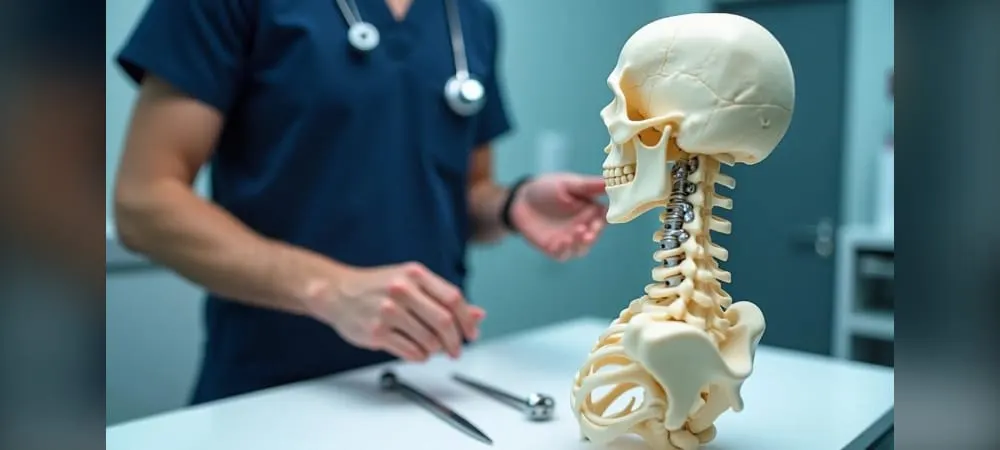
For those seeking a motion-preserving method in cervical disc herniation surgeries, a cervical disc prosthesis offers an important option. Essentially, this procedure involves removing the damaged cervical disc and replacing it with a mobile artificial component. Modern prostheses have become widespread since the 2000s, and today there are many reliable FDA-approved designs. The greatest advantage of the prosthesis is that it preserves motion in the operated area.
In this article, you will find everything you need to know about cervical disc prosthesis surgery, who it can be applied to, and what needs to be considered after the surgery.
What is a Cervical Disc Prosthesis?
Definition and purpose of a cervical disc prosthesis
A cervical disc prosthesis is the procedure of removing a degenerated or herniated disc in the neck and replacing it with a mobile artificial implant. In medical terms, this procedure is also called cervical disc arthroplasty or artificial disc replacement.
The primary task of the prosthesis is to mimic the movement of the natural disc. It ensures that flexion, extension, and rotation movements in the neck region are maintained after surgery. Thus, you can move your neck comfortably in daily life.
The first attempts at cervical disc prostheses date back to the 1960s. However, the widespread use of modern prostheses began in the 2000s. Today, many different FDA-approved prosthesis designs are available, and long-term follow-up studies show that these prostheses are reliable.
Prosthesis types and materials
Cervical disc prostheses are produced from bio-compatible materials that your body will accept. The most commonly used materials include titanium, a cobalt-chrome-molybdenum mixture, and polyethylene. Some prostheses also contain ceramic alloys.
Prostheses consist of two metal plates and, most often, a core made of polyethylene. They come in different sizes, shapes, heights, and angles. Thanks to this variety, a prosthesis suitable for each patient's anatomy can be selected.
Special patterns are applied to the surfaces of the prostheses to provide bone fixation support. In this way, the prosthesis is firmly placed in the spine and integrates with the bone over time.
Differences from fusion surgery
In traditional neck hernia surgery, the anterior cervical discectomy and fusion (ACDF) method is applied. In this procedure, after the damaged disc is removed, a bone graft or cage is placed between two vertebrae to ensure the fusion of the vertebrae. Although fusion is a successful method, movement in the operated area is completely eliminated.
On the other hand, the biggest difference of a cervical disc prosthesis is that it preserves motion at the operated level. This feature offers significant advantages in the long term.
After fusion surgeries, additional load is placed on the discs above and below the fixed segment. Over time, degeneration may also develop at these levels. This condition is called adjacent segment disease. A disc prosthesis aims to reduce this risk and decrease the need for reoperation in the long term.
In fact, adjacent segment disease usually appears after 10 years and may require re-surgery in 10% of patients. The main purpose of the prosthesis is to eliminate such a surgical requirement.
Who Is a Cervical Disc Prosthesis Applied To?
Cervical disc prosthesis surgery is not a method that can be applied to every neck hernia patient. Correct patient selection plays a decisive role in the success of the surgery. Surgeons evaluate the patient's age, bone quality, spinal alignment, and accompanying problems together before the surgery.
Suitable patient profile and conditions
The answer to the question of who receives a cervical disc prosthesis requires the presence of certain conditions. First, you must have a symptomatic neck hernia or disc degeneration. Symptoms such as arm pain, numbness, or spinal cord compression must be confirmed by imaging methods.
The fact that you have not responded to conservative treatment is an important criterion. Your complaints must persist despite at least 6 weeks of medication and physical therapy. According to some sources, this period is also stated as 4-6 weeks. When you cannot overcome the medical treatment and exercise program, your candidacy for surgery is evaluated.
Disc involvement should generally be limited to one or two levels. Patients with problems in a single disc on MRI findings constitute the ideal patient group. Patients with disc damage at multiple levels may also be candidates for surgery, but this requires more careful evaluation.
Age and activity level criteria
The subject of age is an important factor in the application of a cervical disc prosthesis. The ideal patient group consists of healthy adults between the ages of 20-40. On the other hand, accepted criteria state the age as 30-50. It is generally considered suitable for patients between 18-60 years old.
Young and active patients are more suitable candidates for this method. Prosthesis surgery is preferred especially when you are looking for a motion-preserving solution. If you want to maintain your active lifestyle and do not want to lose your neck movements, this surgery can be considered for you.
Bone quality and spinal health requirements
The fact that your bone quality has not deteriorated is one of the fundamental requirements for why a cervical disc prosthesis is applied. In patients with osteoporosis, because bone quality is poor, the spine may break during the placement of the hard metal disc. If you have advanced osteoporosis, this surgery is not suitable for you.
Your disc height must be at a sufficient level. The disc height should not be less than 5 mm, or according to some criteria, at least 4 mm. A narrowed disc space makes the placement of the prosthesis difficult.
The fact that your facet joints are intact is another necessity. There should be no posterior column damage, and especially no facet joint degeneration. If there is advanced arthrosis in the small vertebral joints, it is not possible to place a disc prosthesis. If facet joint arthritis has progressed, other treatment alternatives are evaluated.
If you have instability in your spine, significant kyphosis deformity, a tumor, infection, or a history of trauma, this surgery cannot be performed. In addition, if you have a metal allergy, or autoimmune diseases such as rheumatoid arthritis or ankylosing spondylitis, alternative treatments are resorted to.
Why Is a Cervical Disc Prosthesis Applied?
The main purpose of the surgery is to remove the mechanical pressure on the nerve root or spinal cord. When this pressure is removed in the early period, chronic and permanent changes that may occur in the nerve tissue over time are prevented.
Neck hernia and nerve compression
The primary answer to the question of why a cervical disc prosthesis is applied is nerve compression due to a neck hernia. Radiculopathy findings such as pain radiating to the arm, numbness, or loss of strength constitute the main indication for surgery. The compression of nerve roots emerging from the cervical vertebrae causes severe pain in your arm.
Cases of myelopathy with signs of spinal cord compression are also suitable for cervical disc prosthesis surgery. It is not allowed for the spinal cord to be permanently damaged due to the herniation causing pressure, for your walking to be interrupted, or for a disability situation to arise in your limb movements. Especially when imbalance in walking, loss of fine motor skills in the hands, or loss of bladder control in advanced stages is seen, urgent intervention is required.
Degenerative disc disease
Advanced disc wear is another reason for the application of a cervical disc prosthesis. Discs begin to lose water over time, and this situation usually accelerates after the age of 30. As degeneration progresses, the discs dry out and begin to strain the nerves.
Disc degeneration does not always cause pain, but when it progresses, chronic neck pain, discomfort that increases with movement, and pain radiating to the leg or arm occur. This surgery is also considered in patients who develop spondylotic radiculopathy or spondylotic myelopathy.
Cases that do not respond to conservative treatment
The fact that your symptoms do not improve despite at least 6 weeks of conservative treatment is an important criterion in the decision for surgery. When physiotherapy and medication-based pain treatment do not show sufficient effect, surgical options are evaluated.
If there is pain resistant to medical treatment, progressive nerve damage, or signs of spinal cord compression, surgery becomes inevitable. As the pressure on the nerve increases, nerve damage can become permanent, and loss of strength in the muscles can occur over time.
Situations where it cannot be applied and contraindications
In some cases, cervical disc prosthesis surgery cannot be performed. If you have advanced osteoporosis, a tumor in your spine, a bacterial infection, or advanced arthrosis in the small vertebral joints, it is not possible to place a disc prosthesis.
Autoimmune diseases such as ankylosing spondylitis and rheumatoid arthritis constitute a contraindication. In the presence of instability or abnormal mobility at the level planned for surgery, significant kyphotic deformity, previous cervical spine surgery, and metal allergy, prosthesis surgery cannot be preferred.
When moderate or severe facet arthritis is detected both clinically and radiographically, the surgery is not performed. Preserving motion at the operated level can exacerbate pain in arthritic facet joints. Furthermore, a prosthesis is not recommended for patients whose disc space has collapsed by more than 50%.
Cervical Disc Prosthesis Surgery Process
Pre-operative preparation and examinations
A comprehensive evaluation is performed before cervical disc prosthesis surgery. After your neurological examination, the condition of the disc and the level of nerve compression are determined with a cervical MRI. Additionally, cervical dynamic radiographs are taken. These special X-rays show the limits of your neck movements.
Bone density measurement is important, especially in patients over 50, in terms of predicting the integration of the prosthesis with the bone. If you smoke, it is recommended that you quit at least 4 weeks before the surgery. You need to stop your blood-thinning medications within the period determined by the surgeon.
In some cases, nerve conduction tests can also be performed. These tests distinguish whether the involvement in the nerve is caused by a neck hernia or another problem.
Surgical stages and duration
Cervical disc prosthesis surgery is performed under general anesthesia. An incision of approximately 3-5 cm is made from the front of the neck. The esophagus and trachea are carefully pulled to the side to reach the spine.
First, the diseased disc is completely removed. If herniated tissue remains inside the spinal canal, these are cleaned. Calcifications are also removed. Then, the dimensions of the disc space are measured, and a suitable prosthesis is selected.
Vertebral surfaces are prepared for the prosthesis to sit. The selected artificial disc is placed precisely. At this stage, the position of the prosthesis is checked with live X-ray. Thanks to the rough surfaces of the metal plates, the prosthesis joins with the adjacent vertebrae in the following weeks.
Different protocols are applied regarding the duration of the surgery. In general, the procedure takes 60 minutes. On the other hand, it is completed between 1-2 hours in some centers. The surgery can also end within 90 minutes.
First days after surgery
After the surgery, you are taken to the recovery room. Here, your heart and lung functions are monitored. Bed rest is recommended on the day of the surgery. Temporary mild swallowing problems or muscle stiffness are treated.
The length of hospital stay varies according to the applied protocol. In most patients, the length of stay is 1-2 days. Patients usually stay in the hospital for only one day and are discharged the next day. On the other hand, in some protocols, it is necessary to stay in the hospital for about ten days.
It is recommended that you rest and avoid stiff neck movements within the first 1-2 weeks. Sensitivity in the throat or stiffness in the neck may be seen, but these are usually temporary. Relief in arm pain is expected in the early period.
Things to Consider After Cervical Disc Prosthesis Surgery
Recovery process and timeline
Discharge takes place on the same day or the next day after the surgery. Most patients can go home within 1-2 days. This period is significantly shorter than fusion surgeries.
In the first week, you may experience mild neck pain and difficulty swallowing. These are temporary conditions and improve within a few weeks. You may feel sensitivity in your throat, but there is no need to worry.
It is recommended that you rest and avoid stiff neck movements for the first 1-2 weeks. Afterward, you return to your normal daily life without any restrictions. Even in the early period, there is no need for your neck movements to be restricted.
Between the 2nd and 4th weeks, you can gradually return to your daily activities. You can usually start desk jobs after 2 weeks. Within a few weeks, most patients return to working life. Your neck movements normalize in the 4th-6th week.
After the third month, you can plan your return to heavy physical activities and sports. Full recovery can take up to six months. However, you can start the vast majority of daily activities at a much earlier period.
Physical activity restrictions
Unlike fusion surgeries, the use of a neck brace is generally not necessary. There is no need for a hard neck collar. This situation allows for early mobilization.
In the first weeks, you should avoid sudden neck movements and heavy lifting. For those working at a desk, returning to work is possible after 2-3 weeks. More intense physical activities are planned after a controlled examination.
It is recommended that you take a four-week break from driving. You also need to wait the same amount of time to ride a bicycle. After about ten weeks, you can continue sports such as golf and tennis.
Possible complications and risks
Some risks may be seen after cervical disc prosthesis surgery. However, in experienced hands, complication rates are quite low.
Temporary difficulty swallowing may appear in the post-operative period. It usually improves within a few weeks. Hoarseness may also be seen, but this condition is temporary.
Heterotopic ossification is unwanted bone formation around the prosthesis. It is seen at a rate of 5-10% and can lead to loss of motion. Prosthesis migration is very rarely seen in modern prostheses.
Infection and bleeding can be seen at a low rate as in all surgical procedures. If you feel unexpected pain or numbness, you should definitely consult your doctor.
Long-term care and follow-up
A cervical disc prosthesis is permanent and durable. It does not need to be removed or replaced in the future. Current studies show that prostheses can remain functional for 15-20 years and longer.
Since it does not disrupt the natural movements of the neck, it does not cause any restrictions in daily life. It provides an advantage in the long term because it protects other healthy discs.
You need to go to your regular follow-up appointments. Your doctor will perform checks to ensure that the prosthesis is working properly.
Frequently Asked Questions
Is disc prosthesis surgery painful?
Since the surgery is performed under general anesthesia, you do not feel pain during the procedure. You may experience mild pain in the neck and difficulty swallowing for a few days after the surgery. However, these are brought under control with standard painkillers.
The vast majority of patients report that arm pain decreases dramatically within the first week after surgery. In fact, it is observed that the pain eases immediately after the surgery. The temporary discomfort in the neck is much milder compared to your old hernia pain.
When is it returned to normal after surgery?
The recovery process is significantly faster than fusion surgeries. Most patients are discharged on the same day or the next day after the surgery.
Mild neck pain is seen in the first week, but these are temporary. Light walking is encouraged from the first week. You can usually return to desk jobs after 2 weeks.
Between the 2nd and 4th weeks, a gradual return to daily activities begins. Neck movements normalize in the 4th-6th week. It is recommended that you take a four-week break from driving. You also need to wait the same amount of time to ride a bicycle.
After the 3rd month, a return to heavy physical activities and sports can be planned. The period of incapacity for work is 8 weeks on average.
How long is the prosthesis life?
Cervical disc prostheses are designed to be long-lasting. Current clinical studies show that prostheses can remain functional for 15-20 years and above.
The life of the prosthesis depends on the quality of the material used, your activity level, and your bone quality. Prostheses prepared with the use of quality products can be used for up to 20-25 years. Especially in overweight patients or people living a very active life, the prosthesis life may vary.
Even if the prosthesis wears out over time, conversion to fusion surgery is possible when necessary. Therefore, the prosthesis will serve you for many years.
Can sports be played?
Yes, after the recovery process is completed, a return to many sports activities is possible. One of the most important advantages of a disc prosthesis is that it offers better functional results to athletes thanks to its preservation of neck mobility.
You can start light exercises such as walking after 2-4 weeks. Swimming may be suitable after 6-8 weeks. After about ten weeks, you can continue playing golf and tennis.
For weight lifting, running, and contact sports, it is generally necessary to wait 3-6 months. However, it is recommended that you discuss high-contact sports such as boxing and American football in detail with your surgeon. Planning your sports activities with the knowledge of your doctor is important for the preservation of prosthesis durability.
In Summary, Cervical Disc Prosthesis
A cervical disc prosthesis offers a reliable option that preserves motion in the treatment of neck hernia. Although it is not suitable for every patient, it provides significant advantages compared to fusion surgery under the right conditions. It promises better results in the long term, especially for young and active patients.
Before making a decision for surgery, you need to discuss it in detail with your doctor. Your bone quality, age, and general health status should be evaluated. Undoubtedly, intervention in the early period prevents nerve damage from becoming permanent.
The recovery process after prosthesis surgery is fast, and most patients return to their daily lives in a short time. You can increase your quality of life by preserving your neck movements.