When you experience hoarseness, you may wonder whether this condition is temporary or a sign of a more serious issue. Changes such as a muffled voice, tremulous speech, or a whispered voice are common symptoms of vocal cord diseases. Therefore, it is important to understand the causes of the changes you notice in your voice.
In this article, you will find what you need to know about the symptoms of vocal cord diseases, causes of vocal cord diseases, and treatment of vocal cord diseases. We will also seek answers to the question of how hoarseness goes away.
What Are Vocal Cord Diseases?
Vocal cord diseases encompass disorders, infections, or structural abnormalities occurring in your vocal cords. These diseases are divided into three main categories based on their causes.
Structural Vocal Cord Diseases
Structural diseases stem from physical changes in your vocal cords. A vocal cord nodule is a benign condition resulting from the prolonged misuse of your voice. It is frequently seen in individuals who use their voice intensively, such as teachers, call center operators, and singers. Nodules generally appear as two opposing bumps in the middle section of the vocal cords.
A vocal cord polyp, on the other hand, is a soft tissue piece with or without a stalk on your vocal cord. It typically develops after bleeding into the vocal cord in individuals who abuse their voice. For this reason, they appear red in color; sometimes, when the blood inside them clots, they can be of a darker color.
Reinke's edema is observed in middle-aged women who have a long history of smoking and intensive speaking habits. It develops as a result of the accumulation of a jelly-like substance under the mucosal layer covering your vocal cord. This condition causes a deep and rough voice that is perceived as a male voice over the phone.
A vocal cord granuloma occurs in patients with a history of poor voice use, reflux, or undergoing surgery under general anesthesia. Laryngeal papillomatosis consists of benign soft tissue pieces caused by the Human Papilloma Virus (HPV).
Neurogenic Vocal Cord Diseases
Neurogenic diseases occur due to nervous system abnormalities. Vocal cord paralysis is the most common example of this category. The nerves that move your vocal cords originate in the brain, pass through the neck and rib cage, and reach the vocal cords. If they are damaged anywhere along this path, vocal cord paralysis develops.
Traumas to the head and neck region, tumors, surgical interventions, and viral infections accompanied by nerve involvement can cause paralysis. Spasmodic dysphonia and vocal tremors are also among neurogenic disorders.
Functional Vocal Cord Diseases
Functional diseases stem from the incorrect use of the larynx and diaphragm without anatomical or neurological abnormalities. In this condition, your vocal cords are structurally normal but cannot perform the proper phonation function.
Muscle tension dysphonia develops due to increased muscle tone in the larynx. Vocal fatigue, on the other hand, results from the overuse of the voice and fatigue of the laryngeal muscles. When functional dysphonia lasts long and incorrect use continues, it can turn into organic lesions such as nodules and polyps.
Causes of Vocal Cord Diseases
Multiple causes play a role in the emergence of vocal cord diseases. Different factors, ranging from a simple infection to serious conditions, can affect your voice.
Excessive or Incorrect Use of the Voice
Incorrectly using your voice for a long time leads to the formation of nodules. Specifically, shouting, speaking loudly, or having to constantly speak in noisy environments causes callosity-like bumps on your vocal cords. These benign masses are frequently seen in individuals who use their voice intensively and smoke.
Incorrect use of the voice, such as sudden shouting, creates hemorrhages in the vocal cords and causes the formation of polyps. Smoking can also cause damage to your vocal cords, facilitating polyp formation. The patient usually does not feel pain from this condition, but notices it when blood comes up with coughing.
Reflux and Acid Irritation
Acid contents coming from the stomach can lead to edema and a toxic effect in your vocal cord region, causing hoarseness. Hoarseness and fatigue are observed in 50% of reflux patients. In this condition, you constantly feel the need to clear your voice.
It is generally observed that your voice is worse in the morning hours and improves during the day. Your eating habits, consumption of tea, coffee, and acidic beverages, and smoking increase reflux complaints. Acidic stomach contents irritate your vocal cords, leading to inflammation, wounds, and a drop in voice quality. Parallel to the treatment of reflux, your hoarseness problem also disappears.
Nerve Injuries
Paralysis occurs when the nerves that move your vocal cords are damaged. Damage to the nerve during thyroid and heart surgeries is among the most frequent causes. Additionally, injuries in the neck and chest region, tumor compression, or pressure applied during general anesthesia can lead to nerve damage. Viral infections can involve the nerve and cause vocal cord paralysis.
Tumors and Masses
Malignant masses constitute one of the significant factors of hoarseness. Laryngeal cancer should be suspected, especially when recurring hoarseness or changes in voice quality are observed in individuals who smoke. Vocal cord cancer is most closely associated with smoking.
Viral Infections
Upper respiratory tract infections such as the flu, common cold, and sinusitis cause redness and edema in the region where your vocal cords are located, creating hoarseness. Post-nasal drip linked to infections leads to a condition called laryngitis, and the edema formed on the vocal cords brings about hoarseness. In some cases, intense cough reflexes tied to the tickling caused by post-nasal drip in the throat create traumatic voice hoarseness.
Additionally, blood pressure medications and estrogen-containing birth control pills can cause dryness in the vocal cords of some individuals, leading to the voice becoming hoarse and crackly.
Symptoms of Vocal Cord Diseases
Recognizing vocal cord diseases early makes a huge difference in your treatment process. Symptoms range widely from mild discomforts to serious health problems.
Hoarseness and Voice Changes
Hoarseness is the most common symptom of vocal cord diseases. It manifests as a drop in your voice level, cracking, a wheezy voice, or complete loss of voice. The condition of producing a muffled, weak, or intermittent voice is called dysphonia.
When your voice starts coming out differently than normal, you may experience this in various ways. You may notice a crackly, deep, high-pitched, or breathy voice quality. In some cases, your voice becomes tremulous or rough. You experience interruptions during speech and lose your ability to sing.
You feel fatigue in your voice, and as you speak, you sense tension or pain in your throat or neck. Voice cracking and fatigue are frequently seen in occupational groups that use their voice intensively, such as teachers and call center operators. Inability to shout and speak loudly are also among the problems you experience.
Pain and Tension in the Throat
Feeling pain in your throat or neck when speaking is a significant symptom of voice disorders. Discomfort may occur on the outside of your throat with a gentle touch. You notice that your larynx gets tired after speaking.
You experience burning sensations, itching, and soreness in your throat. Your pain may increase even more when swallowing. In some patients, a lump sensation in the throat is present. These symptoms can appear during speech, while swallowing, or at rest.
Shortness of Breath and Difficulty Swallowing
In severe cases, swollen vocal cords narrow your airway, making it difficult for you to breathe. Feeling short of breath while speaking is evaluated as a serious symptom. Especially in patients with vocal cord paralysis, shortness of breath is seen together with hoarseness.
Difficulty swallowing is another issue that your vocal cord diseases may accompany. You experience a choking sensation and coughing while eating. Food and liquids can escape into your windpipe, causing coughing fits. This condition is called aspiration, and when it recurs, your risk of having frequent pneumonia increases.
In hoarseness associated with cancer, shortness of breath, blood in the throat especially with coughing, bad breath, and difficulty swallowing can be observed. If there are symptoms such as hoarseness lasting longer than two weeks, difficulty swallowing, or bloody sputum, you need to consult a doctor without losing time.
Diagnosis of Vocal Cord Diseases
When diagnosing vocal cord diseases, your doctor first evaluates your complaints in detail and performs a physical examination. This process is necessary to determine both the presence and severity of the disease.
Physical Examination
During the physical examination, your doctor reviews your medical history and symptoms. They ask detailed questions about your voice use habits, health problems, and the development of complaints belonging to your voice. An evaluation of voice quality is performed, and the movement of your vocal cords during breathing and speech is observed. The examination of your neck and chest region is also part of this process.
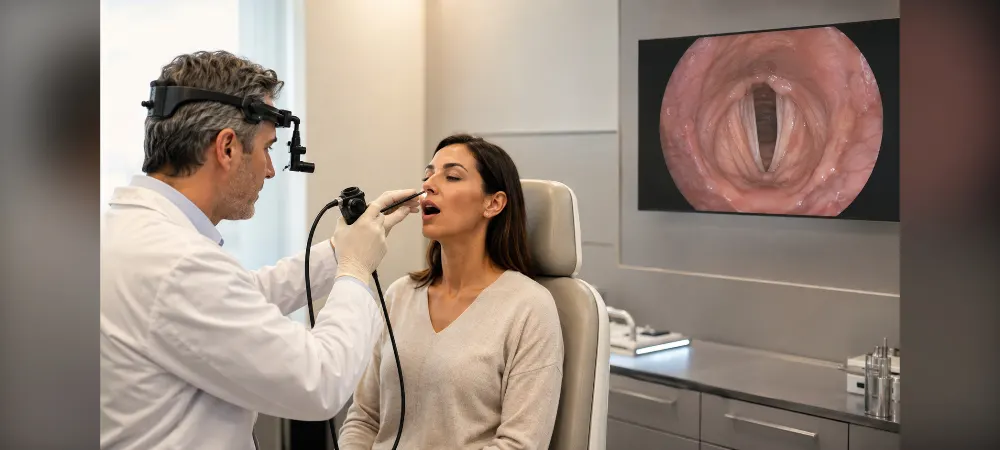
An endoscope system connected to a camera is used for the examination of your larynx. This endoscopic examination method examines your laryngeal structures in detail. The endoscope, which is a thin tube, is directed into the larynx through the nose or mouth. Images received from the camera are monitored on a screen to obtain information about your vocal cords and larynx.
Your doctor applies voice analysis tests when necessary. These tests measure how effective your voice is. Your voice is recorded and examined in a computer environment, and the process is monitored by comparing it before and after treatment. The pitch, intensity, and spectral characteristics of your voice are evaluated through the acoustic analysis method.
Laryngeal EMG (LEMG) evaluates the electrical activity of your vocal cord muscles and analyzes nerve function. The definitive diagnosis of vocal cord weakness is made with this test. Information regarding the recovery of nerve function is also obtained. During EMG, sterile needle electrodes are placed into your laryngeal muscles, and the energy in your muscles is made visible and audible via a special device.
The cause is investigated with imaging methods. Techniques such as neck and chest computed tomography (CT), and brain magnetic resonance imaging (MRI) are used.
Video Stroboscopy
Video stroboscopy plays a significant role in evaluating voice quality by examining the vibrations of your vocal cords. This method visualizes the vibrational movements of the vocal cords in real-time, which are difficult to see with the naked eye.
Your vocal cords vibrate at high speeds per second. Vibrations occur approximately 120 times in a normal male, approximately 200 times in a female, and 300 times in a child. The human eye cannot track these vibrations.
The stroboscope determines the number of vibrations of your vocal cords per second via a microphone placed on your neck. Intermittent transmission is provided from the light source according to this number of vibrations. Thus, the image of the examined region becomes viewable at a speed that your eye can track.
This technique is like observing movement under intermittent white light in a dark environment. You perceive the movement as the successive viewing of frozen frames[184]. The movements of the vocal cord are seen in detail, and the diseased area is accurately defined.
All data obtained during video stroboscopy are saved as digital video recordings. High-resolution photographs can be taken from these recordings during or after the examination. Structural changes in your vocal cords are recorded and used for comparison purposes in controls at different times.
Treatment of Vocal Cord Diseases
The treatment of vocal cord diseases is performed with different methods depending on the type and severity of your problem. Treatment options encompass speech therapy, medical treatment, and surgical treatment.
Speech Therapy
Speech therapy is widely preferred in many voice disorders, and in some cases, the problem can be treated solely with this method. Speech therapy is a suitable option in conditions such as vocal nodules, vocal polyps, vocal cord paralysis, and spasmodic dysphonia.
During the therapy evaluation, your mouth and facial structure, areas with muscle tension, your voice pitch, and voice quality are determined. The voice therapist detects your problematic voice use behaviors in daily life and helps you eliminate them. With correct speech techniques and regular exercises, the nodule is treated to a large extent without the need for surgery.
Medical Treatment Methods
Medical treatment may include reflux treatment. In this process, your dietary habits need to be changed along with medications used to reduce acid production. It is recommended that you sleep with your head elevated at night.
Antibiotics, anti-inflammatory drugs, or corticosteroids can be used for inflammation or infections in the vocal cords. You should rest your voice and limit excessive voice use. Additionally, treatment for a chronic cough linked to other problems such as bronchitis or medication can also be part of medical treatment.
Surgical Treatment Options
Surgical treatment involves the removal of abnormal growth or scar tissue in the larynx. The procedure is performed under anesthesia in the operating room. Surgical intervention may be required in serious conditions such as vocal cord nodules, polyps, or cancer.
Thyroplasty surgery can be applied in the treatment of vocal cord paralysis. In this operation, the paralyzed vocal cord is repositioned to enhance the function of the vocal cords. The surgeon makes a small incision in the neck and places a silicone or Gore-Tex support into the vocal cord.
Support is provided by injecting filling substances into the vocal cords. Hyaluronic acid, calcium hydroxyapatite, collagen, or fat tissue can be used. Endoscopic and laser surgery techniques are less invasive compared traditional methods and accelerate the healing process.
How Does Hoarseness Go Away?
Resting your vocal cords is the most important step for hoarseness to go away. You should avoid talking too much or shouting. If you smoke, you need to quit.
Talking is not recommended after surgery. Speaking negatively affects the healing process of the vocal cords. You can be fed at least five hours after the effect of the narcosis wears off. It is not recommended to consume foods having temperatures above or below room temperature.
The healing process may vary depending on the individual. Healing is fast in those with a strong immune system.
Frequently Asked Questions
What is good for hoarseness?
Drinking plenty of water to keep your throat moist is good for hoarseness. Gargling with warm salt water yields effective results. For this, you can add half a teaspoon of salt to a glass of warm water and do your gargle.
Herbal teas such as chamomile, mint, or linden with added honey and lemon soothe your throat. Honey is a natural antibacterial and anti-inflammatory, helping fight inflammation. Sucking on a throat lozenge or chewing gum increases saliva production, ensuring your throat stays moist.
Ginger has antimicrobial properties that help fight infections. You can utilize fresh ginger root as an herbal tea. Apple cider vinegar also has antimicrobial properties and helps relieve hoarseness. You can consume it by adding 1-2 teaspoons of apple cider vinegar to a glass of water.
Moisturizing your throat with a warm shower or hot water steam is beneficial. Since dry air will irritate your throat, you should keep the air you breathe moist. You should rest your voice and avoid whispering. Additionally, you need to reduce your consumption of smoking, alcohol, and caffeine.
Are vocal cord diseases permanent?
Nodules are generally benign formations and can improve with speech therapy. It is reported that nodules can regress by 50-90 percent with speech therapy. Polyps, on the other hand, are generally unilateral and require removal via surgical intervention compared to nodules.
If vocal cord paralysis is new, it is recommended that the patient wait for 3-4 months. The vast majority of these paralyses recover spontaneously within 6 months. However, when left untreated, vocal cord inflammation can become chronic and lead to permanent voice problems.
Are vocal cord diseases contagious?
If the underlying cause of laryngitis is a viral or bacterial infection, this condition can be contagious. If a viral or bacterial infection caused it, you can transmit it to others. However, structural vocal cord diseases are not contagious.
In which situations should a doctor be consulted?
When hoarseness exceeds three weeks, it must definitely be evaluated by an ear, nose, and throat specialist. In some sources, this duration is stated as 2 weeks. If there are symptoms such as shortness of breath, coughing up blood, difficulty swallowing, or a palpable mass in the neck, medical evaluation must be made immediately, disregarding the duration.
Post-surgical hoarseness suggests recurrent laryngeal nerve damage. Any change in voice in individuals who smoke should be taken seriously and evaluated in the early period.
Vocal Cord Diseases in Summary
Although changes you notice in your voice are generally temporary, prolonged hoarseness should be taken seriously. Therefore, recognizing the symptoms of vocal cord diseases and understanding their causes is important for early intervention. In most cases, the problem can be solved with speech therapy and simple precautions. However, if you are experiencing hoarseness lasting longer than three weeks, shortness of breath, or difficulty swallowing, you must definitely consult an ear, nose, and throat specialist. Resting your voice, drinking plenty of water, and staying away from harmful habits such as smoking accelerate your healing process. You can protect your speech quality by attaching importance to your voice health.
Fill out the Form for Detailed Information and Communication!
Start with the right assessment for What Are Vocal Cord Diseases? What Are the Symptoms and Causes? How Is It Treated?
Share your symptoms with our specialist physicians; let us determine the right diagnosis and treatment plan together.
Warning
If your symptoms started suddenly, are progressing rapidly, or significantly restrict your daily life, consult a physician without delay.
Plan your What Are Vocal Cord Diseases? What Are the Symptoms and Causes? How Is It Treated? journey with our specialists.
Fill in the form or book an appointment to learn about treatment options, the process and preparation.