According to World Health Organization data, 600 million people worldwide have hearing disabilities. In Turkey, 2,000 of the 1,300,000 babies born each year are born with hearing loss. The “Newborn Hearing Test” performed after birth is of great importance in order to prevent hearing loss in newborn babies and to ensure that it does not adversely affect the baby’s physical and mental development.
We asked the specialists of Hisar Hospital Intercontinental Ear, Nose and Throat Diseases and Head and Neck Surgery about the questions people have regarding hearing screening tests, which the Ministry of Health also recommends be performed on every newborn baby today…
What is the importance of early diagnosis and intervention in preventing hearing loss in newborn babies?
Babies complete their physical and mental development by receiving auditory and visual sensory stimuli from their environment. The absence or lack of these stimuli, in addition to affecting children’s language development, can also lead to academic failure, social and emotional problems, and psychological disorders. The earlier a child begins to perceive audible stimuli fully, the healthier and more regular their language and social development will be. For this reason, hearing screening tests are performed on every baby born before discharge from the hospital. These tests are very important for starting the necessary intervention and rehabilitation process early for babies identified as having a hearing impairment.
What is the developmental process of hearing loss in newborns?
During the developmental process from birth up to 2 years of age, a baby exposed to a high sound intensity should make a jumping movement, which is called the startle reflex. A newborn with severe or total hearing loss does not develop this reflex to sound. The newborn’s reactions to sound are a reflex event and are proportional to the intensity of the sound. It gives rough information about whether the sound is perceived. However, it does not determine the degree of hearing loss.
The hearing process in newborns:
From the ... month onward, the human voice becomes the most important stimulus.
Between 6 and 9 months, the baby turns its head toward the direction the sound is coming from.
From the ... month onward, the baby starts to react when its name is called.
From the ... month onward, the baby responds to some verbal commands.
After 18–24 months, however, because the vocabulary develops, the hearing system is examined verbally.
How is a hearing test performed on newborn babies?
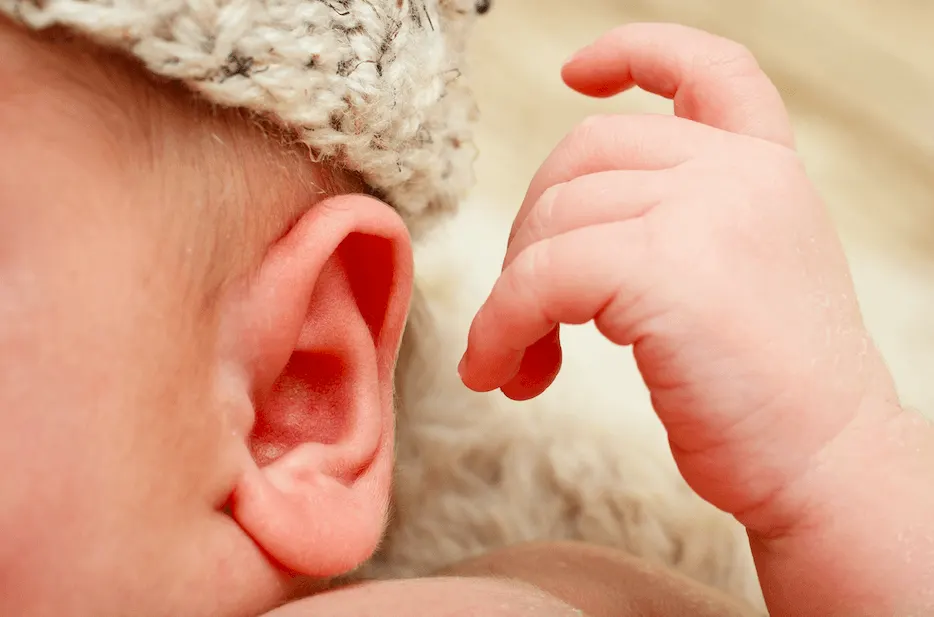
Obtaining valid and reliable results in the hearing test performed on newborns requires special testing techniques. In the Otoacoustic Emissions Test, which is called a screening test, sounds of a certain intensity are delivered to the baby’s ears, and by measuring brain waves, it is understood whether the baby hears them. This test does not cause pain or discomfort to the baby. The test, which lasts a very short time and is performed in a quiet environment, is generally done while the baby is asleep, because the baby crying or making sounds during the test makes it difficult to check hearing ability.
No anesthetic or sedative of any kind is used during the test. After a soft-tipped device is placed inside the outer part of the baby’s ear canal, ''click'' sounds are sent into the ear through it. When the ear hears this sound, the inner part of the ear (cochlea) produces an echo, and the test specialist can examine, via computer, how the baby’s ear responds to the sound.
In addition, the Auditory Brainstem Response Test (ABR), which measures the severity of hearing loss, is one of the most commonly used objective tests. The ABR test is an examination performed by measuring and evaluating the electrical waves generated in the brainstem of the sleeping newborn through electrodes placed on the head.
It should be noted that these tests can only identify babies at risk of congenital hearing loss. For hearing losses that may develop later, parents should monitor their baby’s hearing in the same way they monitor the baby’s other developmental milestones.
When should the hearing test be performed?
If a failure occurs in the screening tests (OAE) performed on newborns after birth, the test is repeated 2 weeks later. If the failure is repeated, the presence of hearing loss is investigated with the ABR test.
What is the critical age range for speech skills in developing children?
Studies have shown that in babies with hearing loss who were identified before 6 months of age and corrected with a hearing aid, vocabulary, self-expression and language skills are much more successful compared to those identified after the 6th month. In children with severe hearing loss, language skills and self-expression do not develop. The popular saying “a child who cannot hear cannot speak” has a degree of truth in this respect. A child who does not hear sounds by the age of 4–5 at the latest cannot learn to speak either. For this reason, the World Health Organization recommends that hearing loss be identified within the first 3 months and treated before 6 months of age.
What are the risky situations in terms of hearing loss?
In newborns, in 50% of cases with hearing loss there are no known risk factors. In 10% of live births, there are risk factors that can cause hearing loss. These are:
Contracting toxoplasmosis, rubella (German measles), cytomegalovirus or herpes virus infection, which can cause hearing loss,
Staying in intensive care for more than three days after birth,
Use of ototoxic medication (a drug containing a chemical that has harmful effects on the ear as a side effect),
Use of ototoxic medication during pregnancy,
Children who have had bacterial meningitis,
Having a family history of deafness,
Being born weighing less than 1 kg 500 g, being deprived of oxygen for a long time during birth,
Requiring artificial respiration,
Having a facial-ear anomaly in the baby
In risky situations for hearing loss, such as very high jaundice, the test must definitely be performed.
What symptoms should be observed especially in babies at risk for hearing loss?
Not being startled or crying or showing any reaction to unexpected loud noises,
Not turning the head toward the direction of a voice when called,
Not making speech sounds between 6 and 12 months,
Not pointing to familiar objects or people when asked. When signs such as these are noticed, more detailed hearing tests need to be performed.