Raynaud's Syndrome
Raynaud's syndrome is a peripheral artery disease that results in the narrowing of blood vessels more tightly than normal. It generally affects the small arteries in the fingers and toes, leading to reduced blood flow. In tissues where blood flow is weakened, symptoms such as pale and cold skin, numbness, loss of sensation, and tingling may occur due to oxygen deficiency. Symptoms tend to improve as blood vessels relax. Upon the restoration of blood flow, temporary symptoms such as tingling and redness may be observed.
Raynaud's syndrome symptoms can occur intermittently and may resolve spontaneously with methods such as rewarming. Exposure to cold, medications, stress, and certain diseases can commonly trigger the development of the syndrome. Therefore, attacks may occur in response to stimuli such as cold environments, stress, etc. It is divided into two subgroups: primary and secondary Raynaud's syndrome. The commonly seen primary syndrome is not associated with any underlying condition and affects women under 40 more frequently. Secondary syndrome occurs in connection with another disease or environmental factors. Most of the time, Raynaud's syndrome does not lead to serious consequences, but various complications may develop depending on the underlying cause.
What is Raynaud's Syndrome?
Raynaud's syndrome is a health condition characterized by the narrowing of blood vessels and reduced blood flow due to various reasons. In tissues where blood flow is reduced, the healthy skin color is lost, and a pale skin color appears. It frequently manifests in the fingers and toes, referred to as extremities. Rarely, the nose, ears, knees, and nipples may be affected. Raynaud's syndrome is divided into two groups: primary and secondary:
Primary Raynaud's syndrome: It occurs without any obvious cause or disease association and is normally called "Raynaud's disease." Exposure to cold, stress, and intense emotions that stimulate the autonomic nervous system can trigger the narrowing of blood vessels, leading to the stimulation of primary Raynaud's syndrome. It constitutes the majority of Raynaud's syndrome cases. It is seen more frequently in women compared to men. It generally follows a benign course.
Secondary Raynaud's syndrome: It usually occurs due to rheumatological and non-rheumatological connective tissue diseases, medications, or environmental conditions. The underlying source must be identified. The primary designation for secondary Raynaud's syndrome is "Raynaud's phenomenon." It may follow a more serious course compared to the primary type and can lead to gangrene and ischemia.
Primary and secondary profiles are disorders that share a similar name but are normally considered different. Colloquially, both conditions are referred to as Raynaud's syndrome. In some individuals with Raynaud's syndrome, conditions associated with the narrowing of arteries such as migraines, pulmonary hypertension, and variant angina may occur simultaneously.
What Are the Symptoms of Raynaud's Syndrome?
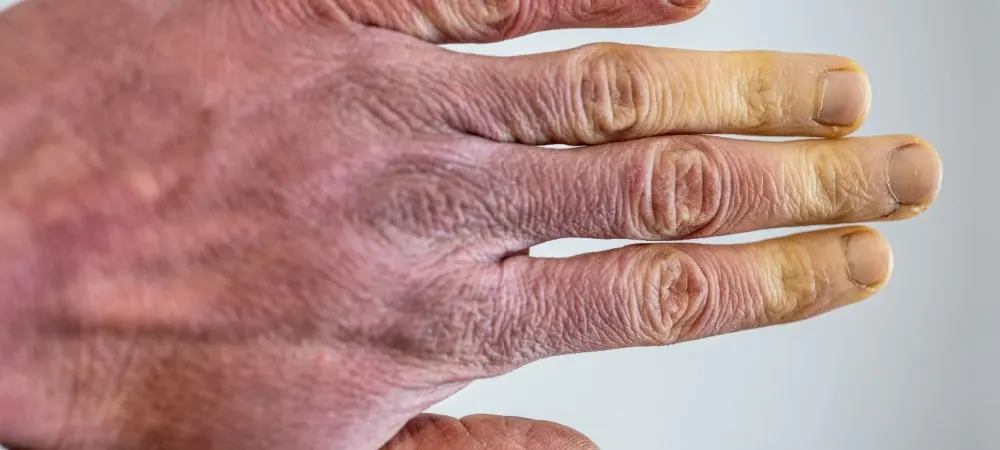
Raynaud's syndrome results in the narrowing of blood vessels and reduced blood flow, manifesting various skin symptoms. Small arteries often begin to narrow rapidly with exposure to cold. This situation can last for minutes or hours. Symptoms can occur in a single finger or multiple fingers. The findings are symmetrical and frequently affect the middle 3 fingers. In rarer cases, the thumb is affected. Raynaud's syndrome symptoms are typically as follows:
White and pale skin color as a result of reduced blood flow,
Blue skin color as a result of oxygen insufficiency in tissues,
Numbness and tingling in the affected fingers,
A sensation of pins and needles and burning,
A sensation of coldness in the skin,
A throbbing sensation in the affected areas.
The skin, which turns white and then blue in sequence, suddenly turns red when the affected area is warmed. This is known as the typical three-phase color change of Raynaud's syndrome. Attacks tend to last approximately 15 minutes. If symptoms continue for long hours and do not improve with warming, it may indicate a serious disease. Generally, in primary Raynaud's syndrome, findings are not severe enough to cause tissue loss. However, if secondary Raynaud's syndrome continues for a long time, it can lead to painful ulcers, gangrene, and tissue loss.
What Causes Raynaud's Syndrome?
Raynaud's syndrome occurs as a result of the impairment of the nervous and hormonal systems' control over blood flow. In Raynaud's syndrome, which is particularly triggered by cold exposure, the body aims to slow down heat loss and maintain temperature. For this reason, blood vessels on the skin surface narrow, and blood begins to move from the surface toward the internal organs of the body. Rapidly narrowing vessels react to cold and stress in this way and may remain narrowed for a long time. The causes of Raynaud's syndrome can vary depending on the primary and secondary type. The exact cause of primary Raynaud's syndrome is not yet known. According to some studies, although some genes are held responsible for the emergence of the syndrome, there is insufficient evidence. The causes of secondary Raynaud's syndrome are linked to general categories such as medication-induced, hematological and autoimmune diseases, and environmental conditions. Diseases that may cause Raynaud's syndrome may include:
Carpal tunnel syndrome,
Buerger's disease,
Lupus,
Scleroderma,
Hypothyroidism,
Cancer,
Peripheral artery disease,
Rheumatoid arthritis,
Polymyositis,
Dermatomyositis,
Vasculitis,
Pulmonary hypertension,
Thoracic outlet syndrome,
Sjögren's syndrome,
Atherosclerosis,
Systemic sclerosis.
Chemotherapy, beta-blockers, migraine medications, and hyperactivity disorder medications are drugs that can be effective in the development of the syndrome. Other causes may include low weight, caffeine, smoking, frostbite, hand and foot injuries, repetitive actions (typing, playing the piano, etc.), and regular vibrations (using a drill, etc.).
How Is Raynaud's Syndrome Diagnosed?
Raynaud's syndrome diagnosis can be easily made through the presence of trauma and injury, medical history, family history, and physical examination, but various tests may be needed to determine the primary and secondary type. Furthermore, the presence of a concomitant disease or the identification of the underlying problem is considered important for treatment planning. The methods applied within the scope of the Raynaud's syndrome test are as follows:
Nailfold capillaroscopy: Allows the examination of the nail bed under a microscope. Seeing dilation and abnormalities in the capillaries in the nail bed may indicate connective tissue diseases and secondary Raynaud's syndrome.
ANA (Antinuclear antibody) test: Enables the detection of autoimmune diseases where the immune system attacks other healthy body tissues. It can also provide information about connective tissue diseases.
ESR (Erythrocyte sedimentation rate) test: Inflammatory conditions in the body can be detected by examining red blood cells. It can help in the diagnosis of inflammatory and autoimmune diseases.
Complete blood count and urinalysis: Can be used in the diagnosis of other existing diseases or hormonal conditions.
Rheumatoid factor test: Can be applied within the scope of the diagnosis of autoimmune diseases.
Controlled inflammatory and autoimmune diseases are associated with secondary Raynaud's syndrome.
How Is Raynaud's Syndrome Treated?
Raynaud's syndrome treatment is determined according to the severity of symptoms, complications, and the type of Raynaud's syndrome. In general, the treatment plan consists of lifestyle changes, medication, and surgical procedures. One or more approaches may be preferred. Primary Raynaud's syndrome treatment primarily aims to avoid cold exposure, quit smoking, and ensure stress management. In cold environments, it is necessary to wear gloves, socks, and thick clothing, and avoid cold objects. When these approaches are insufficient, calcium channel blockers and topical nitroglycerin can be used. Calcium channel blockers help the small blood vessels in the hands and feet to relax and open. They can also contribute to the healing of skin ulcers on the fingers. Topical nitroglycerin is a topical cream used in the healing of ulcers on the fingertips.
Secondary Raynaud's syndrome treatment is mainly directed at identifying and treating the underlying health problem. In addition to moving away from occupational factors and toxic environments and changing lifestyle habits, medical treatment is applied more frequently. Calcium channel blockers, topical nitrates, antibiotics, and analgesics may be prescribed. A severe Raynaud's syndrome presentation may require injections and surgery. Raynaud's syndrome surgery involves cutting the nerves around the affected blood vessels. With surgery, shorter and less frequent attacks can be seen. Additionally, ginkgo biloba may be effective in reducing Raynaud's syndrome attacks.
Frequently Asked Questions
Primary Raynaud's syndrome is seen more frequently in people under 30, in women, and in people with a family history of Raynaud's syndrome. Secondary Raynaud's syndrome, on the other hand, can be seen more frequently in those exposed to cold environments and chemicals, those using migraine, ADHD, and hypertension medications, and those with diseases such as lupus, rheumatoid arthritis, and scleroderma. Raynaud's disease is considered a chronic, i.e., long-term, health problem, but Raynaud's disease attacks are temporary. Attacks can last for minutes or hours. They may then resolve spontaneously. Raynaud's attacks tend to last approximately 15 minutes. In some people, it can last for a few minutes or hours. During an attack, arteries and capillaries stretch and narrow more than normal. The skin color, which first turns white, turns blue as oxygen decreases. When triggering factors are removed, blood vessels suddenly relax and rapid blood flow is provided. As a result, the skin gives a red appearance. Raynaud's syndrome can be understood through nailfold capillaroscopy, antinuclear antibody test, erythrocyte sedimentation test, rheumatoid factor test, complete blood count, and urine tests. The syndrome, which is usually diagnosed by physical examination, can be definitively identified as primary or secondary with these tests. Primary Raynaud's syndrome is not associated with any disease, but secondary Raynaud's syndrome can be a harbinger of various diseases. These include diseases such as lupus, rheumatoid arthritis, scleroderma, cancers, Buerger's disease, vasculitis, hypothyroidism, carpal tunnel syndrome, thoracic outlet syndrome, atherosclerosis, pulmonary hypertension, peripheral artery disease, Sjögren's syndrome, and polymyositis. If Raynaud's syndrome follows a severe course and is not treated, tissue loss may occur as a result of damage to the limbs. Skin ulcers, gangrene, and tissue death are conditions that occur as a result of the interruption of blood flow, but these cases are rarely seen. Raynaud's syndrome in infants should be treated without causing serious complications. Mild Raynaud's syndrome or the primary type usually does not require medical treatment and can resolve spontaneously. The secondary type can be improved depending on the treatment of the health problem that triggers the syndrome. However, both syndromes can show symptoms if triggering factors are present. For Raynaud's syndrome, one should apply to the Internal Medicine department. In addition, cardiovascular surgery specialists can also assist in the diagnosis and treatment of the syndrome. To prevent Raynaud's attacks, one should stay away from caffeine and smoking, avoid touching cold objects and putting hands in cold water, use thick gloves, hats, clothing, and socks in cold environments, ensure regular exercise and stress management, limit the use of vibrating tools, and ensure good skin care.
Are you experiencing symptoms of Raynaud's Syndrome?
If you have complaints of color change, numbness, or pain in your fingers and toes along with cold, early evaluation is important. Hisar Hospital Internal Medicine and Cardiovascular Surgery specialists determine the cause of Raynaud's syndrome with detailed examinations and create a personalized treatment plan.
Do not postpone your health; contact us immediately for a comprehensive evaluation by making an appointment with our specialist physicians.
Start with the right assessment for What is Raynaud's Syndrome? Symptoms, Causes, and Treatment
Share your symptoms with our specialist physicians; let us determine the right diagnosis and treatment plan together.
Warning
If your symptoms started suddenly, are progressing rapidly, or significantly restrict your daily life, consult a physician without delay.
Plan your What is Raynaud's Syndrome? Symptoms, Causes, and Treatment journey with our specialists.
Fill in the form or book an appointment to learn about treatment options, the process and preparation.