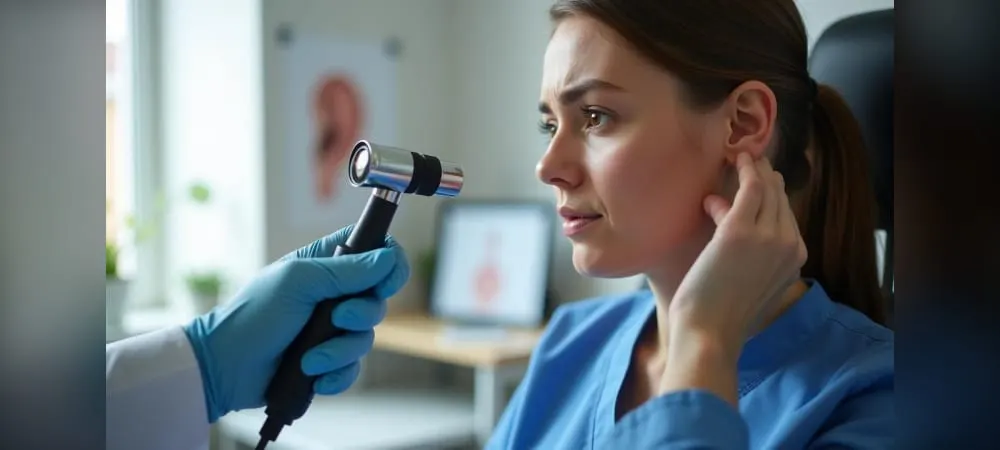
The sensation of a blocked ear is an uncomfortable condition, as if your ear has been stuffed with cotton. Many individuals consult with complaints of "my ear is constantly blocked, pressurized, and full," and this condition is usually underpinned by Eustachian tube dysfunction.
In this article, you will find answers to questions about the causes of ear blockage, ear blockage after the flu, how to relieve persistent ear blockage, ear blockage treatment options, and how ear blockage resolves.
What is Eustachian Tube Dysfunction?
The Eustachian tube is a thin canal acting as a bridge between the middle ear and the nasopharynx. There are two of them in our body, located on the right and left sides. This structure connects the area behind the eardrum to the back of your nose and is of vital importance for your hearing health.
Function and Importance of the Eustachian Tube
The Eustachian tube has three primary functions: protection, ventilation, and drainage.
Thanks to its protective function, your middle ear is protected from secretions that may come from the nasopharynx, throat reflux, and sudden pressure changes. The tube normally remains closed, opening only during swallowing or yawning.
The ventilation function balances the pressure on the inner and outer surfaces of the eardrum. It ensures that your eardrum functions properly by equalizing the atmospheric pressure in the external environment with the pressure in the middle ear.
The drainage feature empties fluids accumulating in the middle ear into the nasopharynx. This prevents fluid accumulation in your ear.
How Does Dysfunction Occur?
Eustachian tube dysfunction is the condition where this tube fails to perform one or more of its mentioned functions.
There are two main types. In the obstructive type, the tube cannot open sufficiently. Blockage occurs in the tube due to reasons such as the flu, allergies, sinusitis, or enlarged adenoids. Air hunger begins in the middle ear and negative pressure develops. You notice this as a feeling of fullness in the ear.
In the patulous type, the tube remains constantly open. The cartilaginous part, which should normally be closed, is always open. In this case, you hear your own voice and breathing in your ear.
Eustachian tube dysfunction is one of the most common causes of middle ear diseases. It can lead to eardrum perforations and middle ear infections.
Who is at Risk?
Children, especially those between 1 and 6 years of age, carry a much higher risk than adults because their Eustachian tubes are shorter and more horizontal. The tube length, which is 17-18 mm at birth, reaches 35 mm in adults. Furthermore, in children, enlarged adenoids can prevent the tube from opening. Studies show that ninety percent of children develop middle ear fluid accumulation due to Eustachian tube dysfunction before starting school.
In adults, the prevalence is one percent. Conditions such as Down syndrome and cleft palate affect the development of the tube, so frequent Eustachian dysfunction is observed in these patients. Obesity increases the risk due to an increase in adipose tissue around the Eustachian tube. Cigarette smoke also disrupts the functioning of the Eustachian tube.
Causes of Eustachian Tube Dysfunction
Many factors disrupt the normal functioning of your Eustachian tube and are among the causes of ear blockage. Understanding these issues helps you cope with conditions such as ear blockage after the flu or persistent ear blockage.
Upper Respiratory Tract Infections and the Flu
Upper respiratory tract infections such as colds, the flu, and sinusitis are the most common cause of Eustachian tube dysfunction. These infections lead to inflammation and mucus accumulation in the Eustachian tubes. Inflammation makes it difficult for the tubes to open, causing fluid and air to become trapped in the middle ear.
Mucosal edema blocks the Eustachian tube and disrupts the tube's pressure-equalizing function. Eustachian dysfunction is seen more frequently in individuals, especially children who frequently experience upper respiratory tract infections, compared to others. Therefore, complaints of ear blockage after the flu are quite common.
Allergic Reactions
Allergies, especially those against pollen and dust mites, cause swelling in the nose and Eustachian tubes. Allergic rhinitis creates chronic mucosal edema and negatively affects the function of the Eustachian tube.
Nasal and nasopharyngeal mucosal edema developing due to allergen exposure causes the Eustachian tube orifice to swell and close. The prevalence of Eustachian dysfunction in patients with seasonal or perennial allergic rhinitis is significantly higher than in the general population. The opening of allergic rhinitis into the nasopharynx contains allergic inflammatory cells, and the risk of Eustachian tube dysfunction is higher in children with allergies compared to non-allergic children.
Anatomic Issues
Enlarged adenoids are the most important cause of Eustachian dysfunction in children. Enlarged adenoid tissue can mechanically block the nasopharyngeal orifice of the tube or create a source of chronic inflammation, leading to functional obstruction.
Septal deviation and concha hypertrophy also cause anatomical obstruction. In cleft palate deformity, the insertion of the tensor veli palatini muscle is abnormal, and the muscle cannot effectively open the tube; therefore, chronic serous otitis media is extremely common in children with cleft palate. Nasopharyngeal tumors should be considered, especially in adults presenting with unilateral chronic obstruction.
Pressure Changes
Pressure changes such as air travel or diving affect the functionality of the Eustachian tubes. Rapid altitude changes can cause this tube to fail to function adequately. Barotrauma occurs during flying, diving, and rapid altitude changes.
If blockage of the Eustachian tube is present due to reasons such as a cold, sinusitis, or allergies, the feeling of pressure in the ear is experienced more intensely during a flight. Inexperienced divers who have not mastered ear-clearing maneuvers also have a high risk of experiencing middle ear barotrauma.
Other Causes
Other factors leading to Eustachian tube dysfunction include:
- Cigarette smoke: Causes damage to the cilia in the Eustachian tubes, making it difficult to clear mucus. Middle ear infections are more common in children whose parents smoke.
- Gastroesophageal reflux: Creates continuous inflammation and blockage in the nasopharyngeal region.
- Hormonal changes and obesity: Affect the blockage of the Eustachian tubes. Rapid weight loss, on the other hand, causes the Ostmann fat pad around the tube to melt.
- Radiotherapy: Radiotherapy applied to the head and neck region can cause fibrosis in the Eustachian tube mucosa, leading to chronic dysfunction.
What Are the Symptoms of Eustachian Tube Dysfunction?
Recognizing the symptoms of Eustachian tube dysfunction is important for early intervention. Complaints vary from person to person. While some patients have mild discomfort, others experience symptoms intense enough to make daily life difficult.
Ear Fullness and Blockage Sensation
This is the most prominent finding of Eustachian tube dysfunction. A sensation as if there is pressure in your ear occurs. Patients often express this as "feeling like they are underwater" or being unable to clear their ears.
Air hunger, i.e., negative pressure, forms in the middle ear, and you feel this as fullness and blockage in the ear. The blockage can be in a single ear or can develop in both ears simultaneously. It particularly does not go away with activities such as swallowing, yawning, or chewing.
This sensation may increase during air travel or altitude changes. If pressure equilibrium cannot be maintained for a long time, fluid accumulation in the middle ear may become permanent.
Hearing Loss and Voice Changes
Due to fluid accumulation in the middle ear, sounds are heard muffled or weak. Ear blockage manifests with symptoms such as sounds coming across as muffled or difficulty distinguishing surrounding sounds.
Temporary or long-term hearing loss may be experienced. The person hears external sounds more muffled. Hearing quality can be significantly affected. Especially in children, they may watch television at a high volume, frequently say "I didn't hear," or experience a delay in speech development.
In patulous Eustachian tube dysfunction, a condition develops where the patient hears their own speech and breathing in their ear (autophony and respiratory autophony).
Ear Pain and Pressure
Blockage in the Eustachian tube causes pain by leading to tension in the eardrum. The feeling of pressure in the ear is a common complaint arising from the inability of middle ear pressure to balance with external environment pressure.
Pain may increase, especially during swallowing or yawning. In obstructive Eustachian tube dysfunction, a feeling of fullness in the ear, pain, and muffled hearing occur. External pressure exerted on the eardrum during atmospheric pressure changes cannot be compensated for in individuals with Eustachian dysfunction because the tube does not function adequately, and severe pain occurs due to the retraction of the eardrum.
Balance Problems
Due to the failure of ear pressure to balance properly, balance problems and dizziness (vertigo) may occur. Especially if it is accompanied by dizziness, the clinical picture may be evaluated differently.
In cases where inner ear pressure increases, fullness, ringing, and episodes of dizziness may occur. In Eustachian tube dysfunction, dizziness, imbalance, and a feeling of lightheadedness can be observed. Pressure imbalance between the middle ears leads to these symptoms.
Tinnitus
There is a sensation of tinnitus in the form of a constant buzzing, ringing, or humming in the ear. Tinnitus can manifest itself as a whistle, a hissing sound, a humming, high-pitched, and throbbing sound.
At the moments when the blockage starts to ease or while swallowing, popping or crackling sounds from the ear may be heard. Additionally, the symptom of hearing clicking sounds of the ear opening and closing is observed. A sensation as if there is fluid movement inside the ear often develops in relation to infection or inflammation.
How Is Eustachian Tube Dysfunction Diagnosed?
Accurate diagnosis is vital prior to ear blockage treatment. Your Otolaryngology specialist will initiate a detailed examination process after listening to your symptoms. A complete ENT examination following your complaints may sometimes be sufficient for diagnosis, but additional hearing tests and imaging methods may be needed.
Physical Examination and Otoscopy
The examination begins primarily with otoscopy. Your doctor examines your ear canal and eardrum using an illuminated instrument called an otoscope. The condition of the eardrum provides very important clues.
In Eustachian dysfunction, inward retraction of the eardrum, amber-colored fluid accumulation, an air-fluid level, or air bubbles may be seen. In the patulous type, eardrum movement synchronous with respiration is observed. The mobility of the eardrum is evaluated with pneumatic otoscopy; mobility is restricted in the presence of fluid.
Your doctor may ask you to try swallowing or pressure maneuvers. In the Valsalva maneuver, you try to blow air outward while your nose and mouth are closed. If the tube opens, you feel a cracking sensation in your ears. In the Toynbee maneuver, however, you swallow while your nose is closed.
Timpanometry and Hearing Tests
Timpanometry is the primary diagnostic test that objectively measures middle ear pressure. The device placed in your ear canal records the response of your eardrum by changing air pressure. The test takes about 2 minutes and is painless.
Results are divided into three main types. Type A shows a normal curve. Type B is a flat curve and indicates fluid accumulation in the middle ear. Type C shows a negative pressure peak point and points to a Eustachian tube problem.
Pure tone audiometry determines the degree and type of hearing loss. Sounds at various frequencies are sent to your ear, and whether you hear them is recorded. Conductive hearing loss is common in Eustachian dysfunction.
Advanced Imaging Methods
Nasal endoscopy directly visualizes the back of the nasopharynx and the Eustachian tube opening. It is critical in evaluating adenoid hypertrophy, tumors, or anatomical problems.
Radiological imaging is not used routinely. However, CT or MRI may be required for nasopharyngeal tumor screening in chronic unilateral obstruction. Imaging is valuable in cases suspected of additional pathology.
Eustachian Tube Dysfunction Treatment
The treatment plan is determined according to the factor causing the problem. Your doctor will recommend the most appropriate method for you by looking at the severity and duration of your complaints. Surgical options come into play in cases that do not respond to medical treatment.
Methods Applied at Home
The answer to how mild ear blockage resolves generally lies in simple exercises. The Valsalva maneuver helps open your Eustachian tube: close your nasal wings with your fingers, keep your mouth closed, puff out your cheeks, and push air toward your ears. In the Toynbee maneuver, you swallow while your mouth and nose are closed.
Chewing gum, yawning, and frequent swallowing support the opening of the Eustachian tube. Drinking plenty of fluids helps thin the mucus. Hot water steam ensures the softening of the mucus in the nose and Eustachian tube. Saline nasal sprays can be used 2-3 times a day.
Medical Treatment Options
Nasal sprays and decongestants are the first choices resorted to in nasal congestion. However, decongestant spray should only be used for 3-5 days; prolonged use has the opposite effect. Intranasal steroids such as mometasone or fluticasone are applied for 6-12 weeks if there is an allergy or nasal discharge.
Antihistamines are effective in allergic reactions. Antibiotics are only required in cases of bacterial infection. If there is a reflux problem, PPI treatment can be given for a duration of 8-12 weeks.
When is Surgical Intervention Necessary?
Surgery is considered if no response is obtained from conservative treatment for 3 months. Surgery may be required in patients with long-term and severe symptoms. Ventilation tube application equalizes middle ear pressure; the tube stays in the eardrum for 6-18 months. If there is adenoid enlargement in children, an adenoidectomy can be performed in the same session.
Balloon Dilatation Method
Balloon tuboplasty is a current method applied for Eustachian tube blockages. It was first applied in the United States in 2010. Under general anesthesia, the Eustachian tube opening is reached from the nose with the help of an endoscope. A balloon catheter is placed and inflated at 10 bar pressure for 2 minutes. The procedure takes 15-20 minutes for both sides.
The success rate of the treatment is eighty percent. No incision is made, and the patient is discharged on the same day. In 12-month follow-ups of 42 patients who underwent balloon dilatation at the clinic, the recurrence rate is fourteen percent.
Post-Treatment Care and Follow-Up
Starting the day after the procedure, performing the Valsalva maneuver 3-5 times a day is recommended. The use of nasal steroids, nasal lavage, and antibiotherapy continues. In patients fitted with a ventilation tube, the external ear canal should be closed with an earplug in the bath and swimming pools.
Frequently Asked Questions
How long does Eustachian tube dysfunction last?
The duration depends on the cause. Ear blockage after the flu usually resolves spontaneously within 1-2 weeks. However, in chronic cases, complaints can last for months. Response to treatment also varies from person to person.
How does ear blockage resolve, does it get better on its own?
Mild conditions can pass with simple maneuvers. Swallowing, chewing gum, and the Valsalva exercise help. If there is an allergy or infection, the underlying cause must be treated. Be sure to consult a doctor for persistent ear blockage.
Which doctor should I consult?
You need to consult an Otolaryngology specialist. Your doctor will examine your ear and perform hearing tests if necessary. Ear blockage treatment is planned specifically for your condition.
How to relieve ear blockage during air travel?
Chew gum or drink water during takeoff and landing. Yawning and swallowing movements help your Eustachian tube open. You can try the Valsalva maneuver. If you have the flu or allergies, use a decongestant before the journey.
Is it seen more frequently in children?
Yes, children carry a higher risk. Their Eustachian tubes are shorter and positioned more horizontally compared to adults. When enlarged adenoids are added, the problem arises more frequently. If your child has frequent ear infections, doctor supervision is important.
What happens if left untreated?
Among the causes of ear blockage left untreated for a long time, the Eustachian tube problem may become chronic. Permanent fluid accumulation in the middle ear and hearing loss develop. Recurrent ear infections may be observed. Permanent changes can occur in the eardrum.
What can I do at home?
Consume plenty of fluids, use saline spray if you have nasal congestion. Take hot steam. Stay away from cigarette smoke. Perform regular Valsalva exercises. However, if your complaints last longer than 2 weeks, get professional help.
What should I do if I have allergies?
Try to stay away from allergens. Use the antihistamines and nasal spray recommended by your doctor. If you have seasonal allergies, start treatment before the season begins. Allergy control is important for ear blockage treatment.
Eustachian Tube Dysfunction in Summary
Although ear blockage is uncomfortable, it is a treatable condition. Ultimately, simple home applications, medical treatment, or surgical options if necessary are available. In our clinic, seventy percent of patients have recovered with conservative methods.
If your complaints last longer than two weeks or affect your daily life, consult an Otolaryngology specialist. Early diagnosis prevents permanent problems. You can start with simple exercises like Valsalva maneuvers, but the underlying cause must be treated. With the right treatment approach, you can regain your ear health and hear comfortably.
Fill out the Form for Detailed Information and Contact!
Start with the right assessment for What is Eustachian Tube Dysfunction? What Are the Symptoms? How Is It Diagnosed and Treated?
Share your symptoms with our specialist physicians; let us determine the right diagnosis and treatment plan together.
Warning
If your symptoms started suddenly, are progressing rapidly, or significantly restrict your daily life, consult a physician without delay.
Plan your What is Eustachian Tube Dysfunction? What Are the Symptoms? How Is It Diagnosed and Treated? journey with our specialists.
Fill in the form or book an appointment to learn about treatment options, the process and preparation.