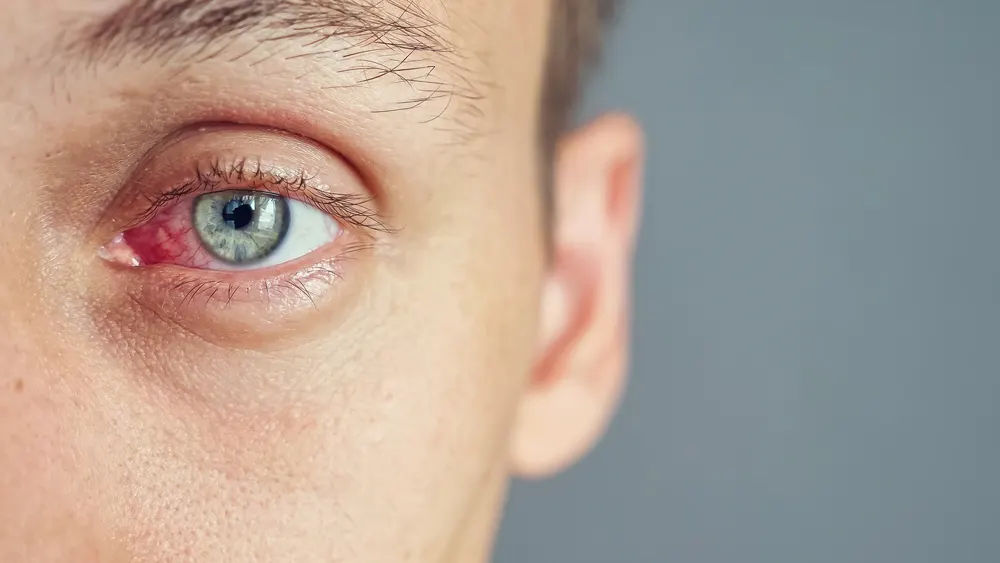
The uvea is the name given to the three layers between the sclera, the white part of the eye, and the retina. These three layers are the iris, the colored part of the eye; the ciliary body, which helps the eye focus; and the choroid, which connects the retina to the sclera. Inflammation of these layers is called uveitis. Depending on the affected area, it is classified as anterior, intermediate, posterior, or panuveitis. It may be caused by an eye infection, an injury, or an autoimmune disease such as Behçet's disease or Crohn's disease. It presents with symptoms such as blurred vision, redness of the eye, pain, light sensitivity, and watery eyes. A standard examination is performed to evaluate blurred vision, by testing intraocular pressure and examining the inside of the eye. In addition, optical coherence tomography may be requested so that the retina can also be visualized, and blood tests may be requested to check for an underlying disease. If there is an autoimmune disease, treating it relieves the eye inflammation. The disease may be acute, chronic, or recurrent. Taking these conditions into account, a controlled drug treatment is decided upon, and in rare cases vitrectomy surgery may be performed.
What Is Eye Inflammation?
Uveitis is the infection of any part of the uvea, the middle layer of the eye made up of the iris, ciliary body, and choroid. It is classified according to the affected area.
Anterior (front) uveitis: Inflammation of the iris, the colored part of the eye.
Intermediate (middle) uveitis: Inflammation of the vitreous fluid that fills the inside of the eye and of the ciliary body, which helps the eye focus.
Posterior (back) uveitis: Inflammation of the retina and choroid.
Panuveitis: Inflammation of all of these areas.
Eye inflammation may be caused by an infection due to a parasite or virus, or by autoimmune diseases. Toxoplasmosis, herpes simplex virus (HSV), cytomegalovirus, or varicella zoster virus are some of these infections. Herpes simplex virus is also the main cause of ocular herpes, another type of eye inflammation. Behçet's disease, multiple sclerosis (MS), Crohn's disease, and sarcoidosis are among the autoimmune diseases that cause uveitis. In addition, eye injuries and some types of cancer can also cause eye inflammation.
Although there is no genetic transmission, the HLA-B27 gene has been detected in some patients with anterior uveitis.
The disease can also be classified according to its course, whether it occurs as a continuous condition or in attacks.
Acute: The type that develops suddenly and in which the inflammation is severe.
Chronic: The type of inflammation that lasts longer than six weeks or recurs three months after treatment.
Recurrent: The repeated occurrence of inflammation in attacks at intervals.
Complications may develop in eye inflammations. Chronic, posterior, or intermediate uveitis, panuveitis, being over 60 years of age, and not receiving treatment are criteria that increase the risk of complications. Cataract may develop as the eye lens becomes less transparent, and glaucoma may develop as eye pressure increases. Vision may be lost as a result of these complications. Early diagnosis and treatment are important to prevent this. Services in Eye Health and Diseases, along with all other types of healthcare services, are provided at Hisar Hospital Intercontinental.
How Is Eye Inflammation Treated?
Treatment plans may vary depending on whether the inflammation is anterior, posterior, or intermediate, or acute or chronic. Control of the inflammation is the first priority. It may be treated with medication or eye drops, but in some severe cases surgical intervention may be required.
In some cases, eye drops may be given that dilate the pupil, the opening in the center of the iris through which light enters the eye, and relax the muscles in this area. In this way, the risk of glaucoma is also reduced.
Depending on the level of inflammation, eye drops alone may not be sufficient. Anti-inflammatory drugs or antibiotics may be given to reduce the inflammation. Medications that control these spasms may be given to relax the pupil, which narrows due to the constant contraction of the iris and ciliary body.
Because light sensitivity is among the symptoms, direct exposure of these individuals to sunlight may worsen their condition. Wearing sunglasses is recommended to prevent this.
Eye drops may cause short-term blurred vision, so these individuals may need to avoid activities that require attention, but there is no obstacle to continuing their daily lives.
In some cases, vitrectomy surgery may be performed. This surgery is the removal of the vitreous fluid inside the eye. It can be applied in diseases affecting the back of the eye.
If the condition is caused by an underlying autoimmune, parasitic, or viral disease, receiving treatment for that disease also improves the eye inflammation. Hisar Hospital Intercontinental provides all types of healthcare services, including Infectious Diseases, Microbiology and Parasitology, and Allergy and Immunology.
What Are the Symptoms of Eye Inflammation?
Symptoms of uveitis may gradually worsen or may come on as sudden attacks.
Stabbing sensation in the eye, pain
Eye redness
Light sensitivity
Blurred vision
Vision loss
Glare
Edema
Watery eyes
Flashes of light
Narrowing of the pupil
Loss of peripheral vision
The stabbing sensation in the eye may increase when trying to focus on an object or text. Flashes of light and the appearance of small particles may increase. The person may begin to be unable to see objects that are within their normal field of vision but located at the periphery, that is, at wider angles to the side.
Symptoms are generally similar for eye inflammations, and one eye condition can lead to another. Inflammation of the transparent conjunctival tissue of the eye, known as conjunctivitis, may cause redness of the eye, watery eyes, and a stabbing sensation in the eye. Inflammation of the tissues inside the eye is called endophthalmitis, and it can progress to vision loss. Keratitis, which occurs when the cornea, the transparent layer in front of the iris and pupil, becomes infected, presents with similar symptoms such as light sensitivity and blurred vision. Blepharitis is inflammation of the eyelid that can appear as blisters on the eyelid, and it may cause a stabbing sensation in the eye, burning, and difficulty seeing.
Eye inflammations can worsen and lead to one another. For example, in a person with uveitis, the infection may spread and cause keratitis, and in a person with blepharitis, the blisters may burst and cause uveitis. For this reason, early treatment is important to improve the course of the disease.
How Is Eye Inflammation Diagnosed?
When a doctor is consulted for eye inflammation, a medical history is taken and a standard eye examination is performed. The eye's response to light is examined.
In digital tonometry, the doctor gently presses the index fingers of both hands on the patient's eyeball, thereby obtaining a rough idea of the firmness of the eye.
In slit lamp microscopy, the patient places their head on the device while the doctor sits opposite, and an image is obtained by directing light into the eye through the pupil. A possible inflammation in the eye can be seen here.
An ophthalmoscope, also known as a fundoscope, is an electrically powered light device containing mirrors and lenses. Held approximately fifteen centimeters from the patient's eye, it images the optic disc, the area where the optic nerve connects to the retina.
Optical coherence tomography (OCT) may be performed. The retina, which covers the back of the eye, is sensitive to light. For this reason, a light wave is sent to this area and the retina is imaged in cross-section. It is a non-invasive imaging method and allows each layer of the retina to be seen.
Fundus fluorescein angiography is used to determine whether there is a problem with the blood vessels in the retina and choroid. For this procedure, a fluorescent dye is injected into a vein, and a special camera is used to take photographs of the blood vessels in the eye.
If an underlying cause such as Behçet's disease or Crohn's disease is suspected, blood tests for this may be requested.
In some cases, a definite cause may not be found, yet treatment can still be provided. Most of these tests are used not only for diagnosis but also for monitoring treatment. Because it is a condition that can recur, regular check-ups are necessary. The degree to which the inflammation has regressed after the prescribed eye drops or medication, or how much it has affected the optic nerve, is again assessed with these imaging methods.
Frequently Asked Questions About Eye Inflammation
Since the symptoms of eye inflammation diseases are similar, you can consult a specialist in eye health and diseases to get a differential diagnosis and detailed answers to your questions. The duration of treatment may vary depending on the type of eye inflammation. Uveitis attacks may last eight weeks, and they may improve with treatment within six to eight weeks. If there is an underlying disease, this duration may vary depending on how that disease is treated. Early signs such as blurred vision, eye pain, redness, and light sensitivity may indicate uveitis. Eye inflammation can spread and damage the optic nerve, progressing to vision loss, or it can affect the blood vessels that nourish the eye and impair the eye's blood supply. Because of these many effects, an infection of the eye must be treated. It should not be expected to resolve on its own, and traditional methods should not be used. These methods may worsen the condition, so a doctor should be consulted. In this way, eye inflammation can be treated with eye drops and medications that reverse the infection. There is no specific age group for uveitis; it can occur at any age. However, the risk of complications is higher in people over 60. If you experience symptoms such as blurred vision, redness, or stabbing pain and think you may have eye inflammation, starting treatment early can be lifesaving. You can make an appointment with the Eye Health and Diseases department at Hisar Hospital Intercontinental.
Start with the right assessment for Eye Inflammation (Uveitis): What Is It, and What Are the Diagnosis and Treatment Methods?
Share your symptoms with our specialist physicians; let us determine the right diagnosis and treatment plan together.
Warning
If your symptoms started suddenly, are progressing rapidly, or significantly restrict your daily life, consult a physician without delay.
Plan your Eye Inflammation (Uveitis): What Is It, and What Are the Diagnosis and Treatment Methods? journey with our specialists.
Fill in the form or book an appointment to learn about treatment options, the process and preparation.