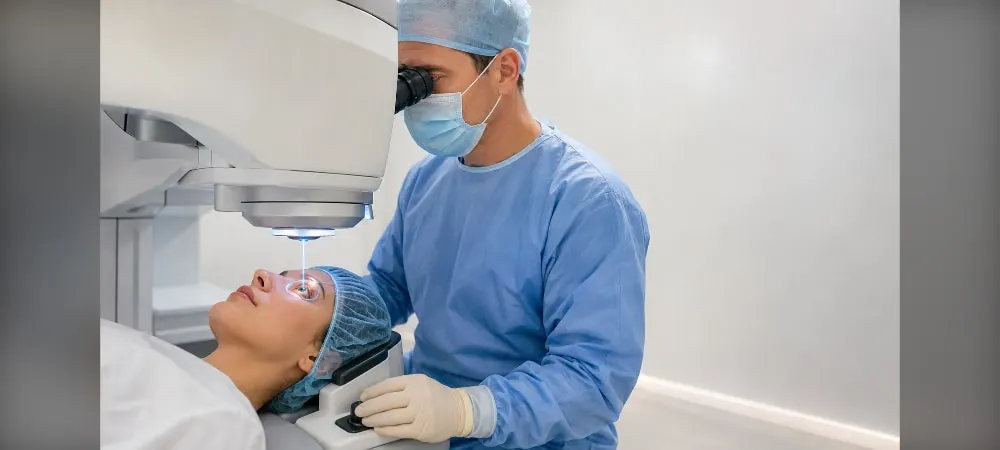
No-touch PRK is a laser method that allows you to treat myopia, hyperopia, and astigmatism without any device touching the eye. It is an ideal solution, especially for those who have been told they cannot undergo traditional laser treatment due to thin corneas. Both of your eyes are treated in the same session within seconds, and your eyes are not patched after the procedure. Developed in Germany, this method is approved in many countries, including European Union countries, America, Japan, and Russia. In this article, we will explain in detail how no-touch PRK works, who it is applied to, and the advantages of no-touch trans PRK technology.
What Is No-Touch PRK and How Does It Work?
Definition of No-Touch PRK
No-touch PRK is a laser treatment method performed without touching the corneal surface with surgical instruments. In this method, called surface ablation, the epithelial tissue, which is the top layer of your cornea, is removed directly by laser rather than with alcohol or a blade.
While in the classic PRK method the epithelial layer is scraped by the surgeon manually or by applying alcohol, in no-touch PRK, this process is performed entirely by laser. Therefore, no surgical instrument touches your eye, which reduces the risk of infection.
Since no flap is created, your corneal integrity is fully preserved. This feature offers a safer alternative compared to other techniques like LASIK, especially when your corneal structure is thin.
Difference from TransPRK Technology
The scientific name for no-touch PRK is TransPRK (Transepithelial Photorefractive Keratectomy). The term "no-touch" is not actually a scientific designation but rather a description used for easy understanding by patients.
The prefix "trans" in the term TransPRK means that the epithelial cell layer is also removed by laser. In other words, while the epithelial removal step is not performed by laser in classic PRK, in TransPRK, both epithelial removal and corneal shaping are performed with the same laser device.
In the normal PRK method, the epithelial tissue on the corneal surface is removed by scraping or alcohol application, and then excimer laser is applied. In the no-touch laser method, the epithelial layer of the cornea is also removed by laser, and then your prescription is corrected with the same laser.
Principle of Treatment Without Touching the Eye
During the treatment process, anesthetic drops are instilled into your eye, and you do not feel any pain. You lie down and focus on the red light emitted by the laser device.
The excimer laser first clears the epithelial layer, then shapes the underlying cornea according to your prescription in seconds. The entire procedure is performed by a computer-controlled laser system without contact.
Since the device is locked onto your eye, if you move your eye, the treatment stops automatically at that second. When you look at the device's light again, the treatment continues from where it left off. Additionally, a temporary bandage contact lens is placed over your eye to help with healing at the end of the treatment.
Who Is No-Touch PRK Applied To?
Suitability for Myopic Patients
No-touch PRK can be applied to you if you have a problem with seeing clearly at a distance. However, you must first be 18 years old and your glasses prescription must have remained stable for the last year. The progression of your prescription must have stopped.
The myopia degrees that can be treated cover a wide range. Generally, myopia treatment is performed up to 6-8 diopters.
Hyperopia and Astigmatism Treatment
If you have a problem with seeing clearly at near, no-touch trans PRK may be a solution for you. Generally, hyperopia treatment is performed up to 4 diopters. Theoretically, it is suitable for +4 diopter hyperopia prescriptions. In some sources, 6 diopter hyperopia treatment is also considered possible.
There is a similarly wide range of application in astigmatism treatment. As a standard, up to 4 diopters of astigmatism can be corrected. However, depending on the patient's condition, astigmatism treatment up to 6 diopters can also be performed.
Patients with Thin Corneas
If your corneal thickness is not sufficient for LASIK treatment, no-touch PRK is the best alternative. LASIK is generally not applied to people with a corneal thickness of less than 500 microns. In this case, no-touch laser treatment can be safely applied.
In this method, no incision is made in the eye, and no piece is removed. There is very little tissue loss in the eye after the laser. Therefore, it can be safely applied to much thinner corneas. It can also be applied to patients whose corneal surface is steeper than normal.
Applicability After Cataract Surgery
If you have previously had cataract surgery and an intraocular lens has been implanted but your eye prescription could not be zeroed out, no-touch PRK can be used. It is a good option for those who have had cataract surgery and have to wear glasses.
For example, this method is safely applied to patients who have remaining glasses prescriptions after cataracts. Thus, you can get rid of your dependence on glasses.
Patients Who Have Undergone Corneal Transplantation
No-touch PRK is safely used in patients who have undergone corneal transplant surgery and have developed high eye prescriptions. Vision problems that occur after transplantation can be corrected with this method.
The fact that it can also be applied to patients who have undergone corneal transplantation shows the flexibility of the treatment. It is important that the glasses prescriptions in this patient group have not progressed in the recent period.
How Is No-Touch PRK Surgery Performed?
Pre-operative Preparation
After the decision for surgery is made, a topographic map of your eye is created. This process reveals the detailed structure of your corneal surface. In addition, dynamic pupillometry is performed to see how your pupil behaves under different lighting conditions.
If you use contact lenses, you must stop wearing your lenses before the surgery. Those who use soft lenses should generally stop wearing lenses for 1 week, and those who use hard lenses for 2 weeks. This step is vital for accurate corneal measurements.
You should not use products such as makeup or lotion on the day of surgery. Such products can disrupt sterility. It is recommended to have an attendant with you, as your vision may be partially blurred after the surgery.
Application Steps and Duration
As the procedure begins, anesthetic drops are instilled into your eye. Thanks to this, you will not feel any pain during the surgery. A small eye speculum is placed to prevent your eyelids from closing involuntarily.
First, your corneal surface is completely dried. Then, using the excimer laser, the corneal epithelium is removed in a single step using the ablation method. At this stage, no device touches your eye. The treatment is applied directly with the help of beams from the laser device.
After the epithelium is cleared, your cornea is reshaped according to your prescription with the same laser. SmartPulse or CIPTA software guides the way your cornea is renewed with precision. The application time of the laser varies between 3-20 seconds per eye.
When the procedure is completed, a protective bandage contact lens is placed on your eye. This lens acts as a protector during the healing process of the epithelial layer and is removed by your doctor after a few days.
Patient Experience During Surgery
The only thing you need to do is look at the red light reaching you from the laser. If you move your eye, the treatment stops automatically, and when you look at the light again, it continues from where it left off.
You will not feel any pain or ache during the application. There is no stinging or burning. The comfort of the surgery is quite high due to the effect of the anesthetic drops.
Treatment of Both Eyes in the Same Session
Both of your eyes are treated in the same session within seconds in a very short time. Your eyes are not patched after the surgery. You can return home the same day with both of your eyes open.
Protective glasses are provided to you by the clinic. Your doctor will give you the necessary warnings to protect your eye. Together with the preparation and recovery process, the procedure usually ends within 10 minutes.
Advantages of No-Touch PRK
Treatment Without Touching the Eye
The most prominent feature of the method is that no surgical instrument touches your eye throughout the surgery. No blade, vacuum ring, or mechanical device touches it. Laser beams are applied directly to your corneal surface.
The non-contact procedure significantly reduces the risk of infection. Sterility is easier to maintain. Also, since there is no surgical intervention, the process is a more modern and automated one. The surface can regenerate more regularly during the healing process.
No Flap Removal
In the LASIK method, a flap in the shape of a lid is cut in your cornea. In no-touch trans PRK, no flap is created. This provides many advantages.
The risk of flap displacement is eliminated. The risk of corneal weakening is reduced. Problems such as flap wrinkling or cell accumulation under the flap do not occur. Since there is no incision in the cornea, the biomechanical integrity of the cornea is better preserved.
Your natural corneal structure is preserved to the maximum level. It is one of the laser methods that best preserves corneal biomechanics. Since ablation is performed from the surface, stromal thickness is preserved.
Minimal Risk of Dry Eye
Since there is less intervention to the nerve endings in the cornea, the risk of dry eye after surgery is at a minimal level. Since there is no incision, the possibility of dry eye is at a minimal level after the procedure.
It is an important advantage for patients with dry eye problems. The risk of dry eye is minimal. Although there is a possibility of complications, even if very low, it is more advantageous compared to other methods in terms of dry eye.
Ideal for Those Who Play Active Sports
Since it is applied without a flap, the risk of complications due to impact is low. Your corneal structure remains more resistant to external impacts. This feature is suitable for occupational groups open to eye trauma, such as athletes and soldiers.
You can even go to a boxing match from the 4th day of the surgery if you wish. It is an ideal method for those who play active sports. Even if it receives an impact, it is safe because there is no flap.
Applicability to High Prescriptions
Since no incision is made in the eye and no piece is removed, there is very little tissue loss in the eye after the laser. Therefore, it can be safely applied to much thinner corneas and high prescriptions.
Astigmatism and hyperopia, especially high myopia, are successfully corrected. Myopia, hyperopia, and astigmatism defects can be eliminated at the same time. It corrects both distance and near in a single session.
Post-operative Recovery Process and Things to Consider
First 36 Hours and Expected Complaints
When the surgery is over, your eyes are not patched, and you can go home with both of your eyes open. UV glasses are provided for protection. It is normal to experience stinging, burning, watering, and sensitivity to light in your eyes for the first 36-48 hours. Resting in a dim environment during this period provides comfort.
Severe pain is not expected. Thanks to the drops given to you, this process passes comfortably. You may see small letters blurred for the first 3 days. It varies from patient to patient; some may have a more comfortable time, while others may have a more difficult one.
Definitely avoid rubbing your eyes. The bandage contact lens acts as a protector and reduces pain. You should not try to remove this lens yourself; the removal time is under your doctor's control.
Control Calendars
After three days of rest, you are expected to come for a check-up on the 4th day. In this check-up, the healing status of your cornea is evaluated, and the bandage lens is usually removed after 4-5 days.
Your visual clarity may fluctuate between the 7th and 20th days. You may see clearly at times and blurred at other times. After the 20th day, your vision quality continues to increase gradually, and the fluctuation decreases. The full recovery process can take about a month.
Water Contact and Hygiene Rules
Your eye should not come into contact with water for the first week. Be careful not to get water in your eye while washing your face. Do not be exposed to hot steam in the shower for a long time and avoid contact with soap and shampoo.
Activities such as pools, the sea, and saunas are not recommended for about 2 weeks. Since water can carry germs, it increases the risk of infection. Stay away from dusty and smoky environments; they can irritate your eye surface.
Use the prescribed eye drops regularly after the procedure. Leave 5-10 minutes between drops and do not touch the bottle tip to the eye.
Use of Sunglasses
Protecting from UV light accelerates healing. Use the protective glasses provided for the first 4 days. Wear UV-filtered sunglasses outdoors for the first 6 months. There is no need to use glasses in room conditions.
Be sensitive about using sunglasses, especially in the first 2 weeks. Use them even in sunny, cloudy, and rainy weather. Prefer glasses with UV protection, wide frames, and polarized lenses.
Return to Daily Activities
You can return to your routine activities on the 4th day after the treatment. You can use devices with screens, but it is recommended to keep it limited for the first week. You can travel with your own vehicle at the end of the 6th day.
You can start light exercise after 1 week. Most sports can be done after the fifth day, but it is necessary to decide on a person-by-person and sport-by-sport basis. Take a break from makeup and cosmetic products for at least 1-2 weeks.
Frequently Asked Questions
Is it the same thing as Transepithelial PRK? Yes, no-touch PRK is actually the popular and commercial name for the Transepithelial PRK method. It is referred to as TransPRK in scientific literature. Both terms refer to the same technique.
What does SmartPulse technology do? It is a "polishing" technology that smoothes your corneal surface after the laser correction process. In this way, higher quality vision and theoretically faster healing are aimed. A smoother corneal surface increases your vision quality.
What is its relationship with excimer laser? No-touch PRK is a type of excimer laser. Its feature is that the epithelial tissue of the cornea is completely removed from the environment by laser without touching the cornea. Therefore, excimer laser is a broad category, and no-touch trans PRK is included in this category.
Does the prescription return? When applied to the right candidate, the risk of your prescription returning is quite low. However, a small amount of regression can be seen in high prescriptions. In suitable patients, the risk of the prescription rising again is very low. Generally, your eye prescriptions are permanently corrected after treatment with no-touch PRK. In addition to this, there may be changes with advancing age in some cases. This situation is followed in regular check-ups, and a touch-up intervention can be performed if necessary.
How many times can the surgery be performed? Generally, no-touch PRK treatment is sufficient in one go, but re-treatment may be required in some cases. It depends on the condition of your eyes and your response to the treatment. If your corneal thickness is sufficient, a second application is possible.
Does SGK or insurance cover it? No, it is generally not covered by SGK or private health insurance as it is considered an aesthetic procedure. You need to cover the treatment cost yourself.
Are there any side effects? Yes, there may be side effects, but most are temporary and mild. It is important to remember that the long-term effect may vary for each patient. The most common side effects are stinging, watering, and light sensitivity in the first days.
Can a phone be used after surgery? It is recommended to stay away from screens for a few days after surgery. However, some patients can use them for short periods as long as they do not feel discomfort. For example, limiting screen use for the first 2-3 days helps your eyes heal.
Can non-prescription colored lenses be used? There is no harm in using non-prescription colored contact lenses after no-touch PRK treatment. You can safely wear the cosmetic lenses you want after healing is complete.
In Summary, No-Touch Laser
No-touch PRK allows you to treat myopia, hyperopia, and astigmatism without any instrument touching your eye. It is an ideal solution if you cannot have LASIK because your cornea is thin or if you have an active sports life. Both of your eyes are treated in a short time within seconds. Since no flap is created, your corneal integrity is fully preserved, and the risk of dry eye is minimal.
Before making a decision for surgery, have a detailed eye examination and discuss your expectations with your doctor. When the right patient selection is made, no-touch trans PRK offers safe and permanent results. In fact, this method, which is approved in many countries, is a reliable step for a life without glasses.