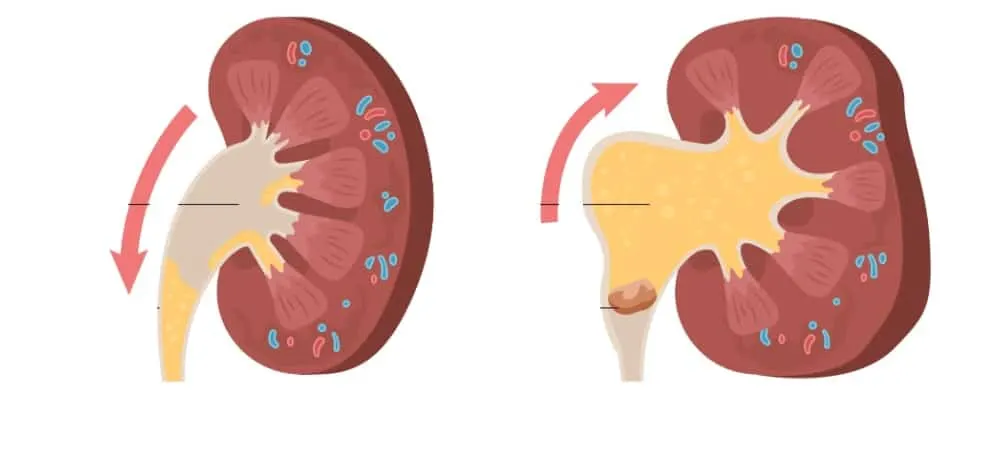
Kidney Enlargement (Hydronephrosis)
Kidney enlargement, known as hydronephrosis, is a urinary tract condition that occurs when urine cannot be completely drained from the body. Various factors can lead to blockages in the pathways that carry urine from the kidney to the bladder. Congenital anomalies, infections, tumors, and other health issues can be responsible for urine backing up and accumulating in the kidneys. It can affect one or both kidneys. Symptoms may include intense and sudden pain in the back and flank, along with painful urination, fever, fatigue, vomiting, etc.
Kidney enlargement during pregnancy is a common condition and often develops in the second trimester. After birth, hydronephrosis may persist for 6-12 weeks. The effect of progesterone and the compression of the ureters due to the growth of the uterus can lead to kidney enlargement during pregnancy.
In infants, kidney enlargement is generally caused by blockages that occur during fetal development. It tends to resolve spontaneously before birth. There are treatment approaches tailored to the underlying cause of hydronephrosis. With a rapid and accurate approach, long-term complications can be reduced. Untreated kidney enlargement can lead to loss of function and kidney failure. In some cases of kidney enlargement or swelling, ureteral dilation may also be observed.
What is Kidney Enlargement (Hydronephrosis)?
Kidney enlargement or hydronephrosis is a condition where urine accumulates in the kidneys as a result of the obstruction of urine outflow from the kidney. A blockage developing in the urinary tract can cause swelling and tension due to the accumulation of urine in one or both kidneys. The excretory system is a complex system consisting of the kidneys, ureters, bladder, and urethra. It is responsible for maintaining the body's fluid volume and electrolyte balance. The goal is to maintain internal body balance through the excretion of the final product, urine.
Preventing the excretion of urine produced in the kidneys can cause an increase in hydrostatic pressure. This can affect the rate at which blood is filtered in the kidneys and lead to a loss of function. When the blockage is not cleared, permanent kidney damage may occur. Improvement in kidney function when the blockage is removed indicates acute hydronephrosis. If no improvement in kidney function is seen even after the blockage is removed, this may indicate chronic hydronephrosis. Sudden onset acute or chronic, partial or complete enlargement can be seen. When a single kidney is affected, it is called “unilateral hydronephrosis,” while enlargement seen in both kidneys is called “bilateral hydronephrosis.”
What Are the Symptoms of Kidney Enlargement (Hydronephrosis)?
Although kidney enlargement often does not show symptoms, it can present various findings depending on the cause of the underlying condition. These findings may often include:
Sudden and severe pain in the lower abdomen, groin, back, and sides,
Painful urination,
Urination more or less frequently than normal,
Blood in the urine,
Fever,
Nausea and vomiting,
Weight loss and loss of appetite,
Urinary tract infections,
Developmental delay in infants,
Inability to empty the bladder completely.
The trapping of urine in the kidneys and urinary tracts commonly brings about urinary tract infections. Infections can cause fatigue, fever, chills, cloudy urine, and a burning sensation. Symptoms of kidney enlargement in infants are usually not noticed. In severe cases, it may appear as frequent urinary tract infections and loss of appetite.
What Causes Kidney Enlargement (Hydronephrosis)?
The most common cause of right or left kidney enlargement, and in some cases both, is partially or completely blocked urinary tracts. Factors that lead to the development of kidney enlargement in adults as a result of blockage can be:
Ureteral obstruction: Blockages occurring in the channels that carry urine from the kidneys to the bladder.
Kidney stones: Stones located in the kidneys or urinary tracts can cause blockage.
Tumors: Tumors developing in the urinary tracts, bladder, uterus, or prostate gland can block urine flow.
Urinary tract narrowing: Narrowing and blockage can be seen due to injury and trauma, infection, surgical interventions, or birth defects.
Prostate enlargement: Enlargement of the prostate gland can put pressure on the urethra.
Ureterocele: This is the protrusion of the lower parts of the ureters into the bladder.
Other causes of hydronephrosis may include the backflow of urine into the kidneys due to various reasons. The most common condition is vesicoureteral reflux, which causes urine to flow back from the bladder into the kidneys. Additionally, pregnancy, uterine prolapse, and bladder prolapse can contribute to kidney enlargement in women. Most cases of kidney enlargement in children are caused by anatomical abnormalities. Kidney enlargement in the baby in the womb may be related to the fetus producing too much urine, a blockage in the urinary tracts, or urine backing up into the kidney.
How Is Kidney Enlargement (Hydronephrosis) Diagnosed?
Diagnosis of kidney enlargement can be achieved by resorting to more than one method. Early diagnosis and treatment are important approaches to minimize damage that may occur in the kidneys. Tests and imaging techniques recommended by specialist doctors for the diagnosis of hydronephrosis are as follows:
Family history: Existing kidney diseases, genetic problems, and other health issues in family members are evaluated.
Physical examination: Includes observation of existing symptoms. Swelling, tenderness, fever, etc., in the kidneys and lower abdominal region are examined. A rectal examination may be performed in men to check for prostate enlargement, and a pelvic examination in women to check the uterus and ovaries.
Blood tests: Can show whether there is an infection in the body. In a complete blood count, eGFR, creatinine, and blood urea nitrogen (BUN) values can provide information about kidney function.
Urinalysis: Includes the examination of urine samples for blood, bacteria, stone crystals, and infection.
Imaging techniques: The main imaging of kidney enlargement is provided by ultrasound. Other causes of hydronephrosis can be detected by computed tomography (CT) and MRI.
Kidney enlargement in the baby in the womb can be imaged with ultrasound. Kidney enlargement in the womb can be diagnosed as early as the first trimester. In most cases, spontaneous recovery is seen in infants.
How Is Kidney Enlargement (Hydronephrosis) Treated?
Treatment of kidney enlargement mainly aims to restore urine flow from the kidney, reduce pressure and swelling in the kidney, and prevent kidney damage. The treatment approach is determined based on the cause of hydronephrosis. Often, mild hydronephrosis resolves spontaneously without the need for medical treatment, but medical help may be necessary for other situations. Treatment options that can be applied within the scope of kidney enlargement treatment are as follows:
Urine drainage procedure: In people with sudden-onset hydronephrosis caused by a blockage, it may be necessary to drain the excessively accumulated urine. A nephrostomy tube can be placed through the skin into the kidney, and a ureteral stent can also be inserted to keep the ureters open.
Medication: Analgesics may be prescribed to relieve pain, antibiotics to clear infection, and various medications to improve fever, nausea, and vomiting.
Ureteroscopy: A procedure applied to break up and remove stones in the urinary tract.
Shock wave lithotripsy: A technique that helps break kidney stones into very small particles of dust and stones using high-energy shock waves so they can be expelled from the body.
Surgery: Surgery may be necessary for the treatment of large kidney stones, blocked or narrowed ureters, prostate enlargement, tumors, and cancers.
Treatment for kidney enlargement in infants may generally not be necessary. Mild to moderate hydronephrosis may resolve spontaneously by the 18th month.
What Is a Kidney Enlargement (Hydronephrosis) Test?
Blood and urine tests, as well as imaging methods, can be used under the name of a kidney enlargement test. There is no specific test that provides a diagnosis of kidney enlargement. However, information about kidney anatomy and function can be obtained. In blood tests, hormone values, eGFR, blood urea nitrogen (BUN), creatinine, and HbA1C levels, which directly or indirectly show kidney activity, are measured. Urinalysis can show any infection, abnormal bacterial growth, bleeding, kidney damage, or the presence of stones and gravel in the excretory system. Structural changes in the kidneys can be determined with the help of ultrasound. Ultrasound can be applied to all age groups, including kidney enlargement in the baby in the womb. Additionally, MRI and computed tomography techniques are also devices used for diagnostic purposes.
Frequently Asked Questions
Kidney enlargement does not often lead to serious health problems. Since it frequently appears as mild or moderate, it can be brought under control and treated. Without early diagnosis and emergency intervention, hydronephrosis can damage the kidneys, and kidney failure can occur as a result of permanent damage. Determining the underlying cause of hydronephrosis and treating it often contributes to recovery. However, in cases where the underlying cause cannot be determined or eliminated, hydronephrosis may return. Additionally, hydronephrosis seen in prenatal infants that resolves spontaneously may reappear after birth without being tied to a specific time. An untreated hydronephrosis profile can cause serious damage to the kidneys. In the case of single kidney enlargement, kidney failure is rarely seen. If there is only one working kidney, the risk of kidney failure is high. Kidney enlargement in infants is not normal; it can be a temporary or permanent problem. While it may resolve spontaneously in some cases, it can sometimes indicate a serious problem. Kidney enlargement in infants during pregnancy can occur due to premature birth and developmental delays, birth defects such as spina bifida, and lower urinary tract obstructions. When hydronephrosis occurs due to large kidney stones, tumors and cancers, prostate enlargement, or narrowed and blocked ureters, surgical intervention may be necessary, but surgery is not resorted to in all cases of hydronephrosis. If unilateral hydronephrosis is treated and the other kidney is in a healthy state, it may not pose a danger. Unilateral hydronephrosis can be a serious problem if the other kidney is not functioning. Kidney failure can develop if emergency and correct intervention is not provided. Hydronephrosis can cause pain in one or both back regions, the lower abdomen, and the groin. This pain can be mild or severe and can start suddenly. Nausea and vomiting, fever, and urinary tract problems may accompany the pain. Hydronephrosis or kidney enlargement can be understood with ultrasound. Additionally, kidney enlargement in the baby in the womb can also be detected with ultrasound. Kidney enlargement occurring in the fetus can be imaged even in the first trimester. Kidney enlargement during pregnancy can usually resolve spontaneously. Hydronephrosis is seen in approximately 80% of pregnant women. It may persist until the 12th week after birth and may subside, but early diagnosis and follow-up are important. Hydronephrosis can be managed under doctor supervision, and symptoms can be minimized.
Do Not Delay Your Kidney Health
Kidney enlargement (hydronephrosis) is a health problem that can be brought under control with early diagnosis and correct treatment. Especially if you are experiencing severe flank pain, frequent urinary tract infections, or urinary problems, an expert evaluation is important without delay.
At Hisar Hospital Intercontinental Nephrology Department, hydronephrosis diagnosis and treatment are successfully performed with advanced imaging methods, modern endoscopic applications, and a multidisciplinary approach.
You can contact us for detailed information and appointments.
Start with the right assessment for What is Kidney Enlargement (Hydronephrosis)? Symptoms, Causes, and Treatment
Share your symptoms with our specialist physicians; let us determine the right diagnosis and treatment plan together.
Warning
If your symptoms started suddenly, are progressing rapidly, or significantly restrict your daily life, consult a physician without delay.
Plan your What is Kidney Enlargement (Hydronephrosis)? Symptoms, Causes, and Treatment journey with our specialists.
Fill in the form or book an appointment to learn about treatment options, the process and preparation.