Persistent or recurrent dizziness and balance problems can negatively affect your quality of life. Vestibular system disorders make daily activities difficult and increase the risk of falls. The good news is that vestibular rehabilitation can help you manage these symptoms.
In this article, you will find answers to what the vestibular system is, how it works, and how the ear's vestibular system relates to balance. We will also share detailed information about vestibular system exercises, the treatment process, and who can benefit from this rehabilitation.
What Is the Vestibular System?
In your inner ear, right next to the organ of hearing, there is a small but complex structure. Known as the vestibular system, this structure allows you to sense your balance and your body's position in space.
The vestibular system consists of two main components. Three canals, which we call the semicircular canals, detect the rotational movements of your head. These canals are positioned at right angles to each other and are filled with fluid. When you turn or tilt your head to the right or left, this fluid moves and sends signals to the brain.
The second component is the otolith organs. These small sacs, called the utricle and the saccule, contain calcium carbonate crystals. These structures detect gravity and linear movements. These organs come into play when you go up in an elevator or accelerate in a car.
Functions of the Vestibular System
The vestibular system has several critical functions. It allows you to stay upright against gravity while standing or walking. Even when the floor is slippery, it prevents you from falling by automatically adjusting your body's center of gravity.
One of its most important functions is controlling eye focus. When you walk or run, your head constantly shakes, yet the image you see does not blur. The vestibular system stabilizes the image by moving your eyes in exactly the opposite direction of head movement. This function is called the vestibulo-ocular reflex and is critically important for seeing clearly in daily life.
It also provides spatial awareness. Even with your eyes closed, you can tell which way your head is facing and whether you are accelerating. It helps you correctly perceive your body's position in its surroundings.
The Relationship Between the Ear's Vestibular System and Balance
Your balance does not depend on your inner ear alone. The brain combines information from three different sources: the inner ear, the eyes, and the musculoskeletal system. However, the data coming from the inner ear are the most valuable.
The nerves originating from the vestibular organs in the inner ear reach the brainstem. There, they combine with nerve fibers from the eyes, the spinal cord, and the cerebellum to form a network. Thanks to this coordinated work, your balance is maintained.
For balance to be maintained, at least two of these three systems must function normally. Therefore, even if there is a problem in your inner ear, the other systems try to compensate for a while. However, when the vestibular system is impaired, the compensation mechanisms may become insufficient.
Causes of Vestibular System Disorders
Problems occurring in the balance structures of the inner ear lead to vestibular disorders. These disorders can arise from different causes.
The most common causes include displaced crystals, viral infections, and inflammation. Imbalances in the fluid or crystals of the labyrinth in the inner ear affect the system. Damage to the balance nerves or problems in the central nervous system can also cause disorders.
Vestibular neuritis, labyrinthitis, Meniere's disease, and migraine-related vertigo are common pathologies. Post-traumatic balance disorders, age-related vestibular insufficiency, and neurological diseases can also affect this system.
Damage to this system causes dramatic symptoms. You experience vertigo, that is, a spinning sensation, unsteadiness, drunken-like walking, nausea, and visual blurring when the head moves. Some patients report that they cannot read text or that objects appear to jump.
Who Is Vestibular Rehabilitation Applied To?
Vestibular rehabilitation benefits a wide group of patients. Forty percent of the adult population consults a doctor at least once with complaints of vertigo and balance disorder. This figure shows how common the problem is.
People With Vertigo and Dizziness Complaints
BPPV, known as displaced crystals in the inner ear, is one of the most common causes of dizziness. When getting out of bed or turning your head, you experience a severe spinning sensation lasting a few seconds. It can be treated with repositioning maneuvers, but vestibular exercises may be needed for the residual feeling of unsteadiness afterward.
When inflammation occurs in the balance nerve, vestibular neuritis is diagnosed. It presents with sudden-onset, severe dizziness lasting for hours, along with nausea and vomiting. After the first attack subsides, you experience persistent unsteadiness and blurred vision while moving. Labyrinthitis follows a similar course, and in both conditions rehabilitation is critically important.
Patients who have had acoustic neuroma surgery also benefit from this treatment. Surgical intervention can cause one-sided loss of balance function, and a structured exercise program is needed for the brain to adapt to this situation.
Patients With Balance Disorders
Patients with unilateral or bilateral inner ear function loss are the group that benefits the most. Especially in cases of bilateral loss, a feeling of unsteadiness appears even while sitting or standing. You have difficulty performing your daily activities and feel insecure when walking.
The ototoxic effect of drugs such as gentamicin can affect both ears. In this case, walking in the dark becomes almost impossible. In addition, images jump when you turn your head, and you have difficulty reading text.
Central nervous system lesions, brainstem problems, and cerebellar disorders are also among the indications for vestibular rehabilitation. Patients with balance problems after stroke, multiple sclerosis, and traumatic brain injury can receive support from the exercise program.
Meniere's Disease and Similar Conditions
Meniere's disease follows a fluctuating course, and you experience chronic unsteadiness between attacks. However, treatment success depends on the frequency of attacks. If attacks occur about once a month, the disease is progressing rapidly and the chance of success with rehabilitation is low. In this case, medical or surgical treatment methods are more appropriate.
That said, if you complain of positional dizziness or constant unsteadiness between attacks, vestibular rehabilitation can help you. If the first attack was very severe but the symptoms are milder in subsequent attacks, this may be due to inadequate compensation, and the chance of treatment success increases.
Chronic functional dizziness syndromes such as vestibular migraine and PPPD are also conditions that require rehabilitation. Individuals who experience motion sickness may also benefit from the exercise program.
Individuals at Risk of Falling
About 30% of individuals over 65 fall at least once each year, and unrecognized vestibular dysfunction plays a role in a significant proportion of these falls. Falls can lead to fractures, dependence in activities of daily living, and even death.
Structured vestibular rehabilitation and balance exercises reduce the frequency of falls by 40-50%. Therefore, they should definitely be applied as part of fall prevention programs in older adults. A previous history of falls is the strongest predictor of future fall risk.
However, some patients do not benefit from vestibular rehabilitation. Hypotensive patients, those with migraine-related dizziness, and those who have had a transient ischemic attack fall into this group. Drug reactions also negatively affect the response to treatment.
How Does Vestibular Rehabilitation Work?
Vestibular rehabilitation works by activating your brain's adaptation and compensation mechanisms. This approach, which is a physical therapy method, reduces or completely eliminates your balance problems through exercises.
The brain's capacity to learn lies at the foundation of the treatment process. When damage occurs in your inner ear, the brain receives incorrect signals. Thanks to vestibular system exercises, the brain learns how to restore balance by using its other senses.
The Connection Between the Brain and the Balance System
When establishing balance, the brain uses information from the inner ear, the eyes, and the musculoskeletal system. The vestibular organs in the inner ear detect the movement of your head and transmit this information to the brainstem via the balance nerve. The brainstem and cerebellum process these signals to regulate your eye movements and control your posture.
When damage occurs in the vestibular system, the brain receives conflicting signals and becomes disoriented. However, thanks to a property called neuroplasticity, the brain can form new neural pathways. With repeated exercises, the use of these new pathways becomes easier, and the brain relearns how to maintain balance.
The central compensation process occurs through strengthening of the vestibular organ on the healthy side and of other sensory systems. Rehabilitation accelerates this process and reduces dizziness and postural disturbances. The goal is for the person to feel safe in daily life and to eliminate the risk of falling.
Pre-Treatment Evaluation Process
A comprehensive evaluation performed by a physiotherapist is the first step of treatment. First, the patient's main problem is identified and the rehabilitation goal is determined. A detailed medical history is taken, and the onset, duration, and triggers of the symptoms are examined.
Movement quality, balance reactions, and symptom severity are analyzed. Eye movements are evaluated for the presence of nystagmus. Head-turning tests are performed, and the presence of positional vertigo is investigated.
Standard inventories are used to measure the degree to which the balance problem affects activities of daily living. Vestibular testing methods are determined according to the patient's needs. Objective tests such as VNG, VEMP, caloric testing, and posturography may be performed.
Limiting health problems such as cervical pathologies must be reported to the physiotherapist. The treatment plan is prepared in light of the results obtained.
Preparing a Personalized Treatment Plan
Each individual's balance problem is different, so treatment is always programmed specifically for the person. Appropriate exercises are selected depending on the type of vestibular loss, the symptoms, and the functional capacity.
The treatment program is divided into three main categories. Habituation exercises treat dizziness symptoms triggered by movement. Gaze stabilization exercises improve control of eye movements. Balance training exercises are given so that daily activities can be performed successfully.
Positional training, eye-head coordination work, and postural balance exercises are included in the program. Safe balance is achieved by supporting central and peripheral vestibular functions. Home exercises and recommendations for adapting daily life increase the effectiveness of treatment.
Throughout the program, continuous follow-up and updates are made according to individual needs. Vestibular rehabilitation therapy is delivered safely with a physiotherapist, using non-surgical and non-drug methods.
Vestibular System Exercises and the Application Process
When the exercise program begins, the physiotherapist teaches you movements specific to you, and you practice them regularly. The program is built on four basic mechanisms: gaze stabilization, habituation, substitution, and adaptation. Each strengthens your balance system in a different way.
Eye Movement Control Exercises
The ability to keep your eyes focused while your head moves is critically important. The VOR x1 exercise serves this purpose. While focusing on a fixed target, you move your head side to side or up and down. The goal is to increase control of eye movements.
The VOR x2 exercise requires more intensive work. Your head and the target move in opposite directions, which provides strong stimulation to your vestibular system. Over time, you increase the speed of movement and add a complex background. The exercises you start while seated are also performed standing and while walking.
If you have difficulty with visual focus during head movement, blurred vision occurs. Eye-head coordination training reduces this problem. Rapid eye movement work and visual tracking exercises are included in the program.
Balance Training Exercises
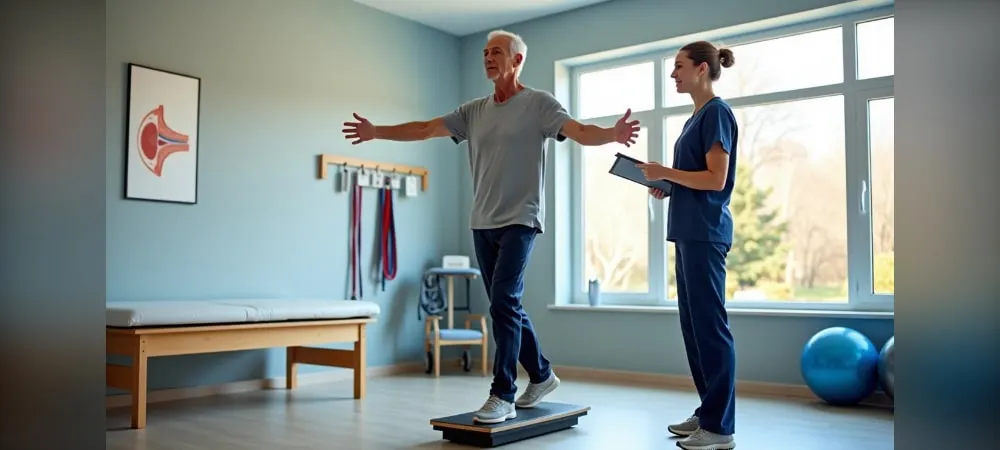
Static balance exercises progress from a wide base of support to a narrow one. You progress from a firm surface to a soft surface, and from eyes open to eyes closed. For example, you first stand on both feet, then move on to single-leg balance.
Dynamic balance exercises improve your control while moving. You do tandem walking, perform turns, and do obstacle-crossing exercises. Dual-task activities provide progress by challenging brain capacity. Talking while walking or doing mathematical operations are examples.
Work on balance boards and soft cushions increases your adaptation to different surfaces. These exercises strengthen the brain's sensory feedback mechanisms.
Walking and Movement Exercises
Functional activity training makes your daily life easier. You repeat practical movements such as climbing and descending stairs, bending and reaching, and carrying. Walking exercises with head turns are also added to the program.
In gait training, step length, speed, and rhythm are regulated. Your ability to cope with environmental stimuli is developed. Cawthorne-Cooksey movements are frequently used in the standard protocol. These exercises begin with eye and head movements while lying on your back and progress to sitting and standing positions.
Strengthening and Flexibility Work
Stretching and strengthening exercises support your body balance. Hip stabilizers and abdominal muscles require special attention. These muscles form the basis of many movements.
Fall prevention strategies are an important part of the program. You learn safe movement patterns and make environmental modifications. Protective reaction training reduces the risk of falling.
Treatment Duration and Expectations
The standard program lasts 6-8 weeks. In the first week, exercises are taught with a specialist at the center, and in the following weeks you continue as a home program. In conditions such as vestibular neuritis, early rehabilitation speeds up recovery by 2-3 weeks.
Home exercises should be performed regularly 2-3 times a day, for 15-20 minutes per session. During follow-up, objective measurements such as the Dynamic Gait Index and the Berg Balance Scale are performed. These assessments structure the progression of the exercises.
Points to Consider During Exercises
Patient compliance is critically important. Keeping an exercise diary and attending follow-up visits regularly directly affect the results. At the beginning, you may experience brief, mild dizziness; this indicates that the vestibular system is being stimulated.
If you feel severe dizziness, nausea, or anxiety, slow down the exercise or take a break. Be sure to inform your physiotherapist of any limiting conditions you have, such as cervical pathologies.
Frequently Asked Questions
How long does vestibular rehabilitation take?
The duration of the treatment program varies from person to person. A typical program ranges from 6 to 12 weeks. Programs delivered as 1-2 sessions per week are common. That said, some acute conditions may improve in a shorter time.
In cases of displaced crystals such as BPPV, even a single-session maneuver can sometimes be the solution. However, in chronic or complex vestibular disorders, the rehabilitation process can take several months. While 4-6 weeks is sufficient in acute vestibular neuritis cases, it can exceed 12 weeks in chronic conditions such as bilateral vestibular insufficiency.
You feel noticeable improvement within the first 2-4 weeks. Full compensation can take up to 6-12 weeks. There may be a slight increase in your symptoms within the first 2 weeks, which is known as the habituation response. From the third and fourth weeks onward, noticeable improvement begins.
Do the complaints go away completely after treatment?
In cases of unilateral vestibular function loss, 70-80% of patients achieve significant improvement in balance and dizziness symptoms. Therefore, in most patients, the complaints decrease substantially. When treatment is successful, lasting improvement is usually achieved.
After the program is completed, the majority return to their daily activities without problems. You can comfortably do things such as driving, going up and down stairs, and playing sports. The frequency of dizziness attacks decreases, your tolerance for sudden movements increases, and the fear of falling eases.
However, in some people, mild unsteadiness may be permanent. The time to complete recovery differs from person to person. It may take 3-4 months in some patients and up to 1 year in others. The brain's capacity for adaptation plays an important role in the success of treatment.
Is it necessary to exercise at home?
Yes, but the initial evaluation should be done in the clinic and the individual program should be determined by a specialist. Most of the exercises planned specifically for you by the audiologist are designed to be performed at home.
Exercises done on your own can worsen symptoms or increase the risk of falling. Incorrect maneuvers can make the problem more complicated. In addition, exercises performed unknowingly can reduce the response.
Specialist supervision is important, especially at the beginning and when the exercise program is updated. Specialists determine which exercises are appropriate and safe for your condition and show you how to perform them with correct form.
Does the treatment have side effects?
Vestibular rehabilitation procedures carry no risk. One of the most common side effects is nausea, increased unsteadiness, and headache at the beginning of the exercises. At first, the exercises may cause mild dizziness. This is normal and is part of the recovery process.
Some patients may experience a temporary increase in their symptoms during exercise. These situations can be controlled by adjusting the intensity and duration of the exercises. As the brain gets used to this new situation, the dizziness will decrease.
Vestibular Rehabilitation in Summary
Although balance problems and dizziness reduce your quality of life, vestibular rehabilitation helps you manage these symptoms. Therefore, if you have chronic complaints, do not lose hope.
The treatment program is prepared specifically for you, and most patients see noticeable improvement within 6-8 weeks. With regular exercises, your brain develops new balance strategies, and you can comfortably return to your daily activities.
However, be sure to have a specialist evaluation before starting. A program suited to you and the correct techniques directly affect success. By working together with your physiotherapist, you can reduce your risk of falling and regain your confidence.