Robotic sleep apnea surgery offers a modern solution to a serious health problem that affects 5-10% of the population in Turkey. Airway obstruction during sleep not only lowers your quality of life but can also lead to serious risks such as heart disease and diabetes. Sleep apnea surgery performed with robotic surgery provides a more precise and effective treatment approach than traditional methods. In this article, you will learn what robotic sleep apnea surgery is, who it is performed for, and what its advantages are.
What Is Sleep Apnea and How Does It Affect Life?
Definition of sleep apnea
If your breathing repeatedly stops and starts during sleep, you may have sleep apnea. This condition occurs when your airway is partially or completely blocked. Pauses in breathing last at least 10 seconds and can occur 30 or more times within an hour.
When breathing stops, the oxygen level in your body drops. Your brain senses this, wakes you up, and restarts your breathing. Most of the time you do not remember these awakenings in the morning, but your body has not been able to rest throughout the night.
In obstructive sleep apnea, the most common type, the soft tissue at the back of your throat collapses and blocks the airway. This obstruction can last from a few seconds to several minutes. Breathing usually resumes with a snorting sound.
The relationship between snoring and sleep apnea
Snoring and sleep apnea are not actually the same thing. While snoring is a social problem for those around you, sleep apnea is a health condition that may cause the patient to face serious problems in later years.
Not everyone who snores has sleep apnea. In fact, only 10% of patients who snore have sleep apnea. However, studies have shown that one in every three men who snore and one in every five women who snore have sleep apnea.
If your snoring suddenly stops, there is no sound for a while, and then you breathe with effort, this may be a sign of sleep apnea. In this case, you must see a specialist.
Effects on daily life
Sleep apnea seriously affects your quality of life. During the day you experience constant sleepiness, irritability, headaches, a tendency toward depression, and difficulty concentrating. You wake up tired in the morning and feel exhausted throughout the day.
When left untreated, sleep apnea increases your risk of traffic accidents 7-8 times. It can also cause workplace accidents due to lack of concentration. In the long term, it triggers serious health problems such as heart disease, high blood pressure, and diabetes.
You may experience decreased work performance, problems in relationships, and a decline in your overall quality of life. Therefore, early diagnosis and treatment are very important when you notice the symptoms.
What Is Robotic Sleep Apnea Surgery?
Robotic surgery technology
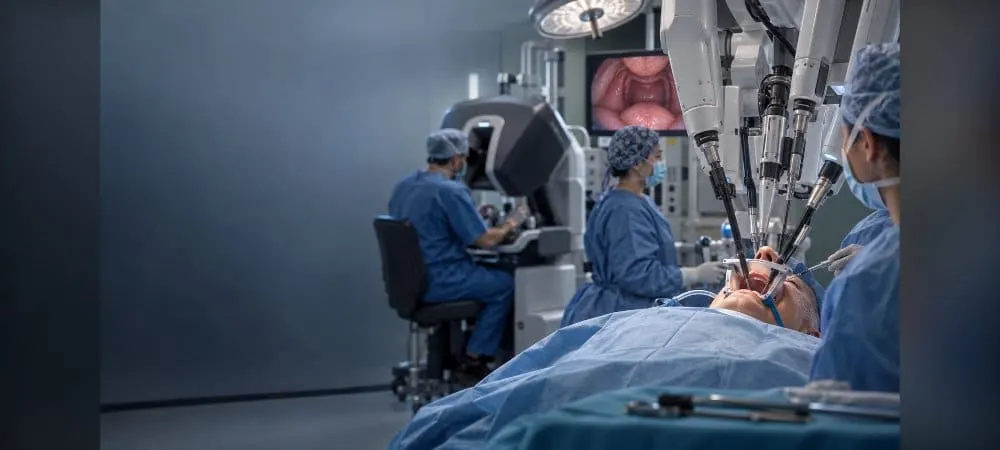
Robotic sleep apnea surgery is performed with advanced technologies such as the Da Vinci Robotic Surgical System. This method, called Transoral Robotic Surgery (TORS), is performed entirely through the mouth without making any external incision on your body.
During the operation, the surgeon sits at a special console located a few meters away from the operating table. The robot's small and precise arms are placed inside the mouth. The surgeon controls these arms with the controls on the console and is able to work in areas that the human hand cannot reach.
The system provides you with a three-dimensional, high-resolution image magnified up to 10-15 times. This image provides depth perception and allows the surgeon to clearly see critical nerve and vascular structures. In addition, the robot transmits the surgeon's hand movements with a tremor filter, enabling intervention with millimetric precision.
Differences from traditional methods
Robotic sleep apnea surgery differs from classical surgical methods in many respects. Normally, surgery of the tongue base region for sleep apnea was performed with the coblation method, radiofrequency application, and tongue base suspension. However, it is not possible to reach some areas with these traditional techniques.
Sleep apnea surgery with robotic surgery offers a minimally invasive approach. There is no externally visible incision on the neck or face. Compared with traditional open surgery, this means less tissue damage, less bleeding, and a lower risk of infection.
The surgeon's control and visual field are maximized. This provides a significant advantage, particularly in areas that are difficult to access with classical surgery, such as the tongue base and the back of the throat. Therefore, effective results are also achieved in patients with complex anatomical conditions.
Treatment approach
Robotic sleep apnea surgery aims to surgically correct narrowing of the upper airway. Abnormal enlargement or sagging of structures such as the tongue base, soft palate, uvula, or tonsils narrows the airway. These structures are targeted more precisely and effectively with robotic surgery.
During the operation, excess tissues that obstruct the airway are precisely reduced or removed with the help of the robotic arms. This procedure is known as tongue base reduction and allows the airway to be reopened. In some patients, enlarged tissue in the tongue base region and the tonsils can also be safely removed.
A personalized treatment plan is created for each patient. Especially if there are problems in more than one area, intervention in multiple areas can be planned during the same operation. For example, together with tongue base surgery, problems in the nose and palate regions are also addressed in the same session, providing comprehensive treatment.
Who Is Robotic Sleep Apnea Surgery Performed For?
Patients who do not benefit from CPAP therapy
Robotic surgery is not performed on every sleep apnea patient. First, standard treatment methods such as a CPAP device are tried. However, some patients cannot use this device or do not get sufficient results.
Patients who cannot tolerate the CPAP device are among the suitable candidates for robotic sleep apnea surgery. Surgery is considered as an alternative for people who cannot use the device because of large tonsils, tongue base, or soft palate tissue. Robotic surgery may be evaluated for patients who find using the mask difficult or who have trouble adapting to the device because of their throat structure.
Similarly, surgical options come into question for patients whose complaints continue despite CPAP therapy. For this group of patients, robotic surgery is considered an alternative treatment.
Patients with anatomical abnormalities
The main cause of sleep apnea is anatomical abnormalities in the upper airway. Conditions such as a large tongue base, sagging of the soft palate, or excessive enlargement of the tonsils make patients suitable candidates for robotic surgery.
In particular, structural problems in the tongue base region are both located in hard-to-reach areas and quite difficult to treat with classical surgical methods. Robotic surgery is preferred in patients with tongue base and soft palate obstruction when there is serious upper airway obstruction.
In some patients, enlarged tissues in the tongue base region are found to cause snoring and sleep apnea. In addition, people who have anatomical problems at the back of the throat that seriously restrict airflow may be candidates for this treatment.
Suitable candidates for surgery
Patients with moderate and severe obstructive sleep apnea more often need surgical intervention. Robotic surgery is a method with which successful results can be achieved in these patients.
Robotic sleep apnea surgery is reconsidered in cases in which sufficient airway opening could not be achieved with previous surgeries. Robotic surgery comes into question for patients whose sleep apnea has not improved despite previous attempts.
In patients whose apnea severity does not decrease despite weight loss and lifestyle changes, correction of the anatomical structures may be necessary. In this case, robotic surgery is considered among the treatment options.
Patient evaluation process
When deciding on robotic surgery, the patient's general health status, the severity of the apnea, the location of the obstruction, and suitability for surgery are carefully evaluated. An individual treatment plan is created for each patient.
Before the operation, patients undergo a detailed ear, nose, and throat examination. When deemed necessary, the airway is evaluated in detail with sleep endoscopy. After the source of the problem is identified, intervention in multiple areas can be planned during the same operation if needed.
Sleep test results, complaints, and the level at which the airway is narrowed are clarified. Whether robotic surgery is suitable is decided according to this evaluation.
How Is Sleep Apnea Surgery Performed with Robotic Surgery?
Preoperative preparation
A comprehensive evaluation is performed before starting the surgical process. Your sleep test results are reviewed, your complaints are heard, and the level at which your airway is narrowed is determined. At this stage, how the tongue base, soft palate, or other parts of the throat affect breathing during sleep is clarified.
In most cases, your problem is precisely determined by performing sleep endoscopy, and the level of obstruction is evaluated. Thanks to this procedure, the surgeon determines which areas need to be treated. In addition, it is checked whether you have sufficient mouth opening so that the surgeon can work comfortably through the mouth.
The surgical process
Robotic sleep apnea surgery is performed under general anesthesia. You are completely asleep throughout the operation and do not feel any pain. No externally visible incision is made on your body; the entire procedure is performed through the mouth.
The robotic arms and a high-resolution camera are placed in your mouth. From the console, the surgeon sees the surgical field magnified and in three dimensions and controls the robotic arms with precise controls. These arms offer superior maneuverability even in places the human hand cannot reach.
Excess tissues in the areas that cause sleep apnea are precisely reduced or removed. If your tongue base blocks the airway, the volume in this area is reduced. If there is sagging of the soft palate, intervention is performed so as to open the airway. At the operating table, another surgeon is also present to assist the surgeon at the console.
Postoperative recovery
In the first days, symptoms such as throat pain, difficulty swallowing, and mild bleeding may be seen. These symptoms usually decrease within a few days. Your doctor will prescribe appropriate medications for pain management.
You need to make temporary changes to your eating habits. You should consume liquid foods for the first few days. After that, you can switch to soft foods. You should stay away from spicy, acidic, very hot, or very cold foods.
You should avoid heavy physical activity during the first week. You can take light walks, but exercise and strenuous activities should be postponed. Sleeping with your head elevated reduces swelling and discomfort. You must absolutely avoid smoking and alcohol, as they will negatively affect the healing process.
Length of hospital stay
You are kept under observation for a few hours immediately after the operation. During this time, the effects of anesthesia are monitored and possible complications are prevented. Most patients are discharged on the same day.
In some cases, especially in patients at risk of complications, you may need to stay in the hospital for one night. It is important that you attend the follow-up appointments set by your doctor regularly. You should contact your doctor immediately if you encounter any sign of infection, excessive bleeding, or any unexpected situation.
What Are the Advantages of Robotic Sleep Apnea Surgery?
After understanding how the surgical procedure is performed, it is important to evaluate the benefits this method offers you. Sleep apnea surgery with robotic surgery provides many advantages over classical methods.
Minimally invasive approach
Sleep apnea surgery with robotic surgery is performed entirely through the mouth. No externally visible incision is made on your body. This approach greatly reduces tissue damage, bleeding, and the risk of infection.
Traditional open surgery requires large incisions. In the robotic method, however, small instruments are used and the focus is only on the problem area. Damage to healthy tissues is minimized. This advantage is more pronounced especially in hard-to-reach places such as the tongue base and the back of the throat.
Less pain and swelling
Postoperative pain intensity is markedly lower than with classical surgery. Therefore, the amount of pain medication you use is also reduced. Patients generally experience a more controlled recovery process.
Because tissue trauma is low, complaints such as swelling and edema are milder. One patient's experience summarizes this clearly: by the third and fourth week after surgery, one feels as if reborn.
Fast recovery time
Thanks to minimally invasive techniques, the recovery process is accelerated. You can return to your daily activities more quickly. Your hospital stay is shorter and you return to your normal life in a short time.
Compared with open surgery, the recovery period is markedly shorter. You can resume your working life and social activities earlier. In this way, your quality of life after surgery is high.
No incision scars
No incision scar forms on the neck or face. Because the operation is performed entirely through the mouth, no scar remains on your skin. If you have aesthetic concerns, this offers a great advantage.
Because there is no visible scar, it is not noticeable that you have had surgery. Patients with aesthetic concerns in particular are satisfied with this.
Low risk of complications
Complications such as infection, bleeding, and tissue damage are seen at lower rates in robotic surgery. Tremors in the surgeon's hand movements are filtered, and the effect of unwanted movements is eliminated. This feature significantly reduces the risk of complications in delicate anatomical regions.
The need for blood transfusion is minimized. Because less tissue damage occurs during the operation, side effects are rare. Therefore, it offers a safe treatment option.
High surgical precision
The robotic system provides you with a three-dimensional, high-resolution image. Tissues are seen much more clearly and intervention can be performed at the millimeter level. This precision reduces the risk of damaging surrounding tissues.
Thanks to the tremor-suppressing arms of the robotic system, the surgeon can work with millimetric precision. There is the possibility of pinpoint intervention on the target tissue. A great advantage is provided in protecting critical structures such as nerves. Similarly, it is an effective treatment option for patients with complex anatomical conditions.
Frequently Asked Questions
Is robotic sleep apnea surgery painful?
Because sleep apnea surgery with robotic surgery is a minimally invasive technique, postoperative pain is significantly less than with classical methods. The mild discomfort and pain felt in the throat can be easily managed with prescribed pain medications.
Because the precise nature of the surgery minimizes tissue trauma, most patients do not experience severe pain. They regain their normal comfort in a short time. One patient's experience summarizes the situation as follows: "It is a painful process, but the result is worth it."
How long does it take to return to normal after surgery?
The recovery process is faster and more comfortable than with classical operations. Mild pain and difficulty swallowing are normal in the first few days after surgery. This can be easily controlled with the pain medications recommended by your doctor.
You can usually return to your daily activities within 1-2 weeks. Depending on the type of surgery, the time to return to work varies between 7 and 14 days. However, it is recommended to wait about 3-4 weeks for heavy exercise, excessive voice use, and intense physical activity.
Patients say they feel as if reborn in the third and fourth week after surgery. For example, improvements such as waking up in the morning without an alarm and feeling refreshed are observed.
Can robotic surgery be performed on every patient?
Robotic sleep apnea surgery is not a method that can be applied to every patient. It is suitable for patients who meet certain criteria.
This surgical intervention is recommended for patients who do not get sufficient results from classical treatment methods such as CPAP or oral appliances. It is also preferred for patients who anatomically need surgical intervention. It is particularly effective when the lingual tonsil and tongue base are excessively large.
The success of treatment depends on the cause of the sleep apnea, the location of the obstruction, and the patient's general condition. Therefore, an individual evaluation must be made for each patient.
Does snoring go away completely after surgery?
In most patients, snoring decreases significantly or disappears completely. However, in some cases mild snoring may continue. The reason is usually weight gain, nasal obstruction, or tissue changes that occur after surgery.
Although surgery eliminates the main anatomical cause of snoring, there is a risk that snoring may recur. In particular, factors such as weight gain after surgery and smoking or alcohol use can cause snoring to start again. In some patients, apnea symptoms may return over time due to causes such as weight gain, aging, or renewed relaxation of the throat muscles.
Therefore, adhering to the lifestyle changes recommended by your doctor after surgery is very important to prevent the recurrence of snoring. Maintaining healthy lifestyle habits increases the long-term success of the treatment.
In Summary: Robotic Sleep Apnea Surgery
Robotic sleep apnea surgery offers an effective option for patients who do not benefit from the CPAP device or who have anatomical problems. Thanks to this surgery performed through the mouth, no incision scar remains on your body, and pain and swelling are reduced. The recovery time is also much shorter than with traditional methods.
However, this treatment cannot be applied to every patient. A detailed evaluation is essential for success. If you have sleep apnea symptoms and are not getting results from current treatments, you can consult a specialist doctor to find out whether robotic surgery is suitable for you. Early diagnosis and the right choice of treatment will significantly improve your quality of life.