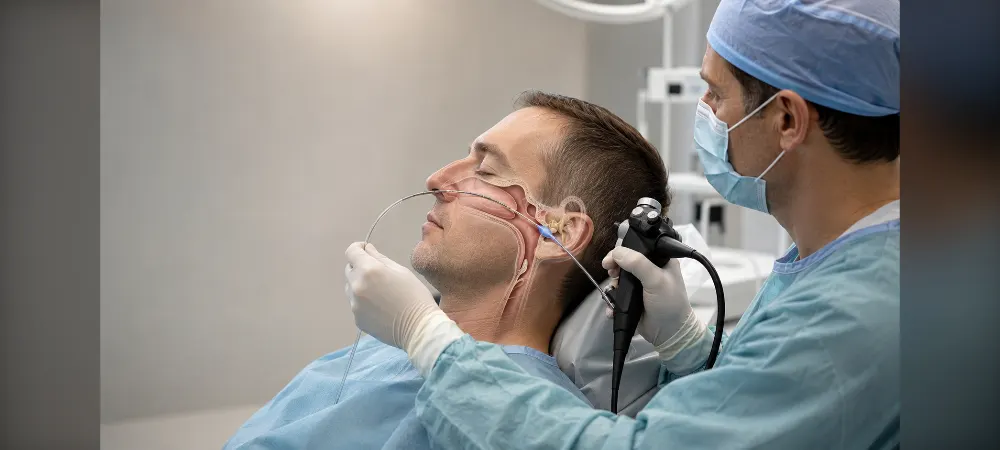
Eustachian tube balloon dilation offers a modern solution for ear congestion and pressure issues. Balloon tuboplasty is a minimally invasive treatment method that requires no incisions to relieve obstruction in the Eustachian tube. In fact, this method restores the function of the Eustachian tube. The procedure is performed under general anesthesia with the aid of an endoscope and takes an average of 15-20 minutes for both sides. Thanks to balloon tuboplasty, your ear pressure is maintained, and ear pain experienced during air travel is prevented. In this article, you will find answers to the questions of what balloon tuboplasty is, how it is performed, and why it is done.
What Is Balloon Tuboplasty and What Is Its Purpose?
Definition of Balloon Tuboplasty
Balloon tuboplasty is a minimally invasive treatment method applied to dilate an obstructed Eustachian tube. Also known as Eustachian tube balloon dilation, this technique is performed without any incisions. During the procedure, the Eustachian tube is accessed with the help of a special catheter, and a balloon is inflated in this area to widen the narrow passage.
This method was first applied in the United States in 2010. Subsequently, in 2010, Ockermann and his colleagues scientifically described its use in a group of patients. Today, 3 types of balloon systems are used worldwide: Bielefeld balloon systems, Reliva Solo Sinus Balloon Dilation systems, and the Reliva Vortex sinus irrigation catheter. Bielefeld balloon systems are available in our country.
About the Eustachian Tube
The Eustachian tube is a narrow channel connecting the middle ear to the nasopharynx (the area behind the nose). This tube is approximately 3.5 cm long and is positioned at an inclined angle. Its length, which is 17-18 mm at birth, reaches 35 mm in adults.
The structure of the Eustachian tube consists of two different sections. The one-third portion close to the ear is bony. The two-thirds portion close to the nasopharynx is made of cartilage. Both sections are cone-shaped and join at their narrow ends. This junction point, called the isthmus, is the narrowest part of the tube and measures 1x2 mm.
The Eustachian tube has three main functions. Its first task is to ventilate the middle ear. The middle ear is normally an air-filled space, and this air is important for the vibration of the eardrum. Its second task is drainage; it allows fluids accumulated in the middle ear to be drained into the nasopharynx. Its third task is protection; it protects the middle ear from pressure and pathological secretions in the nasopharyngeal region.
The tube is normally in a closed state. It opens during swallowing and yawning due to the contraction of the surrounding muscles. The opening time is about a tenth of a second. For sufficient airflow, a pressure difference of 200-300 mmH2O is required in adults. Air exit from the middle ear is a passive event and occurs more easily than air entry into the middle ear.
Primary Goal of Balloon Tuboplasty
The main goal of balloon tuboplasty is to relieve the obstruction in the Eustachian tube and restore its function. The procedure widens the narrowing cartilaginous part of the Eustachian tube with a balloon. Thanks to this dilation, the middle ear is sufficiently ventilated, and pressure balance is achieved.
The treatment success rate is high. Looking at publications in medical literature, the rates of benefit from the treatment are reported between 80-90%. As a result of the procedure, ear pressure is maintained, and ear pain and congestion experienced during air travel are prevented. The most important benefit is the prevention of eardrum retraction. Thus, many ear problems are avoided, and there is no need for ear tube insertion.
Balloon tuboplasty is used to eliminate hearing problems caused by fluid accumulation in the middle ear. If the Eustachian tube is blocked, problems such as fluid accumulation in the ear and hearing loss may occur. Therefore, treating it with timely and qualified methods prevents serious problems such as hearing loss.
In Which Situations Is Balloon Tuboplasty Applied?
Eustachian Tube Obstruction (Catarrh of the Tube)
In Eustachian tube obstruction, the middle ear cannot be ventilated sufficiently, and negative pressure forms in the middle ear or fluid accumulates. In this case, fullness, pain, and muffled hearing are experienced in the ear. If left untreated, eardrum retraction, adhesion of the eardrum to middle ear structures, inward pocketing of the eardrum, and recurrent middle ear infections may develop.
Many factors cause Eustachian tube obstruction. Allergies, upper respiratory tract infections, and sinusitis are at the forefront of these causes. In addition, reflux, septum deviation, turbinate hypertrophy, and adenoid enlargement can also lead to obstruction. If cabin pressure is not balanced during the plane's descent and ascent, the Eustachian tube becomes blocked. Benign and malignant tumors of the nasopharynx can also cause this problem.
Patulous Eustachian Tube
In cases where the Eustachian tube is more open than normal, middle ear ventilation is impaired in the opposite direction. The protective effect of the Eustachian tube is lost. Patients state that they hear their own speech and breathing in their ears. There is a feeling of fullness in the ear, and they experience frequent ear infections.
The prevalence of a patulous Eustachian tube in the population is 0.3-6.6%, being more common in women and rarely seen in children. Due to the loss of the convex structure on the anterior wall, the Eustachian tube cannot close, remains open, and cannot perform its duties.
Causes of a patulous Eustachian tube include tubal mucosal atrophy, pregnancy, and dehydration. Rheumatic diseases and excessive and rapid weight loss also lead to this condition. Injury to the opening of the Eustachian tube during adenoid surgery is another cause.
Indications for Balloon Tuboplasty
Balloon tuboplasty is a suitable option, especially for patients experiencing chronic Eustachian tube dysfunction who do not benefit from medical treatments. The decision for the procedure is made after performing tympanometry and Eustachian tube dysfunction tests and taking a CT scan of the Eustachian tube.
Balloon tuboplasty is applied in the following situations:
- In patients with chronic Eustachian tube obstruction who have failed ventilation tube application
- In patients with cleft palate
- In those with eardrum retraction, pocketing, or adhesion
- In cases where the middle ear eardrum is adhered
- In cases that do not respond to medical treatment
- In those whose Eustachian tube functions do not improve despite the correction of diseases on the nasal side
Balloon tuboplasty can also be successfully applied to children. It is especially effective in children who have frequent middle ear infections or have problems such as fluid accumulation in the middle ear and eardrum retraction. Patients who experience problems due to the inability to equalize middle ear pressure despite medication support during air travel or underwater sports are also suitable candidates for balloon tuboplasty.
How Is Balloon Tuboplasty Performed?
Before balloon tuboplasty is applied, you need to make certain preparations. The success of the procedure largely depends on proper preparation and an experienced team.
Preoperative Preparation
You need to stop taking blood-thinning medications two weeks before the surgery. If you are using medications such as aspirin or coumadin, you should stop them unless your doctor directs otherwise. This reduces the risk of bleeding during surgery.
If you smoke, it is recommended to quit at least 3 weeks before the surgery date. Even if you cannot quit, minimizing your consumption is beneficial for your recovery process. If you have colds, flu-like infections, or a fever within 5 days before the surgery, you must inform your doctor. Such situations can increase anesthesia risks and cause your surgery to be postponed.
Detailed blood tests are performed to detect conditions that may affect the risk of bleeding and the application of anesthesia. These tests are necessary to evaluate your health status before the surgery.
Procedure Steps
Balloon tuboplasty is performed with the aid of an endoscope. The procedure can be performed by entering through the nose or mouth. First, a small lighted tube called an endoscope is inserted into the nose. Thanks to this tool, your doctor clearly sees the opening of the Eustachian tube into the nasopharynx.
Then, a small catheter is passed through the nose to the area where the Eustachian tube will drain. A special tool with a balloon at the tip is advanced through the catheter into the Eustachian tube. The balloon is carefully placed in the cartilaginous part of the Eustachian tube.
After the balloon is placed, it is inflated with saline solution at 10 bar pressure. This pressure is maintained for two minutes. The inflated balloon widens the narrow cartilaginous part of the Eustachian tube. After the waiting period is completed, the balloon is deflated and removed.
Depending on the status of your symptoms, the procedure can be applied unilaterally or bilaterally. If you have problems in both ears, the balloon dilation Eustachian tuboplasty procedure is performed on both sides.
Procedure Duration and Anesthesia
Balloon tuboplasty is performed under general anesthesia. The procedure takes an average of 15-20 minutes in total for both sides. It is usually completed in less than an hour. Its short duration is advantageous for patients.
Overnight hospital stay is usually not required after the surgery. You can go home on the same day. This is a natural result of balloon tuboplasty being a minimally invasive method.
Discomfort after the procedure is usually minimal. There may be a small amount of nosebleed, but you rarely need painkillers. A sore throat may be expected for a few days. You need to protect your ears from high pressure for 1 week after Eustachian tube balloon dilation.
To prevent bleeding and postoperative discomfort, you should avoid strenuous activities, heavy exercise, lifting heavy loads, bending over too much, and straining for 1-2 weeks after the procedure. These recommendations accelerate your recovery process and reduce the risk of complications.
Process After Balloon Tuboplasty
Patients are kept under observation for a few hours after the procedure. Usually, there is no overnight hospital stay, and you can go home on the same day. This is one of the advantages of the minimally invasive nature of balloon tuboplasty. The recovery process continues at home, and the pain level is minimal.
Postoperative Care
Immediately after the procedure, slight congestion in the ear and the feeling of water coming out are considered normal. These symptoms may last for a few days but improve over time. Ear congestion and hearing loss may continue for a few days after the surgery. The medications your doctor gives will relieve pain and reduce the risk of infection.
It is important to avoid water contact during the first week. You should stay away from activities that may cause water to enter the ear, such as showering or swimming. You need to pay attention to nasal cleaning to keep the nose open. You can keep the nasal area clean by performing nasal lavages.
You may experience a small amount of nosebleed. Sometimes, it is beneficial to use nasal drops that relieve the nose and nasopharynx and remove edema, as recommended by your doctor. For pain, mild painkillers that do not increase the possibility of bleeding are usually sufficient.
Recommended Treatment and Exercises
The postoperative treatment protocol includes specific medications. It is recommended to use antibiotic therapy to protect against infection. Nasal steroids are prescribed to keep the nose open and remove edema. Taking these medications regularly accelerates your recovery process.
It is recommended to perform the Valsalva maneuver 3-5 times a day starting from the day after the procedure. The Valsalva maneuver is a movement performed by trying to exhale with moderate force while closing the respiratory tracts, i.e., the mouth and nose. This exercise supports the functioning of the Eustachian tube.
You can also do other exercises to work the Eustachian tube. Chewing gum is considered a beneficial exercise because it causes frequent swallowing. Blowing up a balloon is also among the activities that improve the function of the Eustachian tube. When you do these exercises, a "pop" sound from the ear and the improvement of fullness indicate that the Eustachian tube is working.
Recovery Process
The recovery process is fast, and you can return to your normal life in a short time. Full recovery occurs within a few days. Patients feel relief in ear congestion immediately after the surgery. A decrease in the feeling of pressure in the ear and improvement in hearing are expected after the procedure.
It is important not to skip postoperative check-ups. You should increase your activities gradually. You should avoid lifting heavy objects or exerting excessive effort. The recovery process may vary according to individual differences, but most patients return to normal within a few weeks.
There is a significant reduction in symptoms within about two months after the balloon tuboplasty surgery, which is applied in many centers around the world. The recovery process ends within a month at the latest. The success rate in this operation has been determined as 85%.
When applied in the correct patient group, long-term and permanent results are obtained. The risk of re-obstruction is low but not completely eliminated. Especially if there are accompanying conditions such as chronic sinusitis or allergic rhinitis, obstruction may redevelop. Therefore, regular follow-up is important.
Frequently Asked Questions
Patients frequently ask similar questions about balloon tuboplasty. These questions are about the benefits, safety, and results of the procedure. Below you will find answers to the most curious topics.
What are the advantages of balloon tuboplasty?
Since balloon tuboplasty is a non-surgical procedure, it is less invasive than surgical procedures. The postoperative recovery process is shorter and less painful. No external incisions are made, and this significantly reduces the risk of infection.
The procedure is usually performed under local anesthesia, which carries less risk than general anesthesia. Patients can usually return to their daily activities immediately after the procedure. Since it is applied as an outpatient treatment, patients do not need to be hospitalized.
Balloon tuboplasty provides hearing improvements. This operation, which is performed to correct the function of the Eustachian tube, can reduce or eliminate fluid accumulation that leads to hearing loss. Especially for patients experiencing recurrent serous otitis media, this procedure can prevent such problems from recurring frequently.
Compared to traditional surgical procedures, surgical risks and complications are lower in the balloon tuboplasty operation. In addition, eardrum retraction is prevented, and many ear problems are avoided. Ear pain and congestion experienced during air travel are significantly reduced with this method.
Can balloon tuboplasty be applied to children?
Balloon tuboplasty is also safely applied to children over 4 years old. This procedure is performed upon the observation of Eustachian tube obstruction symptoms in children and the establishment of a correct diagnosis. It can be safely applied to children and adults, but it requires a detailed evaluation by an expert ear, nose, and throat physician.
It is preferred especially in cases such as advanced eardrum retraction even after adenoid treatment, recurrent ear fluid accumulation, and the need for repeated tube insertion. It can be successfully applied to children who have frequent middle ear infections or have problems such as fluid accumulation in the middle ear and eardrum retraction.
It can also be applied to children with recurrent middle ear infections and Eustachian tube obstruction. However, the indication in children is evaluated carefully and is usually considered as an alternative to ear tube treatment.
What causes Eustachian tube dysfunction?
The improper functioning of the Eustachian tube can be due to various reasons. Upper respiratory tract infections, allergic reactions, and sinusitis are at the forefront of these reasons. Surgical traumas or tumors in the nasopharyngeal region also lead to dysfunction.
In some cases, dysfunction can also develop due to structural reasons without any external factors. Adenoid enlargement, cleft palate, laryngopharyngeal reflux, septum deviation, and turbinate hypertrophy can be counted among other reasons. Sudden pressure changes can also cause Eustachian tube obstruction.
On the other hand, the Eustachian tube being excessively open also leads to problems. Rapid and excessive weight loss, severe dehydration, post-adenoid surgery, pregnancy, and some chronic diseases cause excessive openness.
Is balloon tuboplasty a safe procedure?
The balloon dilation procedure, which is applied extremely safely in suitable patients, is minimally invasive. The complication rate is low, and nosebleed, infection, or temporary pressure sensation can rarely be seen. It is considered safe when performed by experienced surgeons.
Thanks to its minimally invasive nature, short application time, and low complication rate, it constitutes a strong treatment alternative for adult patients with Eustachian dysfunction. No cuts are made during the procedure, which accelerates the recovery process.
When to return to normal after the procedure?
Patients feel relief in ear congestion immediately after the surgery. Full recovery occurs within a few days. Pain is minimal and usually does not require medication. Most patients return to normal within a few weeks.
Patients can usually return to their daily lives in a short time after the procedure. If no complications develop, they are discharged on the same day and can return to their normal activities within a few days. The recovery process may vary according to individual differences but is usually fast.
In Summary, Balloon Tuboplasty
Eustachian tube problems can negatively affect your daily life. However, thanks to balloon tuboplasty, you have found a modern and safe solution to these problems. The procedure is minimally invasive, short, and the recovery process is fast.
Undoubtedly, with an 80-90% success rate, balloon tuboplasty is an effective option for your chronic ear congestion and pressure problems. It can be safely applied to both adults and children.
If you are experiencing ear congestion, recurrent infections, or hearing problems, it is important to consult an expert ear, nose, and throat physician. With the right diagnosis and treatment, you can protect your ear health and improve your quality of life.