Hearing loss can occur at any age today and is a common condition affecting millions of people. Audiometry is a painless and reliable test used to evaluate your hearing ability. These losses, which are seen more frequently in men than in women, can be congenital or develop later in life. In this article, you can find answers to the questions of what an audiometry test is, in which situations it is performed, and how it is applied. Additionally, we will discuss test types, how results are interpreted, and treatment options in detail.
What is Audiometry (Hearing Test)?
The basic principle of the hearing test
The audiometry test measures your hearing ability based on the pitch and vibration speed of sound waves. Simply put, it is an evaluation method used to understand how well your ears hear. During the test, you are played sounds at different frequencies and intensities.
When a sound is produced in your environment, molecules in the air vibrate to create sound waves. Light vibrations create a soft sound, while high vibrations produce stronger sounds. The intensity of sounds is measured in decibels (dB), and the frequency is measured in hertz (Hz). Audiometry uses these measurements to evaluate your hearing capacity.
The test measures how well you hear through both air and bone conduction. In air conduction measurement, sounds are delivered via headphones. In bone conduction measurement, vibrations are sent using a special device placed behind the earlobe. This makes it possible to determine the type of hearing loss.
The importance of the audiometry test
Ensuring that your ears hear well is a condition that significantly affects quality of life. If hearing loss is not diagnosed early and treated correctly, it can become permanent. It can also appear as a symptom of a serious health problem.
The audiometry test is used to determine the degree, type, and cause of hearing loss. Test results are reflected on a graph, and through this graph, your doctor can understand your hearing level, the degree of the problem if any, and its possible causes. This allows for guidance on the most appropriate treatment options.
Hearing loss can be congenital due to genetic factors or can develop later in life. Many conditions such as ear infections, exposure to loud noises, perforated eardrums, and inner ear diseases lead to hearing loss. With early diagnosis, appropriate intervention can be performed, and quality of life can be preserved.
Who should have an audiometry test?
To have a hearing test, you must be examined by an Ear, Nose, and Throat (ENT) specialist. After the examination, the doctor will refer you to teams trained in audiometry if necessary. You may notice a hearing problem yourself, or you may apply based on the recommendation of your relatives.
The audiometry test can be applied to the following individuals:
- Individuals who suspect hearing loss or have complaints related to hearing
- Individuals experiencing tinnitus or symptoms such as dizziness
- People working in noisy environments
- Newborn babies to detect congenital hearing loss
- Children to evaluate hearing development
- Elderly individuals to monitor age-related hearing changes
It is recommended that people who have difficulty understanding conversations, constantly turn up the television volume, or have trouble hearing conversations when there is background noise should have the test. While a test is recommended every 2 years for those working in loud environments, a test should be performed once a year for those using hearing aids.
In Which Situations Is an Audiometry Test Performed?
Situations with suspected hearing loss
If individuals have a complaint related to hearing, an audiometry test is performed for diagnostic purposes. You should consult a doctor when you notice a sudden or gradual decrease in your sense of hearing. The test is applied when you feel that you do not hear the voices of those around you clearly.
In individuals who constantly experience tinnitus, audiometry is performed to investigate whether this condition is related to hearing loss. The test is also necessary when there is a suspicion of a tumor in the ear. It is used as an important diagnostic tool for individuals with symptoms related to hearing, such as dizziness. The inner ear is important for both hearing and balance function; therefore, the test may be performed in individuals experiencing balance problems to understand if there is a problem in the inner ear.
Ear disorders and infections
Otitis media (middle ear infection) is a serious health problem that can lead to hearing loss, especially in children. Fluid accumulation and infection in the middle ear make it difficult for sound waves to be transmitted from the eardrum to the inner ear. Audiometry is performed to check hearing status after ear infections.
With the audiometry test, the degree of hearing is measured, and with the tympanometry test, middle ear pressure is measured. In cases where fluid accumulation in the middle ear is detected, treatment is planned according to the test results. Audiometry is also required before and after some ear surgeries.
Individuals at occupational risk
Regular hearing screenings are recommended for occupational groups working in noisy environments. In individuals working in industrial jobs, long-term exposure to loud noise can lead to hearing loss. An audiogram should be performed once a year before starting work, before starting to work in a hazardous area, and as long as the work in a noisy environment continues.
It has been determined that the group exposed to noise at 85 dB and above has a 1.52 times increased risk of injury compared to the group not exposed. Factory workers, musicians, mining, quarrying, construction work, transportation, metal industry, and textile industry workers are at risk.
Early diagnosis in children
In children, audiometry is performed in cases of chronic otitis media and if there is a delay in speech development. Congenital hearing loss is usually due to genetic factors, birth trauma, or infections during pregnancy. Today, approximately 2 to 3 out of every 1000 babies are born with hearing loss.
Since 2004, newborn hearing screening has been mandatory for every baby born in our country under the supervision of the Ministry of Health. It is possible to detect hearing loss early with a painless and easy test that takes only a few minutes, performed in the first days of the baby's life.
Routine check-ups in the elderly
Annual hearing health examinations are generally recommended for everyone over the age of 60. 39% of adults between the ages of 60-69 experience hearing loss. This rate rises to 77.2% in the elderly between the ages of 80-84. A natural decrease in the sense of hearing can be seen with aging. If you have previously been diagnosed with hearing loss, it is recommended that you come for annual check-ups to ensure that there is no change in your hearing.
How Is an Audiometry (Hearing) Test Performed?
Pre-test preparation process
Before the test, a detailed evaluation of your ear health is performed. It is checked whether there is any blockage, infection, or other condition in the ear. To ensure the test provides accurate results, it is recommended that you avoid noisy environments and enter the test in a relaxed state.
No special preparation is required for the audiometry test. However, it is important to inform your hearing specialist or audiologist about hearing aids or medications you use. You should avoid situations that may cause ear canal blockage. It is recommended to wear comfortable clothing to feel at ease during the test.
Staying away from loud environments for a few days before the test preserves your hearing sensitivity. Avoiding noisy places such as concerts, construction sites, or heavy traffic is beneficial. Conditions such as ear infections, ear canal blockages, or a history of ear surgery may require the test to be interpreted differently.
Test environment and equipment
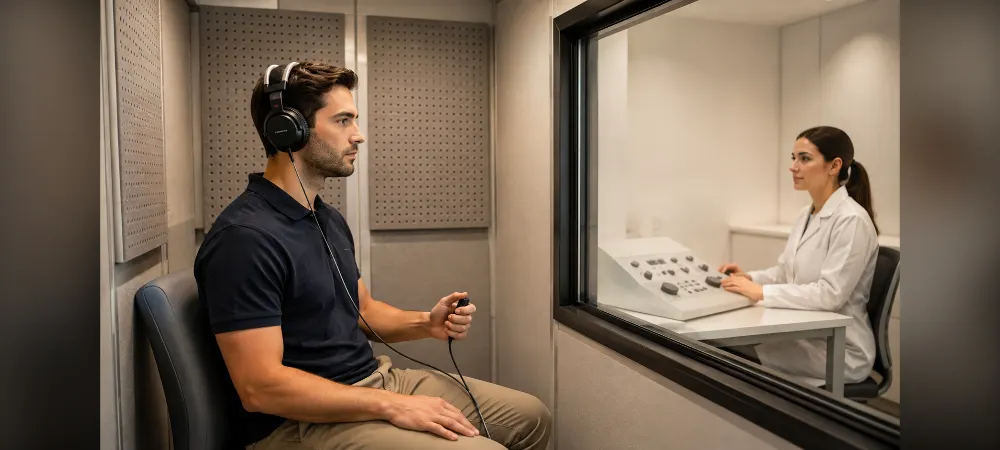
The audiometry test is performed in a soundproof room. These rooms are specially designed to minimize all sounds coming from outside. Acoustic insulation materials are used on the walls, ceiling, and floor of the room.
The internal volume of the test booth must be at least 2 m³. This measurement allows you to sit comfortably and for the test equipment to be placed. The booth contains professional equipment that cuts off connection with the outside as much as possible. Thanks to the soundproof environment, the tests provide accurate results.
Audiometry devices measure whether you hear these sounds by sending sounds at different frequencies. Headphones, a bone vibrator, and a control button are the basic equipment for the test. The devices are extremely sensitive and play an important role in detecting hearing loss.
What is done during the test
The audiologist puts headphones on you and explains how you should react to the sounds that will come from the headphones. You are asked to report the sounds you hear by pressing a specific button. Your reactions are recorded by providing sounds in different frequency ranges.
Both ears are tested separately. Sounds start at a low frequency and gradually increase until you hear them. Frequency is measured in Hertz, and sound level is measured in decibels. The sound you hear can be low-intensity, high-intensity, high-pitched, or low-pitched.
When the test is completed, the results are shown on a graph. This graph is called an audiogram and provides detailed information about your hearing capacity. It shows at which frequencies there is hearing loss and the degree of the loss. The audiometry test usually takes 15-30 minutes and is a painless procedure.
Air and bone conduction measurement
The main purpose of air conduction measurements is to find the level of the hearing threshold. The degree of hearing loss is measured by placing headphones on your ears. This measurement evaluates the hearing level in the path of sounds coming from the eardrum to the inner part of the ear.
Bone conduction provides information starting from the inner ear. Bone conduction thresholds are measured with a bone vibrator placed on the protrusion called the mastoid. In this measurement, your sensorineural sensitivity is defined. The bone conduction test evaluates the hearing level independently of the eardrum.
The two measurements are evaluated together to determine the type of hearing loss. The difference between air and bone conduction results shows which part of the ear the problem is in. The obtained values are marked on the audiogram and analyzed by the specialist.
Audiometry Test Types and Features
Pure tone audiometry
Pure tone audiometry is the most frequently applied hearing test for patients. By providing pure tones at different frequencies and intensities, it is measured which sounds you hear at what level. Both ears are tested separately to determine the degree of hearing loss and at which frequency it occurs. This test is used especially to detect the presence of hearing loss and to follow the progression status.
The patient is played sounds at different frequencies via headphones. When they hear the sound, they react by pressing a button or raising their hand. The test is measured for both air conduction and bone conduction. The results obtained are marked on the audiogram, and the type of hearing loss is determined.
Speech audiometry
Speech audiometry is a test that measures your ability to understand words and sentences. Your hearing and understanding ability is evaluated by having specific words or sentences read at different sound levels. It is applied especially to determine the effects of hearing loss on daily life and to evaluate suitability for hearing aid use.
During the test, you are played words at different levels. The patient is asked to repeat the words they hear. By evaluating the correct answers, your speech discrimination level is determined. In people without hearing problems, this rate is around 90%.
Tympanometry
Tympanometry is a test performed to measure pressure in the middle ear and eardrum mobility. It is used to evaluate conditions such as fluid accumulation in the middle ear, eardrum perforation, or eustachian tube dysfunction. During the test, a low-frequency sound is given to the ear, and information about middle ear health is obtained by measuring how the eardrum reacts to this sound.
The measurement is performed by placing a probe in the ear. The tympanometry test can be easily applied even to babies. For the test to be performed, the eardrum must not be perforated. The test is a simple procedure that takes about 2 minutes.
Acoustic reflex test
The acoustic reflex test is performed to evaluate the hearing nerves in the inner ear and brainstem reflexes. By measuring the automatic reaction of the inner ear to high-intensity sounds, it is determined whether there is a problem in the hearing pathways. This test, which helps in the diagnosis of nerve damage, hearing loss, and some neurological diseases, provides important information about the general functioning of the hearing system.
BERA/ABR test
The BERA test is a test applied to determine hearing thresholds and the functionality of the nerve pathways that make up the sense of hearing. It works by evaluating the electrical activity responses generated in the nerve pathways extending from the inner ear to the auditory cortex by the sound stimuli sent to the patient. It can be performed on individuals of all age groups and is a test method that eliminates misleading answers that may arise from the patient.
Electrodes are placed on the head region and around the ear. The electrical activity of the sounds sent via headphones is monitored. The test is a painless procedure and has no harm.
Newborn hearing screening test
The newborn hearing screening test is a routine test performed for the early diagnosis of congenital hearing loss in babies. It is usually applied in the first days after birth, and it is checked whether the baby's hearing ability is normal. Early diagnosed hearing loss allows the initiation of the necessary treatment and rehabilitation process for healthy language and communication development in the future. The test is applied in a few minutes, and the baby does not feel any discomfort from this situation.
Test Results and Degrees of Hearing Loss
How to read an audiogram
Test results are shown on a graph called an audiogram. On the graph, the horizontal axis represents frequency in Hertz (Hz), and the vertical axis represents the intensity of the sound in decibels (dB). The hearing threshold is determined separately for each ear.
On the graph, the red O symbol represents the right ear, and the blue X symbol represents the left ear. The results of air conduction tests are shown with these symbols. Bone conduction tests are indicated with red < and blue > symbols. The difference between the two tests shows which part of the ear the problem is in.
Normal hearing level
The normal hearing level is between 0-25 dB. In this range, a person can easily hear whispers, light sounds in nature, and normal conversations. It means the hearing system is working in a healthy way.
Mild hearing loss
In mild hearing loss, hearing thresholds are between 26-40 dB. You have difficulty hearing low sounds. You may have difficulty understanding conversations in noisy environments. You experience problems in places with whispers and background noise.
Moderate hearing loss
Moderate hearing loss is at levels between 41-55 dB. You cannot hear normal conversation sounds clearly. You may hear people speaking loudly but miss some words. Use of a hearing aid may be recommended.
Moderate-severe loss is between 56-70 dB, and you can only hear loud sounds. You have serious difficulty understanding conversations. It becomes difficult to follow what is being said without a hearing aid.
Severe hearing loss
Severe loss is between 71-90 dB. You can only perceive very loud sounds. Hearing and understanding conversations is almost impossible. Powerful hearing aids or implants are required.
Profound loss is 91 dB and above. Hearing is completely lost, or only very powerful sounds can be perceived. You need lip reading and the use of sign language.
Treatment options according to test results
The results are evaluated by the audiometrist and the ENT doctor. According to the test result, options such as hearing aids, medication, or surgical intervention can be evaluated. Conductive losses can be treated medically or surgically. Sensorineural losses are usually permanent and require hearing aids.
Frequently Asked Questions About Audiometry
Is the audiometry test painful?
No, the audiometry test is a completely painless and non-invasive procedure. Sounds at different frequencies are given via headphones, and it is evaluated whether you hear these sounds or not. You do not feel any discomfort during the test. Some people may feel temporary discomfort from wearing headphones, but this is at a minimum level and resolves quickly after the test.
Audiometry is a safe test and does not cause any harm. It only measures your hearing functions using sound waves. It is extremely safe as it does not contain X-rays or radiation in any way. Therefore, it can be applied easily and repeatedly in all age groups, including babies.
How long does the test take?
The audiometry test usually takes between 15 and 30 minutes. The duration of the test may vary depending on the method used, your hearing status, and the evaluation process of the responses given during the test. While the initial screening takes about 5 to 10 minutes, detailed audiometry can take about 1 hour.
Which doctor should be consulted?
For the audiometry test, an Ear, Nose, and Throat (ENT) specialist should be consulted. An audiologist is a healthcare professional who has received special training to test your hearing and determine the type and degree of hearing loss. Tests are performed by specialists in hospitals where ENT clinics are located and in hearing centers.
When do test results come out?
Audiometry test results usually come out on the same day. The results are shown on a graph called an audiogram and are explained in detail by your specialist. Necessary treatment options are presented immediately.
In summary, Audiometry
Audiometry is a very reliable method for evaluating your hearing level. The accuracy of the test depends on the test environment being quiet and the test being performed by an experienced audiologist. It should be applied to individuals who suspect hearing loss or experience tinnitus or balance problems.