The Heimlich Maneuver
The Heimlich maneuver is a life-saving, simple yet effective first aid method applied to dislodge a foreign object trapped in the
airway.
It is named after Dr. Henry Heimlich, who first described this technique. The Heimlich maneuver can be a life-saving
intervention in cases of choking alone. Developed in the 1970s, this maneuver is applied to prevent a person from choking, especially when eating or when a small object accidentally enters the trachea through the mouth. The Heimlich maneuver ensures that the airway obstruction is expelled thanks to forceful, sudden pressures applied to the abdominal region. It is relatively easy to perform. Doing it at the right time and in the right way is critical enough to save a person's life.
What Is the Heimlich Maneuver?
The Heimlich maneuver is a life-saving first aid technique aimed at the rapid and safe removal of a foreign object trapped in the airway. Generally, a person experiences the danger of choking when eating or when accidentally letting a small object enter the trachea through the mouth. In this case, breathing becomes impossible and urgent intervention is required. This is precisely where the Heimlich maneuver comes into play. Applying the Heimlich maneuver to oneself is difficult.
Basically, by applying sudden and upward pressure to the abdominal cavity, the diaphragm is pushed upward; this powerfully pushes the trapped air in the lungs upward and ensures the foreign object is expelled. First described in 1974 by American doctor Henry Heimlich, this method is effective enough to save a person's life, especially when applied in the first minutes of the obstruction. Although it seems like a very simple movement, it is an intervention that must be performed with care because it can lead to serious internal injuries if not applied correctly. Therefore, knowing what the Heimlich maneuver is in society is just as important as learning how and when it should be applied.
In Which Situations Is the Heimlich Maneuver Applied?
The Heimlich maneuver is applied in emergency situations where the airway is completely blocked and the person cannot breathe. Symptoms for the Heimlich maneuver may include the person's inability to speak and cyanosis (bluish discoloration). In such cases, the person generally becomes unable to speak, cough, or breathe, and most of the time panics and takes their hands to their throat. This condition is also defined as silent choking and creates a life-threatening danger within minutes.
If the person is coughing or can make a sound, there is a partial opening in the airway and the maneuver should not be performed in this case; because the natural cough reflex is the safest way for the object to come out. However, if the person has started to turn blue, has a clouded consciousness, or cannot make any sound at all, the Heimlich maneuver must be put into immediate effect. This situation is seen more frequently especially while eating, at moments when small children put small objects in their mouths while playing, or when the swallowing reflex weakens in elderly individuals. In such a situation, it is necessary to race against time; because a timely and correct intervention can determine the difference between life and death.
Why Is the Heimlich Maneuver Performed?
The Heimlich maneuver is performed to ensure that a foreign object completely blocking the airway is rapidly and effectively expelled. This
type of obstruction prevents the person from breathing and stops oxygen from going to the brain, creating a life-threatening risk in a very short time. If not intervened in the first few minutes especially, brain damage or death may occur.
The Heimlich maneuver increases intra-abdominal pressure with a simple yet powerful technique to push the air in the lungs upward and help expel the object. Therefore, this intervention is of critical importance for the person to breathe again and for vital functions to continue. Its purpose of performance is simple, but its effect is life-saving.
How Is the Heimlich Maneuver Performed?
To apply the Heimlich maneuver, it is first necessary to make sure that the person truly cannot breathe; if the person cannot speak, cannot cough, and has started to turn blue, this is an indicator of a severe obstruction. As the first step, one goes behind the choking person and ensures they remain standing or in an upright position if sitting. The practitioner makes a fist with one hand and places the thumb side just above the person's navel, beneath the ribs.
Then, they grasp this fist with their other hand and press upward quickly and forcefully. This movement applies pressure to the abdominal region from the inside upwards, helping the trapped air in the lungs to blast the foreign object out. If necessary, this push is repeated 5-6 times or until the object comes out. During the intervention, the person's head should be tilted slightly forward so that when the object comes out, it can be easily expelled through the mouth.
If the person loses consciousness or the maneuver yields no result, emergency help must be called immediately and basic life support should be initiated. Although this application seems simple, doing it at the right time and with the right technique makes a huge difference.
What Should Be Considered While Applying the Heimlich Maneuver?
The most important point to consider when applying the Heimlich maneuver is to correctly evaluate whether the intervention is truly necessary. If the person can cough, speak, or breathe, the airway is not completely blocked and the maneuver should not be applied.
In this case, the person's own cough reflex should be supported, and they should be observed without intervention. However, if the person is silent, in panic, and starting to turn blue, the Heimlich maneuver must be put into effect immediately.
It is very important to place the hands at the correct spot during the application. The fist should be placed between the navel and the breastbone, in the soft abdominal area right in the middle; pressures made too high or too low can cause damage to internal organs. Pressure from chest level should be preferred instead of classic abdominal pressure especially in elderly, pregnant, or severely overweight individuals.
While performing the maneuver, the person should lean forward slightly, thus facilitating the expulsion of the foreign object. Each push should be strong but controlled; hasty, random movements made in panic can lead to unwanted injuries. In addition, if the person experiences breathing difficulty afterwards even though the object came out during the intervention, a health institution must definitely be consulted for medical evaluation.
Frequently Asked Questions
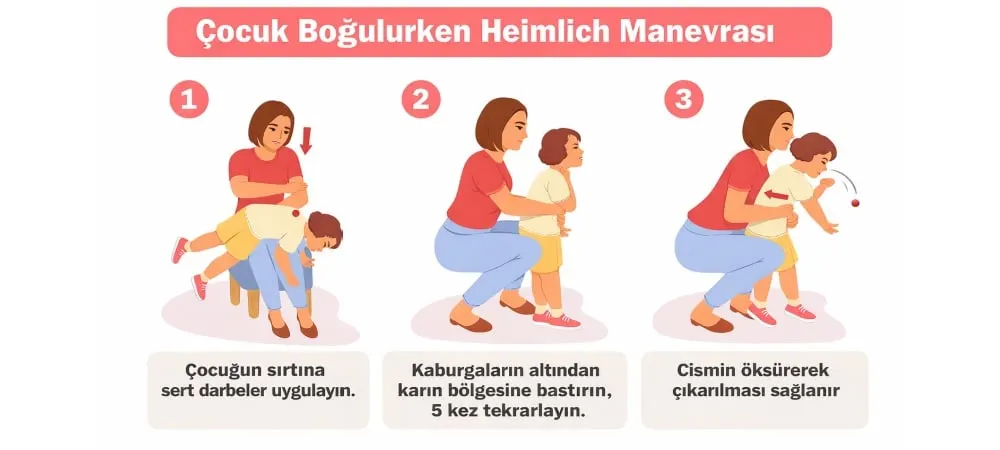
The main purpose of the Heimlich maneuver is to clear the blocked airway and ensure the person breathes again. Choking can result in death within minutes when not intervened. This maneuver is one of the most effective first aid methods that can be applied until medical help arrives. If the Heimlich maneuver does not work, emergency help should be called immediately and intervention should be made. The Heimlich maneuver can be applied to anyone who is conscious and shows signs of choking, primarily children and adults. However, the method of application may vary depending on the person. For example, while gentler movements are required in small children, pressure should be applied from chest level in pregnant or overweight individuals. In an unconscious person, different intervention techniques come into play rather than the maneuver. The Heimlich maneuver in adults is applied with pressures made between the chest and the diaphragm. When applying the Heimlich maneuver in infants, back blows and chest thrusts must be performed with a specific technique. The Heimlich maneuver for infants must be applied in a special position and carefully. In infants under 1 year of age, back blows and chest compressions are performed instead of the Heimlich maneuver. Keeping the head lower than the hips during the infant Heimlich maneuver is a critical point. The infant is laid face down on the forearm and 5 controlled blows are applied to the back. If the object does not come out, the infant is turned on their back and 5 presses are applied to the breastbone with two fingers.
This cycle continues until the foreign object comes out. During the infant Heimlich maneuver, if the foreign object is clearly visible inside the mouth and in a reachable area, it can be removed with a finger. Incorrect interventions performed on infants can cause serious harm, so care must be taken and if it is to be performed, it should be applied by a trained person. The Heimlich maneuver in children is generally carried out by kneeling and wrapping around the child from behind. When applying the child Heimlich maneuver, avoiding the use of excessive force is necessary. For the Heimlich maneuver, one goes behind the person, makes a fist with one hand and places it just above the navel. The other hand is wrapped around this fist and a forceful, upward pushing motion is made. This pressure pushes the air in the lungs upward and ensures the object causing the obstruction is expelled. If necessary, this movement is repeated a few times. The intervention must be fast and decisive. The maneuver should be applied without wasting time as soon as the obstruction is noticed. The risk of permanent damage begins within approximately 4 to 6 minutes after brain cells remain without oxygen. Therefore, the earlier the intervention is made, the higher the person's probability of survival. Every second is of vital importance. Incorrect application can cause serious internal injuries. Conditions such as rib fractures, stomach or liver rupture can be seen. Care should be taken especially in frail individuals or the elderly. In addition, when the maneuver is applied unconsciously, the obstruction can go even deeper. Therefore, intervening without taking basic first aid training is risky. The Heimlich maneuver in adults is generally performed in a standing or sitting position. If the person can still cough or make a sound during the intervention, the maneuver should not be performed. In this case, the person should be encouraged to continue coughing. In addition, it is normal for the person to continue coughing for a while when the object comes out during the intervention. However, if they have difficulty breathing despite the object coming out, emergency help must be requested. In Turkey, these trainings are provided at Ministry of Health-approved first aid training centers, public education centers, or private institutions. First aid Heimlich maneuver training should be provided especially in schools and workplaces. Certificates are also offered to those who successfully complete the training. Such courses both increase the safety of individuals and raise the rate of conscious intervention in society. If the Heimlich maneuver cannot be performed and the person is conscious, they can also apply it to themselves. The same effect can be created by pressing the abdominal area against a hard surface or hitting the back hard against a chair. Basic life support (CPR) should be applied to unconscious persons. Especially until medical teams arrive, different intervention options can be evaluated. The Heimlich maneuver is among the core topics of first aid training. Especially if a severe obstruction has been experienced or the maneuver has been applied more than once, the person must definitely apply to a health institution. Internal injuries may not be noticed. In addition, whether the airways are fully opened and whether any foreign object remains must be checked by experts.
Life-Saving Knowledge Gains Meaning with Correct Intervention
In emergency situations such as choking, correct first aid application saves lives. However, a medical evaluation must definitely be performed after the intervention.
As Hisar Hospital Intercontinental, we are by your side 24/7 with our emergency service and expert physician staff. You can contact us for post-Heimlich maneuver checks, respiratory evaluation, and all necessary advanced examinations.
Contact us for detailed information and appointments.