Hearing loss can be congenital or acquired later in life. The answer to what the BERA test is lies in its application as a test used to determine hearing thresholds and the functionality of nerve pathways. Detecting hearing losses, especially those originating congenitally or during infancy, is critically important to prevent any impact on the child's language development. Therefore, babies who fail newborn hearing screenings are referred for advanced tests. In this article, we will answer questions such as what the BERA test is, how it is performed, who it is applied to, and how the test results are evaluated.
What is the BERA (ABR) Test?
Definition and purpose of the BERA test
BERA (Brainstem Evoked Response Audiometry) is a test that measures the electrical activity of the hearing pathways in the brainstem. This test evaluates the transmission of sound along nerve pathways extending from the inner ear to the cerebral cortex. The electrical responses generated by the sound stimuli sent to the patient along these pathways are recorded and analyzed.
The answer to what the BERA test is that it is an evaluation method serving two fundamental purposes. The first purpose is to determine from which sound intensity onwards hearing is perceived. The second purpose is to check whether the nerve pathways constituting the sense of hearing are working properly. Thus, both the hearing threshold is determined and potential problems in neural structures are uncovered.
An important feature in the explanation of what a clinical BERA test is that it operates independently of patient compliance. Other hearing tests require active participation and response from the patient. However, since BERA measures automatic electrical responses in the brainstem, there is no need for the patient to consciously cooperate. Therefore, it can be safely applied particularly to patient groups that do not show active participation, such as babies, young children, and mentally disabled individuals.
Difference between ABR and BERA
There is no difference between ABR and BERA. Both terms refer to the same test. ABR (Auditory Brainstem Response) is an English abbreviation and is synonymous with BERA. In some centers, this test is also defined by the term "Auditory Evoked Potential" or the abbreviation AEP.
Although different nomenclatures are used, the purpose and application method of the test do not change. All these terms refer to the recording of auditory evoked potential responses in the brainstem. Consequently, the questions of what the ENT BERA test is or what the ABR test is have the same answer.
Place of BERA among hearing tests
To answer the question of what the BERA hearing test is and how it differs from other tests, it is important that this test specifically evaluates brainstem mechanisms. While standard hearing tests only measure responses coming from the ear, BERA also encompasses neural structures. Thanks to this feature, problems that may occur along the entire pathway from the inner ear to the brain can be detected.
In cases where sufficient information cannot be obtained through other methods, the BERA test comes into play. It yields very valuable results, particularly in cases where cerebral mechanisms need to be examined. At the same time, it is successfully used in Alzheimer's, autism, and dementia patients.
BERA also plays a critical role in distinguishing between cochlear and retrocochlear hearing losses. In other words, it determines whether the problem is in the inner ear or the auditory nerve. This information is of vital importance for formulating the correct treatment plan. BERA is also utilized in pre-bionic ear evaluations.
This test, which can be safely applied to individuals of all age groups, eliminates misleading responses originating from the patient. It can be performed under sedation or by putting the patient to sleep. Test results are evaluated by expert audiologists, and the treatment plan is determined together with ENT physicians.
Who is the BERA Test Performed On?
BERA test in newborn babies
Hearing screening is performed on all babies within the scope of the National Newborn Screening Program implemented by the Ministry of Health. Babies who cannot pass the Torema ABR test applied in the first stage are evaluated with the BERA test. Congenital hearing loss is seen in 1 out of every 1000 babies (1-3).
If the hearing test was forgotten during the first checks after birth, it must definitely be performed within the first 3 months. Making an early diagnosis is of vital importance in terms of not affecting the baby's language development. To be able to speak, one must first hear; therefore, hearing losses noticed late negatively affect the child's psychosocial development and communication skills.
The BERA test is applied in two different ways during the newborn period. While "Newborn BERA/ABR" is used for routine screenings, a more detailed evaluation is required in babies carrying risk factors.
Suspicion of hearing problems in children: The "Clinical BERA/ABR" test is recommended for children in whom a delay in speech and language development is detected. Children who have recurrent middle ear infections must also undergo this test. BERA yields more accurate results in children who cannot adapt to standard audiometry tests due to developmental or mental problems.
Patients experiencing communication difficulties due to conditions such as Down syndrome, autism, paralysis, or dementia cannot respond to normal hearing tests. Therefore, the BERA test, which operates independently of patient compliance, is preferred. It is also frequently applied for hearing evaluation in mentally disabled individuals.
Indications for the BERA test in adults
The BERA test is performed on adults presenting with complaints such as tinnitus or problems in understanding and discriminating speech. This test comes into play when it is necessary to evaluate the functionality of the auditory nerve and brainstem. It is used in the differential diagnosis of cochlear and retrocochlear hearing losses.
BERA is utilized in the diagnosis and treatment of cerebellopontine angle tumors. It also plays an important role in distinguishing cases of auditory neuropathy. Hearing must be examined with BERA in pre-bionic ear evaluations. It can also be applied for the purpose of continuous monitoring of the brain, spinal cord, and nerve pathways during surgery.
Patients carrying risk factors
Newborns with risk factors must definitely undergo ABR screening; screening ABR tests are not considered sufficient. The Ministry of Health has made the BERA test mandatory in these babies.
Babies with a birth weight of 1500 grams and below are in the high-risk group. Similarly, premature babies born at 35 weeks and below also undergo the test. Babies with hyperbilirubinemia requiring phototherapy or blood exchange due to jaundice must be evaluated.
If there is a family history of permanent childhood hearing loss, the baby is at risk. Ototoxic drug use, bacterial meningitis, and TORCH group infections are counted among other risk factors. The BERA test must also be performed in babies with ear canal or congenital ear anomalies.
How is the BERA Test Performed?
Test preparation process
Before starting the test, the entire process is explained in detail to the patient or their family. Ensuring that the patient feels comfortable and understands the process is important for test success. The person to be tested is placed in a lying position on a stretcher.
Babies need to sleep during the test. Families must make some preparations for this. It is recommended to keep your baby sleep-deprived on the night of the appointment, outside of their daily routine sleep. Waking them up early in the morning is also an effective method.
In babies younger than 6 months, the audiology specialist may request that the baby fast for a certain period before the procedure. It is advised to feed your baby when you arrive at the hospital. This allows the baby to fall asleep comfortably on a full stomach. Immediately before entering the procedure, you need to clean the baby's skin again, especially the forehead and ear regions.
As for adults, staying calm is sufficient for them. They can sit or lie down in a comfortable position. Clean and dry ears affect test results. Dirt or water inside the ear can lead to misleading results.
Electrode placement procedure
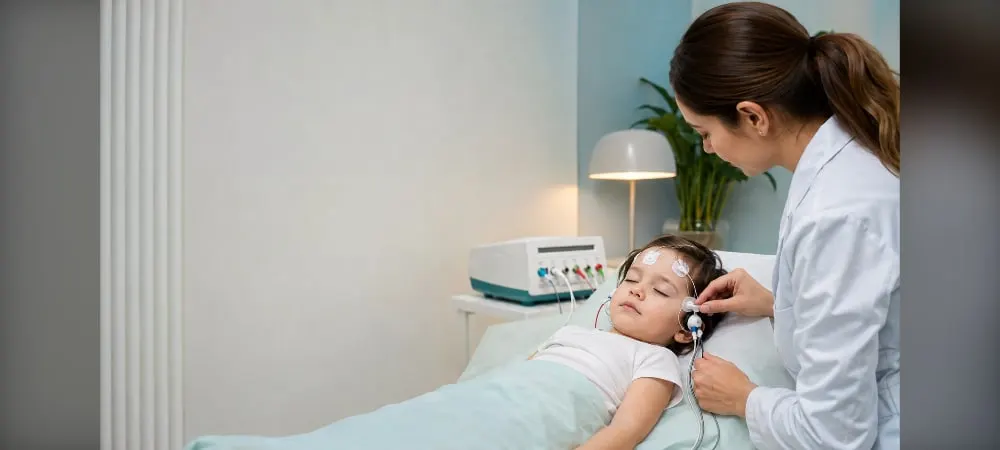
The areas where the electrodes will adhere are cleaned with alcohol so that the electrodes stick well to the skin. Cleaning the skin increases test quality. Electrodes are pasted onto specific regions such as the forehead, behind the ears, and the starting point of the scalp.
These electrodes are for recording responses coming from the brain. They are in the form of small discs pasted onto the skin. No pain or discomfort is felt. Once the electrodes are placed, computer connection is established.
Administration of sound stimuli
Earphones are placed in both ears. Sounds at specific frequencies are sent to the patient through the earphones. Short-duration click sounds or tones are generally used.
By giving stimuli at different frequencies, electrical responses in the brainstem are recorded. Electrical activities obtained from the sounds sent to the ear are measured. The brainstem produces automatic electrical responses against these sounds. The electrodes record these responses and transfer them to the computer environment.
Test duration and patient comfort
The test duration varies between 15-40 minutes depending on the baby's sleep state and the environment's compliance with the test. In adults, it generally takes 30 to 60 minutes. The patient's age and condition affect the duration.
It is of great importance that the person does not move during the procedure. Movement or talking can disrupt test results. The patient needs to sleep in a quiet environment. External noises can affect the results.
Data obtained throughout the entire test are transferred to a computer environment and recorded. The audiologist and ENT specialist analyze this data in terms of wave morphology, wave latencies, ear symmetry, and age-appropriate normative data.
Sedation requirement
In babies younger than 6 months, the test can be performed in natural sleep without requiring any sedation. It is generally performed during natural sleep in newborns. In this age group, the test can be completed without carrying sedation risks.
In babies older than 6 months and in adults, mild sedation can be preferred to ensure maximum efficiency from the test. It becomes possible to avoid unwanted movements and noises. For more accurate results, it is generally recommended to be performed while in a state of sleep.
BERA Test Results and Evaluation
Interpretation of results
All information collected throughout the test is recorded in a computer environment. This data is displayed in the form of graphs and reflects the electrical responses given by the brainstem to sound stimuli. The expert audiologist and ENT physician examine these graphs in detail.
Evaluating the results requires meticulousness. Test printouts provide clear information about the working status of the hearing nerves and the brainstem. Consequently, it is revealed whether hearing loss is present and, if so, what its cause is. Detailed information is acquired regarding the quality of auditory functions and the reasons for potential problems.
BERA test results are also used to determine the degree of hearing loss. A distinction of mild, moderate, or severe hearing loss can be made. Additionally, it is detected whether the loss stems from a neural problem or another cause. This information plays a critical role in determining the treatment method.
Normal and abnormal findings
If the brainstem gives normal responses to auditory stimuli, it means the auditory nerves and brainstem are working properly. A normal test result shows that the hearing pathways are functioning healthily. In this case, any intervention may not be necessary.
However, if the brainstem gives abnormal responses, it is understood that there is a problem in the auditory nerves or the brainstem. Abnormal findings indicate a disruption or damage in the hearing pathways. Such results require further evaluation and treatment.
Treatment planning
Depending on the test results, a hearing aid or cochlear implant may be recommended. If it is determined that the auditory nerves are working normally, benefit can be seen from using a hearing aid. Particularly in young children, device use in hearing problems detected at an early stage provides a significant contribution to the development of speech skills.
Disorders in the eardrum or bone structure may require surgical intervention. In hearing losses originating from recurrent ear infections, the tube insertion method can be applied to drain the fluid inside the ear. The choice of treatment depends on the patient's age, the level of hearing loss, the cause of the loss, and the patient's ability to comply with treatment.
If other treatment options remain insufficient in advanced-degree hearing losses, cochlear implants come to the agenda. Cochlear implants bypass the damaged area in the inner ear and directly stimulate the auditory nerve. For children with very advanced-degree losses where the device cannot show benefit, a decision is made to enroll them in a cochlear or brainstem implant program by evaluating inner ear and brainstem structures with imaging methods.
Advanced tests and referral
Babies who fail the test are referred to pre-determined centers. The aim here is for advanced tests to be performed and for them to be taken into a hearing rehabilitation program. Rehabilitation plans include how to use hearing aids, developing communication skills, and strategies for coping with hearing loss.
Each patient's condition and needs are different. Which treatment method is the most accurate is decided after evaluations regarding the clinical BERA test results.
Frequently Asked Questions About the BERA Test
Is the BERA test painful?
No, the BERA test is a completely painless procedure. Electrodes placed on the ears and head only record the responses given by the brainstem. You do not feel any pain or discomfort.
Nothing is inserted into the body during the test. No incisions or needles are used. Electrodes are small discs pasted onto the skin and are placed on top of the skin. The same situation applies to babies; it does not hurt them.
Since it is not a radiological procedure, there is also no radiation risk. Therefore, it is completely safe for babies and adults.
How long does the test take?
The test duration varies between an average of 30 and 90 minutes. In adults, it generally takes 30 to 60 minutes.
In babies, the test duration can be more flexible. When the baby wakes up, the technician or audiologist waits for the baby to fall asleep again. The parent can also help soothe the baby. Therefore, the duration sometimes prolongs.
Although the test itself takes this long, the analysis of results and writing of the report take additional time. However, results can generally be given within the same day.
Are there risks to the BERA test?
The BERA test is a completely safe and non-invasive method. No device insertion is made into the body. No medication is given during the test, and it contains no radiation.
There are no known risks or side effects. Sounds given from the earphones are far below the sound levels exposed to in daily life. Sounds at completely safe levels are used.
The only potential situation is that slight redness can occur during the removal of the electrodes pasted onto the skin. This can be seen especially on the sensitive skin of babies. However, this is temporary and disappears in a short time. Parents can have this test performed with peace of mind.
Things to do before the test
Give your baby a bath one day before the appointment. Clean the ear and forehead regions carefully. Skin cleaning is important for the reliability of test results.
Try to keep your baby sleep-deprived on the day of the appointment. Put them to bed 1-2 hours later than normal. Do not allow your baby to sleep in the car seat or stroller on the way on the day of the test. Thanks to this, they sleep deeply and for a long time during the test.
Bring your baby to the test with approximately 3 hours of fasting. Being fed right before the test enables them to fall asleep more easily. In fact, putting them to sleep by breastfeeding or giving a bottle during the test is a frequently applied method.
If there are hearing tests performed previously, bring them with you. Dress them in comfortable clothes. Keep necessary items such as diapers and formula with you. Parents can bring a small pillow and blanket to rock the baby.
If your baby has a cold or flu before the test, be sure to inform your doctor.
Is sedation necessary in babies?
In babies younger than 6 months, no sedation is required. The test can easily be performed during the baby's natural sleep. The audiology specialist may recommend that the baby fast for a certain period before the procedure and be fed when they arrive at the test. Thus, the baby falls asleep on a full stomach and the test is performed.
In babies older than 6 months and in adults, mild sedation can be preferred. The purpose of this is to avoid unwanted movements and noises. Medication can be given accompanied by an anesthesia specialist, particularly in children with sleep problems or mental development retardation such as autism and Down syndrome.
When are test results obtained?
Evaluating the results can take a few days. They are examined by an expert doctor. However, in many centers, results can be given on the same day, a few hours after the test. Since analyzing waveform forms and writing the report takes time, the exact duration varies according to the center.
In Summary, the BERA Test
The BERA test is of critical importance in the early diagnosis of hearing loss. This evaluation performed particularly in babies prevents speech and language development from being harmed. The test is completely painless and carries no risks. Therefore, families can have their babies undergo this test with peace of mind.
If you pay attention to the preparation phase, the test is completed in a shorter time. Leave your baby sleep-deprived and feed them when you arrive at the test. Results are generally obtained within the same day, and your expert doctor recommends the most appropriate treatment plan for you. Early diagnosis is the most valuable investment for your child's future.