Smile laser eye surgery established its place in the medical world as a reliable method for treating myopia and astigmatism after receiving FDA approval in 2016. Requiring much less intervention to eye tissues compared to traditional laser treatments, this technology significantly shortens the recovery period. In this article, we will comprehensively cover what the smile laser method is, the application process, which patients it is suitable for, and the advantages it provides.
What is Smile Laser?
SMILE is an abbreviation for "Small Incision Lenticule Extraction." Developed by Carl Zeiss Meditec, this technology uses a femtosecond laser to correct vision defects with minimal intervention within the cornea.
The most important feature of Smile laser eye treatment is that no large flap is opened in the cornea. The procedure is performed through a small incision of only 2-4 mm. In this way, the natural structure of the cornea is largely preserved.
It holds the status of 3rd generation technology as the latest development in the field of corneal refractive correction. It offers treatment options up to -10 diopters for myopia and up to -5 diopters for astigmatism.
How Does Relex Smile Laser Work?
With femtosecond laser technology, the inner layers of the cornea are worked on precisely. The procedure takes place in three basic steps.
In the first step, the laser creates a thin layer of tissue called a lenticule within the cornea. This lenticule is specially shaped according to the vision defect that needs to be corrected. In the second step, a minimal 2-4 mm incision is made on the corneal surface.
In the final step, the surgeon removes the created lenticule through this small incision. The removal of the lenticule changes the curvature of the cornea and ensures that light is correctly focused on the retina. Thus, the myopia or astigmatism defect is corrected.
The entire procedure is completed with a single device, and there is no need for the use of an excimer laser. Thanks to iris recognition technology, rotations on the eye's own axis can be calculated, which ensures that astigmatism, in particular, is treated on the most accurate axis.
Differences from Other Laser Methods
In the PRK method, the surface layer of the cornea is removed and the laser is applied. Although there is no incision size in this technique, the recovery period is as long as 2-4 weeks. In addition, moderate-to-high levels of pain and discomfort may be experienced.
In LASIK surgery, a wide flap of approximately 20 mm is opened on the cornea. After the laser application, this flap is put back in place. Recovery takes 1-2 days, but there is a risk of flap displacement.
Since Smile laser is a flapless treatment, corneal biomechanics are preserved at the maximum level. Since corneal nerves are less affected, the risk of dry eye is very low. Furthermore, the risk of post-traumatic complications is also minimized.
Who Is Smile Laser Applied To?
Suitable Patient Profile
Smile laser treatment is a method developed for people with myopia and astigmatism vision defects. Patients with myopia between -1 and -10 diopters and astigmatism under 3 diopters can benefit from this treatment. According to some sources, successful results can be obtained in astigmatism treatment up to -5 diopters.
For the success of the treatment, the eyeglass prescription must not have changed within the last year. This indicates that the vision defect has stabilized. It is also critical that the corneal structure is healthy and of sufficient thickness.
Smile laser is an ideal option, especially for athletes and those working in professions with a high risk of physical contact. This method provides an advantage for people with a high probability of exposure to mechanical trauma, such as firefighters, police officers, and soldiers. In addition, patients experiencing dry eye problems can now be safely treated with this method.
The use of smile laser treatment in people with hyperopia vision defects has begun in recent years.
Who Is Smile Laser Not Applied To?
Smile laser is not applied if the corneal layer is thin. Likewise, this treatment is not suitable for people with other eye diseases such as glaucoma or cataracts.
Patients with chronic health problems such as diabetes may not be suitable candidates for smile laser. Uncontrolled diabetes, in particular, can negatively affect the healing process. The presence of a trauma-related wound on the cornea or an active infection affecting the eyes is also an obstacle to treatment.
Due to hormonal changes, eye prescriptions may not be stable in women during pregnancy and breastfeeding. Therefore, smile laser is not applied during these periods. Having had previous eye surgery is also a situation that requires evaluation.
If the vision defect is variable or if there are health problems that may negatively affect the healing process, other methods are preferred instead of smile laser.
At What Age Is Smile Laser Performed?
Smile laser can be applied to adults over the age of 18. However, the most ideal age range is between 18-40 years old.
In this age group, the eye structure is generally stabilized and the success of the treatment is higher. In cases where there is an additional eye disease in the older age group, smile treatment may not be suitable.
In people over 40-45 years of age who have myopia and myopic astigmatism, if there are no additional problems such as cataracts, smile laser treatment can be performed while also preserving near vision quality. The important thing is that the eye prescription has not changed in the last year and the corneal structure is found to be suitable.
How Is Smile Laser Applied?
Pre-Operative Preparation
After deciding on the treatment, a detailed eye examination is performed. In this examination, a corneal map is created and eye measurements are taken. Corneal topography provides information about the shape and thickness of the cornea. Corneal depth analysis is provided with OCT. Refraction measurement is performed to determine the eyeglass prescription precisely.
Intraocular pressure measurement and retinal evaluation are also performed. Those who use contact lenses must take a break from their lenses before the surgery. Soft lenses should be discontinued at least 5-7 days before the surgery. Since hard lenses affect the corneal shape more, they are usually discontinued 2 weeks in advance.
On the day of the surgery, the area around the eyes must be completely clean. Makeup products such as mascara, eyeshadow, and eyeliner should not be used. Perfumes and heavily scented lotions are also not recommended as they may affect the sterile environment. You do not need to be hungry. Comfortable clothing should be preferred and it is recommended to have an attendant with you.
Step-by-Step Surgical Process
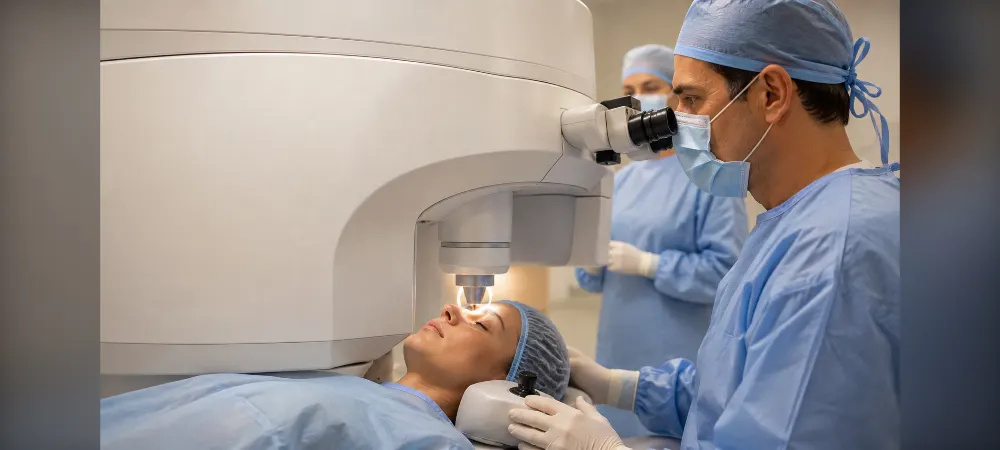
Smile laser surgery is a short and painless procedure that usually takes 10-15 minutes. During the procedure, anesthetic drops are instilled into your eyes. No needles are used and the laser procedure is completely painless.
The surgery is completed in three basic steps:
- Lenticule creation: A thin piece of tissue called a lenticule is prepared within the cornea with a femtosecond laser. This lenticule is shaped according to the amount of vision defect that needs to be corrected.
- Making a mini incision: A small entry incision of 2-4 mm is created on the corneal surface. This incision is made without opening any flap.
- Lenticule removal: The created lenticule is removed through this small incision. Thus, the curvature of the cornea is changed and the vision defect is corrected.
The entire treatment is completed in a single stage and on a single platform. There is no need for the use of different devices. The operation is performed with great precision with the help of computer-controlled systems. Some people may feel slight pressure during the procedure, but this is only momentary.
First Hours After Surgery
There may be slight stinging or watering after the operation. These complaints usually disappear within 1-2 hours. Blurred vision for the first few hours is considered normal. Blurred vision after the operation may last for about 2-3 hours.
Vision usually becomes significantly clear within 24 hours. It is critical not to rub or touch the eyes for the first 24 hours after the operation. You should avoid washing your eyes with water.
The eye drops given by the doctor must be used regularly. These drops help to moisturize the eyes and protect them from irritation. Wearing sunglasses is recommended. Since a procedure is performed on the corneal layer during the operation, you may need to have an attendant with you.
The patient can be discharged in a short time. A follow-up examination is performed half an hour after the operation. Since no bandages or stitches are required afterwards, the return to social life is extremely short.
What Are the Advantages of Smile Laser?
Fast Recovery Process
The most remarkable among the advantages of Smile laser is the fast recovery process. Most patients return to their daily lives the next day. Vision recovers quickly and long rest is not required. The patient can return to work life the day after the operation.
Vision reaches 80% in the first 24 hours. In Smile Pro laser applications, patients achieve clear vision within 6-8 hours. Recovery is usually completed in as short a time as 24-48 hours. The vast majority of patients start seeing clearly the next day and return to their normal lives within 2-3 days.
It provides a significant advantage for athletes. Sports such as walking and running can be started the next day. Water sports can be started within 1 week, and contact sports such as karate and kickboxing within 1-2 weeks. Therefore, this method is more advantageous for people with busy work and educational lives.
Less Dry Eye
In Smile laser eye treatment, corneal nerves are largely preserved. For this reason, the risk of dry eye is lower. Thanks to the small incision, damage to the corneal nerve endings is much less. This situation is advantageous, especially for people who use screens.
Patients experiencing dry eye problems after surgery can now be safely treated with this method. Compared to LASIK, the complaint of dry eye is significantly lower. Patients do not feel dry eye in the weeks following the treatment.
Preservation of Corneal Structure
Because no flap is created, corneal biomechanics are less affected. The strongest corneal biomechanics after laser surgeries are obtained after the smile technique. Only a 2 mm incision is created in the cornea.
The smile method provides a significant advantage over other methods in preserving the mechanical strength of the patient's cornea. The strongest front 1/3 part of the cornea is preserved as much as possible. Complications such as flap displacement or flap wrinkling do not occur.
In addition, because the corneal thickness is thin, it provides the chance to perform treatment on patients who could not have laser applied before. It is a suitable treatment method for athletes and professional groups at risk of exposure to impacts and pressure.
Minimal Pain and Discomfort
Less pain is felt during and after the operation. Since the surface epithelium is not scraped over large areas, the pain and burning sensation in the first days are milder. Post-operative pain is usually at a minimal level.
Our patients experience a very small amount of burning sensation immediately after the laser. While significant pain is experienced in the first 2-3 days in the PRK method, this process is much more comfortable in smile. The procedure is completely painless and the patient may only feel slight pressure.
Process and Care After Smile Laser
Things to Consider
Following post-operative care rules is necessary for a smooth recovery. Avoid rubbing, scratching, or touching your eyes for the first 24 hours. It is also very important that water does not come into contact with your eyes.
You must use the eye drops prescribed by your doctor regularly. These drops reduce the risk of infection and prevent irritation by moisturizing your eyes. Do not neglect the use of antibiotic and artificial tear drops.
Wearing sunglasses protects your eyes from harmful UV rays. Stay away from eye makeup for the first week. Eye makeup can be applied 1 week after Smile laser. Avoid dusty and dirty environments as much as possible.
It is recommended that you stay away from heavy exercise and strenuous physical activities for the first few weeks. Entering swimming pools and the sea is possible 10 days after smile laser. Therefore, being patient during this process accelerates your recovery. You can get on a plane immediately after the operation.
How Long Is the Recovery Process?
Smile laser recovery time varies from person to person, but averages between 2 and 7 days. Mild stinging, watering, and light sensitivity lasting for the first 3-4 hours may be experienced. However, these symptoms are normal and usually decrease within the same day.
Patients can return to their daily lives 2-3 hours after the Smile laser procedure. A very clear vision is achieved the next morning, and driving and computer use day and night are easily possible. The vast majority of patients return to their work life the next day.
Paying attention to the recommendations of the ophthalmologist after the operation can help the recovery process to be comfortable. The first check-up is usually done the day after the operation. Going to subsequent check-ups without neglecting them is important for your eye health in the long term.
Possible Side Effects
Although Smile laser is generally a safe procedure, some side effects may be experienced. Temporary dry eye is one of the most common complications. This situation can be brought under control with artificial tear drops.
Night vision difficulties and light scattering may be experienced in the first weeks after surgery. Mild halo or glare may be seen in the first weeks after surgery. It usually improves within 1-3 months. As the healing process progresses, these complaints decrease.
In rare cases, if your prescription returns due to a reason we call regression, a second treatment is performed, and it is possible to zero out the prescription with this treatment. Corneal infection is very rarely seen. With the regular use of antibiotic drops after surgery, the risk is minimized.
Frequently Asked Questions
Is Smile laser permanent?
Yes, smile laser is a permanent treatment method. The correction made on the cornea is permanent and eliminates the need to use glasses or lenses. However, age-related near vision problems may develop after the age of 40. This situation is not related to smile laser.
Is it necessary to use glasses again after Smile laser?
Most patients do not use glasses after surgery. In rare cases, there may be a slight regression. In this case, a second correction can be performed after a few years have passed. Therefore, you will be free from glasses dependency in the long term.
What is the biggest difference between Smile laser and LASIK?
Smile laser is a flapless method and only a small incision of 2-4 mm is made. In LASIK, a large flap of about 20 mm is opened. However, smile laser affects corneal nerves less and the risk of dry eye is low. The possibility of post-traumatic complications is also at a minimal level.
Is pain felt during the surgery?
No, the surgery is completely painless. Anesthetic drops are instilled into your eyes and you may only feel slight pressure during the procedure. The procedure takes 10-15 minutes and no needles are used. Post-operative pain is also at a minimal level.
Can Smile laser be applied for every eye?
No, it is not suitable for all eyes. Corneal thickness, eye health status, and the degree of vision defect are evaluated. If there is a thin cornea or another eye disease, alternative methods are recommended.
When will I return to normal after Smile laser?
Most patients return to their normal lives the next day. Computer use and driving are usually possible after 24 hours. The return to sports varies between 1 day and 2 weeks depending on the activity. Swimming and entering the sea can be done after 10 days.
In Summary, Smile Laser
Smile laser offers a safe and effective option to correct your vision defects. It draws attention with its fast recovery time, minimal discomfort, and long-term success rates. Especially if you have an active lifestyle or want to get rid of glasses dependency, this method may be ideal for you.
However, not every eye structure may be suitable for smile laser. Having a detailed examination and talking to your ophthalmologist is essential for you to make the right decision. Do comprehensive research before treatment and evaluate your options. Thus, you will have chosen the best treatment for your eyes.