You may feel worried when you experience hiatal hernia symptoms, but this is a very common health problem that affects approximately 10–50% of the adult population worldwide. In particular, the sliding hiatal hernia (type 1) is the most common type, accounting for approximately 90% of all hiatal hernias in the USA.
What are the symptoms of a hiatal hernia, and when is surgical intervention required? If you are curious about the answers to these questions, you are in the right place. In cases that are generally resistant to medications and lifestyle changes, modern approaches such as robotic surgery are preferred. Robotic hiatal hernia surgery offers the possibility of a more precise intervention compared with laparoscopic methods.
Studies have shown that laparoscopic repair results in less blood loss and a shorter hospital stay. In fact, the average hospital stay is only 2 days, and 89% of patients are discharged within the first 3 days. In this article, we will clearly and understandably explain what a hiatal hernia is, its symptoms, and in which situations its treatment with robotic surgery is performed.
What Is a Hiatal Hernia and What Are Its Symptoms?
Definition and Anatomy of Hiatal Hernia
A hiatal hernia is a condition in which part of the stomach is displaced through the opening in the diaphragm (esophageal hiatus) into the chest cavity. The diaphragm is the muscular layer that separates the chest and abdominal cavities, and the stomach normally sits below this muscle. The esophagus (food pipe) is approximately 38–40 cm long, and its last 3–4 cm lies within the abdominal cavity. This anatomical structure keeps the stomach fixed in the abdominal cavity.
There are various openings (hiatus) in the diaphragm: the esophageal hiatus, the inferior vena cava hiatus, the aortic hiatus, the foramen of Morgagni, and the foramen of Bochdalek. Hernias that develop through the esophageal hiatus are called "hiatal hernias." When the ligaments and muscular structure that normally hold the stomach in place weaken, the upper part of the stomach is displaced upward through this opening.
Types of Hiatal Hernia
Hiatal hernias are classified into four main types:
Type I (Sliding Hernia): This is the most common type and accounts for 95% of all hiatal hernias. The upper part of the stomach and the gastroesophageal junction slide upward together. In this type, the stomach can move up and down, and a complete hernia sac usually does not form.
Type II (Paraesophageal Hernia): In this type, the fundus of the stomach rises up alongside the esophagus, but the gastroesophageal junction remains in place. It is usually seen over the age of 60 and does not resolve with a change in position.
Type III (Mixed Type): Features of both Type I and Type II are seen together. That is, both the gastroesophageal junction and the gastric fundus pass into the chest cavity. It accounts for approximately 80–90% of all paraesophageal hernias.
Type IV: This is the rarest type. It is the condition in which other intra-abdominal organs, such as the spleen, omentum, pancreas, or intestines, also enter the hernia sac along with the stomach.
What Are the Symptoms of a Hiatal Hernia?
Hiatal hernia symptoms vary according to the type and size of the hernia. Some patients show no symptoms, while others may develop various complaints:
- Reflux Symptoms: Burning in the chest, heartburn, acid or stomach contents flowing back into the esophagus
- Digestive System Symptoms: Difficulty swallowing, a sensation of a lump in the throat, early satiety, bloating after meals
- Respiratory System Symptoms: Cough, shortness of breath (especially if the hernia presses on the lung)
- Other Symptoms: Sore throat, hoarseness, a bitter taste in the mouth, belching, and vomiting
While Type 1 hernias in particular cause reflux symptoms, early satiety, fullness, and pain after meals are more pronounced in Type 2–3 hernias. In paraesophageal hernias (Type 2), difficulty swallowing and a feeling of fullness after meals are more common, and intermittent obstruction due to twisting of the stomach (volvulus) may sometimes occur.
The robotic surgical approach is an effective treatment option, particularly in hiatal hernia cases with severe symptoms that do not respond to conservative treatment. Because it allows a more precise intervention compared with open surgery, it is preferred for complex types of hiatal hernia.
What Is Robotic Hiatal Hernia Surgery?
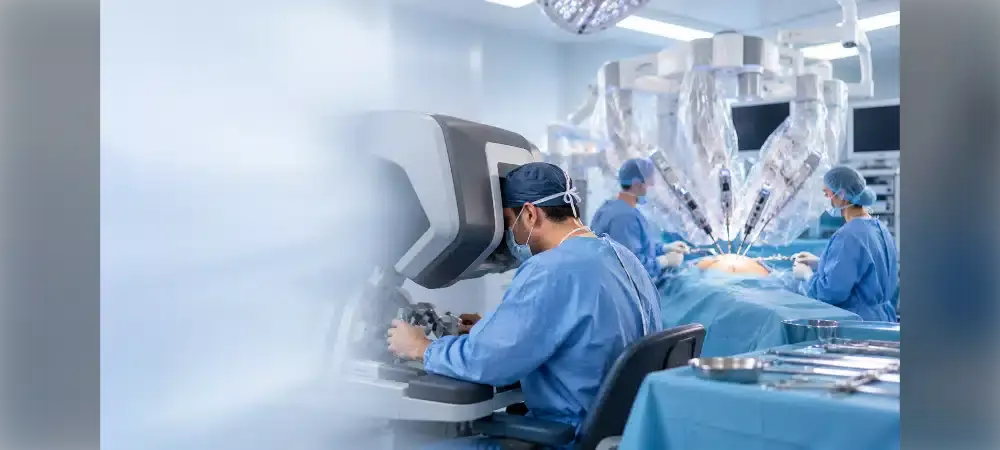
Robotic hiatal hernia surgery is a minimally invasive surgical approach that goes beyond traditional open surgery and laparoscopic methods, performed using advanced-technology robotic arms and high-resolution imaging systems. Essentially, it allows the surgeon to perform the operation with millimetric precision.
Features of the Robotic Surgery System
Robotic surgery systems generally consist of three main components:
- Surgeon console: The surgeon controls the operation from this console. Thanks to the console, the surgeon can see the surgical field in 3D and magnified 10–15 times.
- Patient cart: This is the section containing the robotic arms positioned over the patient. One of these arms acts as the camera, while the others carry the surgical instruments.
- Vision tower: This is the system that processes and transmits the high-resolution images.
Robotic systems enable the surgeon to perform the operation through advanced-technology robotic arms that mimic the surgeon's hand and wrist movements. These arms can move far more flexibly than the human wrist and, thanks to a tremor filter, eliminate the surgeon's hand tremors.
Differences Between Laparoscopic and Robotic Surgery
While laparoscopic surgery has been preferred over open surgery for many years, robotic surgery has begun to surpass laparoscopic surgery in some specialized centers. The main differences between them are as follows:
In laparoscopic surgery, the surgeon stands next to the patient in the operating room and performs the operation with long, straight instruments. The images are two-dimensional and depth perception is limited. In contrast, in robotic surgery, the surgeon sits at a console to control the operation and obtains 3D, high-resolution images.
Particularly in complex hiatal hernia cases, the robotic system provides greater precision in mobilizing the esophagus in the chest cavity, placing sutures at the hiatus, and performing the fundoplication.
Advantages of Robotic Surgery
Robotic hiatal hernia surgery offers many advantages for both patients and surgeons:
Analyses of 7 years of robotic experience have shown that robotic repair results in a shorter hospital stay compared with laparoscopic repair. In addition, recurrence rates were found to be lower in patients with at least 1 year of follow-up.
Thanks to the robotic system, surgery can be performed through smaller incisions. Smaller incisions mean less bleeding, less pain, and a faster recovery process. Patients generally get out of bed earlier after surgery, start eating earlier, and are discharged from the hospital sooner.
From the surgeon's perspective, controlling the operation while seated at the console reduces physical fatigue and helps maintain precision even during long operations. Thanks to 3D imaging and enhanced dexterity, it gives the surgeon superior control, especially when working in narrow spaces.
However, more randomized controlled studies are needed to clearly demonstrate the clinical benefits of robotic surgery. Nevertheless, current studies show that robotic surgery provides a technical advantage, particularly in large hiatal hernias.
When Is Robotic Hiatal Hernia Surgery Performed?
Not all hiatal hernias require surgical intervention. So under exactly which conditions should robotic hiatal hernia surgery be preferred? In this section, we will examine in which situations surgical treatment is performed.
Situations That Require Surgery
Hiatal hernia surgery generally becomes necessary in the following situations:
GERD resistant to medication: Surgical treatment is considered in patients whose reflux symptoms continue despite long-term medication use. Surgery is recommended especially if there are severe symptoms that significantly affect quality of life.
Excessive enlargement of the esophageal hiatus: When the size of the opening in the diaphragm exceeds 3–4 cm, an indication for surgery may arise. Surgical repair may be required in patients in whom a large hiatal enlargement is detected on diagnostic imaging.
Paraesophageal hernias: All symptomatic paraesophageal hernias (Types II, III, and IV) must be repaired surgically when they show signs of obstruction or twisting. Such hernias can lead to serious complications such as twisting of the stomach (volvulus) and tissue death.
Severe obstructive symptoms: Surgical treatment is recommended in the presence of symptoms such as difficulty swallowing, early satiety, or chest pain, especially when they do not improve with conservative methods.
Preoperative Evaluation and Tests
A comprehensive evaluation is performed before robotic hiatal hernia surgery:
Blood tests: A complete blood count and electrolyte levels are checked. These tests help assess the patient's general health status and suitability for surgery.
Imaging studies: The size and type of the hernia are determined using a barium swallow study, computed tomography (CT), or chest X-ray. 55% of patients undergo preoperative imaging examinations.
Endoscopic examination: Gastroscopy is used to examine the presence of esophagitis, Barrett's esophagus changes, and the structure of the hernia. Signs of esophagitis are detected in 24% of patients.
Esophageal manometry and pH testing: Lower esophageal sphincter pressure and acid reflux status are assessed. It also provides information about esophageal motility.
Comparison of Conservative Treatment and Surgery
Medications and lifestyle changes are usually the first treatment option. However, these approaches are not always sufficient:
Limits of drug therapy: Anti-reflux medications can control symptoms regardless of the anatomical problem. However, there is no drug treatment that can be used for the obstructive symptoms of paraesophageal hernias.
Advantages of surgery: Modern minimally invasive surgery can effectively repair paraesophageal hernias, offering low morbidity and mortality and short hospital stays. The robotic surgical approach may further reduce complication rates.
Patient Selection for Surgery
Not every patient is a suitable candidate for robotic hiatal hernia surgery:
Ideal candidates: Better results can be obtained in younger and healthier patients. Patients who are symptomatic, have endoscopic or radiographic evidence of a hiatal hernia, and can tolerate the surgical procedure are considered.
Unsuitable patients: Surgery may be risky in asymptomatic patients, people with heart problems, and those with serious lung problems. It is important to perform an individual assessment for each patient.
Comorbidity factor: Obesity, age, and accompanying diseases should be taken into account in the decision for surgery. The patient's body mass index is also an important factor when choosing robotic surgery.
How Is Robotic Hiatal Hernia Surgery Performed?
Robotic hiatal hernia surgeries are a modern surgical approach that allows a more precise intervention compared with traditional methods. Let us examine the surgical process step by step.
Preoperative Preparation
A comprehensive preparation process is required before robotic hiatal hernia surgery. Your surgeon will first perform a physical examination and request blood tests. In addition, the surgeon may request the following tests to examine the function of your esophagus and stomach:
- Esophagogastroduodenoscopy (EGD) - to evaluate esophagitis and the gastroesophageal junction
- pH monitoring - to confirm the diagnosis of GERD
- Barium swallow - to evaluate the presence of a hiatal hernia and the anatomical structure
- Esophageal manometry - to detect motility disorders
You must not eat or drink anything after midnight on the night before the surgery. This rule ensures that the stomach is empty and allows the surgeon to work more comfortably.
The Surgical Process Step by Step
The surgery is performed under general anesthesia, and the patient is positioned on their back. In the modified lithotomy position, the arms are tucked and the legs are separated; the hips are raised 10–15 degrees. The patient is then placed in the reverse Trendelenburg position at approximately 15–20 degrees.
To reach the intra-abdominal operating field, 4–6 small incisions are made. Typically, one 12 mm port is placed at the navel, four 8 mm robotic ports are placed, and one 5 mm port is placed for the liver retractor. The Da Vinci Xi robotic system is positioned next to the patient.
The surgical procedure begins with division of the gastrohepatic ligament, providing access to the right crus. Then:
- The hernia sac is freed from the mediastinum and removed completely
- The short gastric vessels are divided
- The esophagus is mobilized so that 2–3 cm of length is obtained within the abdomen
- The hiatus is closed with V-Loc sutures and silk reinforcement sutures
Fundoplication Procedure
After the hiatus is closed, a gastric fundoplication is created over a 54 Fr. bougie. The type of fundoplication is decided on a case-by-case basis depending on the patient and the preoperative tests. There are three main fundoplication techniques:
- Nissen Fundoplication: A complete 360° wrap of the gastric fundus around the esophagus
- Toupet Fundoplication: A 270° posterior partial wrap
- Dor Fundoplication: A 180° anterior partial wrap
Use of Mesh and Alternatives
In some cases, particularly in large hiatal hernias, the use of mesh may be preferred to reduce recurrence rates. In large hiatal hernias (larger than 5 cm), the use of sutures alone may not be sufficient.
The mesh is generally placed in a U shape and secured to the crura with 4–6 tacks. When using mesh, composite materials (such as Polyvinylidene fluoride + PP) may be preferred. However, data on long-term outcomes of mesh use are still insufficient.
As an alternative to mesh use, a combination of cruroplasty with sutures alone and fundoplication can be performed. Studies have shown that suture repairs also give adequate results in suitable patients.
Recovery After Surgery and Outcomes
After robotic hiatal hernia surgery, the recovery process is much faster compared with classic open surgery. This modern approach offers advantages in many areas, from patient comfort to success rates.
Length of Hospital Stay
The hospital stay after robotic hiatal hernia surgery is quite short. Studies show that patients stay in the hospital for an average of 2 days and that 89% are discharged within the first 3 days. Patients' diet is generally advanced to full liquids on the first day after surgery, and pain is controlled with oral medications. On the second day after surgery, most patients can be discharged home in stable condition.
Recovery Process and Points to Consider
Full recovery after robotic hiatal hernia surgery occurs within 2–6 weeks. In particular, those who work desk jobs can return to work within 7–10 days. It is important to pay attention to your diet during the first weeks:
- First 1–2 weeks: Only liquids and soft foods should be consumed
- Weeks 3–4: You can gradually transition to solid foods
- Small portions should be preferred, and you should eat at frequent intervals
You should avoid heavy exercise and lifting during the first week after surgery. Light walks can speed up your recovery.
Frequently Asked Questions
How large are the incisions in robotic hiatal hernia surgery? The width of robotic surgery incisions is typically about 8 mm, and three to five incisions are sufficient for most procedures.
What are the differences between robotic surgery and traditional open surgery? Robotic surgery is performed through much smaller incisions compared with the single large incision in open surgery. This means less tissue trauma and, in open surgery, longer recovery times.
How long will it take me to recover after robotic hiatal hernia surgery? The recovery process is generally fast; noticeable improvement is seen in the first weeks. You may experience some discomfort in the postoperative period, but you can gradually return to normal activities within the first week.
How should I sleep after the surgery? It is recommended that you sleep with the head of your bed raised by 15–20 cm. This helps keep stomach secretions in the fundus of the stomach. For the same reason, sleeping on your left side is beneficial.
Is mesh used in robotic surgery? Most hiatal hernias can be repaired using the patient's own diaphragm muscle. However, if the muscles of the diaphragm are extremely weak, a surgical mesh made of synthetic materials may be needed to reinforce the surgical repair.
What is the connection between GERD and hiatal hernia? The escape of food, drink, and stomach acid into your esophagus is called gastroesophageal reflux disease (GERD). People with a hiatal hernia often have GERD, but the two conditions do not directly trigger each other. A person can have a hiatal hernia without GERD, or vice versa.
What is the Da Vinci Surgical System and how is it used in robotic hiatal hernia surgery? The Da Vinci Surgical System is an important technology that provides surgeons with advanced visualization and dexterity. It allows more precise dissection and repair of hernias, thereby potentially reducing complications and speeding up recovery.
In Summary: Robotic Hiatal Hernia Surgery
In conclusion, robotic hiatal hernia surgery leads to positive changes in patients' lives with the important advantages offered by modern surgical approaches. Compared with traditional open surgery, it provides smaller incisions, less pain, and a shorter hospital stay. It also offers surgeons 3D imaging and the possibility of precise intervention.
Robotic surgery is particularly preferred in patients who do not respond to drug therapy, have severe symptoms, and have a paraesophageal hernia. Thanks to this approach, patients can generally be discharged within two days and return to their daily lives more quickly.
However, robotic hiatal hernia surgery may not be suitable for every patient. Comprehensive preoperative evaluations, imaging studies, and endoscopic examinations are of great importance in determining the treatment strategy.
Following dietary recommendations and avoiding heavy physical activity in the postoperative period will speed up the recovery process. In the first weeks, it is important to eat soft foods and choose small portions. Undoubtedly, the recovery process may vary from person to person, but most patients recover completely within 2–6 weeks.
If you are experiencing hiatal hernia complaints and are evaluating treatment options, speaking with a specialist experienced in robotic surgery will help you determine the treatment method that is most suitable for you. Ultimately, robotic hiatal hernia surgery is a modern treatment approach that stands out with high success rates and rapid recovery times when performed with proper patient selection and by expert surgeons.