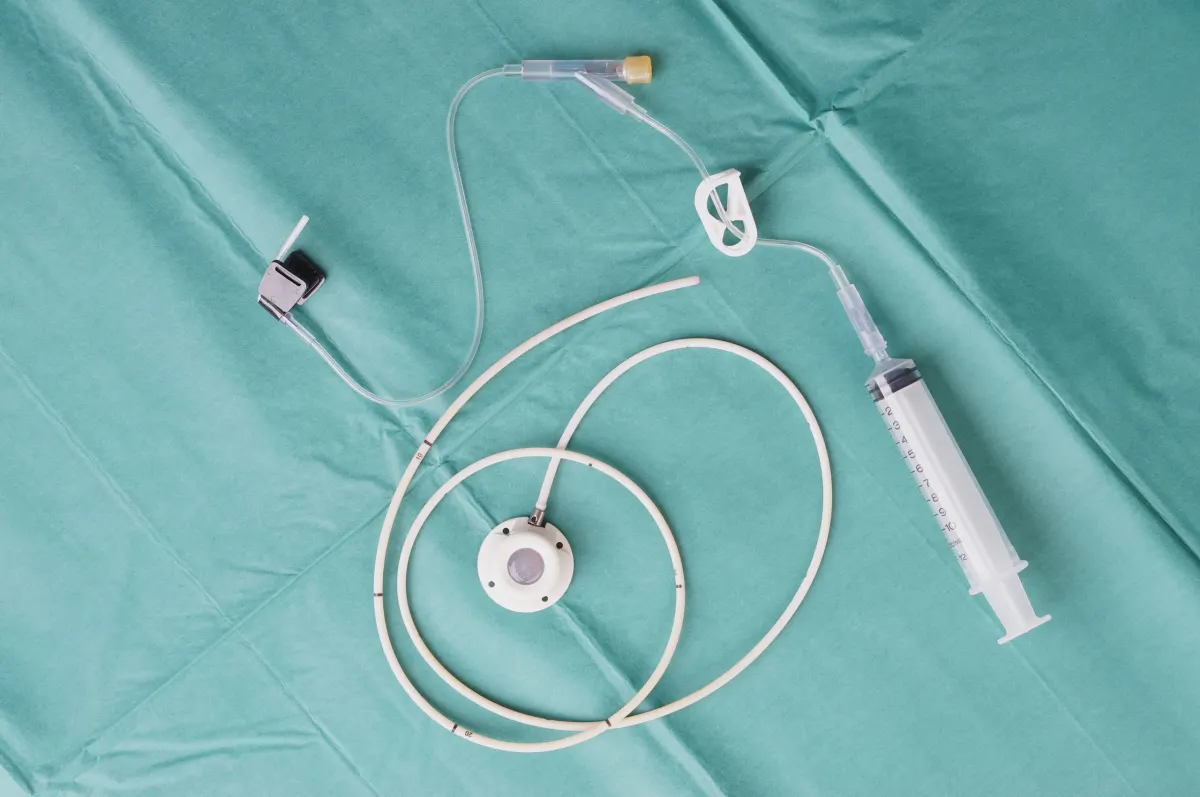
What Is a Port Catheter?
A port catheter is a type of catheter used in interventional radiology, generally performed in oncology and hematology patients, in cases requiring repeated injections, or in patients whose venous access is difficult to obtain. It can be performed under local anesthesia or general anesthesia. It must always be performed in a sterile environment and under imaging guidance.
How Is a Port Catheter Placed?
The port catheter placement procedure begins with the patient being informed about the procedure and their consent being obtained. Following this, the doctor selects the site, and the area where the catheter will be placed is cleaned under sterile conditions. Then, local anesthesia is applied to make insertion of the catheter easier. The most commonly used access sites are the internal jugular vein in the neck or the subclavian vein below the collarbone. First, a vein is entered under ultrasound guidance with a guidewire. Afterwards, a subcutaneous pocket where the port catheter will be placed is created under local anesthesia. The connection between this pocket and the vein in the neck is numbed with local anesthesia. The catheter is advanced from the pocket area to the neck region and from there, with the help of special guides, it is placed inside the superior vena cava, close to the heart, with its tip positioned there. The entire procedure is performed under fluoroscopic control. After the catheter has been checked, the reservoir is secured with special subcutaneous sutures and the skin is closed with stitches. Immediately after the procedure, the port catheter is flushed with a blood-thinning medication to prevent clot formation. Light-to-moderate compression is applied for approximately 1 hour to prevent leakage from the vessels in the procedure area and from the incision site.
The aim of port catheter placement is to safely and effectively insert a catheter into the patient's blood vessels. The procedure is very important in interventional radiology practice.
What Are the Advantages of a Port Catheter?
Port catheters allow medications needed for the effective treatment of patients to be injected directly into the heart. In addition, they make it possible for the patient to receive an injection at a single point in one go. This increases the patient's comfort and the efficiency of the treatment. There is no need to repeatedly perform venous access procedures; intravenous medications can easily be given from this reservoir. Medications that cause burning, blockage, or thrombophlebitis in peripheral veins can also easily be given through a port catheter.
How Long Does Port Catheter Placement Take?
The procedure performed under local anesthesia takes an average of 45 minutes. Once the catheter is placed, port catheters generally remain in place for a lifetime. They do not need to be removed after treatment ends. They are catheters that are compatible with the body.
Why Is a Port Catheter Placed?
Port catheters are catheters placed permanently in the body for the purpose of providing vascular access. They are generally used for purposes such as drawing blood from patients, administering blood products, or injecting medications directly into the body. In interventional radiology, port catheters are used to provide patients with permanent intravenous access.
Is There a Risk in Placing a Port Catheter?
Although it is very rare, some complications may be encountered during port catheter placement.
These risks include complications such as infection, bleeding, blood clot formation, damage to the liver and kidneys, blockage of the catheter within the circulatory system, or damage to the heart valves.
These risks are generally very low and can be prevented with a well-planned procedure and the use of correct techniques. However, the importance of an interventional radiology procedure performed by an expert medical team must be emphasized to prevent all these risks. To minimize these risks, one should work with an expert medical team, use correct techniques and procedures, and ensure that the placed port catheters are appropriately monitored under the supervision of the medical team.