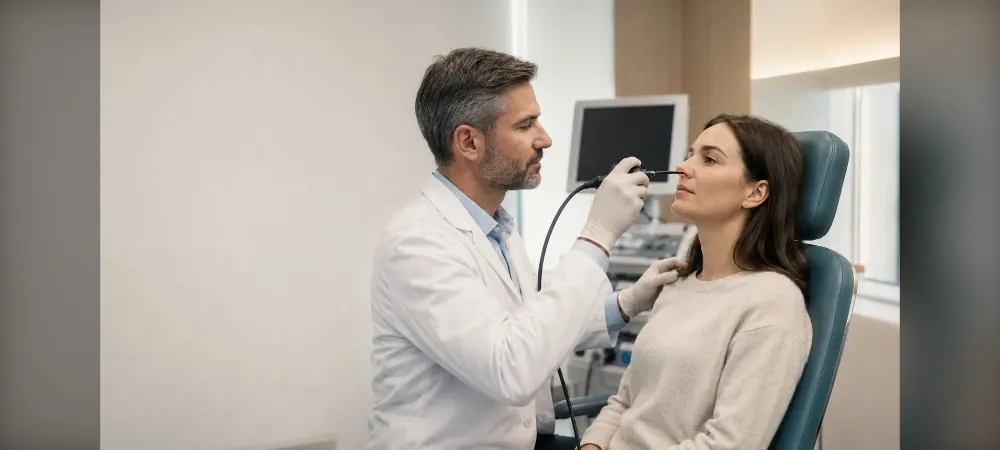
If you are experiencing nasal congestion, recurrent nosebleeds, or sinus headaches, your doctor may recommend a nasal endoscopy. Nasal endoscopy is a simple diagnostic method used to examine your nasal cavities and sinus passages in detail. The procedure takes only one to five minutes and is usually performed as an outpatient procedure. In this article, we will discuss why nasal endoscopy is performed, how it is performed, the post-procedure process, and potential risks in plain language.
What is Nasal Endoscopy?
Definition of nasal endoscopy
Nasal endoscopy is an examination method that allows for the internal inspection of your nose and sinus passages. Your doctor inserts a thin, tube-like device into your nose to evaluate areas that are impossible to see with the naked eye in great detail.
The nasal passages and sinus openings have a very complex structure. It is impossible to see these details by looking with a flashlight at home. For this reason, nasal endoscopy allows your doctor to easily evaluate polyps inside the nose, the condition of the mucosa, any bleeding points, and the areas where the sinuses open.
Endoscopic nasal examination is a method specifically used when an examination of the posterior region of the nose is required, which is difficult to see during a standard ear, nose, and throat examination. This procedure allows for the visualization of all structures from the front to the back of your nose.
Rhinoscopy and nasoendoscopy
Rhinoscopy and nasoendoscopy are terms that actually refer to the same procedure. Both terms describe an internal nasal examination. While the term nasoendoscopy points to a more modern and comprehensive approach, rhinoscopy may cover more traditional examination methods.
Rigid endoscopes are used in endoscopic nasal examinations. These devices provide access to areas that cannot be reached during a standard examination and make it possible to obtain clearer images.
What is an endoscope and how does it work?
An endoscope is a special medical device containing a thin light source and a camera system. The endoscopy process actually began in the Hippocratic era as a way to view the gastrointestinal tract without operating on the patient. Today, there are endoscopic systems used for both diagnosis and therapeutic methods.
The endoscope is moved through the nasal passages to perform the internal nasal examination. The camera at the tip of the device transmits images to a screen. This allows your doctor to examine your nasal structure in real-time.
When necessary, taking a biopsy, shrinking polyps, or removing a foreign body can also be done during this procedure. Therefore, nasal endoscopy is a versatile method that can be used for both diagnostic and therapeutic purposes.
Why is Nasal Endoscopy Performed?
Your doctor may recommend a nasal endoscopy for various reasons. This examination is an effective method used to find the source of your nasal and respiratory tract problems.
Diagnosis of chronic nasal congestion
A comprehensive physical examination is performed on patients who present with complaints of nasal congestion that has not resolved for 1 month. Endoscopic nasal evaluation is one of the primary diagnostic tools used to determine the cause of your nasal congestion.
If you are complaining of chronic nasal congestion, your doctor will evaluate the structural problems in your nose with nasal endoscopy. Conditions such as nasal septum deviation, suspected nasal polyps, or persistent congestion due to allergic rhinitis can be clearly seen with an endoscopic examination.
When investigating the causes of unilateral congestion, the focus is particularly on structural problems. It is possible to easily evaluate polyps inside the nose, the condition of the mucosa, and the areas where the sinuses open using this method.
Evaluation of sinusitis and headache
Endoscopic nasal examination is one of the most valuable diagnostic tools in the evaluation of sinusitis. Sinusitis symptoms usually manifest with complaints of nasal congestion, post-nasal drip, and headache.
With nasal endoscopy, nasal structures, sinus ostia, and any polyps or foci of inflammation are directly observed. This examination provides important information about the extent of the disease.
Determining the causes of nosebleeds
If you experience frequent nosebleeds, your doctor may want to conduct further investigation. If deemed necessary, the interior of the nose is visualized via endoscopy. Fiberoptic nasal endoscopy technology images vascular cracks and pathological formations in the deepest points of the nose.
For patients with nosebleed problems, endoscopic examination is an effective method for identifying the source of the bleeding. Thanks to endoscopic imaging, hidden polyps, vascular tumors, or anatomical deviations are diagnosed.
Investigation of loss of smell
Nasal endoscopy is used to diagnose problems such as nasal congestion, polyps, tumors, and sinusitis. If you have a loss of sense of smell, it is useful to perform a nasal endoscopy during the physical examination.
Obstructive diseases related to the nose and sinuses can cause a loss of smell. Polyps that cause complete obstruction inside the nose and severe swelling of the nasal lining are evaluated with endoscopy.
For biopsy and surgical procedures
When necessary, taking a biopsy, shrinking polyps, or removing a foreign body can be done during this procedure. Endoscopy and endoscopic surgery can be used in the diagnosis and treatment of many diseases related to the ear, nose, and throat.
Endoscopy is primarily used for diagnosis in cases such as suspected nasal polyps or masses, hoarseness, and laryngeal lesions. This method is also preferred in cases that do not improve with non-surgical methods.
How is Nasal Endoscopy Performed?
Preparation before the procedure
Nasal endoscopy is usually performed in your doctor's office or at the outpatient clinic. Before the examination, the physician listens to the patient's complaints in detail. Information such as how long the complaint has been ongoing and whether it is unilateral or bilateral is obtained.
Before the examination, a local anesthetic spray or intranasal dilator medication may be applied to relax the patient. In some patients, the nasal structure may be narrow or there may be a septum deviation. In such cases, your doctor will inform you before the procedure.
Decongestant and anesthesia application
Before starting the procedure, a decongestant is used to shrink the nasal turbinates. This application allows the endoscope to move more comfortably inside the nose.
Before the endoscopic nasal examination, cotton swabs soaked in anesthetic medication are placed in one or both sides of your nose. In this way, mild anesthesia is provided, and the process is carried out without feeling pain. A few minutes are waited for it to take effect before starting the procedure. Usually, 2-3 minutes are waited.
If unexpected effects have been observed following the application of a similar medication before, you must inform your doctor about this.
Insertion of the endoscope into the nose
After the anesthesia takes effect, the endoscopic nasal examination begins. A thin, lighted endoscope equipped with a camera is gently inserted into the nose. The internal nasal examination is performed as the endoscope moves through the nasal passages.
The surgeon evaluates the nose and sinus cavities simultaneously on the screen with the help of the endoscope, camera, and lighting systems. Rigid endoscopes are used.
Examination process and imaging
Thanks to the endoscope's camera, the interior of the nose, nasal concha, and nasopharynx region are examined in detail. Your doctor views the nasal structures in real-time on the screen.
During the examination, the patient may be asked to breathe calmly. Nasal structures are observed, any pathological condition is noted, and additional examinations are recommended if necessary. Thanks to the endoscope, sinus ostia, any polyps, and the condition of the mucosa are evaluated.
Procedure duration
Nasal endoscopy is a very fast and painless procedure. The procedure is short for most people. Usually, the procedure itself is completed within a few minutes.
After the procedure is completed, the patient can immediately return to normal life. Rarely, mild nasal congestion or discharge may be felt. The duration may vary depending on the area to be examined and the patient's tolerance.
What to Expect After Nasal Endoscopy?
You can return to your normal life immediately after the procedure is completed. However, it will be beneficial to know the natural reactions of your body to a minor intervention.
Side effects after the procedure
You may experience mild side effects for a few days after nasal endoscopy. Mild bloody discharge and congestion are normal for the first few days. Having slightly bloody mucus from your nose is not a cause for concern.
In fact, endoscopy is generally a safe method. Some patients may experience mild discomfort or a feeling of fatigue that can last for a few days. A feeling of mild swelling or fullness inside the nose is also common.
Rarely, you may feel mild nasal congestion or discharge. The nose is an area open to the outside, and germs can enter. Therefore, your doctor may recommend antibiotics if deemed necessary.
Pain and discomfort management
Nasal endoscopy is not a very painful procedure. Usually, the patient does not have pain after the procedure. If you feel mild discomfort, the painkillers recommended by your doctor will be sufficient.
Aspirin and similar medications should not be used for 3 weeks after the procedure as they increase bleeding. Intervention is performed under endoscopy.
Nasal care accelerates the healing process. Saline nasal rinses should be performed upon doctor's recommendation. These rinses ensure the cleaning of crusts inside the nose and support healing. You can rinse the inside of your nose with saline at least a few times a day.
Heavy exercise should be avoided for a few weeks. Similarly, heavy lifting and forceful nose blowing are not recommended. Smoking delays healing and should not be used.
Evaluation of results
Your doctor can explain what they saw during the examination. If a biopsy was taken, it may take a few days for the laboratory results to arrive.
Although the healing process varies from person to person, you can usually return to daily life activities within 1-2 weeks. It takes about 2 months for your nose to return completely to normal. During this process, conditions such as crusting and discharge may be seen.
Follow-up appointments
If an intervention is performed during the endoscopic examination, your first check-up will be approximately 1 week after the procedure date. At this appointment, your doctor will clean the crusts inside the nose and evaluate the healing.
The healing stage and whether any adhesions have formed will be evaluated with regular endoscopic check-ups. Follow-up appointments are important for cleaning nasal crusts.
Your subsequent follow-ups will be arranged by your physician according to the disease and the response to healing. For example, long-term medication treatment may be required for some patients. Complying with follow-up examinations increases the success of the process.
Risks and Complications of Nasal Endoscopy
Although nasal endoscopy is generally a safe method, it carries some risks like any medical procedure. Even though the risks of endoscopy are low, they can cause some discomfort. Risks include bleeding, infection, and allergic reactions. However, these conditions are rare and most can be prevented with careful monitoring.
Allergic reactions
Allergic reactions may develop in some patients during anesthesia and sedation. This condition may manifest itself with symptoms such as breathing difficulties or swelling. If unexpected effects have been observed following the application of a similar medication before, you must inform your doctor about this.
Allergic reactions are usually mild and can be brought under control when intervened quickly. If you feel redness on your skin, itching, or difficulty breathing, your healthcare team will immediately apply the necessary treatment. Especially if you have a sensitivity to local anesthetic drugs, it is important to inform your doctor before the procedure.
Bleeding and infection risks
Although the risk of bleeding during nasal endoscopy is low, bleeding may occur when procedures such as taking a biopsy or removing a polyp are performed. In most cases, this bleeding is mild and stops on its own. It is very common to have a small amount of bleeding from your nose in the days following FESS surgery.
Serious bleeding is extremely rare. If you experience regular blood flow after the procedure or if the bleeding does not seem to stop, you should consult your doctor. Remember that aspirin and similar blood-thinning medications increase the risk of bleeding.
Developing an infection is also among the possible complications. There is a risk of infection, especially when a biopsy is taken or a procedure is performed. Symptoms of infection may include fever, pain, swelling, or redness. Since your nose is an area open to the outside, germs can enter, so your doctor may recommend antibiotics if deemed necessary.
Fainting and other rare complications
In rare cases, some patients may experience a feeling of fainting during or immediately after the procedure. This is usually due to anxiety or a vasovagal reaction. If you feel lightheaded or dizzy, it is sufficient to inform your doctor.
Since the sinuses are close to the eye wall, sometimes a small amount of bleeding can occur inside the eye. This condition can usually be noticed as some bruising around the eye and heals without any special treatment. More serious bleeding into the eye socket is very rare.
Cerebrospinal fluid leak complications are extremely rare. Since the sinuses are close to the bony structures at the base of the brain, there is a risk of leakage of the fluid surrounding the brain as a result of damage to thin bone structures. If this leakage does not resolve with follow-up, a long hospital stay may be required.
Frequently Asked Questions
Is nasal endoscopy painful?
Nasal endoscopy is generally a painless procedure. A local anesthetic spray is applied to your nose before the procedure, so you will not feel discomfort. If a surgical intervention is planned, a special anesthesia called conscious sedation is applied to all our patients in our Endoscopy unit with drugs given intravenously.
In fact, pain is not felt during diagnostic nasal endoscopy. In procedures performed under sedation, the patient does not feel anything and does not experience pain. If a biopsy is taken, a sore throat or mild discomfort may be seen after the procedure, but this condition passes within a few hours.
You will definitely not have complaints of pain, shortness of breath, or nausea and vomiting during the procedure. Thanks to the special effect of the drugs used, you usually do not remember the procedure at all.
How long does the procedure take?
Nasal endoscopy is a very quick procedure. Endoscopic nasal examination usually takes 5-10 minutes. The procedure itself is completed within a few minutes and is comfortable for patients.
However, general endoscopy procedures may vary depending on the patient's condition. The endoscopy procedure usually lasts between 15 minutes and 30 minutes. If an additional intervention is to be performed, for example, if a biopsy is to be taken, the duration may be slightly longer.
You can be discharged within a few hours after the anesthesia effect wears off and you have rested after the procedure. Therefore, your total hospital stay is quite short.
Can I drive after the procedure?
If a surgical intervention has been performed under endoscopy with anesthesia, No, you should not drive on the same day after the procedure. Driving after endoscopy is not considered safe, especially for patients who have undergone sedation or anesthesia. The drugs used can slow down reflexes, prolong reaction time, and cause distraction.
Even if the patient feels energetic after general anesthesia and sedation, research shows that there is a decrease in reflexes within the first 24 hours after anesthesia. For this reason, vehicles should not be driven on the day anesthesia is applied.
You should not drive for at least 8 hours after the procedure and should stay away from jobs that require attention. It is recommended that you bring a relative with you who can help you when returning home.
How many days does it take for nasal endoscopy to heal?
The healing process varies depending on the type of procedure. If only diagnostic nasal endoscopy was performed, most patients return to normal life on the same day. It does not require hospitalization, and you can be discharged within a few hours after the anesthesia effect wears off.
If a surgical intervention was performed, the healing process is slightly longer. In minimally invasive methods such as endoscopic sinus surgery, patients can usually return to their daily activities within 1-2 days. Most patients can return to work within 5-7 days after surgery.
Full recovery time usually varies between 2 and 6 weeks. Complete healing of the surgical area takes six to eight weeks depending on the content of the surgery performed. It is important to go for regular check-ups and follow your doctor's recommendations during this process.
Is private insurance required for nasal endoscopy?
Nasal endoscopy is usually performed when there is a medical necessity, and many health insurance policies cover this procedure. However, the coverage details of your insurance may vary. It will be beneficial to contact your insurance company before the procedure to learn about the coverage status.
If you have private health insurance, check which coverage scope endoscopic procedures are paid under. Supplementary health insurance may cover additional costs in some cases. The report and medical justification written by your doctor are important for insurance approval.
In Summary, Nasal Endoscopy
Nasal endoscopy is an effective and safe method for the diagnosis of your nasal and sinus problems. The procedure takes only a few minutes and is usually painless. Thanks to local anesthesia, you will not feel discomfort.
With this method, your doctor can easily determine the cause of your nasal congestion, sinusitis problems, or recurrent nosebleeds. You can return to your normal life on the same day after the procedure.
If your doctor recommends a nasal endoscopy, there is no need to worry. Do not hesitate to ask your questions before the procedure and follow the instructions given. Therefore, this small step to be taken for your health can bring long-term relief.