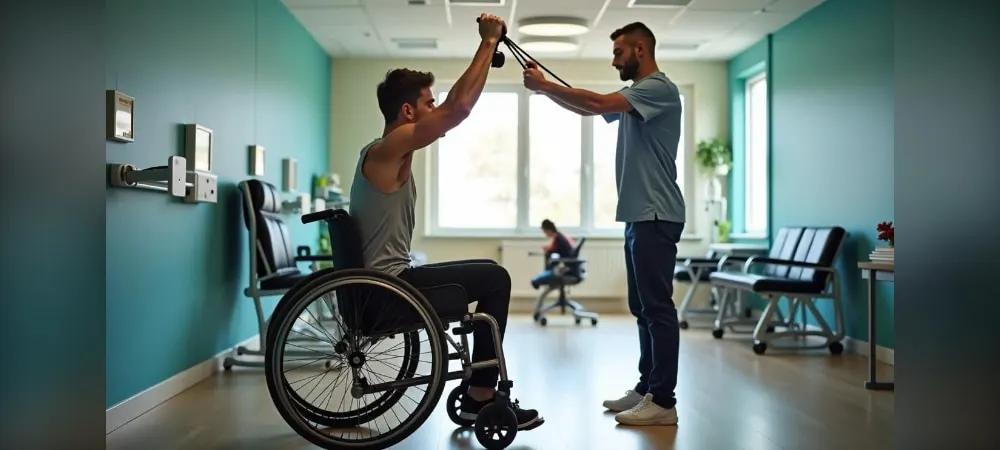
Paraplegia is a type of paralysis characterized by the loss of strength and sensation in both legs. Generally resulting from spinal cord injuries, this condition significantly impacts your daily life.
To explain paraplegia simply, also known as spinal cord paralysis, it is the loss of motor and sensory functions of the lower extremities. Paraplegic individuals cannot perform voluntary movements below the level of injury and experience a loss of sensation. This issue mostly develops as a result of events such as traffic accidents, falls from heights, sports accidents, or gunshot wounds.
In this article, we will discuss the symptoms, causes, and treatment methods of paraplegia in a clear and understandable way for you. You will also learn ways to make life easier with paraplegia in terms of physical therapy.
What does paraplegia mean? Basic definition and scope
Paraplegia, also known as spinal cord paralysis, is a serious medical condition that causes a loss of movement and sensation, particularly in the lower extremities (legs). This condition usually occurs as a result of damage to the spinal cord and significantly affects a person's quality of life. So, what does it actually mean and how is it classified? Let us now examine this subject in more detail.
What is a paraplegic and its relation to spinal cord paralysis
Paraplegia is defined as the loss of muscle strength and sensory functions in the lower extremities. It is not limited only to muscle and sensory loss, but also affects autonomic functions that operate outside a person's own will. Spinal cord paralysis, on the other hand, is the clinical picture formed as a result of damage to the spinal cord due to trauma, tumors, infections, or neurological diseases.
A paraplegic individual becomes unable to use their legs and lower body muscles as a result of damage occurring in the spinal cord. This damage interrupts nerve conduction between the brain and the lower parts of the body, causing a loss of functions such as movement, sensation, and reflexes. However, an important point is that upper body functions are generally preserved in the case of paraplegia.
The spine consists of 4 different sections—cervical (neck), thoracic (chest), lumbar (lower back), and sacral—and 33 separate bones. The location of the spinal cord injury directly determines the effects of paraplegia. Damage in the thoracic, lumbar, or sacral regions generally results in paraplegia.
The difference between paraplegia and tetraplegia
Paraplegia and tetraplegia show significant differences among types of paralysis. Paraplegia develops as a result of damage seen in the 2nd thoracic vertebra and spinal discs located below it, affecting only the trunk, legs, and pelvic organs. The hands and arms maintain normal function.
In contrast, tetraplegia (also known as quadriplegia) occurs with the involvement of the area from the 1st thoracic vertebra up to the brainstem. In this case, both the arms and legs, the trunk, pelvic organs, and lungs may also be affected. Therefore, tetraplegia is a more severe condition compared to paraplegia.
In both conditions, there is a loss of function in the motor, sensory, and autonomic systems. However, the scope of the affected body regions differs. While paraplegia generally stems from injuries in the lower back or thoracic vertebrae, tetraplegia stems from injuries in the neck region.
Types of paraplegia: Complete, partial, spastic
Paraplegia appears in different types depending on the level and severity of the spinal cord injury:
Complete paraplegia: The individual shows no sensation or mobility in their lower extremities. No sensation or movement is observed in the entire lower extremity starting from the region of damage. In this case, there is a complete transection of the spinal cord.
Partial paraplegia (paraparesis): The individual may have a certain level of sensation and mobility. In this type, limited muscle function and sensory loss are experienced due to nerve damage or injury. For example, there is movement in the feet, but the patient cannot walk unassisted due to loss of strength.
Spastic parapleji: This type is associated with a condition called "spasticity" that develops due to spinal cord damage. It is characterized by marked stiffness, spasms, and restricted movement in the leg muscles. There is a state of continuous contraction, inability to voluntarily relax, and tension in the extremity and sometimes trunk muscles. Over time, this condition can lead to permanent joint stiffness called contractures.
In addition, there are congenital or acquired types of paraplegia. Alongside genetically transmitted types such as hereditary spastic paraplegia, there are types that develop later due to causes such as trauma, infection, or tumors.
In every type, appropriate physical therapy and rehabilitation programs play a critical role in improving patients' quality of life. Early diagnosis and appropriate treatment approaches facilitate the adaptation of paraplegic individuals to daily life and are of great importance in preventing complications.
What are the symptoms of paraplegia?
Paraplegia symptoms vary depending on the level and severity of the injury. Viewed from the perspective of physical therapy, these symptoms significantly affect patients' daily lives and form the focus of the rehabilitation process. Let us now examine these symptoms in more detail.
Decreased mobility
Paraplegia manifests itself with the partial or complete loss of mobility below the waist. Complete or partial paralysis can develop in the legs as a result of spinal cord injury. The loss of movement occurs in all muscles below the damaged spinal cord region.
Your ability to move your legs decreases or may be completely lost. While partial mobility can be preserved in some cases, no movement is observed in the legs in severe cases. This situation makes it difficult to maintain your daily life activities and usually necessitates the use of a wheelchair.
Loss of sensation and reflex disorders
Along with the loss of movement, impairments are also seen in sensory functions. Loss of sensation or a tingling sensation can be experienced, particularly in the lower extremities. In paraplegia patients, senses such as touch, temperature, pain, and position sense may be partially or completely lost.
The weakening or complete loss of reflexes may also occur. This situation prevents your body from responding normally to external stimuli. During the physical therapy process, various exercises are applied to preserve and improve remaining sensory functions.
Bladder and bowel control problems
Paraplegia can also affect the nerves that provide bladder and bowel control. As a result of this:
Inability to urinate or urinary incontinence
Inability to have a bowel movement or having difficulty doing so
Fecal and urinary incontinence
These problems significantly affect the quality of life of paraplegic individuals. Regular toilet habits and sometimes methods such as catheter use may be required to regulate bladder and bowel functions. Physical therapy specialists develop patient-specific programs in the management of these problems.
Muscle spasms and neuropathic pain
Muscle spasms and involuntary muscle movements are common in paraplegia patients. These spasms can make daily activities difficult and can lead to muscle stiffness over time. Additionally, chronic pain or neuropathic pain (burning, stinging sensation) may develop.
Physical therapy applications, medication, and sometimes alternative methods can be used for pain control. Physical therapy specialists recommend stretching exercises, positioning techniques, and various physical modalities to reduce muscle spasms and manage pain.
Furthermore, secondary problems such as circulatory problems (slowing of blood circulation, risk of pressure sores) and decreased resistance to infections can also arise due to paraplegia. The risk of developing bedsores, joint stiffness, and muscle tightness increases due to prolonged immobility.
What causes paraplegia?
There are various causes of paraplegia cases. Understanding the factors underlying this problem plays an important role in shaping treatment approaches. So, from what causes does this condition, which causes loss of movement and sensation in the lower part of the body, arise?
Traumatic spinal cord injuries
The most common cause of spinal cord paralysis is traumatic injuries. It is seen approximately 2.5 times more often in men than in women. Especially:
Traffic accidents: Responsible for 40-50% of all traumatic spinal cord paralysis cases
Falls from heights: Constitutes 30-40% of cases and is generally more frequent in children and construction workers
Acts of violence: Responsible for 2-14% of spinal cord paralysis cases
Sports accidents: Constitutes approximately 7% of traumatic spinal cord paralysis pictures
It should not be forgotten that in patients who are not transported properly after a traffic accident or fall from height, existing spinal fractures can turn into paraplegia. From the perspective of physical therapy, initial intervention and transport techniques after an accident are of vital importance.
Infections and tumors
Various infections and tumors are among non-traumatic causes. These conditions can lead to loss of movement and sensation by creating pressure on the spinal cord. For example:
Infectious diseases such as brucellosis and tuberculosis can cause paraplegic spinal cord paralysis in advanced stages. Additionally, spine infections can lead to the development of paraplegia by putting pressure on nerve tissue.
Tumors forming around or inside the spinal cord can cause pain, muscle weakness, and difficulty walking by putting pressure on the spinal cord.
Congenital anomalies and genetic factors
Sometimes paraplegia can stem from birth or genetic factors:
Congenital anomalies such as spina bifida lead to the damage of the spinal cord and paraplegia at birth due to the failure of the membranes and bones over the spinal cord to develop while in the womb.
Physical therapy supports the child's development by starting at an early age in congenital paraplegia and helps prevent complications.
Multiple sclerosis and other neurological diseases
Various neurological diseases are also among the causes of paraplegia:
Multiple Sclerosis (MS) can increase the risk of paraplegia by causing damage to nerve cells in the spinal cord. Spinal cord paralysis can develop in advanced stages of MS.
A spinal cord infection called transverse myelitis is also associated with paraplegic spinal cord paralysis. This condition occurs when inflammation forms in a section of the spinal cord.
Advanced lower back and neck hernias can cause paralysis by putting pressure on the spinal cord. Neurodegenerative diseases characterized by the progressive loss of nerve cells are also associated with spinal cord paralysis.
Physical therapy is indispensable for preserving existing mobility and developing daily living skills in these patients.
How is paraplegia diagnosed?
When paraplegia is suspected, your doctor initiates a comprehensive evaluation process to make a diagnosis. Accurate and early diagnosis is of vital importance for creating an appropriate treatment plan. Physical therapy specialists also play an important role in the evaluation stage during this process.
Neurological examination and reflex tests
The first step in the diagnostic process is a detailed neurological examination. Your doctor first reviews your medical history and the symptoms you experience in detail. Then, they comprehensively evaluate your nervous system.
During the neurological examination, the following are evaluated:
Muscle strength and mobility
Reflexes and nerve responses
Sense of touch, temperature, and pressure
Bladder and bowel functions
Reflex tests are important to understand the working status of the nervous system. In these tests, tendons are gently tapped using a special hammer, and the response of the muscles is observed. Muscle strength is generally graded between 0-5; here 5 indicates normal muscle strength, and 0 indicates complete paralysis.
In the sensory examination, the boundaries of sensory loss in the legs and other regions of the body are determined. This helps understand which region of the spinal cord is damaged.
Imaging methods such as MRI and CT
Following the physical examination, imaging tests are performed to see the condition of the spinal cord. These tests help detect the location and size of the damage.
Magnetic Resonance Imaging (MRI) shows damage in the spinal cord and surrounding soft tissues. MRI is the most effective method to determine the level and severity of spinal cord injury. Thanks to this, your doctor can understand precisely where the paralysis originates from.
Computed Tomography (CT), on the other hand, is especially useful in showing fractures and damage in the spine bones. It also identifies problems in the bone structure that create pressure on the spinal cord.
X-rays can also be used in the initial evaluation, but they do not provide as detailed information as MRI and CT.
Electrical tests such as EMG and SSEP
In some cases, electrical tests may be required to evaluate nerve conduction and muscle functions:
Electromyography (EMG) measures the electrical activity of muscles and nerves. During the test, small needles (electrodes) are placed through the skin into the muscle. These electrodes record the electrical signals produced by the muscles both at rest and while moving. The EMG test usually takes 30-60 minutes, and the results are evaluated by neurologists.
The Somatosensory Evoked Potentials (SSEP) test measures the signals that nerves transmit to the brain. This test is used to evaluate the condition of sensory pathways. In the SSEP test, low-intensity electrical stimulation is generally given to the nerves in the wrists and ankles, and responses are recorded with electrodes placed in different regions of the body.
Early diagnosis of paraplegia is one of the most important factors increasing the success of treatment. After an accurate diagnosis is made, physical therapy specialists aim to raise the quality of life by developing patient-specific rehabilitation programs.
Paraplegia treatment: Methods applied
Paraplegia treatment requires a personalized and multifaceted approach depending on the patient's condition. The treatment plan is shaped based on the level and type of spinal cord injury and the patient's general health status. A holistic treatment process aims to increase quality of life alongside physical recovery.
Acute intervention and spine stabilization
Immediately following a paraplegia injury, the primary goal is to prevent further damage. It is a priority that the patient is not moved and supportive devices such as steel corsets and neck braces are used. Steroid drugs may be administered during this early period to reduce edema on the spinal cord.
Surgical intervention may be required in emergency situations. Operations can be applied, particularly to correct fractured bones putting pressure on the spinal cord or to eliminate hematomas. The treatment plan is created by considering the level of damage, the patient's age, and general health status.
Physical therapy and rehabilitation process
Rehabilitation is the longest and most critical stage of paraplegia treatment. Your goal is to maximize remaining functions and gain independent living skills. Physical therapy programs are of vital importance to increase muscle strength, maintain joint mobility, and support the circulatory system.
It primarily starts with mat activities such as short sitting, long sitting, and rolling. Afterward, wheelchair use and transfer techniques are taught. A balanced nutrition plan prepared in addition to a correct physical therapy program increases your quality of life.
While a motorized wheelchair is recommended for moving comfortably inside the home, your family members are also informed about home physical therapy applications.
Surgical interventions and implants
Surgical procedures may be required for spine stabilization in some cases. Vertebrae can be stabilized with spinal fusion, or tumors pressing on the spinal cord can be removed. While the pressure on the spinal cord is removed with decompression surgery, spinal stability is provided with stabilization surgery.
Surgical interventions are determined based on the underlying cause, and their goal is to alleviate symptoms, increase functionality, and improve your quality of life.
Psychological support and social adaptation
Paraplegia brings along not only physical but also emotional and social challenges. Psychotherapy and group therapies help you feel stronger during this process.
Additionally, vocational rehabilitation and social adaptation programs support your active participation in community life. Alongside psychological support, family support also increases the effectiveness of the treatment process. This holistic approach significantly raises the independence and quality of life of paraplegic individuals.
In recent years, studies have been conducted on experimental methods such as stem cell therapies and spinal cord implants. Although they have not entered standard treatment yet, these approaches offer new opportunities for the future.
Frequently Asked Questions
Answering our patients' questions during the physical therapy process is an important factor that increases treatment success. Here we answer the most frequently asked questions about paraplegia.
Is paraplegia permanent? It varies depending on the degree of damage in the spinal cord. If there is complete damage, paraplegia is generally permanent. However, in partial damage, a portion of nerve functions can be regained with treatment and rehabilitation. It is possible to increase your functional capacity with physical therapy programs.
Can paraplegia patients continue their sexual life? Yes, you can continue your sexual life. Depending on the level and severity of the spinal cord injury, changes may occur in sexual functions. During the rehabilitation process, you can receive special support for the protection of your sexual health.
Can paraplegia patients live independently? Independent living is possible with correct rehabilitation, appropriate assistive devices, and environmental arrangements. Your physical therapy specialist will teach you special exercises and techniques to carry out your daily activities.
Can paraplegia patients drive vehicles? Yes, you can drive vehicles with specially adapted vehicles. Steering, gas, and brake controls are arranged in a way to be used by hand. Thus, your freedom of movement increases and your social life becomes active.
Can paraplegia patients do sports? Absolutely you can. Sports such as wheelchair basketball, swimming, and adaptive yoga support you psychologically while protecting your muscle strength. Your physical therapy specialist will recommend sports activities suitable for you.
What is spastic paraplegia? It is a condition that develops due to spinal cord damage and involves continuous contraction in the muscles and an inability to relax voluntarily. This state of tension in the extremity and sometimes trunk muscles can lead to restricted movement in joints over time.
Does paraplegia (spinal cord paralysis) go away? A complete recovery from a spinal cord injury is not an expected situation. Some recovery can be seen in partial injuries. With good rehabilitation, you can gain your own independence and return to daily life and business life.
Do spinal cord nerves regenerate themselves? Nerve tissues cannot regenerate themselves after being completely damaged. Therefore, physical therapy programs focus on protecting and improving remaining functions.
Will a paraplegia patient walk? If your injury level and preserved muscle strength are sufficient, it may be possible for you to walk with a rehabilitation program and appropriate assistive devices. In fact, in some cases, if you have sufficient muscle strength, you can walk even without using assistive devices.
Paraplegia causes loss of movement and sensation in the lower extremities due to spinal cord damage. Learn its symptoms, causes, and treatment methods in detail.
Start with the right assessment for What is Paraplegia (Spinal Cord Paralysis)? What Are Its Symptoms? How Is It Treated?
Share your symptoms with our specialist physicians; let us determine the right diagnosis and treatment plan together.
Warning
If your symptoms started suddenly, are progressing rapidly, or significantly restrict your daily life, consult a physician without delay.
Plan your What is Paraplegia (Spinal Cord Paralysis)? What Are Its Symptoms? How Is It Treated? journey with our specialists.
Fill in the form or book an appointment to learn about treatment options, the process and preparation.