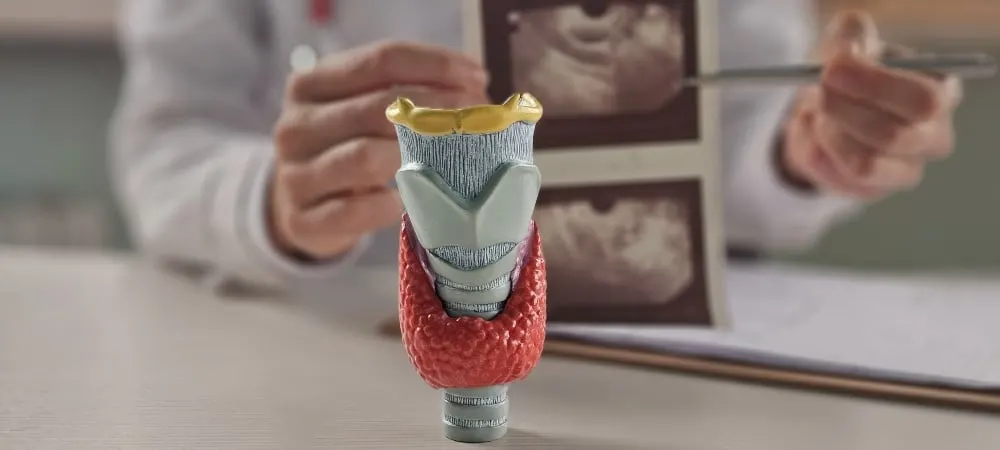
Goiter
Goiter is the irregular enlargement of the thyroid gland responsible for producing thyroid hormones. Operating under the control of the pituitary gland, the thyroid gland is a structure situated on both sides of the base of the neck. It has important roles such as controlling the body's metabolism, maintaining homeostasis, and supporting growth and development in children. These metabolic activities are carried out by thyroid hormones produced by the thyroid gland. When abnormal growths develop in the thyroid gland contrary to its normal structure, a goiter may occur. This condition can lead to small or large noticeable swellings in the front of the neck. Although generally painless, other symptoms may cause pain.
The enlargement can occur throughout the entire gland or appear in the form of nodules. Depending on the severity of the goiter and the intensity of the symptoms, bothersome signs may be observed. A goiter may not cause any changes in hormone levels, or it may show an increase or decrease. The most common cause of thyroid enlargement can be explained as iodine deficiency. Other causes may include factors such as puberty, pregnancy, inflammation, cancer, and nodules. Goiter can develop in any age group, but the risk may be higher with aging. Particularly in individuals with metabolic syndrome, obesity, and insulin resistance, the risk of developing a goiter may be high.
What is Goiter?
Goiter is a health problem defined as the thyroid gland being larger than its normal dimensions. Located in the neck below the Adam's apple, the butterfly-shaped thyroid gland is an important hormone center. It is responsible for producing thyroxine (T4) and triiodothyronine (T3) hormones. Through the hormones it secretes, the thyroid gland regulates events such as body temperature, digestion, blood pressure, heart rate, metabolism, and mood. The dimensions of the thyroid gland can increase proportionally with age and body size. In addition, the thyroid gland may enlarge due to various physiological and pathological factors. The condition resulting from the enlargement of the gland is called goiter. The thyroid may grow entirely or in the form of small nodules. Furthermore, the amount of thyroid hormone may decrease (hypothyroidism), increase (hyperthyroidism), or remain within normal values. Goiter classification can be made as follows depending on the growth pattern of the tissue and hormone levels:
Simple goiter: The condition where the thyroid gland swells completely.
Nodular goiter: The development of solid/fluid-filled nodules in the tissue and the formation of a lumpy sensation in the neck.
Multinodular goiter: The condition resulting from the development of multiple nodules in the tissue.
Toxic goiter: The condition formed as a result of the thyroid gland enlarging and producing excessive amounts of thyroid hormone.
Non-toxic goiter: Despite the enlargement of the thyroid gland, normal hormone levels can be explained as a non-toxic goiter.
The treatment plan for different types of goiter may vary.
What Are the Symptoms of Goiter?
Goiter mostly may not present with prominent symptoms. Furthermore, small lumps formed in the neck may go unnoticed. Generally progressing painlessly, a goiter may be painful in the presence of thyroid inflammation. Other commonly seen symptoms may vary depending on changes in thyroid activity and the degree of progression of the goiter. Goiter symptoms in the presence of hypothyroidism (low thyroid hormone) may include:
Fatigue or exhaustion,
Constipation,
Increased drowsiness,
Sensitivity to cold,
Dryness in the skin,
Unexplained weight gain,
Irregularities in the menstrual cycle,
Concentration problems.
Among the common symptoms seen in the presence of a goiter accompanied by hyperthyroidism (high thyroid hormone) can be:
Unexplained weight loss,
Excessive sweating,
Diarrhea,
Tachycardia (fast heartbeat),
Irritable mood,
Hypertension,
Tremors,
Muscle weakness,
Sleep problems.
In children and infants, symptoms of goiter in the presence of hyperthyroidism may include greater bone growth for their age, height increase, and behavioral changes. Additionally, an obstructive goiter can block the airway and lead to certain issues in the larynx. Symptoms such as difficulty swallowing, hoarseness, coughing, snoring, and difficulty breathing may occur.
How Does Goiter Form?
The adaptation event responding to factors that slow down or prevent hormone production in the thyroid gland can be called a goiter. This process, in which the thyroids are stimulated to work harder, can occur depending on multiple factors. A series of events that can trigger the development of a goiter may include:
Iodine deficiency: Iodine is needed for the production of hormones from the thyroid gland. As a result of an iodine-deficient diet, hormone production begins to decrease. This situation causes the pituitary gland to stimulate the thyroids more. Stimulated thyroids begin to grow to produce more hormones.
Hashimoto's disease: This is an autoimmune health problem that leads to inflammation of the thyroids. Hormone production decreases in inflamed and damaged thyroids, and they begin to be stimulated more by the pituitary gland.
Graves' disease: This is an autoimmune disease that causes the thyroids to enlarge and secrete more hormones.
Thyroid nodule: This is the irregular growth of thyroid cells forming lumps. It usually progresses as benign.
Thyroid cancer: Cancer developing in the thyroid glands can lead to irregular growth.
Thyroiditis: This is inflammation of the thyroid caused by bacterial, viral, and autoimmune disorders.
Other risk factors for goiter may include pregnancy, radiation exposure, and aging.
How is Goiter Diagnosed?
Goiter is generally diagnosed through a physical examination. Along with a goiter, there may be certain differences in the structure of the thyroid gland and hormones. Therefore, finding the underlying cause and shaping the treatment plan is important. In this context, tests used in the diagnosis of goiter may include:
Thyroid function test: This is the measurement of TSH (thyroid-stimulating hormone), thyroxine, and triiodothyronine hormone levels in a taken blood sample. A decrease or increase occurring in thyroid activity can be observed.
Antibody test: In certain autoimmune goiter types such as Graves' disease and Hashimoto's, specific antibodies are produced in the body. Antibodies produced by white blood cells can be measured in the antibody test.
Ultrasound: Neck tissues can be imaged using sound waves. With this method, the size of the thyroid gland and the presence of nodules can be checked.
Computed tomography and MRI: CT and MRI can be used to check the size and spread in cases of excessively enlarged and spreading goiter.
Radioactive iodine uptake: This measures how quickly radioactive iodine administered intravenously in a small amount is used by the thyroids. The cause of the goiter can be determined with a special scanning device. It is not a frequent test and may be recommended in certain situations.
Biopsy: This involves taking a tissue or fluid sample from the nodules with the help of a fine needle and examining it in the laboratory. It may be recommended especially to differentiate large nodules from cancer.
How is Goiter Treated?
Goiter treatment aims to reduce tissue growth and pressure formed in the neck region, alleviate symptoms, and return to normal thyroid hormone values. The treatment program may vary depending on the size of the thyroids and the underlying cause. Methods preferred within the scope of goiter treatment are mainly:
Observation: A goiter may not require any treatment when it is small in size and asymptomatic. However, the goiter needs to be monitored regularly.
Drug therapy: Medication can be administered to increase or decrease hormone production in the thyroid, block hormone activities, and relieve pain. These drugs are synthetic hormones used as T4 hormone and T3 hormone replacement.
Radioactive iodine therapy: Used in cases where the thyroid gland is overactive, radioactive iodine is taken orally in this treatment. Radioactive iodine moves toward the thyroid gland and begins to kill thyroid cells there. With this treatment, a reduction in goiter size can be achieved and hormone production can be reduced.
Surgery: Goiter surgery involves the removal of part or all of the gland. This procedure is called a thyroidectomy and may be recommended if it leads to respiratory tract problems. Furthermore, surgery may be necessary for the removal of nodules and cancerous cells. Following goiter surgery, hormone replacement therapy must be provided depending on the removed tissue. Goiter surgery risk is low in terms of complications such as laryngeal nerve damage or hypoparathyroidism.
Frequently Asked Questions
Thyroid hormone levels in individuals with goiter disease can remain normal (euthyroid), increase (hyperthyroid), or decrease (hypothyroid). Metabolic activities may change in the presence of hyperthyroidism and hypothyroidism. In toxic goiter cases, excessive hormone production from the thyroid gland is observed. Non-toxic goiter, on the other hand, has normal hormone levels, but the thyroid gland enlarges. Goitrogens found in some foods prevent the thyroid gland from using iodine, causing it to secrete more hormones and causing the gland to enlarge. Those with a goiter should consume foods containing goitrogens more limitedly. Among these foods, limited consumption of vegetables belonging to the cruciferous family such as cabbage, broccoli, kale, soybeans, tofu, soy milk, unpasteurized dairy products, peaches, and millet may be recommended. If the goiter is progressing mildly, proceeding asymptomatically, and not bothering individuals, it is generally not subjected to any treatment. However, non-surgical treatment options such as hormone replacement therapy and radioactive iodine treatment may be recommended for people with goiter. Goiter surgery may be preferred for the removal of nodules and cancerous tissues. Goiter does not always cause pain and mostly progresses painlessly. However, a goiter can cause pain, especially in some people where inflammation of the thyroids is observed. Goiter pain can affect the thyroid gland and its surroundings. When tissue growth is severe, the vocal cords, esophagus, and airway can be affected. Goiter disease is a health problem that can be examined and diagnosed in a blood test. TSH, T3, T4 hormones, and antibody values can be measured in the blood test supporting the physical examination. Levels of thyroid hormones can provide information regarding the functioning of the gland. Since the TSH hormone has the function of directing the stimulation of the thyroids by the pituitary gland, it can indicate thyroid gland activity. Autoimmune goiter types can cause antibody production in the body and can be examined in blood samples. When goiter disease is accompanied by hypothyroidism, it can be linked to unexplained weight gain. Hypothyroidism can be explained as the secretion of lesser amounts of thyroid hormones than normal. Lower hormone levels can cause metabolic activities to change, and weight gain can be observed in some individuals. Diagnosis and treatment of goiter can be provided by doctors specialized in Endocrinology or General Surgery departments. Goiter can have mild or severe symptoms, and symptoms and complications can be managed with the help of specialist doctors. If you suspect a goiter, make sure to consult your doctor. Within the scope of the goiter test, thyroid function test, antibody test, and radioactive iodine test can be applied. Thyroid function test and antibody test involve taking blood samples and examining them in a laboratory environment. The radioactive iodine test is a less frequently applied test. It is in the form of administering a small amount of radioactive iodine intravenously and imaging the activation of the thyroid gland from a special monitoring device. Consuming foods containing the goitrogen compound is not good for goiters. Goiter patients need to limit these foods in their daily diet. Soy products, cruciferous vegetables, and certain fruits are among the foods containing goitrogens. After the goiter is removed with the thyroidectomy procedure, hormone replacement therapy may need to be started. Hormone treatment is shaped according to the size of the removed thyroid gland. This hormone replacement therapy lasts for a lifetime.
Expert Approach in Goiter Diagnosis and Treatment
Thyroid gland diseases are among health problems that can be controlled with early diagnosis and correct treatment. If you are experiencing swelling in the neck, hormone irregularities, or suspicion of goiter, you can benefit from comprehensive evaluation and personalized treatment options by Hisar Hospital Endocrinology and Metabolism Diseases specialists.
You can contact us for detailed information and appointments.
Start with the right assessment for What is Goiter? Symptoms, Causes, Diagnosis and Treatment Methods
Share your symptoms with our specialist physicians; let us determine the right diagnosis and treatment plan together.
Warning
If your symptoms started suddenly, are progressing rapidly, or significantly restrict your daily life, consult a physician without delay.
Plan your What is Goiter? Symptoms, Causes, Diagnosis and Treatment Methods journey with our specialists.
Fill in the form or book an appointment to learn about treatment options, the process and preparation.