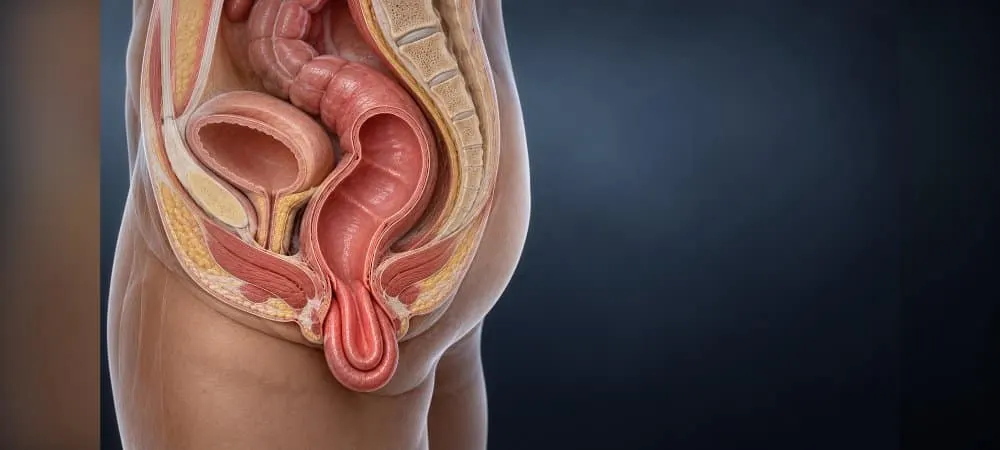
Rectal prolapse is a condition in which the final part of the intestine protrudes outside the body. It is usually noticed as a reddish mass coming out of the anus during straining. This condition can occur in both women and men, but women make up 80% of patients.
Also known as the rectum coming out of the anus, this condition occurs when the intestines located in the pelvic area shift to another position within the abdominal cavity. When you notice the symptoms of rectal prolapse, it is very important to see a specialist right away so that it can be treated before it leads to worse outcomes. If left untreated, it can lead to serious problems such as constipation, difficulty holding stool, and rectal ulcers. In this article, we will cover the causes, symptoms, diagnosis, and treatment methods of rectal prolapse in clear and understandable language.
What is rectal prolapse?
Rectal prolapse is a condition in which the last part of the large intestine protrudes out through the anus. This condition is a health problem that can seriously affect quality of daily life. Although it is not actually a malignant disease, it considerably reduces a person's comfort in daily life.
What does rectal prolapse mean?
Rectal prolapse means that the rectum, the final section of the large intestine, protrudes out of the anus. This can lead to socially restrictive problems such as being unable to control bowel movements. It is seen 6 times more often in women aged 50 and over than in men of the same age group. In addition, women make up 80% of patients.
Rectal prolapse can occur in different types. These are:
- Partial rectal prolapse: Protrusion of the mucosa, the inner layer of the rectum
- Full-thickness rectal prolapse: Protrusion of the entire rectum
- Occult (internal) rectal prolapse: The prolapse is not visible, but a sensation of telescoping inward is felt during straining and similar situations
How does the rectum come out of the anus?
The rectum coming out of the anus is usually noticed during straining and is seen as a reddish mass protruding from the anus. This mass may sometimes slide back in on its own or may remain visible. At first it appears only during bowel movements, but over time it progresses and may also occur during daily activities.
The amount of prolapse can vary from 1-2 cm to 5-10 cm. In advanced cases, patients may have to push the protruding tissue back in with their hands, which is a very uncomfortable situation for patients. In addition, if left untreated for a long time, a condition called solitary rectal ulcer, which can cause bleeding, may develop.
Difference between rectal prolapse and hemorrhoids
Rectal prolapse and hemorrhoids (piles) are often confused because they show similar symptoms. Both conditions can cause symptoms such as rectal bleeding and prolapse. However, there are important differences between them:
In rectal prolapse:
- The last part of the large intestine protrudes outward or moves inward
- It is usually accompanied by fecal incontinence
- It spreads over a wider area
In hemorrhoids:
- There is enlargement of the blood vessels close to the anus
- They result from swelling of the vascular cushions in the anal region
- Itching and pain are usually more prominent
Untreated hemorrhoids do not turn into rectal prolapse, because the mechanisms by which these two diseases develop are completely different. Rectal prolapse is associated with weakening of the pelvic floor muscles, whereas hemorrhoids are usually caused by enlargement of the blood vessels.
In both cases, the most appropriate approach is to see a general surgery specialist when symptoms begin.
Causes of rectal prolapse
There are many factors that lead to rectal prolapse. Weakening of the muscles and connective tissues that support your pelvic floor forms the basis of this condition. So which factors exactly cause rectal prolapse? Let us examine these causes in detail.
Chronic constipation and the habit of straining
People who have long-term constipation are at high risk for rectal prolapse. Constantly straining during bowel movements causes your pelvic floor muscles to weaken over time. This sets the stage for the rectum coming out of the anus. Chronic constipation not only increases the risk of prolapse but can also worsen an existing rectal prolapse. Struggling and straining during defecation puts pressure on the rectal wall and triggers it to protrude outward through weak points.
Difficult births and pelvic muscle weakness
The risk of rectal prolapse is higher in women, especially those who have had many vaginal deliveries. Injury to the muscles that provide pelvic support during childbirth leads to impairment of pelvic support. Prolonged labor, delivering a large baby, and multiple births increase this risk even further. Forceful pushing during vaginal delivery can trigger prolapse of the intestine through the vagina. In addition, procedures such as episiotomy and vacuum application during childbirth also increase the risk of prolapse.
Aging and loss of muscle function
As age advances, the muscles in the body naturally weaken. This is one of the important factors that increase the risk of rectal prolapse. Rectal prolapse is seen more often especially in people over the age of 50. Aging causes both weakening of the ligaments that suspend the intestine and weakness in the muscles that control the anus. For this reason, when the pelvic floor muscles and the intestinal support tissues weaken, the rectum may protrude out of the anus over time.
Disturbances of the intestinal flora and infections
Disruption of the intestinal flora by harmful bacteria and frequent infections such as parasites and dysentery can trigger rectal prolapse. Such conditions weaken the intestinal wall and increase the risk of prolapse. In addition, intestinal diseases such as ulcers, SIBO, Crohn's disease, colitis, and polyps can also be underlying causes of rectal prolapse.
Obesity and increased intra-abdominal pressure
Excess weight causes intra-abdominal pressure to remain constantly high. This puts continuous pressure on the pelvic floor muscles and leads to their weakening. Because of obesity:
- The pelvic floor muscles are under constant load
- The pelvic support tissues weaken
- Chronic constipation and respiratory problems worsen the condition
Apart from these, heavy lifting, chronic cough, neurological diseases (Parkinson's disease, multiple sclerosis), connective tissue diseases, and genetic predisposition are other factors that increase the risk of rectal prolapse.
Symptoms of rectal prolapse
Rectal prolapse is a condition that starts with mild symptoms in its early stages and can, over time, seriously affect your quality of life. Also known as the rectum coming out of the anus, this condition presents with various complaints. Recognizing the symptoms early will speed up the treatment process.
Swelling at the anus and fecal incontinence
The most obvious symptom of rectal prolapse is seeing or feeling a reddish mass protruding from the anus. At first the prolapse appears only during bowel movements, but in later stages it may also be seen during your daily activities. Although the protruding tissue may sometimes go back in on its own, in advanced cases you may need to push it back in with your hand.
Fecal incontinence is a serious symptom seen in 60% of patients. Because of rectal prolapse, the muscles around the anus (sphincters) are constantly stretched and weaken over time. As a result, your ability to hold gas and stool decreases. This is especially more pronounced in older patients.
Constipation, diarrhea, and difficulty with defecation
Constipation is seen in approximately 60% of people with rectal prolapse. This complaint usually occurs in younger patients. Disruption of the normal structure of the intestine prevents bowel movements from occurring regularly. At the same time, you may experience a constant sensation of needing to defecate (tenesmus). This may cause you to feel a constant need to go to the toilet and to have to look for a toilet in every setting.
You do not get the feeling that defecation is complete, and you feel the need to strain constantly on the toilet. Difficulty with defecation is seen in 50% of patients. In addition, the feeling that the bowels have not emptied completely after using the toilet can also bother you psychologically.
Abdominal pain and gas problems
Pain in the pelvic region and abdomen is one of the common symptoms of rectal prolapse. The severity of the pain may increase continuously or intermittently. The intestinal system, whose normal function is impaired, causes problems in the digestion of food, leading to gas and a feeling of indigestion.
You may also experience discomforts such as abdominal bloating, vague abdominal pains, and a feeling of fullness in the anus. These symptoms can make your daily life difficult and limit your social activities.
Pain during sexual intercourse
Rectal prolapse can cause severe pain and discomfort during sexual intercourse, especially in women. Because of the unwanted prolapse in the pelvic area, pressure on the uterus increases and dyspareunia (painful sexual intercourse) may occur. This can lead to loss of sexual desire and sexual dysfunction.
Since rectal prolapse is usually seen together with prolapse of other pelvic organs, your sexual life may be adversely affected. A feeling of looseness in the vagina or loss of muscle tone may also be among your complaints.
Difficulty urinating
Urinary problems are also frequently seen in people with rectal prolapse, especially women. Because of the pressure on the pelvic organs, complete emptying of the bladder is prevented. This shows itself as burning and pain during urination and a frequent urge to go to the toilet.
Increased pressure on the bladder can make urinary control difficult and cause urinary leakage. Especially in elderly female patients, prolapse of the urinary bladder may also be seen due to weakness of the pelvic muscles.
How is rectal prolapse diagnosed?
If you suspect rectal prolapse, you need to see a specialist physician for an accurate diagnosis. After listening to your complaints, your doctor will make a diagnosis using various methods. The diagnostic process may include a series of procedures ranging from a simple examination to advanced imaging techniques.
Physical examination and digital rectal examination
The diagnosis of rectal prolapse usually begins with a detailed history and physical examination. A patient's statement that a swelling comes out of the anus during defecation, or that tissue remains outside after using the toilet, provides important clues for the doctor.
During the physical examination, the doctor examines you in a side-lying position and asks you to strain so that the prolapse becomes visible. In this way, it can be evaluated whether the rectum protrudes outward. If the prolapse is not visible during the examination, you may be asked to strain in a squatting position.
During the digital rectal examination (rectal examination with a finger), sphincter tone and contraction ability are assessed. This examination is very important both for revealing the cause of the disease and for predicting the benefit that will be obtained after treatment.
Anorectal manometry
Anorectal manometry is a special test that measures the function and strength of the muscles in the anal region. With this method, pressure values within the anal canal are measured, and objective information about the function and strength of the muscles is obtained.
During the test, a thin, flexible catheter is placed into the anus. A small balloon at the tip of the catheter is inflated, and the patient is asked to perform certain muscle movements. In this way, the following are measured for the anal muscles:
- Resting tone
- Contraction strength
- Ability to relax
- Sensitivity of the rectum to the sensation of fullness
Thanks to this test, the pressures of the muscles that enable you to hold gas and stool are evaluated during contraction and at rest. The procedure usually takes 20-30 minutes and is painless.
Pelvic MRI and defecography
Pelvic MRI is an imaging test used to visualize the condition of the muscles located in the pelvic area or anal region. In some cases, the prolapse may take the form of telescoping of the intestine without protruding out of the anus. Defecography or MR defecography is used to detect such occult prolapses.
Defecography is a special imaging method that shows the movements of the rectum during defecation. During this procedure, the rectum is filled with a contrast agent, and images are taken while the patient defecates. In addition, different alternatives such as magnetic resonance imaging (MR defecography), video defecography, and computed tomography can also be used.
These methods are very helpful in determining the degree of prolapse and in treatment planning. For example, thanks to MR defecography, not only the rectum but also the condition of other structures in the pelvic region can be analyzed.
Excluding other diseases with colonoscopy
Because rectal prolapse is mostly seen in older age groups, the risk of colon cancer is also increased in these patients. For this reason, your doctor may recommend a colonoscopy. With this procedure, the inner surface of the large intestine is visualized, and the presence of other underlying diseases such as cancer or polyps is investigated.
Colonoscopy is also used to exclude other diseases that can cause symptoms similar to rectal prolapse. Structural abnormalities inside the rectum, such as ulcers or polyps in particular, can be easily detected with this method.
Treatment methods for rectal prolapse
Treatment of rectal prolapse is individualized according to the degree of the condition, the patient's age, and general health status. While non-surgical methods are sufficient in mild cases, surgical intervention may be required in advanced cases. Your treatment plan will be determined according to the severity of your complaints.
Lifestyle changes and exercise
In the early stages of rectal prolapse or when symptoms are mild, lifestyle changes provide significant benefit. Increasing water intake and emphasizing high-fiber foods in your diet is an effective way to prevent constipation. In addition, exercises aimed at strengthening the pelvic floor muscles (Kegel exercises) are recommended. These exercises help strengthen the muscles of the anus and reduce the symptoms of prolapse. Furthermore, light activities such as regular walking and swimming can relieve complaints by regulating bowel movements.
Medication and supportive devices
In some cases, bowel-regulating medications may be part of the treatment. These medications are particularly effective when the source of problems such as diarrhea or constipation is bacteria, parasites, or other microorganisms. Medical products that support the pelvic area may also be used during the treatment process. These ring- or band-shaped devices help control rectal prolapse by supporting the pelvic muscles.
Non-surgical methods: sclerotherapy, acupuncture
Alternative treatment methods may be considered for patients who do not want surgical intervention or whose health condition is not suitable for surgery. Sclerotherapy involves injecting special substances into the prolapsed section of the intestine, causing the tissue to harden and the prolapse to regress. This procedure is usually performed under general anesthesia. Acupuncture treatment has also been used in recent years as a method that gives positive results. In addition, techniques such as radiofrequency ablation can also help the rectum return to its former state.
Surgical methods: open, laparoscopic, and robotic
Surgical treatment may be necessary in advanced rectal prolapse or when improvement cannot be achieved with other methods. Surgical approaches can basically be performed through the anus (perineal) or through the abdomen (abdominal). Laparoscopic surgery is performed with special instruments inserted into the abdomen through small incisions, and the recovery process is faster than with open surgery. Robotic surgery is a more advanced form of laparoscopic methods. In operations performed through the abdomen, fixation of the rectum to the sacral region (rectopexy) is usually performed, whereas in operations performed through the anus, the prolapsed portion is cut and removed.
In Summary: Rectal Prolapse
Rectal prolapse is a condition that can significantly affect your daily life but can be treated with the right approach. Seeing a specialist as soon as you notice symptoms will speed up the treatment process.
Preventing constipation, avoiding heavy lifting, and strengthening the pelvic floor muscles can prevent rectal prolapse. Women who have given birth and those over 50 in particular should be more careful.
In the early stage of the disease, lifestyle changes and exercises may be beneficial. However, in advanced cases, surgical treatment may be required. It is important to create a treatment plan specific to each patient.
Rectal prolapse should not be confused with hemorrhoids. Although they show similar symptoms, they are different conditions. If in doubt, you should definitely be evaluated by a specialist physician.
In conclusion, rectal prolapse is a health problem that should be treated, not be ashamed of. With early diagnosis and the right treatment, you can return to a healthy life. If you have complaints, do not neglect to see a general surgery specialist without delay.
Frequently Asked Questions
What happens if rectal prolapse is not treated? Untreated rectal prolapse may worsen over time. A condition called solitary rectal ulcer, which can cause bleeding and may be mistaken for cancer, may develop. In addition, the problem of fecal incontinence may increase, and your quality of life may decline seriously.
Does rectal prolapse resolve on its own? In mild cases, symptoms may decrease, but medical intervention is usually necessary for complete recovery. Pushing it back in with every bowel movement is definitely the wrong approach.
Can untreated hemorrhoids turn into rectal prolapse? No, untreated hemorrhoids do not turn into rectal prolapse. The mechanisms by which the two diseases develop are completely different. In rectal prolapse, a layer of the rectum protrudes outward, whereas in hemorrhoids, pressure develops on the vascular bed.
Who gets rectal prolapse? This condition, which can occur at any age, is observed more frequently especially in the elderly due to muscle weakening. In women, the risk is higher because the pelvic muscles weaken in situations such as childbirth.
Which department should I see? You should see the general surgery department. In some cases, a coordinated evaluation with the gynecology department may be made.
Is it life-threatening? It does not directly pose a life-threatening risk, but if left untreated, complications such as the risk of colon and rectal cancer, hemorrhoids, ulcers, and bleeding may develop. The risk of infection may also increase.
Fill Out the Form for Detailed Information and Contact!
Start with the right assessment for What Is Rectal Prolapse? What Are Its Symptoms? How Is It Diagnosed and Treated?
Share your symptoms with our specialist physicians; let us determine the right diagnosis and treatment plan together.
Warning
If your symptoms started suddenly, are progressing rapidly, or significantly restrict your daily life, consult a physician without delay.
Plan your What Is Rectal Prolapse? What Are Its Symptoms? How Is It Diagnosed and Treated? journey with our specialists.
Fill in the form or book an appointment to learn about treatment options, the process and preparation.