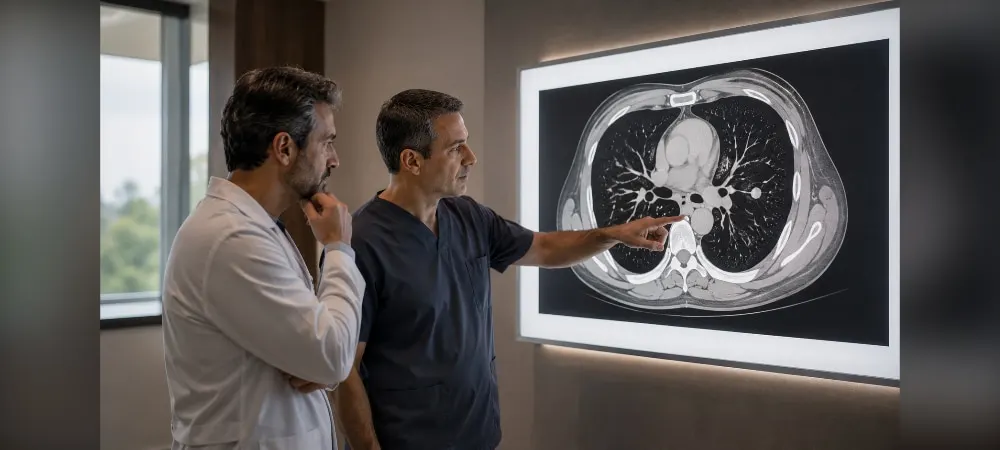
What is a Lung Nodule, Is It Dangerous, How Is It Monitored and Treated?
Learning that a "nodule" has been seen on your chest X-ray or CT scan can be concerning. Therefore, let's start with the most important information: the vast majority of lung nodules are benign and often do not require any treatment. Most nodules are simply small scars left in the lung from a past infection.
In this article, we explain in plain language what a lung nodule is, why it forms, in which cases it requires attention, and how the follow-up and treatment process works.
A lung nodule is a small, round or oval-shaped area of increased density seen within the lung tissue. In medicine, formations with a diameter of less than 3 centimeters (30 mm) are generally called nodules. Those above this size are referred to as "masses" and require more detailed examination.
Nodules can occur singly or as multiple foci distributed in different regions of the lung. They are most often discovered incidentally during a chest X-ray or CT scan performed for another reason.
Benign Nodules
Benign nodules are usually scars left by past infections, inflammations, or small scar tissues. Such nodules mostly do not grow at all or grow very slowly, have smooth borders, and calcification may be seen within them—calcification is a finding that supports the likelihood of being benign.
The most common benign lung tumor is a hamartoma. A hamartoma is formed by the irregular combination of the lung's own normal building blocks (such as cartilage and adipose tissue). On a CT scan, it usually presents with a characteristic appearance and generally does not require surgery.
Malignant Nodules
Malignant nodules can appear in two ways. The first is lung cancer originating directly from the lung cells. The second is metastatic nodules formed by the spread of cancer from another organ in the body (such as breast, colon, or prostate cancer) to the lungs via the bloodstream. Metastasis-related nodules are mostly seen in multiple numbers.
Malignant nodules typically have irregular borders, may show radiating extensions toward the surrounding tissue, grow over time, and do not contain calcification.
Types of Nodules According to Their Appearance
On CT scans, nodules are divided into three groups based on their density. This distinction is important in determining how the nodule will be followed:
• Solid nodules: They appear dense and opaque, and their borders are usually clear. This is the most common type.
• Ground-glass nodules: As the name suggests, they appear semi-transparent like frosted glass; the lung tissue can still be distinguished through them. They generally follow a very slow course, but require long-term follow-up.
• Part-solid nodules: They contain both a ground-glass area and a solid core within it. This group requires the closest monitoring.
This classification is merely a guide to help determine the follow-up plan; it does not indicate by itself whether a nodule is benign or malignant.
Why Does a Lung Nodule Form?
Past Infections
The vast majority of nodules result from scars left by past infections. During infections such as tuberculosis and pneumonia, the body creates small clusters of tissue to limit inflammation. Over time, these clusters harden and turn into permanent structures called "granulomas." In our country, where tuberculosis is relatively common, such past infections are the most frequent cause of nodules.
Certain fungal infections and rarely parasitic infections can also leave similar scars in the lung.
Risk Factors
The main factors that increase the likelihood of a nodule being malignant are:
• Smoking: This is the factor that most increases both the frequency of nodules and the probability of a nodule being malignant. The risk rises with the amount and duration of smoking.
• Advanced age: As age advances, the probability of a nodule being malignant increases. This probability is quite low in young and non-smoking individuals.
• Size and appearance of the nodule: As the nodule grows and its borders become irregular, the need for careful evaluation increases.
• Occupational and environmental exposures: Long-term exposure to substances such as asbestos, silica dust, and radon gas increases the risk.
• Family history: Having close relatives with lung cancer is taken into consideration during evaluation.
Other Causes
Certain immune system-related diseases such as rheumatoid arthritis, lupus, and sarcoidosis can lead to the development of lung nodules. Additionally, scar tissue left by past surgery or radiotherapy may appear as a nodule on a CT scan.
Do Lung Nodules Cause Symptoms?
The most prominent feature of lung nodules is that they mostly cause no symptoms at all. Therefore, the vast majority are discovered incidentally during imaging performed for another complaint. Early-stage malignant nodules also mostly run a silent course; this is why early diagnosis is so important.
When a nodule grows or is located near the airways, certain complaints may arise:
• Persistent, stubborn cough
• Blood in the sputum
• Shortness of breath or wheezing
• Chest pain that may increase when taking a deep breath
• Hoarseness
• Recurrent lung infections in the same area
• Unexplained weight loss, loss of appetite, and fatigue
These symptoms can be confused with much more common conditions such as bronchitis, allergies, or the flu. Therefore, a physician must be consulted without fail, especially in the case of a cough lasting longer than a few weeks or blood in the sputum.
How Is a Lung Nodule Evaluated?
When a nodule is detected, the goal is not to perform an immediate procedure, but to determine the correct step by evaluating the characteristics of the nodule and your risk status together. In this evaluation, the nodule's size, borders, density, behavior over time, as well as your age and smoking history are considered collectively.
Imaging: Computed Tomography and X-ray
A chest X-ray can only show nodules above a certain size; small nodules are not visible on the film. Therefore, the primary method for nodule evaluation is computed tomography (CT). CT shows the nodule's size, edge structure, density, and whether there is calcification within it in detail.
Nodules with smooth borders, containing calcification, and unchanged over time are generally less worrisome. Nodules with irregular borders, radiating extensions, or growth are examined more closely.
PET-CT
For nodules above a certain size, PET-CT can be used to determine whether the nodule is active. This examination measures how much of a radioactively labeled sugar molecule given intravenously is used by the tissues; rapidly proliferating cells consume more energy and thus become prominent on the scan.
PET-CT is a valuable method but does not provide a definitive diagnosis on its own. Inflammatory conditions such as tuberculosis and sarcoidosis may falsely appear suspicious; conversely, very small nodules or some slow-growing tumors may not become prominent enough. Therefore, the result is always interpreted together with other findings.
Biopsy
If the nodule shows growth, is above a certain size, or is found to be suspicious on imaging, obtaining a tissue sample comes to the agenda. The method is determined according to the location of the nodule: for nodules close to the center of the lung, a sample can be taken via bronchoscopy, and for nodules in the outer parts, via fine-needle aspiration guided by computed tomography. In some cases, the most accurate approach is to remove the nodule directly via minimally invasive surgery and examine it.
Growth During Follow-up Is Very Important
The behavior of a nodule provides more information than its appearance on a single image. Nodules whose size and shape do not change at all over a certain period have a very low probability of being malignant. In contrast, nodules that grow or change shape between checks are investigated further.
Important: Detecting a nodule does not mean a cancer diagnosis. The recommendation for follow-up does not mean "something bad is expected"; on the contrary, it is because it is the most accurate way to safely observe the nodule's behavior without performing unnecessary procedures.
Lung Nodule Treatment
The treatment decision is made by evaluating the nodule's size, appearance, behavior over time, and your risk status together. The vast majority of small and benign-appearing nodules require no treatment.
Follow-up (Surveillance)
For small, smooth-bordered, and low-risk nodules, the most accurate approach is usually surveillance by performing CT scans at specific intervals. The frequency of control is determined according to the nodule's characteristics and your risk status; low-risk nodules are checked less frequently, while those with suspicious features are checked at shorter intervals. If the nodule remains unchanged throughout the follow-up period, surveillance can be terminated.
It is very important not to skip your follow-up intervals, because the safety of this method depends on regular monitoring.
Infection-Related Nodules
If it is thought that the nodule stems from an active infection, appropriate antibiotic or antifungal treatment is administered. Such nodules may shrink with treatment or disappear completely. Regression of the nodule on a control CT scan is a finding that strongly supports that it is benign.
Surgery
If the nodule is growing, carries suspicious features, or cancer is detected via biopsy, surgery comes to the agenda. Today, most of these surgeries can be performed using minimally invasive methods (video-assisted or robotic surgery) through a few small incisions without opening the chest cage. This results in less pain and faster recovery.
During surgery, the nodule is removed along with a certain amount of surrounding healthy tissue. The removed tissue is sent to the pathology specialist while you are still on the operating table, and a rapid examination (frozen section) is performed. If the result comes back benign, the procedure is concluded; if cancer is detected, the necessary surgery is continued in the same session. This spares most patients a second surgery.
The amount of tissue to be removed varies depending on the location and diagnosis of the nodule: only a small piece containing the nodule, a section of the lung, or a lobe may be removed. The goal is to treat the disease completely while preserving as much healthy lung tissue as possible.
If Cancer Is Detected
If the cancer is limited only to the lung, surgery is mostly the most effective treatment. Depending on the extent of the disease, chemotherapy, radiotherapy, targeted therapies, or immunotherapy may be administered alone or in addition to surgery. This decision is made in the oncology council, where specialists from different branches evaluate together.Patient Check-ups After Treatment
Post-Treatment Check-ups
For patients who have undergone surgery, CT control is performed at more frequent intervals in the first years and less frequent intervals in subsequent years. Controls include examination, blood tests, and imaging. Especially in individuals with a smoking history, regular follow-up maintains its importance because a new nodule may develop in another region of the lung years later.
Frequently Asked Questions
Is a lung nodule dangerous?
The vast majority of nodules are benign and pose no danger. However, not every nodule is the same; the level of danger depends on the nodule's size, appearance, growth rate, and your risk factors. The probability of malignancy is quite low in young, non-smoking individuals. In advanced age and individuals with a smoking history, a more careful evaluation is required. Therefore, when a nodule is detected, rather than panicking, establishing a follow-up plan with your doctor is the most accurate approach.
Does a lung nodule disappear on its own?
Nodules developing due to infection or inflammation may shrink or completely disappear with treatment or on their own. In contrast, nodules that are in the nature of permanent scars left by a past infection generally do not disappear; however, these are also harmless and do not pose a problem as long as they do not grow.
Does a nodule definitely require surgery?
No. The majority of nodules do not require surgery and are only monitored. Surgery comes to the agenda in cases where the nodule shows growth, carries suspicious features, or cancer is detected.
How long is a nodule monitored?
The duration and frequency of follow-up are determined on a personalized basis according to the nodule's size, type (solid, ground-glass, or part-solid), and your risk status. Small and low-risk nodules are checked at longer intervals, while those with suspicious features are checked more frequently. Ground-glass nodules are usually monitored for a longer period because they follow a very slow course. Your doctor will explain your specific follow-up plan in detail.
What should I do if I have a nodule?
First of all, do not miss the recommended control dates; the safety of nodule follow-up depends entirely on this. If you smoke, quitting is the most effective step you can take to reduce both the risk of developing a new nodule and the risk of lung cancer. If a new complaint develops such as a cough, blood in the sputum, or shortness of breath, consult a physician without waiting for the control date.
A lung nodule is a commonly encountered finding, and the vast majority are harmless. Most nodules consist of a scar left in the lung by a past infection and require only monitoring.
The important thing is that the nodule is evaluated correctly and the recommended controls are not skipped. Thus, while unnecessary procedures are avoided for benign nodules, nodules requiring attention are caught at the earliest stage when the chance of treatment is highest.
Start with the right assessment for What is a Lung Nodule?
Share your symptoms with our specialist physicians; let us determine the right diagnosis and treatment plan together.
Warning
If your symptoms started suddenly, are progressing rapidly, or significantly restrict your daily life, consult a physician without delay.
Plan your What is a Lung Nodule? journey with our specialists.
Fill in the form or book an appointment to learn about treatment options, the process and preparation.