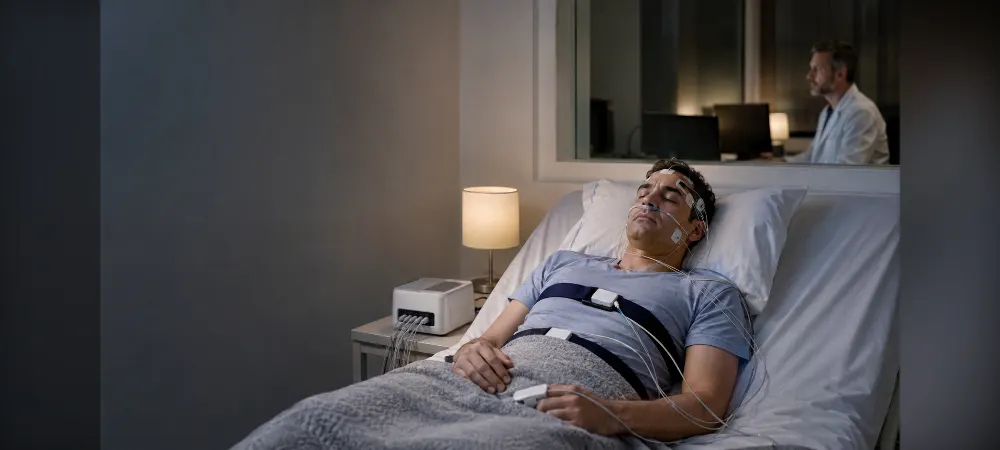
Sleep, which accounts for one-third of your life, can lead to serious health problems when it is not sufficient or regular. Polysomnography is a comprehensive sleep test that detects issues you may be unaware of during sleep, such as snoring, breathing pauses, or leg movements. Untreated sleep disorders can increase the risk of developing conditions such as heart disease, hypertension, and depression. In this article, we will answer the questions of what polysomnography is, why it is performed, and who it is for and how it is applied. You will also learn about the diseases diagnosed with this test and what you are curious about regarding the testing process.
What Is Polysomnography (Sleep Test)?
Polysomnography is a test used to diagnose sleep disorders by monitoring various functions of your body during sleep. Performed in sleep centers or hospitals, this test records a wide range of data throughout the night, from your brain waves to your heart rhythm.
Purpose of the Sleep Test
The sleep test is primarily performed to detect abnormalities and disorders that occur during sleep. Recording your brain waves, measuring your oxygen levels, and diagnosing sleep disorders are the main objectives of this test. It also assists in the diagnosis of problems related to respiration and heart rate. Therefore, by determining the diagnosis and severity of sleep disorders, a treatment plan is established.
During the test, sleep stages and findings observed in these stages are monitored. Your sleep structure is analyzed in detail by calculating the number and duration of dream periods, deep sleep periods, and arousal reactions. This makes it possible to detect conditions such as sleep apnea, narcolepsy, restless legs syndrome, and chronic insomnia.
Parameters Measured in the Test
During polysomnography, sensors and electrodes are placed on different parts of your body. Thanks to these devices, brain waves (EEG), eye movements (EOG), muscle activity (EMG), and heart rhythm (ECG) are recorded.
For respiratory parameters, belts that detect chest and abdominal movements and sensors that measure airflow in the mouth and nose are used. A sensor attached to your finger continuously monitors the oxygen level in your blood. Electrodes attached to your legs detect your leg movements, while a position sensor determines in which position breathing pauses increase.
All this data is recorded on a computer by a sleep technician throughout the night, accompanied by video. The next day, the specialist doctor examines the entire night's recording and marks your sleep stages, abnormal respiratory events, and leg movements one by one.
Types of Tests
Polysomnography (PSG) is the most comprehensive sleep test performed in a sleep laboratory. It monitors many parameters such as brain waves, eye movements, muscle tone, heart rate, respiration, and blood oxygen levels.
The Multiple Sleep Latency Test (MSLT) is performed to investigate narcolepsy or idiopathic hypersomnia in patients with excessive daytime sleepiness. The standard nighttime PSG and the MSLT test are performed together the next day. In this test, you are asked to sleep a total of 4-5 times every 2 hours, and your time to fall asleep is tracked.
The Home Sleep Test option is performed with simpler and portable devices. Although it measures breathing patterns, heart rhythm, and oxygen levels, it records fewer parameters compared to the laboratory test.
Why Is Polysomnography Performed?
For the accurate and permanent treatment of sleep disorders, the cause must first be determined. Polysomnography enables the creation of an accurate treatment plan by diagnosing abnormalities and sleep disorders that occur during sleep.
Sleep Quality Issues
If you wake up tired in the mornings despite getting enough sleep at night, or if you feel like you haven't had a restful sleep, you may need to have the test. Similarly, polysomnography is applied to evaluate frequent awakenings throughout the night or disturbances in sleep patterns.
Chronic insomnia can start due to anxiety and stress and continue for weeks. Because the underlying cause is not investigated, acute insomnia can become chronic and negatively affect daily life. In some cases, a polysomnography test is applied to investigate the underlying causes of chronic insomnia. Additionally, investigating sleep problems associated with chronic fatigue syndrome is among the reasons for the test.
Respiratory Disorders
The evaluation of snoring and breathing cessation problems is one of the most common areas of use for polysomnography. If you wake up at night with a feeling of not being able to breathe, or if your partner says that you snore and breathe irregularly at night, a sleep test may be necessary.
Suspicion of sleep apnea is one of the most common reasons for the test. Sleep-disordered breathing usually manifests as the cessation or shallowing of breathing for 10 seconds, often accompanied by snoring. The sleep of these patients is not restorative, and they may wake up repeatedly at night with a feeling of choking. If there is sweating on the neck and nape at night and you wake up very often to go to the toilet, these symptoms should also be evaluated.
The test is also performed to determine whether heart rhythm irregularities are related to sleep. Untreated sleep-disordered breathing can lead to serious conditions such as stroke, heart attack, high blood pressure, and heart rhythm disorders.
Abnormal Sleep Behaviors
Polysomnography is used to examine abnormal movements or behaviors during sleep. For example, conditions such as sleep terrors, REM sleep behavior disorder, or sleepwalking may need to be evaluated.
If your partner says that you talk, shout, or move your arms and legs while you are asleep, this may indicate REM sleep behavior disorder. People with this disease may exhibit excessive activity and aggression while dreaming at night.
The test is also performed for the diagnosis of restless legs syndrome or periodic limb movement disorder. When involuntary movements occur in the legs during sleep, sleep quality is impaired, and the person cannot get a fully restorative sleep.
Excessive Daytime Sleepiness
Polysomnography is required to evaluate symptoms of narcolepsy. Even if you sleep enough at night and wake up refreshed in the morning, if you experience sudden sleep attacks during the day and excessive sleepiness that you cannot prevent, it is recommended to have the test.
Polysomnography is used to determine the causes of excessive daytime sleepiness, that is, in the diagnosis of hypersomnia. The state of feeling sleepy or drowsy enough to fall asleep at any moment during the day leads to functionality problems at work and in social life.
Who Is Polysomnography For?
Polysomnography is recommended for people experiencing certain symptoms and health problems. Your doctor may decide to perform the test by evaluating the deterioration in your sleep quality, the excessive fatigue you experience during the day, or the abnormal behaviors observed by your partner.
Suspicion of Snoring and Sleep Apnea
If you snore loudly and your partner says your breathing stops during sleep, you need to have a polysomnography. People with breathing problems during sleep, those who experience waking up with a feeling of choking, and those who wake up with a headache in the morning are suitable candidates for the test.
If you wake up frequently throughout the night, wake up tired in the morning, and experience constant sleepiness during the day, you may have a suspicion of sleep apnea. This condition, which is especially seen in middle-aged and overweight men, can lead to heart disease and high blood pressure if left untreated.
Those Experiencing Chronic Insomnia
If you have had difficulty falling asleep for a long time or if you wake up many times throughout the night and cannot fall back asleep, a test may be necessary. In people whose insomnia complaints last longer than three months, polysomnography is applied to investigate the underlying causes.
If you feel unrefreshed in the morning even though you slept enough at night, and you are experiencing concentration problems and forgetfulness, these symptoms indicate a deterioration in your sleep quality. Similarly, an evaluation should be made in cases of waking up feeling sluggish in the mornings and feeling constantly tired throughout the day.
Abnormal Movements During Sleep
If you experience itching, tingling, or burning sensations in your legs before falling asleep, you may have restless legs syndrome. If you feel the urge to constantly move your legs while sleeping or if your partner says your legs are kicking, you should have the test.
If you talk, shout, walk, or exhibit sudden behaviors during sleep, this may be a symptom of parasomnia. Also, if you are experiencing sleep terrors and wake up with fear, rapid breathing, and sweating, an evaluation with polysomnography is required.
Symptoms of Narcolepsy
If you experience unbearable sleepiness during the day and suddenly fall asleep during daily activities, you may have a suspicion of narcolepsy. If you fall asleep while driving, talking, or eating, these symptoms are the first indicators of narcolepsy.
If you experience a loss of muscle control such as a sudden feeling of weakness in your knees, your head dropping forward, or speech impairment when you experience strong emotions, you may have cataplexy. In addition, the state of being temporarily unable to move and speak while falling asleep or waking up indicates sleep paralysis.
Heart Rhythm Irregularities
If you feel chest pain, palpitations, or irregularity in your heartbeat during your night's sleep, polysomnography may be necessary. Since it is known that sleep apnea causes heart rhythm disorders, it is recommended that patients with heart problems have a sleep test.
How Is Polysomnography Performed?
The test process is carried out in a laboratory at a hospital or sleep center. Specially designed single rooms include a toilet and bathroom. All the comfort necessary for you to sleep comfortably throughout the night is provided.
Pre-Test Preparation Process
On the day of the test, you should stay away from caffeinated beverages such as coffee, tea, cola, and alcohol after 13:00. These substances can affect your sleep pattern and mislead the test results. You should not use sleeping pills or take naps during the day.
You should take a shower and clean your hair on the day you will take the test. Do not use products such as gel, spray, or hair mousse as they make it difficult for the electrodes to stick. Female patients should not apply makeup, false nails, or nail polish. It is recommended that men shave their beards.
Eat your dinner normally but avoid very heavy meals. You can bring comfortable pajamas, slippers, and your personal belongings with you. You are asked to come to the laboratory in the evening, usually between 20:00-22:00.
Procedures Applied During the Test
After you arrive at the laboratory, sensors are attached to various points of your body by trained technicians. This process takes about 45-60 minutes. Electrodes are placed on the hairy areas of your head to record brain waves. Sensors that measure eye movements are attached to the sides of your eyes, and sensors that measure muscle activity are attached to your chin.
Electrodes that track heart rhythm are attached to your chest, and elastic belts that detect your respiratory movements are attached to your chest and abdomen. A thin cannula is placed at the tip of your nose to record airflow. A clip attached to your finger continuously measures the oxygen level in your blood and your pulse. Motion sensors are also attached to your legs.
All sensors are connected to a recording device, and the room camera is activated. After the recording starts, you go to bed at your normal bedtime. Throughout the night, the technician keeps you under surveillance from the control room. If the sensors come off when you get up to go to the toilet, the technician will assist you.
You wake up around 06:00-07:00 in the morning. The electrodes are removed, and you can continue your daily life.
Home Sleep Test Option
The home sleep test, known as polygraphy, is performed with a portable device. You receive the device from the hospital during the day. A healthcare professional shows you how to attach the sensors.
Before going to sleep in the evening, you attach the elastic belt to your chest, the cannula to your nose, and the oxygen meter to your finger. You turn on the device and sleep normally. In the morning, you turn off the device and remove the sensors. You take the device back to the hospital the next day.
Although the home test is more comfortable, it records fewer parameters than the laboratory test. Since it cannot measure brain waves, it cannot distinguish sleep stages. Therefore, it is only preferred in cases of suspected sleep apnea.
Post-Test Evaluation
The collected data is examined in detail by a sleep specialist. Preparing the report takes a few days to a week. The specialist calculates the apnea-hypopnea index to determine the presence and severity of the disease. A treatment plan is created according to the results.
Diseases Diagnosed with Polysomnography
This comprehensive test performed in the sleep laboratory provides a definitive diagnosis of many sleep disorders. Thanks to polysomnography, doctors can determine the true cause underlying the symptoms and offer you the most appropriate treatment.
Obstructive Sleep Apnea
In this disease, which occurs as a result of the blockage of your upper respiratory tract, your breathing stops repeatedly during sleep. The oxygen level in the blood decreases, paving the way for cardiovascular diseases. This condition is seen 3 times more often, especially in obese individuals.
Snoring is the first and most common symptom of obstructive sleep apnea. You experience sleep-disordered breathing, daytime fatigue, concentration problems, and morning headaches. After the polysomnography test, the severity of the disease is determined, and CPAP treatment, intraoral devices, or surgical methods are applied.
Narcolepsy and Hypersomnia
Narcolepsy stems from a dysfunction in the mechanisms of the brain that control sleep patterns. You tend to fall asleep suddenly and uncontrollably throughout the day. Cataplexy, where you temporarily lose muscle control during strong emotional reactions, may also occur.
Hypersomnia, on the other hand, is the state of feeling excessively sleepy—as if you could fall asleep at any moment—during the day, even though you slept enough at night. The diagnosis of narcolepsy is supported by applying polysomnography and the multiple sleep latency test together.
Restless Legs Syndrome
In this disease, which affects 10% of the population, uncomfortable sensations appear in your legs while resting. These symptoms, which increase in the evening or at night, decrease when you move. During polysomnography, your leg movements and muscle activities are measured, and the presence of the syndrome is confirmed.
Parasomnias and REM Behavior Disorder
These disorders, which emerge with abnormal movements, behaviors, or emotional reactions during sleep, include conditions such as night terrors and sleepwalking. In REM sleep behavior disorder, you live out your dreams with physical movements. It is generally seen more frequently after the age of 50 and in men.
Motor movements such as talking, shouting, punching, and kicking occur during sleep. The diagnosis is made by demonstrating REM sleep without atonia in the polysomnography examination.
Periodic Limb Movement Disorder
Involuntary and repetitive movements occur in your legs during sleep. These movements affect your sleep quality and cause daytime fatigue. Periodic limb movement during sleep is seen in 80% of patients with restless legs syndrome. Polysomnography helps define the disorder by measuring muscle activities.
Chronic Insomnia
You constantly have difficulty falling asleep or staying asleep. It leads to fatigue, difficulty concentrating, and emotional fluctuations. Polysomnography is used to determine whether your insomnia is caused by other sleep disorders.
Frequently Asked Questions
How Long Does Polysomnography Take?
Polysomnography is performed over one night and takes an average of 6-8 hours. The test duration may vary depending on the person's normal sleep duration. You come to the laboratory in the evening and sleep throughout the night. The test is ended by waking up early in the morning.
For people working the night shift, the test can also be performed during the day. The goal is to mimic your normal sleep pattern and collect sufficient data. The eight to nine-hour period is designed to record all of your sleep stages.
Does the Test Hurt?
Polysomnography is a completely painless and non-invasive test. The sensors are attached to the skin surface, and you do not feel any pain during the procedure. No needles are pricked, and no electric current is given.
The only thing you will feel is a slight discomfort caused by the unusual nature of the sensors attached to your body. Some people may experience mild skin irritation from the sensor adhesives, but this is rare. You may have difficulty falling asleep at first due to the cables, but this does not cause pain.
What Should Be Considered Before the Test?
On the day of the test, you should avoid caffeinated beverages and alcohol. These substances can affect your sleep pattern and mislead the results. If you are using sleeping pills, you should consult your doctor and stop them 3-5 days before the test.
You should wash your hair but not use gel, spray, or cream. Men should shave their beards. You should remove your nail polish and wear comfortable clothes. Avoid heavy foods at dinner. Avoid sleeping during the day and maintain your normal sleep pattern.
When Will the Results Be Available?
After the test, the analysis of the data takes a few days. In most cases, the results are evaluated and communicated to you within 1-2 weeks. The report preparation time varies depending on the center where the test is performed and its complexity.
The sleep specialist examines the collected data in detail, marks your sleep stages one by one, and scores them according to international guidelines (AASM). Breathing pauses, oxygen drops, and leg movements are reported. After the results are out, your doctor will share the treatment plan with you.
Is Polysomnography Safe?
Polysomnography is a safe and non-invasive test. It has no health risks. The sensors used during the test, which is performed under the supervision of a technician, are extremely safe and do not harm the body.
In rare cases, mild skin sensitivity to the sensor adhesives may occur. However, you may feel discomfort or boredom due to movement restrictions during the test. Nevertheless, in general, polysomnography is accepted as a safe method for the diagnosis of sleep disorders.
Can the Test Be Done at Home?
A sleep test can be done at home, but it provides limited data compared to the laboratory test. The home test, known as polygraphy, records respiration, oxygen levels, and heart rate. It is reliable, especially in the diagnosis of moderate and severe sleep apnea.
Thanks to the portable device, it is more comfortable to sleep in your own bed. However, since it cannot measure brain waves, it cannot distinguish sleep stages. It may be insufficient in the diagnosis of complex sleep disorders. If there is a suspicion of sleep apnea, a home test is usually sufficient; in other cases, a laboratory test is preferred.
In Summary, Sleep Test
If you are experiencing sleep problems, polysomnography is the most reliable method for an accurate diagnosis. In essence, this test reveals the cause of your symptoms such as snoring, nighttime breathing pauses, or excessive daytime fatigue. The test is completely painless and lasts one night. Once the results are clear, your doctor prepares a treatment plan specific to you. When sleep disorders are not treated, they can lead to heart disease and chronic fatigue. Do not ignore your symptoms. Regular and quality sleep is the foundation of a healthy life. If you have doubts, consult a sleep specialist and have the test done.