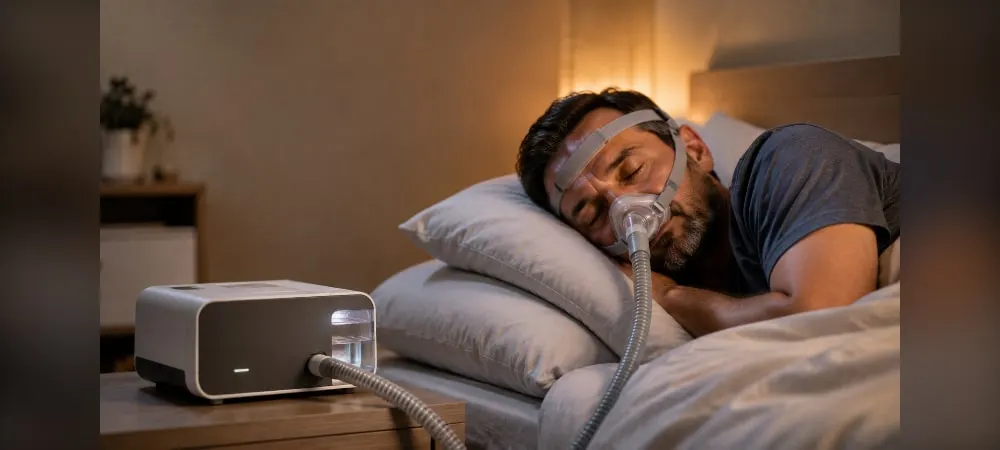
If you are not getting quality sleep throughout the night and feel constantly tired, a CPAP device may be an effective solution for you. A CPAP sleep apnea device is a treatment method that keeps your airways open during sleep. Untreated sleep apnea can lead to serious health problems such as high blood pressure, heart disease, and type 2 diabetes. When used regularly, a CPAP respiratory device significantly improves your sleep quality. In this article, we will answer the questions of what a CPAP device is, how it works, and in which situations it is used.
What is a CPAP Device?
The term CPAP stands for "Continuous Positive Airway Pressure." This respiratory support device helps you breathe without interruption by ensuring your airways remain open during sleep.
The device draws in air from the room through a dust filter and delivers this air to your airways at a pre-set pressure. The pressure value varies according to your personal needs, and your doctor will determine the pressure required for you during your sleep studies.
Basic Components of a CPAP System
A CPAP system consists of several basic parts. The pump that produces pressurized air is the main motor of the system. This pump continuously produces air at the determined pressure and keeps your airways open.
The flexible hose that carries the air to the patient delivers the air from the pump to the mask. The length and flexibility of the hose allow you to move comfortably during sleep. Some CPAP devices include heated humidifiers. The humidifier system prevents a feeling of dryness in the nose and mouth area.
The device also contains an air filter. The filter system ensures that clean air reaches your airways. All these components work together to provide effective treatment.
Types of CPAP Masks
Mask selection is critical for treatment success. Different mask types are available according to your facial structure and breathing habits.
A nasal mask covers only the nose and is the most commonly used model. It has a lightweight structure and maintains its position even when lying on your side. It is ideal for users who do not tend to breathe through their mouths.
A full-face mask covers both the mouth and the nose. It is suitable for people with nasal congestion or those who breathe through their mouths. It shows more stable performance in patients who need high pressure throughout the night.
A nasal pillow mask consists of soft silicone tips that sit directly into the nostrils. Because it has a minimal structure, it is preferred by users who do not want a closed area on their face. It is recommended for those who wear glasses and those with claustrophobia.
A hybrid mask is a face mask that sits over the mouth and has tips that cover the nostrils. This model provides respiratory support without covering the bridge of the nose.
Full contact of the mask with the face is critical for treatment effectiveness. Your doctor will determine which option suits your needs and will work with you to find the right mask.
Other Positive Airway Pressure Devices
Among positive airway pressure devices, there are different options besides CPAP. BiPAP (bilevel positive airway pressure) devices provide two different pressures: a higher level when inhaling and a lower level when exhaling. They can be an alternative for patients who cannot adapt to CPAP devices.
An APAP (automatic positive airway pressure) device automatically adjusts the air pressure according to your breathing patterns. It detects your pressure needs through sensors and uses its software to provide the most accurate pressure. It provides the minimum pressure required to keep the airway open.
In Which Situations Is a CPAP Device Used?
A CPAP respiratory device is used to provide respiratory support in different health conditions. Before your doctor recommends this device, they will perform a comprehensive sleep test and determine your treatment needs.
Obstructive Sleep Apnea Syndrome
A CPAP sleep apnea device is considered the gold standard in the treatment of obstructive sleep apnea. During sleep, your airway narrows or closes completely, leading to repeated breathing pauses. The device provides continuous positive air pressure to prevent your tongue and soft tissues from blocking your airway.
In moderate and severe sleep apnea, a CPAP device is the first choice of treatment. Treatment must be applied to patients with an apnea-hypopnea index of over 20 per hour. If you experience between 5 and 15 breathing pauses per hour but also have heart disease or hypertension, CPAP treatment should still be evaluated.
Regular CPAP use leads to a decrease in blood pressure, improvement in arrhythmias, and a reduction in your overall cardiovascular risk. Untreated sleep apnea increases the risk of high blood pressure, heart attack, stroke, and type 2 diabetes. Therefore, patient compliance is critical, and treatment success is directly proportional to how regularly you use the device.
Chronic Snoring and Respiratory Disorders
In snoring associated with sleep apnea, a CPAP device keeps your airway constantly open, preventing both snoring and apnea attacks. Snoring occurs due to narrowing in your airway, and since the device keeps the airway open, it reduces the sound.
Using CPAP not only eliminates breathing pauses during sleep but also returns your sleep stages to normal. As a result, since you get uninterrupted sleep, complaints such as daytime sleepiness and waking up unrefreshed disappear.
Heart Failure and COPD Support
CPAP treatment is an application supported by strong evidence in acute cardiogenic pulmonary edema. Sleep apnea is present in 50 to 70 percent of men with heart failure. With effective CPAP treatment, the cardiovascular disease rate has been reduced from 56.7 percent to 6.7 percent.
In COPD exacerbations, CPAP should be applied primarily in patients with mild respiratory acidosis. Non-invasive ventilation should be considered in COPD acute attack patients with a pH value below 7.35. This treatment reduces both the intubation rate and complications.
In addition, cases with chronic obstructive pulmonary disease and associated severe respiratory failure also benefit from a CPAP device.
Post-Surgical Respiratory Support
Prophylactic postoperative early-stage respiratory support applied to patients diagnosed with COPD who have undergone upper abdominal surgery prevents the deterioration of respiratory functions and potential hypoxia. CPAP should definitely be kept in mind for acute respiratory failure that develops after lung resection.
Postoperative respiratory failure has the highest mortality among all perioperative complications. It has been shown that non-invasive mechanical ventilation treatment reduces mortality. A CPAP device is also used for premature babies in the neonatal intensive care unit who were born early and whose lungs have not developed.
How Does a CPAP Device Work and How Is It Used?
Understanding the mechanical structure of the device and the usage process increases your treatment success. A CPAP sleep apnea device has a simple but effective working principle, and proper use and maintenance are essential parts of the treatment.
Working Principle of the Device
The motor unit draws in air from the room and pumps it at the set pressure. The air is first cleaned by passing through a filter, which removes particles such as dust and germs. The pressurized air reaches your mask through a flexible hose.
Continuous positive pressure is applied to your airways through the mask via the nose or mouth. This pressure prevents the soft tissues at the back of your throat from collapsing. Therefore, your airway remains open throughout the night, and your breathing pause attacks are eliminated.
The functioning of the system ensures uninterrupted breathing, and your oxygen level is kept within the normal range. You wake up feeling refreshed in the morning because you have had quality sleep at night.
Steps for Proper Use
After your sleep test, your doctor will determine the appropriate pressure setting for you. If an automatic device has been recommended, no pressure adjustment is made because the machine provides pressure automatically according to your needs.
Before using your device, you need to fill the humidifier container with distilled water up to the recommended level. Use distilled water instead of tap water because it reduces the risk of calcification. Ensure the water chamber is full and the filter is clean.
Put the mask over your head and place it on your face properly by securing it with its adhesive straps. The mask should fit your facial structure perfectly, and there should be no air leaks. Adjust the mask in your normal sleeping position because gravity affects your facial muscles in different positions.
Plug in the device and turn it on with the power button. You will feel a flow of pressurized air throughout the night, and this flow will keep your airway open. When you wake up in the morning, turn off the device and remove the mask.
Cleaning and Maintenance Rules
Clean your mask with warm soapy water every morning and rinse thoroughly. The silicone cushions that come into contact with your skin should be washed daily due to oil and sweat accumulation. Empty the remaining water in the humidifier chamber and rinse the chamber with warm water.
Once a week, soak your mask, headgear, and hose in warm, fragrance-free soapy water for 15-20 minutes. Rinse the inside of the hose thoroughly with clean water and hang it to dry. There should be no water droplets left inside. Soak the chamber with a mixture of white vinegar and water (1 part vinegar, 3 parts water) to prevent mineral buildup.
Rinse the white filters with warm water once a week and let them dry completely. Replace the gray disposable filters once a month. Renew mask cushions every 3-6 months and full-face masks every 6 months. Hoses should be replaced once a year, and water chambers every 6 months.
Do not use harsh chemical or alcohol-based cleaners as they damage the silicone material. Wipe the device body with a damp cloth but never submerge it in water. Regular maintenance both extends the life of the device and minimizes the risk of infection.
Benefits and Side Effects of CPAP Device Use
Regular CPAP use significantly improves both your quality of life and your overall health. Understanding the benefits of the treatment and being prepared for the side effects you may encounter will facilitate your adaptation process.
Benefits for Sleep Quality and Daily Life
You breathe without interruption throughout the night, which provides deep, restful sleep. With the prevention of apnea attacks, daytime sleepiness, headaches, and fatigue disappear. Your energy level increases, and your risk of falling asleep while driving decreases.
Brain oxygen levels normalize, and daytime alertness and energy levels rise. Your concentration, memory, and problem-solving skills improve. Interrupted sleep negatively affects cognitive functions and attention span, but when regular sleep is achieved with CPAP, morning fatigue decreases and mental performance increases.
Snoring is largely eliminated, creating a more peaceful sleep environment for couples. The quality of shared life improves because there is no longer a need to sleep in separate rooms. Depression scores drop, and mood stabilizes. Sleep apnea patients with high anxiety and depression scores, in particular, benefit from CPAP treatment.
Contributions to Cardiovascular Health
Long-term CPAP use can prevent high blood pressure and arrhythmias. By balancing oxygen levels throughout the night, it contributes to reducing the risk of cardiovascular diseases. Sleep apnea increases the risk of hypertension, arrhythmia, and heart attack, but with CPAP, this risk can be reduced by up to 40 percent.
Similarly, with CPAP treatment, the risk of stroke is reduced by 50 percent and the risk of heart attack by 40 percent. The heart is allowed to rest throughout the night. Increased pulmonary artery pressure drops, left ventricular dysfunction improves, and hematocrit value decreases. Left ventricular ejection fraction increases, and as a result, left ventricular functions improve.
Possible Side Effects and Solutions
In long-term treatment, skin irritation, nasal dryness, or pressure marks due to the mask may occur. If the mask does not fit the face perfectly, redness around the nose, skin irritation, or a feeling of dryness or discomfort due to air leaks may be experienced.
Dry mouth is the most common side effect and is a sign that you are opening your mouth while sleeping. You can solve this problem by using a full-face mask or a chin strap. Increasing the humidifier level and raising the humidity of the bedroom also provide benefits.
If you feel nasal congestion or dryness, use a heated humidifier. Nasal irrigation or saline sprays open the sinus systems. If you have headaches in the mornings, check your pressure setting with your doctor.
Tightening the mask excessively causes redness on the face. Tighten your mask only enough to prevent leaks. These effects can be largely reduced with proper mask selection and humidification settings.
Difficulties Experienced During the Initial Usage Period
Discomfort may be felt in the first few days, but the body adapts quickly with regular use. Proper mask selection and correct pressure settings facilitate the adaptation process. Many users experience the feeling of not being able to sleep with the mask or the air pressure feeling suffocating during the first few nights.
Wear your mask while reading a book or watching television during the day. This ensures your brain perceives this airflow as normal, and the feeling of panic at night decreases. Use your device's ramp setting because it allows the pressure to gradually reach the treatment pressure after you fall asleep.
Try to use the device for at least 4 hours every night. It usually takes 2 to 4 weeks for your body to get used to this new breathing rhythm. Patience is the key to success. Most CPAP users get used to the new routine after a few months of adaptation.
The CPAP device should be used regularly every night; especially taking a break from use for a few nights reduces its effect. Therefore, it is necessary not to stop using it, keeping in mind the health importance of continuing the treatment, and to be in constant communication with the doctor.
Frequently Asked Questions About CPAP Devices
Do CPAP devices really work?
Regular use of CPAP devices is directly and highly effective in treating problems such as sleep apnea and respiratory distress. A correctly chosen and correctly used respiratory device provides effective treatment. However, you should use your device at least 5 days a week and at least 5 hours a night. Respiratory devices not used in this way cannot protect against the side effects of the disease.
In most patients, snoring decreases significantly or disappears completely. Daytime sleepiness improves, and energy levels rise. Therefore, the effectiveness of CPAP treatment is directly related to your frequency of use. Regular use every night gives the best results.
How long does it take to get used to a CPAP device?
Most patients adapt to the therapy in 1-2 weeks. However, this period may increase depending on your sensitivity to sleeping with a mask. It usually takes 2 to 4 weeks for your body to get used to this new breathing rhythm.
Feeling discomfort in the first few days is a normal situation. Proper mask selection and correct pressure settings facilitate the adaptation process. Practicing by wearing your mask during the day provides benefits. Try to use the device for at least 4 hours every night. Be patient because after a few weeks, your body will adapt to this new routine.
What is the difference between CPAP and BiPAP?
While CPAP devices can be set to a fixed pressure, BiPAP devices can be set to different pressures when inhaling and exhaling. While CPAP provides single-level fixed air pressure, BiPAP applies two different pressures during inhalation and exhalation. In BiPAP devices, there are two concepts: IPAP and EPAP. IPAP refers to the pressure value the device applies while inhaling, and EPAP refers to the value while exhaling.
CPAP is usually the first preferred device. Similarly, many insurance plans cover CPAP devices first because they are more cost-effective and provide effective results for many people. BiPAP is used especially in patients with weak respiratory muscles or those who cannot adapt to CPAP.
Is a CPAP device used for life?
The device should be used regularly unless sleep apnea is completely cured. CPAP treatment does not cure the disease; it is effective as long as it is continued to be used. It is a prosthetic device like glasses. Glasses do not permanently treat the disease that causes your vision problem, but they improve your vision.
In most patients, CPAP treatment continues for a long time, even permanently. If apnea decreases with weight loss or surgical treatment, the doctor may decide to discontinue the device. If you have significant weight loss, it may be possible to reduce the pressure, but you should be guided by your doctor on this matter. The need for use is re-evaluated with weight loss, surgical treatment, or a decrease in apnea severity.
In Summary, the CPAP Device
A CPAP device is an effective solution in the treatment of sleep apnea. When used regularly, it improves your sleep quality, reduces your daytime fatigue, and protects your heart health. In summary, the device ensures you breathe without interruption by keeping your airways open.
The adaptation process may feel difficult in the first few days. Be patient and take care to use it regularly every night. Proper mask selection and cleaning habits increase your treatment success.
Consult your doctor in detail before starting CPAP treatment. After your sleep test, the most suitable device and pressure setting for you will be determined. Healthy sleep awaits you with regular follow-up and proper use.