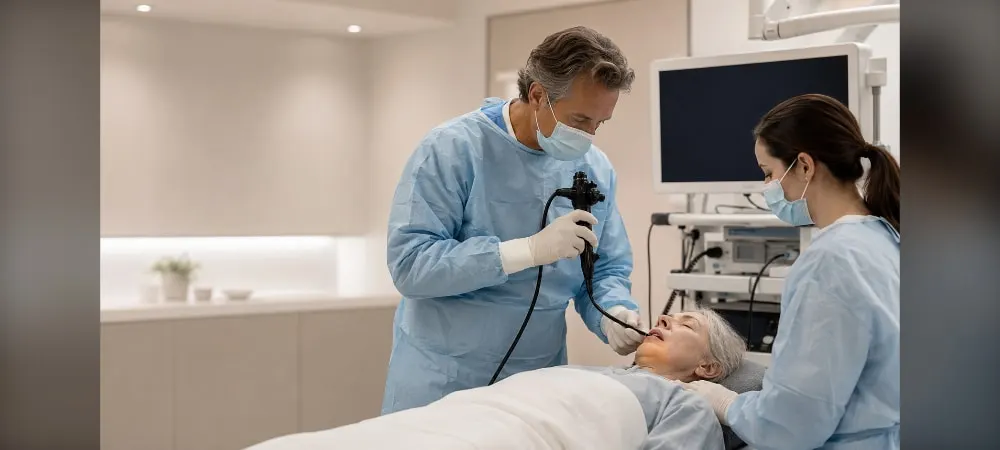
Bronchoscopy is a procedure that allows for a detailed examination of your airways, helping to detect tumors and bleeding in your lungs. This procedure typically lasts 20-30 minutes and is performed using a thin camera tube inserted through the nose or mouth. In this article, we detail what bronchoscopy is, why and for whom it is performed, how it is done, what to consider before the procedure, and the hospital stay process after bronchoscopy.
What is Bronchoscopy?
A bronchoscope, used to examine your airways and lungs, is a specialized device with a small camera and light system at its tip. Your doctor can insert this device through your nose or mouth to directly visualize the throat, trachea, bronchi, and the smaller branches of the bronchi. Through the bronchoscope, the inner surface of your airways is examined in detail, and tissue samples can be taken or therapeutic interventions can be performed when necessary.
There are two different types of bronchoscopes. Each has its own unique advantages and is preferred in different situations.
Flexible Bronchoscope
A flexible bronchoscope is in the form of a long, thin, bendable tube. About the thickness of a pencil, this device can easily navigate the natural curves of the airways due to its flexibility. The camera system at its tip allows you to reach the smallest branches of the bronchial tree.
This type of bronchoscope is usually performed under local anesthesia and light sedation. Therefore, it can be done on an outpatient basis and is less uncomfortable for patients. Thanks to its flexible structure, access to peripheral airways, i.e., deeper regions of the lungs, is possible.
The flexible bronchoscope is frequently used, especially for diagnostic procedures. For example, it is preferred for taking tissue biopsies, clearing secretions, placing respiratory tubes into the airways, or administering medication to the lungs. It is also effective in procedures such as examining small lesions and bronchoalveolar lavage. Because it has high flexibility and maneuverability, it allows you to perform a detailed examination of the airways.
Rigid Bronchoscope
A rigid bronchoscope is in the form of a straight metal tube. Its diameter is larger than that of a flexible bronchoscope and it cannot be bent. For this reason, it is used only to visualize larger airways. Due to its rigid structure, it cannot reach small airways.
However, a rigid bronchoscope can be life-saving in certain situations. It is preferred for interventions such as controlling large amounts of bleeding, removing foreign bodies, clearing diseased tissues, and stent placement. Thanks to its wide working channel, it provides superior control in stopping massive bleeding and removing large foreign objects.
On the other hand, since a rigid bronchoscope is a more invasive procedure, it requires general anesthesia. It can only be applied through the mouth and requires more preparation for patients compared to flexible bronchoscopy. It is a reliable option in cases of central airway tumors, severe strictures, and situations requiring emergency airway management.
The choice between the two types of bronchoscopes depends on the type of procedure to be performed, the area to be examined, and your clinical condition. Your doctor will determine the most appropriate type of bronchoscope for your condition.
Why and For Whom is Bronchoscopy Performed?
Your doctor may recommend a bronchoscopy for various reasons. Persistent cough, difficulty breathing, infection, or abnormal findings seen in imaging tests are common reasons requiring bronchoscopy. The procedure is used for both diagnostic and therapeutic purposes.
Diagnostic Use Cases
If you have a chronic cough and it does not go away despite treatment, a bronchoscopy may be necessary. Especially in cases of cough lasting longer than 12 weeks, bronchoscopy is performed to demonstrate or rule out pathologies in your airways.
In case of seeing blood in your sputum or coughing up blood, bronchoscopy can be performed for both diagnostic and therapeutic purposes. This procedure is necessary to determine the source of the bleeding and to create a treatment plan. If you smoke and are over the age of 35, a bronchoscopy must be performed in cases of hemoptysis.
When an abnormal finding is detected on a chest X-ray or computed tomography, bronchoscopy allows for a detailed examination of these conditions. When there is a suspicion of a tumor in the lung, bronchoscopy is performed to take a sample from the tumor. Bronchoscopy plays an important role in the diagnosis of lung cancer.
Symptoms such as shortness of breath, wheezing, or stridor may indicate airway obstruction or narrowing. In these cases, bronchoscopy is a valuable diagnostic tool. Additionally, bronchoscopy can also be performed in cases of hoarseness and vocal cord paralysis.
In the diagnosis of lung infections, especially in smokers, bronchoscopy may be required in cases of pneumonia. In pneumonias that do not respond to treatment, samples are taken from the lungs to identify the microorganisms causing the infection. In patients with immune system disorders, bronchoscopy may need to be performed to find out which germ is causing the pneumonia.
Taking biopsies from lymph nodes near the lungs and taking biopsies from lung tissue are also among the diagnostic uses of bronchoscopy.
Therapeutic Use Cases
Bronchoscopy is an effective method for removing foreign bodies that obstruct your airways. Especially in children, the aspiration of foreign bodies into the airways is a common situation, and these objects can be removed via bronchoscopy.
Bronchoscopy can be performed to clear obstructions such as mucus or tumors. In the presence of excessive secretion accumulation in the bronchi, bronchoscopy is performed to clear them and correct atelectasis.
A stent can be placed during bronchoscopy to keep an obstructed airway open. Metal or plastic tubes are used to open narrowed airways. Methods such as laser, electrocautery, or argon plasma can be applied in the treatment of strictures of the trachea and main bronchi caused by various reasons.
In case of bleeding in the lung, a bronchoscopy procedure can be performed to locate and stop the bleeding. Bleeding can be brought under control by injecting medication into the bleeding area or by other methods.
For Whom is Bronchoscopy Performed?
Bronchoscopy is generally a safe procedure. However, bronchoscopy is carefully evaluated in patients with severe heart disease, severe respiratory failure, or clotting disorders. Bronchoscopy may not be performed in cases of unstable angina pectoris, uncontrolled arrhythmia, and severe hypoxemia that does not respond to oxygen therapy.
How is Bronchoscopy Performed?
Preparation before the procedure is very important for the bronchoscopy to be safe and successful. Your doctor will give you specific instructions, and you must follow these instructions carefully.
Things to Consider Before Bronchoscopy
You must fast for at least 6-8 hours before the procedure. You should not eat or drink anything during this time. The fasting rule must be strictly applied to prevent the risk of vomiting and aspiration during the procedure.
If you are taking blood-thinning medications, you must inform your doctor. Medications such as aspirin and coumadin should be discontinued before the procedure. If a biopsy is to be taken during the bronchoscopy, these medications can lead to serious bleeding. In cases where a biopsy is planned, your platelet count must be above 50,000. Anticoagulants should be discontinued at least 3 days before the procedure.
If you have high blood pressure, heart disease, or diabetes, you must also mention the medications you use. If you have existing heart disease, you may need to get approval from a cardiologist. It is also important to report whether you have any allergies to medications.
You should have all your test results with you before the procedure. These may be requested from you during the application. Also, it is recommended to wear comfortable and loose clothing on the day of the procedure. You will be asked to remove your dentures, contact lenses, and hearing aids if you have any.
Since the effect of sedation will continue after the procedure, it is recommended that you come with a relative who will take you home.
What Happens During the Procedure?
When you are taken to the procedure room, you will first be asked to lie on your back. Your head will be positioned upward so that your airways are more easily accessible. You will be connected to monitors to track your heart rate, blood pressure, and oxygen levels. A device called a pulse oximeter is attached to your finger. Oxygen is given to your nose through a thin tube.
An intravenous line will be opened before the procedure. Sedative medications are given intravenously to help you relax. Thanks to this sedation, you will be comfortable during the procedure, but you may not remember the procedure when you wake up.
Local anesthetic medication is sprayed into your nose and the back of your throat to numb these areas. The purpose of the local anesthesia applied here is to suppress your cough and gag reflex and to eliminate the feeling of nausea that will occur during the insertion of the endoscope. There is no pain during bronchoscopy.
The pulmonologist advances the tip of the bronchoscope, preferably through the nostril. If you have narrow nostrils, the procedure is performed through the mouth with the help of a mouthpiece. The bronchoscope is slowly directed from the back of your throat toward your windpipe.
Thanks to the camera at the tip of the bronchoscope, your doctor sees the inside of your bronchi in detail. In cases deemed necessary, one or more tissue samples and wash water can be taken from your lung. These samples are sent to the pathology laboratory for examination.
How Long Does the Bronchoscopy Procedure Take?
A bronchoscopy procedure performed under local anesthesia usually takes 15-30 minutes. However, the duration may vary depending on the complexity of the procedure and additional interventions to be performed. In some cases, the procedure may take between 20-60 minutes.
A total of approximately 3 hours may be required for preparation before the bronchoscopy, the procedure itself, and the aftermath. This duration also includes the observation periods before and after the procedure.
Post-Bronchoscopy Process and Hospital Stay
After the procedure is completed, an observation process begins. This stage is necessary for the early detection of possible complications and a safe recovery process.
First Hours After the Procedure
After the bronchoscopy is finished, you will be monitored in the observation room for 1-2 hours. During this time, your heart rate, blood pressure, and oxygen levels are checked regularly. In some cases, the observation period may extend up to 2-3 hours.
The feeling of numbness in your mouth and throat lasts for a few hours. You should not eat or drink water for an average of 2-3 hours until the numbness wears off. This restriction is applied to prevent food and liquids from entering your airways. Since your swallowing reflex is weakened, you should pay attention to this duration.
You may feel sleepy and tired as the effect of the sedation continues. This is completely normal. Before leaving the hospital, your blood pressure and pulse are checked. The IV needle in your arm is removed. If deemed necessary, your chest X-ray may be taken.
Hospital Stay Duration After Bronchoscopy
Most patients are discharged on the same day. Since bronchoscopy is an outpatient treatment method, hospitalization is not required unless complications develop. However, in some cases, you may need to stay in the hospital.
The average length of hospital stay varies between 1-2 days. If complex procedures are performed or if you have serious underlying diseases, your doctor may want to keep you under observation. When pathology or culture results arrive, your follow-up appointment is planned, and subsequent treatment steps are determined.
Things to Consider After Returning Home
When you return home, you should spend the rest of the day resting. Since the effect of sedation can last for a long time, you should not drive for 12-24 hours after the procedure. Therefore, it is essential that you have a relative with you to take you home.
It is normal to have a fever on the day of the procedure. Sore throat, cough, or hoarseness may last for a few days. It is also common to see a small amount of blood in your sputum, and it will resolve within 1-2 days. You can use gargles and throat lozenges with your doctor's recommendation.
After the numbness wears off, it is recommended that you eat soft foods such as soup and puree. You can return to your normal diet as you feel comfortable. You can start work or school the day after the procedure. On the other hand, you should avoid heavy lifting and intense exercise for the first few days.
You should not consume alcohol until the effect of the anesthesia has completely worn off. You should also stay away from activities that require attention, such as operating heavy machinery.
When to Consult a Doctor?
You should definitely consult your doctor when certain symptoms appear. You should go to the doctor immediately if you have a fever that lasts for more than a day. Although a fever on the day of the procedure is normal, a persistent fever can be a sign of infection.
If you feel chest pain, especially if there is a sharp pain when breathing, seek medical attention immediately. Experiencing shortness of breath is also a situation that requires emergency intervention.
Coughing up a large amount of blood is an abnormal side effect. While a small amount of blood is normal, you should reach your doctor in case of severe bleeding. Therefore, it is important to monitor your symptoms closely and contact your doctor if you have any concerns.
Frequently Asked Questions About Bronchoscopy
Is Bronchoscopy Painful?
There is no pain during bronchoscopy. Local anesthesia or sedation is applied to you during the procedure. Thanks to the numbing medications sprayed into your nose and throat, you will not feel any pain.
Thanks to sedation, the procedure passes painlessly or with very little discomfort. Some patients may describe a slight sensation or a cough reflex while passing through the larynx, but this is a normal reaction. It may be uncomfortable, but it does not cause pain.
After the procedure is completed, slight sensitivity in the throat area may last for a few days. You may feel a sore throat when swallowing; this is completely normal. Using a throat lozenge or gargle can help with this situation.
You will not feel any pain while a biopsy is being taken either. Since there are no pain receptors in the lung tissue, taking a tissue sample does not cause discomfort.
Is Bronchoscopy Risky?
Bronchoscopy is generally a safe procedure. The mortality rate with fiberoptic bronchoscopy has been reported as 0.01-0.04%. Looking at these rates, the procedure is considered extremely safe.
While the incidence of major complications is 0.03-0.12%, the incidence of minor complications is 2%. Complications resulting from bronchoscopy are rarely seen. The most common complication is bleeding at the biopsy site.
Mild side effects include hoarseness, sore throat, cough, and slightly bloody sputum. These usually resolve on their own within a few days. Rare complications include severe bleeding, pneumothorax (collapsed lung), infection, and problems related to anesthesia.
During bronchoscopy, minor bleeding is seen at a rate of 0.19%, and major bleeding at a rate of 0.26%. The risk of lung collapse with bronchoscopic biopsy is much less than 1%. Bleeding that occurs after a biopsy usually stops on its own.
During the procedure, your oxygen level may drop; in this case, you may be given oxygen. Bronchoscopy is considered safe when performed under appropriate conditions by an experienced pulmonologist. Oxygen saturation in room air of at least 90% before bronchoscopy is sufficient for a safe procedure.
However, the risk of complications is slightly higher in people with COPD. While the complication rate is 0.6% in people with normal respiratory function, this rate rises to 5% in patients with severe COPD.
Is Bronchoscopy Performed Under Sedation?
Bronchoscopy is a procedure that can be performed under local and general anesthesia. How the procedure will be applied is determined by the specialist physician according to your condition. It is usually performed under local anesthesia.
Bronchoscopy performed for diagnostic purposes is usually done under local anesthesia. In addition, a sedative medication (sedation) is given to help you relax before and during the procedure. With this medication, you will follow the commands given during the procedure, but you will not remember the procedure when you wake up.
In bronchoscopy performed under light sedation, you are awake, but you feel comfortable and calm. Not remembering the coughing and gagging reflexes created by the instrument during the procedure ensures both your comfort and that the doctor can perform the procedure more easily.
General anesthesia may be preferred in the use of a rigid bronchoscope and in some flexible bronchoscopy applications. When performed under general anesthesia, you are completely put to sleep, and the procedure is performed without you feeling any discomfort. Sedation is given at the safest and lowest effective dose.
In children, the bronchoscopy procedure is usually performed under general anesthesia or deep sedation. The procedure is performed in a controlled environment to ensure safety in pediatric patients.
Is Bronchoscopy Performed on Children?
When deemed necessary, bronchoscopy can also be performed on infants and children. The most common reasons for performing bronchoscopy on children are recurrent croup, chronic stridor, and suspected foreign body.
In cases where a foreign body enters the airways in children, bronchoscopy can be life-saving. You should consider foreign body aspiration if there is a frequent, recurrent upper respiratory tract infection that appears out of nowhere when they start to move, and does not respond to treatment.
Bronchoscopy is performed to investigate a congenital anomaly in the airways in children who have recurrent pneumonia and respiratory problems such as wheezing and coughing that do not improve from birth. This procedure may also be necessary to find out which germ is causing pneumonia in children with immune system disorders.
Examination of the airways with flexible bronchoscopy is a 2-3 minute procedure. However, it requires staying in the hospital for at least 3-4 hours, including opening the patient's IV line, administering medications, light sedation, and waking up. The patient can only be sent home after they have fully woken up and started feeding.
Very small children with severe respiratory symptoms may need to be kept under observation in the hospital for 24 hours after the procedure. Bronchoscopy in children is safe but requires special considerations.
When Can You Eat After Bronchoscopy?
You are not allowed to eat or drink water until the numbness in your mouth and throat wears off. This helps prevent food and liquids from entering your airways and lungs.
You should not eat or drink water for an average of 2-3 hours until the numbness wears off. Since your swallowing reflex is weakened, eating and drinking are not allowed until 2 hours after the procedure. It takes approximately 2 hours for the numbness in the throat and larynx area to pass and for the swallowing reflex to return to normal.
When your mouth and throat are no longer numb and you can swallow and cough normally, you can start sipping water. Later, you can eat soft foods such as soup and applesauce. You can add other foods as you feel comfortable.
Cold drinks and soft foods should be preferred in the first hours. It is recommended that you avoid hard, hot, or spicy foods. When tolerated, foods can be consumed normally.
In Summary, Bronchoscopy
Bronchoscopy is a safe method for examining and treating your airways. If you have symptoms such as chronic cough, blood in your sputum, or shortness of breath, your doctor may recommend this procedure. In fact, bronchoscopy can be used for both diagnosis and treatment. The procedure usually lasts 15-30 minutes, and most patients can return home the same day.
You must carefully follow the instructions given by your doctor before the bronchoscopy. In this way, the procedure will be safe and successful. You may feel a sore throat for a few days after the procedure, but this is completely normal. You should contact your doctor if you have any concerns.