Although lung cancer surgery is a treatment option accessible to only 25% of patients, it provides an 80-90% success rate when performed in the early stages. However, research shows that only 1 in 5 patients is suitable for surgery. In this article, we will discuss in detail when lung cancer surgical treatment is applied, which surgical methods are used, how the procedure is performed, and the advantages of surgical treatment for lung cancer.
What is Lung Cancer Surgery?
Lung cancer surgery is a treatment method that allows for the removal of cancerous lung tissue from the body through an operation. It is considered the most effective approach for early-stage lung cancer and aims to completely remove the tumorous region.
This surgical method is applied if the disease is detected before it has spread to other organs. In other words, if cancer cells have not spread from the lung region into the chest cavity or other parts of the body, surgical treatment is initiated. Detecting the tumor at an early stage directly affects the success of the treatment.
Being found suitable for lung cancer surgery is an important opportunity. Because in a large majority of patients, 80%, cancer is only detected at stages 3 and 4, where surgery does not provide a significant benefit. Therefore, early diagnosis is of vital importance.
Three Conditions for Surgery to be Performed
For surgery to be performed on lung cancer patients, three conditions must be met simultaneously:
- The cancer must not have spread (metastasized) to other organs
- The entire cancer must be removable
- The patient's heart and respiratory functions must be at an adequate level
Surgical treatment can be preferred not only for treatment purposes but also for diagnostic applications. This method is used especially in cases where a definitive diagnosis of the disease or the status of its spread needs to be determined.
All scientific studies have proven that the most important factor affecting treatment success is the complete removal of the tumor without leaving cancer cells behind. In fact, the scope of the surgical intervention varies depending on the location of the tumor and how much of the lung can be preserved. Therefore, each patient should be evaluated individually and treatment options should be determined accordingly.
Lung cancer surgical treatment is a multidisciplinary approach requiring the cooperation of specialists in pulmonology, thoracic surgery, pathology, radiology, nuclear medicine, and oncology. This teamwork ensures the creation of the most appropriate treatment plan for the patient.
When is Lung Cancer Surgical Treatment Applied?
Surgical intervention is the primary treatment option when the disease is in an early stage and the tumor is limited to the lung. Lung cancer surgery is a method applied only when the disease is detected in its early stages. Especially in patients diagnosed with non-small cell lung cancer who do not have distant spread, surgery may be the primary option.
The treatment decision is made by a multidisciplinary team including medical oncology, radiation oncology, pulmonology, and thoracic surgery. In this council, the patient's imaging, biopsy results, respiratory tests, and general condition are evaluated in detail.
Metastasis Status
The absence of cancer spread to other organs is the first requirement for surgery. This status is determined by examinations, especially PET-CT. Surgery can be performed in cases where the cancer is only in the lung and there is no spread to the bones, brain, adrenal glands, liver, or other organs.
Lung cancer occurs in 4 different stages, and surgery is only applied in stages 1 and 2. Surgery may also be considered for some stage 3 patients. If the cancer has spread to distant organs, i.e., it has reached Stage 4, the priority is usually systemic drug treatments.
In the group called early stage, the tumor is still small and has not shown significant spread to the lymph nodes. This group is the most ideal candidate for surgical treatment and is the group with the highest chance of success.
Degree of Tumor Spread
For surgery, it must be possible to remove the entire tumor. If the cancer has invaded other nearby structures, it may not be possible to remove it completely. Surgery is not performed on tumors that have involved structures such as the spine, large vessels, aorta, esophagus, or heart.
The size of the tumor, lymph node involvement, and the status of spread to surrounding tissues are evaluated in detail. PET-CT and biopsy results are decisive in the decision-making process. If the disease has reached a locally advanced stage, meaning the tumor has grown and is pressing against the chest wall, ribs, or trachea, the surgical plan changes completely.
Patient's General Health Status
It is mandatory that the patient's heart and respiratory functions are at an adequate level. To demonstrate this, respiratory tests and heart examinations are performed. Since a certain cancerous lung tissue will be removed during the surgery, heart and respiratory functions must be at an adequate level.
The patient's respiratory capacity and general health status are important for surgical suitability. Advanced age is not an obstacle on its own, but additional diseases can pose a risk. Surgical suitability is determined by evaluating the patient's general performance score.
Sometimes the disease may be at an advanced stage or the tumor may be very large. In these cases, the council may determine a strategy of first shrinking the tumor with drug treatment and then performing surgery.
Lung Cancer Surgical Treatment Methods
Lung cancer surgeries can be performed with two basic approaches: open or closed surgery. While the closed method can be applied in 85% of patients, open surgery may be required in the 15% group. As the surgeon's experience in closed operations increases, this rate rises even further.
Open Surgical Method
Open surgery, known as thoracotomy, is performed through an incision made between the ribs in the chest wall. In this method, the surgeon sees the operation field directly with the naked eye and can intervene in the tissues with their hands.
The size of the incision varies between 15-20 cm. The ribs are separated with a special instrument called a retractor, and access to the chest cavity is provided. The duration of the surgery can take 2-5 hours depending on the degree of the disease. The length of hospital stay is approximately 5-7 days.
Open surgery is preferred especially in certain situations. It is generally applied in large tumors exceeding 7-10 centimeters or in masses showing spread to the chest wall. It provides a wide field of view in complex cases where the tumor surrounds major vessels or bronchi, requiring delicate vascular suturing.
If dense adhesions have developed due to previous lung surgery, severe infections, or radiotherapy, the open method is safer. Additionally, if unexpected bleeding or technical difficulty occurs during closed surgery, it can be switched to open surgery within seconds for patient safety.
Closed Surgical Method (VATS)
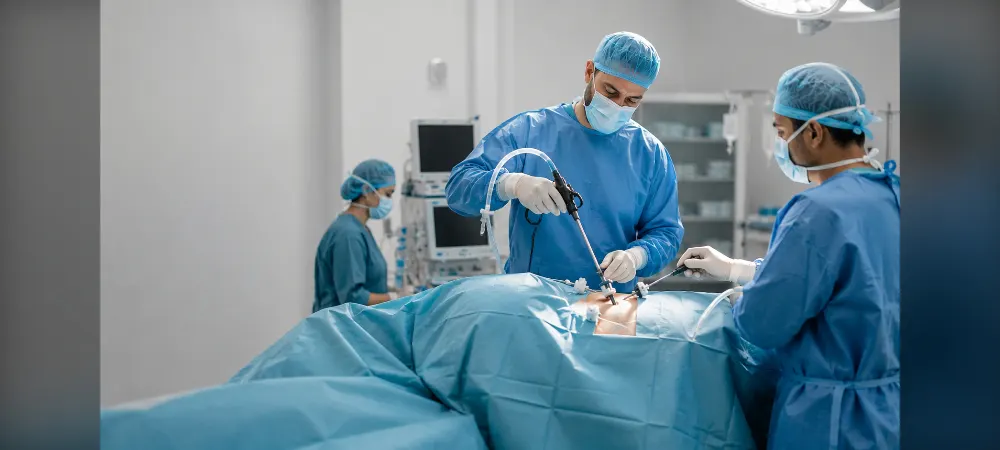
VATS is a minimally invasive method performed with small 1-3 centimeter incisions in the chest wall. A camera and special surgical instruments are inserted into the chest cavity through these incisions. The surgeon completes the surgery by watching the images on the monitor.
In the single-port VATS method, the surgery is performed with only a single small incision. Thanks to technological developments, the camera is only 5 millimeters in size. The recovery time is as short as 2-3 days.
The advantages of the VATS method are quite clear. Since the surgery is performed without stretching the ribs, postoperative pain is significantly reduced. The length of hospital stay usually drops to a few days. Less bleeding, lower risk of infection, and leaving a smaller surgical scar are other important gains.
Robotic Surgery
The Da Vinci robotic surgery system offers a range of motion that exceeds the mobility of the human hand. The robot arms have the ability to rotate 540 degrees. The surgeon sits at a console and performs the surgery under high-definition 3D imaging.
There are 4 robot arms in the robotic system. One of them holds the camera, and the others hold the surgical instruments. The system does not transmit the surgeon's hand tremors to the instruments. The image is magnified 10-12 times.
The biggest advantage of robotic surgery is that it is more successful than video-assisted surgeries in clearing lymph nodes and provides oncological superiority. It offers less pain, faster recovery, minimal blood loss, and better cosmetic results. The length of hospital stay usually drops to 2-3 days.
However, robotic surgery may not be suitable for every patient. It is especially preferred in early-stage lung cancer patients.
Types of Lung Cancer Surgery
The type of surgery is determined according to the location and size of the tumor. There are two lungs in the human body, right and left. The right lung consists of 3 lobes, and the left lung consists of 2 lobes. Inside each lobe, there are segments that are its own sub-sections. There are a total of 10 segments in the right lung and 8 in the left lung.
Segmentectomy
Segmentectomy involves the removal of a small segment of the lung. It is preferred in the presence of a limited tumor. Thanks to this method applied in early-stage cases, healthy lung tissue is largely preserved.
It gives effective results especially in tumors of 2 cm or smaller. It can be applied even in patients with limited respiratory function. This method is safe because it reduces the lung's respiratory capacity to a limited level.
In recent years, segmentectomy has gained popularity thanks to the ability to catch cancer at very early stages. Instead of lobectomy, only the segment where the tumor is located is removed. This is called "parenchyma-sparing surgery."
Lobectomy
Lobectomy is the process of completely removing a lung lobe. It is preferred in cases where the tumor covers one lobe. It is the most common type of surgery applied in early-stage patients.
In the majority of patients, the surgery is completed in this way. If it is applied in the right lung, it is named as right upper, right middle, or right lower lobectomy. In the left lung, it is named as left upper or left lower lobectomy.
The cancerous lobe is completely removed, and the presence of the tumor in the lung is significantly cleared. The healthy lung tissue remaining after the surgery continues to function normally.
Bilobectomy
Bilobectomy is the removal of two lung lobes together. This surgery can only be applied in the right lung. If the upper and middle lobes are removed, it is called upper bilobectomy; if the lower and middle lobes are removed, it is called lower bilobectomy.
Removing the 2 lobes on the left is not called bilobectomy because the entire lung has been removed. This condition is called pneumonectomy.
Pneumonectomy
Pneumonectomy is the procedure where one of the lungs is completely removed. It is preferred in cases where the cancer completely surrounds one of the organs. It is a serious procedure and is not suitable for every patient.
In cases where the cancer is located on the main trachea or a major vessel, it may be necessary to remove the entire right or left lung. It can be applied in cases where the capacity of the other lung is sufficient on its own.
It is mandatory that the patient's respiratory and heart functions are adequate. Living with a single lung reduces the patient's effort capacity, so it is the scenario that surgeons avoid the most.
Advantages and Risks of Lung Cancer Surgical Treatment
In lung cancer detected at an early stage, surgical treatment is the only method that offers a chance to completely get rid of the disease. Success rates vary depending on the stage of the disease, the surgical technique, and the patient's general condition.
Success Rates of Surgical Treatment
The 5-year life expectancy in stage 1 patients is between 60-80%. In stage 2, this rate drops to the 40-60% level. A large portion of patients who are caught at an early stage and can be operated on can completely recover from this disease.
The average recovery rate from the disease in patients treated with surgery is fifty-fifty. In cases detected at an early stage and successfully treated surgically, recovery rates reach 80-90%.
Even if there is a recurrence in follow-up in some patients after surgery, their survival times are much longer than those who do not have surgery. Therefore, surgical treatment should definitely be evaluated in eligible patients.
Surgery Durations
The duration of the surgery varies according to the type of surgery applied, but it can take an average of 2-5 hours. If the closed method is applied by an experienced surgeon, it usually ends within 1-3 hours.
Surgeries of patients with tumors close to large and critical organs are generally performed with the open method, and the surgery duration can extend up to 4-6 hours. In addition, the anesthesia process is detailed in thoracic surgery and varies between 30 minutes and 1 hour.
Recovery Process
Patients are discharged with recovery within 3-12 days (average 5 days) after the surgery. While patients who have closed surgery are usually discharged within 3-4 days, this period can reach 5-7 days in open surgeries.
Rest and physical activity restriction are required for the first few weeks after surgery. The full recovery process can vary between 4-8 weeks. The recovery time for open lung surgery is between 4-6 weeks.
The patient is followed up regularly by staying in the intensive care unit for two days after the surgery. At the end of two days, when the patient feels well, they are taken to a normal ward room. Although patients have complaints such as getting tired easily during intense efforts in the first 3 months, it is observed that they return to their pre-surgery performance after 6 months.
Possible Risks and Complications
Various complications are seen in 5-30% of patients after lung cancer surgery. In particular, the rate of developing heart rhythm problems after surgery is between 5-15%. Pneumonia occurs in 4-25% of patients.
The risk given for the lobectomy procedure is around 2-3%. The death risk of lobectomy, which is the most frequently performed surgery, is at the 2% level. In larger surgeries such as pneumonectomy and if there are additional diseases, the risk rises up to around 6%.
During the surgery and within 30 days after, the vital risk is around 1% on average for segmentectomy, 2% for lobectomy, 4% for the removal of the entire left lung, and 6% for the removal of the entire right lung. In addition to this, complications such as infection, bleeding, and air leakage may be seen.
Frequently Asked Questions About Lung Cancer Surgery
Patients encounter many questions during the surgery process, and getting clear answers to these questions facilitates the treatment decision.
How many years do patients who have lung cancer surgery live?
Life expectancy depends directly on the stage at which the disease is caught. In patients diagnosed at an early stage, if the surgery is performed, there is a 92% probability of complete recovery. In some types, this rate can go up to 100%.
The success rate of surgery in first-stage patients is at the 73% level. In the second stage, a success rate of 46% is achieved. In cases without surgery, these rates are lower than 5%.
Especially in early-stage patients, life expectancy after surgery is between 85-92%. If the treatment and surgery process progresses well, a survival time of 30 months to 5 years can be achieved. If the patient cannot be treated at all, the survival time can be stated as 5-6 months.
In contrast, this rate gradually decreases in advanced stages. Considering all stages, a patient with lung cancer lives an average of 8 months.
Who can have lung cancer surgery?
Three basic conditions are sought for surgery. First, cases where the cancer has not spread are necessary. Surgery is not applied in spread lung cancer. There are some exceptions to this situation, such as having a single metastasis in the brain and its treatment having been completed.
Second, it can be evaluated in patients with suitable heart and respiratory functions. The operation is not applied to patients whose respiration is severely impaired before surgery. For this, measurement is made with a respiratory function test and, if necessary, an exercise test.
The risk of operation is high in patients who have had a heart attack in the last 6 months or have significant heart failure. After the evaluations made by a cardiology specialist, if there is no condition that would prevent the operation in terms of the heart, surgery is applied.
Third, it is applied in patients where the cancerous region can be completely removed. If the cancer in the lung has spread to surrounding tissues such as the heart, esophagus, or spine in a way that it cannot be completely removed, success cannot be achieved with surgery.
How long does lung cancer surgery take?
The duration of the surgery varies according to the method applied. The average surgery duration for a patient taken into the procedure with the closed surgery method varies between 2-3 hours. If it is applied by an experienced surgeon, it usually ends in a shorter time (1-3 hours).
In open surgeries, the situation can be limited to 2.5-3 hours. Surgeries of patients with tumors close to large and critical organs are generally performed with the open method, and the surgery duration can last up to 4-6 hours. We can point to an average of 5 hours for lung cancer surgery in the elderly.
How does the postoperative recovery process go?
Patients receive anesthesia before the surgery and are usually hosted in the intensive care unit for one night for precautionary purposes after the surgery. Hospitalization of 3 or 4 days is required after closed surgeries. After open surgeries, a hospital stay of 5-7 days is in question.
A chest tube is attached to drain the fluid and air accumulated in the surgical area. In patients who have surgery with closed methods, the drain is usually removed within 2-3 days and the patient is discharged.
Most patients can start their normal daily routines such as driving and returning to office work within 3-4 weeks after the operation. The lung surgery recovery process is two months on average.
In Summary, Lung Cancer Surgical Treatment
Lung cancer surgery is the most effective treatment method that offers you a chance for full recovery when caught at an early stage. Although only a quarter of patients are suitable for surgery, if you have this opportunity, your success rate is quite high.
The type and method of surgery are determined according to the location and size of your tumor. Thanks to closed surgical techniques, you can recover in a shorter time and return to your normal life.
Early diagnosis is of vital importance. You can increase your chance of catching the disease at an early stage by having regular health check-ups. Being evaluated by an expert team ensures the creation of the most appropriate treatment plan specific to you.