

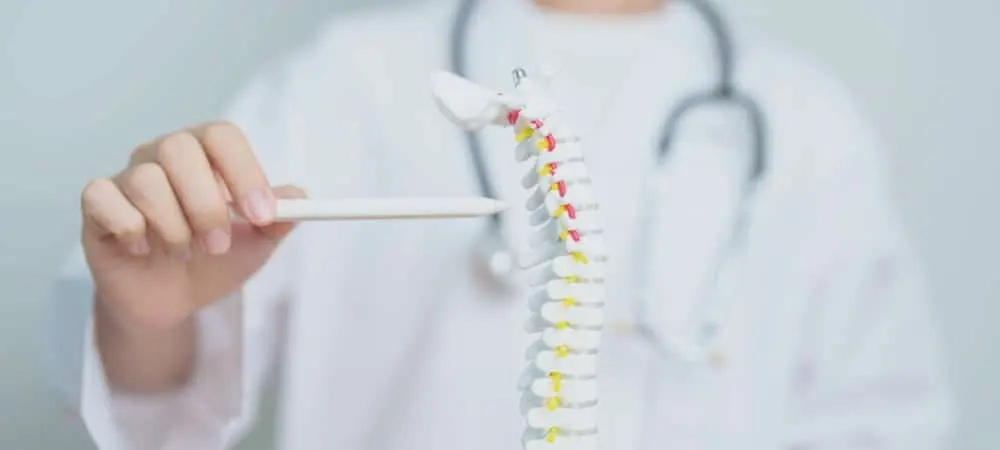
The spine consists of a series of interconnected bones called vertebrae. In approximately 5% of adults, a developmental fracture may occur in the bony part connecting the upper and lower joints of the lowest vertebrae in the lower back. This fracture may occur on one or both sides of the vertebra. These are “stress fractures” caused by overload, usually in the lower vertebrae of the lower back, which is a very mobile region. These fractures are called “spondylolysis.” Because this region is very mobile, these fractures often may not heal. However, while these fractures usually cause pain in adolescence, they may not cause serious problems in adulthood. In some patients, however, due to the fracture, the upper vertebrae may slip forward relative to the vertebrae below. This condition is also called “spondylolisthesis” or “slipped vertebra.” Depending on the amount of slippage, spondylolisthesis may cause more serious problems. “Slipped vertebrae” caused by this type of fracture are called “isthmic spondylolisthesis” in medical terminology, and usually appear as the L5 vertebra slipping over the S1 vertebra. It has been determined that 5 to 10% of patients who consult a doctor for back pain have a slipped vertebra.
Another type of slipped vertebra is the “degenerative slip,” which usually occurs after age 40 due to wear and tear from aging of the spine and surrounding connective tissues. This condition is called “degenerative spondylolisthesis” in medical terminology. A slipped vertebra resulting from aging and wear is usually the forward slipping of the L4 vertebra over L5. A narrow canal often accompanies the slipped vertebra.
What are the symptoms?
Stress fractures (spondylolysis) may not always cause clinical symptoms. Sometimes they may be incidentally detected on back X-rays taken for other reasons. If there are clinical findings, these may appear as low back pain, pain in the buttocks, muscle tension in the back, and, more rarely, numbness and pain in the legs (sciatica) and loss of strength in the feet. Pain usually increases with standing, walking and other activities, and decreases with rest.
How is it diagnosed?
After listening to your complaints and performing an examination, your doctor will request your films if spondylolysis or isthmic spondylolisthesis is suspected. However, stress fractures (spondylolysis) may not be visible on plain films. In this case, if your doctor still suspects a fracture, they may request scintigraphy and/or CT. If a fracture is detected with these tests, they may consider MRI necessary for treatment planning. In addition, in patients with slippage and leg pain and/or numbness, MRI may be necessary to evaluate the spinal cord and nerves. If you have isthmic spondylolisthesis, its severity will be determined from grade 1 to grade 4 according to the amount of slippage. For the diagnosis of degenerative spondylolisthesis, evaluation will be made with plain radiographs and MRI. For this type of slipped vertebra, scintigraphy and CT may generally not be necessary.
What are the treatment methods?
If your complaints are only low back pain, the slippage is not severe, and your doctor has not suspected significant nerve compression or involvement on examination and tests, the first treatment option is non-surgical treatment. These methods may include rest, pain relievers and anti-inflammatory drugs, temporary use of a brace, and one or more physical therapy methods. If your pain persists, another option may be steroid and local pain-relieving injections into the fracture area and the joints connecting the vertebrae (facet joints). If leg pain and numbness due to nerve compression accompany back pain, epidural or foraminal injections may be added. Pain from a stress fracture (spondylolysis) generally improves with these treatments. However, in these patients, the fracture may not always fully heal. Once the pain has resolved, a non-healed fracture does not pose a danger. Generally, severe slippage is not expected in these patients in later years. Nevertheless, these patients may occasionally need follow-up with radiographic examinations.
When might surgical treatment be necessary?
Surgical treatment may be necessary for patients whose complaints do not resolve with non-surgical treatment methods. Likewise, if there is spinal cord compression due to slippage and this causes serious neurological impairment (foot drop, urinary incontinence), early surgical intervention may also be necessary. Two types of surgical treatment can be applied for spondylolysis. The first is repair of the fractured area. Another method is spinal fusion. For isthmic spondylolisthesis, the preferred surgical method is spinal fusion. If there is spinal cord compression, the compressing structures are removed to relieve it. The surgery may be performed from the front, from the back, or from both sides. Fixation materials may be used. Recovery is achieved with a good rehabilitation program after the operation.
Start with the right assessment for Spine Diseases (Spondylolysis and Spondylolisthesis)
Share your symptoms with our specialist physicians; let us determine the right diagnosis and treatment plan together.
Warning
If your symptoms started suddenly, are progressing rapidly, or significantly restrict your daily life, consult a physician without delay.
Plan your Spine Diseases (Spondylolysis and Spondylolisthesis) journey with our specialists.
Fill in the form or book an appointment to learn about treatment options, the process and preparation.




